An audio cable tester can locate an open conductor, short, or incorrect pin route before a studio fault turns into an hour of swapping interfaces, microphones, and preamps. The useful choice depends on the connectors in the room. A podcast desk may need XLR and quarter-inch TRS, a synth rack may add MIDI and DIN, and an installed studio may need a detachable sender and receiver at opposite ends of a wall run.
The eight options here range from broad multi-format boxes to pocket-sized XLR sniffers and a rechargeable tester for quarter-inch patch and DC power cables. All eight are primarily continuity and wiring tools. They do not measure frequency response, capacitance, shielding effectiveness, intermittent faults under every bend, or the audible condition of the whole recording chain.
The MFL MF-CT88 is the best overall studio tester because it covers many common audio connectors and splits into sender and receiver halves for installed runs. The Cable Matters 500119-N is the clearest XLR and DMX diagnostic option, while the NUX NMT-1 is the best compact choice for quarter-inch TS/TRS patch cables and pedalboard power leads.- Best overall multi-format tester: MFL MF-CT88 separates into two parts for long or preinstalled cables and lists XLR, TRS, RCA, MIDI-related DIN, BNC, HDMI, network, and speaker formats.
- Best XLR and DMX diagnostic: Cable Matters 500119-N identifies open pins, pin swaps, and shorts and includes its A23 battery.
- Best quarter-inch patch tester: NUX NMT-1 checks TS/TRS and 2.1 mm DC leads through a rechargeable pocket unit.
Audio Cable Tester Comparison
| Image | Product | Details | Check Price |
|---|---|---|---|
 | MFL MF-CT20 15-Plug Audio Cable Tester | Primary Formats: 15-plug claim; exact connector list not stated Remote Testing: No; single chassis Test Method: 10-way switch and LEDs Fault Detail: Conductor connection status Power: Battery required; type not stated; not included | Check Price on Amazon |
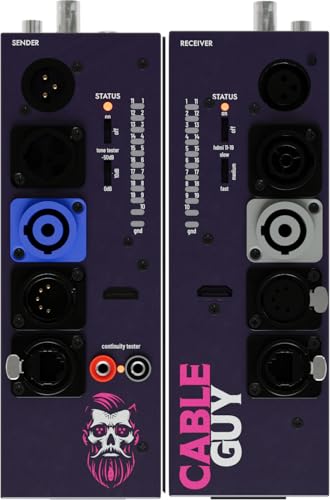 | Blizzard Cable Guy Multi-Function Tester | Primary Formats: 3/5-pin XLR, TRS, RCA, BNC, HDMI, RJ45, powerCON Remote Testing: Yes; detachable sender and receiver Test Method: Matching LED status Fault Detail: Mismatched continuity pattern Power: Not stated | Check Price on Amazon |
 | SoundTools XLR Sniffer and Sender | Primary Formats: 3-pin XLR and 3-pin DMX Remote Testing: Yes; sniffer and sender Test Method: LED feedback Fault Detail: Not stated Power: A23 battery; inclusion not stated | Check Price on Amazon |
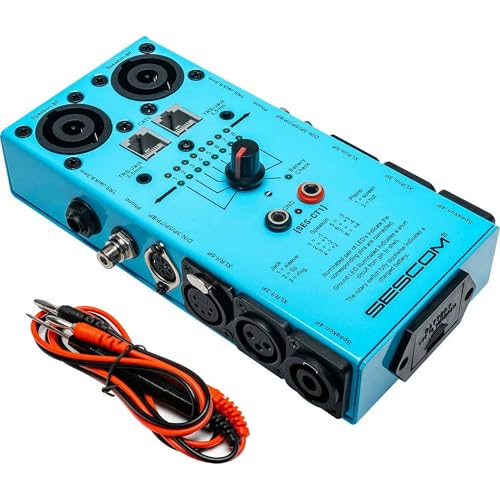 | Sescom SES-CT1 Audio and Ethernet Tester | Primary Formats: XLR, RCA, TRS, 3.5 mm, SpeakON, DIN, RJ45 Remote Testing: Not stated Test Method: 9-way switch Fault Detail: Includes ground-connection status Power: Battery check present; battery type not stated | Check Price on Amazon |
 | OSP CT-04C Audio Cable Tester | Primary Formats: TRS, XLR, RCA, MIDI/DIN, 3.5 mm, SpeakON, RJ45, DMX Remote Testing: Not stated Test Method: Not stated Fault Detail: Not stated Power: Not stated | Check Price on Amazon |
 | MFL MF-CT88 Detachable Cable Tester | Primary Formats: XLR, TRS, RCA, DIN, SpeakON, BNC, HDMI, RJ45/RJ11, DMX, banana Remote Testing: Yes; detachable sender and receiver Test Method: 10-way switch and LEDs Fault Detail: Conductor connection status Power: Battery required; type not stated; not included | Check Price on Amazon |
 | Cable Matters 500119-N XLR Tester | Primary Formats: XLR and DMX Remote Testing: Yes; sender and sniffer Test Method: Pin-specific LEDs Fault Detail: Open pins, pin swaps, and shorts Power: A23 12V battery included | Check Price on Amazon |
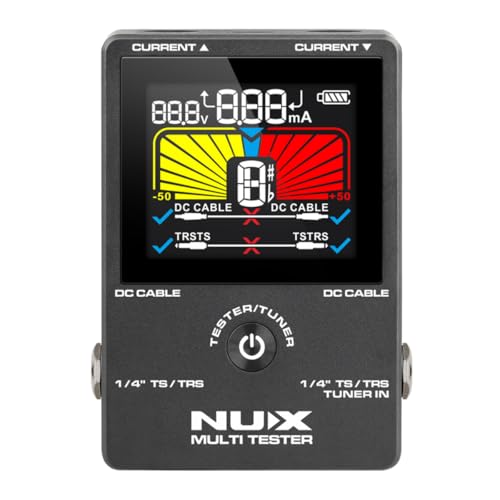 | NUX NMT-1 Rechargeable Patch Cable Tester | Primary Formats: 1/4-inch TS/TRS and 2.1 mm DC; no XLR Remote Testing: No; single compact unit Test Method: Large display Extra Functions: Pedal current/voltage meter and chromatic tuner Power: Built-in rechargeable battery; USB-C charging | Check Price on Amazon |
1. MFL MF-CT20 — Best Single-Box Multi-Connector Tester
The MFL MF-CT20 puts a broad set of cable connections into one rectangular metal box. The manufacturer includes a 10-way rotary switch to select the conductors under test, while LEDs show whether each connection reaches the expected destination. That manual process is useful for checking pin-by-pin continuity rather than relying on a single pass-or-fail light.
The title calls it a 15-plug tester, while the bullets say it supports 13 cables at the same time. The listing does not name every connector, explain how plug count differs from cable formats, or say whether “at the same time” means simultaneous attachment or simultaneous testing. Confirm that XLR, TRS, and any other connector you need are on the panel.
Power comes from a battery that is not included, and the listing does not name the battery type. The compact metal casing suits a repair bench or equipment case. The MF-CT20 is the best single-piece general tester when both cable ends can reach the same box and the connectors on the panel match your studio. It is less suitable for a wall run because the chassis does not split.
[accentbox color=”blue”]Best for bench-testing many patch-cable formats when both ends can be brought to one metal tester.[/accentbox]- Manual 10-way conductor selection
- LED continuity indication
- Compact metal housing
- Exact connector list is not provided
- Battery is not included and type is unstated
2. Blizzard Cable Guy — Best Through-Wall Format Range
Blizzard Cable Guy covers 3-pin and 5-pin XLR, quarter-inch TRS, RCA, BNC, HDMI, RJ45/EtherCON, powerCON, and powerCON TRUE1. That mix serves recording audio, lighting control, installed video, and network cabling from one steel-housed tester. Matching LED patterns indicate the expected route, while mismatches point to a potential wiring problem.
The sender and receiver detach for testing a cable whose ends are separated by a wall, stage, rack, or conduit. That feature is valuable in a studio with permanent tie lines, where bringing both connectors to one bench tester is impossible. The listing does not say whether every connector exists on both detachable halves, how remote results are read, or which fault types beyond mismatched continuity the LEDs can distinguish.
The listing gives no power source, battery inclusion, switch method, pin-by-pin behavior, or accessory list. The wide format coverage is the main reason to choose it. For a studio that handles audio and production infrastructure, the detachable design reaches farther than a single box, provided the manual confirms the exact testing sequence.
[accentbox color=”blue”]Best for installed studios that need separate sender and receiver units across XLR, TRS, network, video, and power-control connectors.[/accentbox]- Detachable sender and receiver
- 3-pin and 5-pin XLR plus TRS and RCA
- Also covers HDMI, RJ45, BNC, and powerCON formats
- Power source is not stated
- Specific fault readouts are not fully described
3. SoundTools XLR Sniffer and Sender — Best Pocket XLR Remote Tester
The SoundTools pair focuses on 3-pin XLR and 3-pin DMX rather than filling a chassis with unrelated jacks. One unit attaches at each end, allowing a single technician to diagnose a cable without bringing its connectors together. LED feedback makes it appropriate for quick checks during a studio session or stage setup.
Its pocket-size aluminum housings are easier to carry through a facility than a large multi-format box. Power comes from an A23 battery, but the listing does not say whether that battery is included, how long it lasts, or whether both pieces require separate cells. The listing describes extended use without providing a runtime figure.
The narrow focus is a benefit when the studio mainly uses three-pin XLR microphone leads. It is not a quarter-inch TRS, RCA, MIDI, or speaker-cable tester. The listing also does not say whether the LEDs distinguish opens, shorts, and swaps individually or simply report conductor status. Choose it for portability and remote-end testing, not connector breadth.
[accentbox color=”blue”]Best for a technician who mainly checks three-pin XLR microphone and DMX cables across a room or installed route.[/accentbox]- Detachable remote-end operation
- Pocket-size aluminum construction
- Focused 3-pin XLR and DMX testing
- No TRS, RCA, or MIDI connections
- A23 battery inclusion is not stated
4. Sescom SES-CT1 — Best Detailed Studio Connector Mix
The Sescom SES-CT1 provides one of the clearest connector lists: 3-pin and 5-pin XLR, RCA/phono, quarter-inch TRS, 3.5 mm, 4- and 8-pole SpeakON, 3/5/7/8-pin DIN, and RJ45 CAT5. This nine-in-one tester therefore covers many microphone, patch, MIDI-style, speaker, and network leads found around a production room.
A nine-way switch selects connections and includes a battery-check position. Ground-connection status checking is also listed, and it is useful when investigating an unexpected shield or ground path. The listing does not state LED layout, detailed fault categories, power source, battery inclusion, housing material, dimensions, weight, or whether each uncommon DIN pin count has separate paired sockets.
The SES-CT1 is the best broad bench choice when you need XLR, both common analog patch sizes, RCA, SpeakON, and DIN. Unlike the detachable products, it is not described for two cable ends in separate locations. Plan on bringing both ends to the tester unless the manual says otherwise.
[accentbox color=”blue”]Best for a mixed studio bench that needs XLR, TRS, 3.5 mm, RCA, SpeakON, DIN, and RJ45 coverage in one unit.[/accentbox]- Detailed nine-format connector list
- Nine-way selector with battery check
- Ground-connection status function
- Power source and battery inclusion are not stated
5. OSP CT-04C — Best Broad Legacy-and-Modern Panel
The OSP CT-04C covers quarter-inch TRS, male and female XLR, RCA, MIDI, DIN, 3.5 mm stereo, RJ45 CAT5e, 3-pin and 5-pin DMX, plus 2-, 4-, and 8-pole SpeakON. That range can serve a studio with older DIN and MIDI leads alongside current microphone, monitor, patch, and network cables.
The listing is essentially a connector list. It does not state how results appear, whether the test is automatic or switch selected, which fault types are identified, whether the unit splits for installed cables, power source, battery inclusion, housing material, size, or weight.
Choose the OSP tester for connector coverage rather than a documented diagnostic workflow. Confirm the panel layout and instructions before buying, especially if ground testing, pin-swap identification, or remote testing is essential. For a bench where both cable ends are accessible, the format coverage is among the widest here.
[accentbox color=”blue”]Best for a studio bench that needs wide coverage including MIDI, DIN, several SpeakON formats, XLR, TRS, RCA, and DMX.[/accentbox]- Broad analog, MIDI, speaker, DMX, and network coverage
- Male and female XLR support listed
- Includes both quarter-inch and 3.5 mm formats
- Test method and fault readout are not described
- Power and housing details are not stated
6. MFL MF-CT88 — Best Overall Multi-Format Tester
The MFL MF-CT88 combines wide connector coverage with a detachable sender and receiver. The manufacturer lists supported formats including RJ45, RJ11, HDMI, SpeakON, XLR, RCA/phono, BNC, DIN, quarter-inch TRS, DMX, and banana connections. The mix makes it useful in a studio that combines recording, installed AV, lighting, networking, and speaker infrastructure.
A 10-way switch selects the conductor under test, and LEDs display connection status. When both ends of a cable are nearby, the chassis can operate together; for long or preinstalled runs, the two parts separate. A compact metal case protects the test panel. This combination of manual pin selection and remote-end use earns the top overall position.
The tester runs on a battery that is not included, and the listing does not name the battery type. The listing also calls the product 15-in-1 without explaining how the connectors are counted, and it does not detail fault categories beyond confirming conductors. Confirm the exact sockets for uncommon formats. For XLR and TRS studio work with occasional installed runs, it offers a broad practical toolset.
[accentbox color=”blue”]Best for a studio that needs broad connector coverage and the option to split the tester across long or installed cable runs.[/accentbox]- Separates into sender and receiver
- Includes XLR, TRS, RCA, DIN, SpeakON, and more
- Manual 10-way switch with LEDs
- Battery is not included and type is unstated
- Detailed fault categories are not specified
7. Cable Matters 500119-N — Best XLR and DMX Diagnostic
The Cable Matters 500119-N focuses on XLR microphone and DMX cables and gives the clearest stated diagnostic detail. LEDs identify the malfunctioning pin and can distinguish open pins, incorrect pin swaps, and electrical shorts. That information is more actionable than a generic mismatch indicator when deciding whether to resolder or retire a cable.
The sender and sniffer plug into opposite ends of the cable, which allows remote testing. Cable Matters recommends joining the two pieces directly first to verify tester function, then replacing the battery if an LED fails to light. An A23 12V battery is included, the only replaceable battery clearly included in this group.
The listing does not say whether five-pin XLR/DMX is supported, so check the connector shown against your cables rather than assuming broad support. There is no TRS, RCA, MIDI, or network testing. The Cable Matters tester is the best specialized diagnostic for microphone cables when explicit fault identification matters more than format count.
[accentbox color=”blue”]Best for fast, specific diagnosis of XLR and DMX opens, swaps, and shorts with an included battery.[/accentbox]- Identifies opens, pin swaps, and shorts
- Separate sender and sniffer
- A23 12V battery included
- No TRS, RCA, or MIDI testing
- Three-pin versus five-pin support is not stated
8. NUX NMT-1 — Best Quarter-Inch Patch and DC Tester
NUX lists the NMT-1 as a compact four-function tool for quarter-inch TS and TRS patch cables, 2.1 mm DC power cables, pedal current and voltage measurement, and chromatic tuning. Its large display presents more information than simple conductor LEDs, while the built-in lithium-ion battery charges through USB-C.
The NUX is the only pick aimed directly at instrument and pedalboard patch work rather than broad studio wiring. It can check correct connections and shorts in solderless patch cables, then measure pedal power needs or tune an instrument. The combination is useful beside a guitar recording station where audio and DC faults often share the same workbench.
It does not list XLR, RCA, MIDI, SpeakON, or network connectors, so it cannot serve as the only tester in a microphone-heavy studio. The listing also omits battery runtime, charge time, voltage and current ranges, measurement accuracy, display dimensions, and included USB-C cable. Choose it for focused TS/TRS patch and pedal-power work.
[accentbox color=”blue”]Best for a guitar or synth production desk that needs rechargeable TS/TRS patch testing plus DC cable and pedal-power checks.[/accentbox]- Tests quarter-inch TS and TRS cables
- Also checks 2.1 mm DC cables and pedal power
- USB-C rechargeable with large display and tuner
- No XLR connector
- Battery and measurement specifications are not stated
Buying Guide: Choosing an Audio Cable Tester
Inventory the actual studio connectors
List every cable format that can stop a session: three- and five-pin XLR, quarter-inch TRS or TS, 3.5 mm, RCA, MIDI/DIN, SpeakON, BNC, and installed network lines. Buy for the connectors physically present, not the largest claimed format count.
A specialized XLR sender may be faster and smaller than a multi-panel box when microphone cables dominate. A broad tester is better for mixed racks and live-production gear. The NUX serves quarter-inch patch leads but not XLR. No single product here is best for every studio inventory.
Choose single-box or detachable testing
A single-box tester needs both ends of the cable at its panel. That works for loose patch leads on a bench. Detachable sender and receiver designs can check a wall run, stage line, or cable already routed through furniture. Physical access determines the useful chassis style.
Blizzard, SoundTools, MFL MF-CT88, and Cable Matters offer remote-end operation. Confirm how results are read when the units are separated, and verify the sender and receiver together before testing the installed cable. A failed tester battery can resemble a failed conductor.
Understand what continuity LEDs prove
A correct LED pattern shows that expected conductors connect from one end to the other. Better-described tools can reveal an open, swapped pin, or short. Continuity does not certify audio quality, shielding coverage, impedance, capacitance, or freedom from intermittent faults during movement.
After a cable passes, listen or measure it in your actual signal chain if noise remains. Flex the cable gently near strain-relief points while monitoring, without stressing it. A static pass can miss a break that appears only when the cable bends.
Check pin count as well as connector family
Three-pin XLR microphone cable and five-pin DMX use related connector shapes but different pin counts and wiring. SpeakON and DIN formats also have several pole counts. A label such as XLR or DIN is incomplete without the pin configuration.
Sescom and OSP provide detailed multi-pin lists, while Cable Matters does not state three- versus five-pin support on its listing. Compare every jack with the cables on hand. Do not force a connector into a socket that merely looks similar.
Plan battery type and field spares
Cable Matters includes an A23 12V battery, SoundTools uses A23 with inclusion unstated, and several MFL listings say a battery is not included without naming its type. NUX uses a rechargeable internal cell. Power details affect whether a tester is ready during a fault.
Keep the correct spare cell with replaceable-battery testers and charge rechargeable tools before a session. Run a self-check or known-good cable first. A known-good reference separates tester trouble from cable trouble.
Decide whether extra functions justify extra complexity
Network, HDMI, powerCON, banana, and DC measurement may be valuable in a production facility but irrelevant in a voice booth. Additional sockets increase panel size and can make the intended path harder to scan. The best tester shortens diagnosis for the common fault.
NUX adds a tuner and pedal power measurement, while Sescom includes a ground-status function. Those extras help only when the studio uses them. Do not trade away required XLR or TRS coverage for unrelated functions.
Use a repeatable cable-check workflow
Label the cable, inspect both connectors and jacket, verify the tester with a known-good lead, then check every conductor. Record the fault type and retest after repair. A simple written result prevents failed cables returning to the live bin.
Quarantine any lead with an intermittent or unexplained result. Keep tested cables coiled without sharp bends and protect connector latches. Preventive checks before a session are faster than tracing the same cable after guests arrive.
Related Studio Cabling Guides
- XLR microphone cable snakes for podcast desks
- Best XLR phantom power supplies for condenser microphones
- XLR-to-USB adapters for dynamic microphones
- Top standalone microphone preamps for laptop recording
- Rack shelves for non-rack studio gear
- Top desktop rack stands for small audio interfaces
- MIDI expression pedals for hands-free DAW control
- Best keyboard stands for home music production
Frequently Asked Questions
Can a cable tester measure audio quality?
Not directly. These products primarily check continuity and wiring. They can help find opens, shorts, and sometimes swapped pins, but they do not publish frequency-response, distortion, capacitance, or shielding measurements. A correct wiring result is not a full audio-performance test.
If a cable passes but still causes hum or signal loss, test it in a known-good audio path and inspect grounding, shielding, connectors, and nearby interference. Use the tester as one diagnostic step.
Can I test a cable installed through a wall?
Yes, with a tester whose sender and receiver separate. Blizzard Cable Guy, SoundTools, MFL MF-CT88, and Cable Matters provide remote-end designs. A one-piece bench tester needs both connectors in the same location.
Confirm that the detachable halves support the required connector at each end and that results remain readable when separated. Test the pair directly first. Known tester operation prevents a false cable diagnosis.
Are XLR and DMX cables tested the same way?
Not exactly. Three-pin XLR audio and three-pin DMX can share connector geometry, but wiring application and cable electrical requirements differ. Five-pin DMX adds more conductors. The tester must support the correct pin count and route.
A continuity pass only confirms the wiring presented to the tester. It does not certify that an audio cable meets DMX impedance requirements or that a DMX cable has appropriate audio handling. Use cable designed for its intended signal.
What does a pin swap mean?
A pin swap means a conductor reaches the wrong numbered pin at the opposite connector. Cable Matters explicitly lists improper pin-swap detection. A swapped balanced-audio conductor can reverse polarity or break expected wiring.
Mark the cable failed and repair it only if the connector is serviceable and the technician can verify the correct pinout. Retest every conductor afterward. Do not return a known miswired lead to studio use.
Should every cable be tested before recording?
Not every cable before every session. New, repaired, heavily used, or mission-critical cables are good candidates for preventive testing. A full studio inventory can be checked on a schedule and after transport. The cost of a quick check is low compared with a lost take.
Known-good installed cables do not necessarily need testing before every session, but a fast preflight of critical lines is sensible. Keep a labeled spare ready. Consistent labeling and quarantine make testing more useful.
Bottom Line
The MFL MF-CT88 provides the strongest combination of connector breadth and detachable testing. For microphone cables specifically, the Cable Matters 500119-N offers the clearest fault descriptions and includes its battery, while the SoundTools Sniffer and Sender is the compact remote alternative. Choose the NUX NMT-1 for TS/TRS pedalboard and instrument patch work, but it does not test XLR.