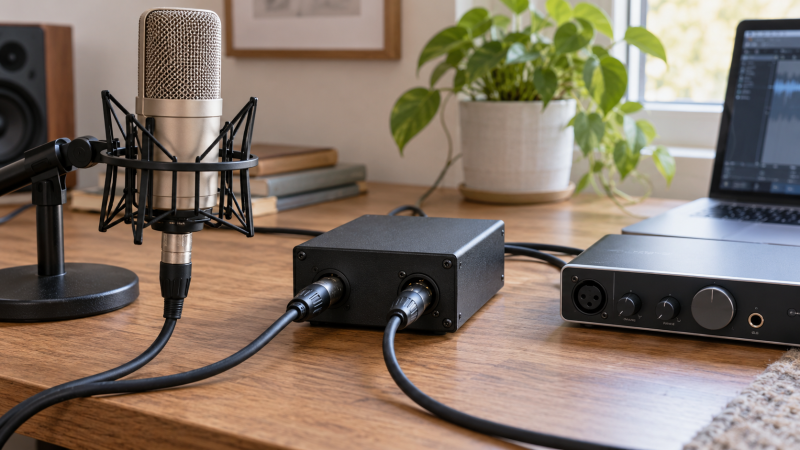
A standalone phantom power supply solves a narrow audio problem. It sends the required DC voltage through a balanced XLR connection when the existing mixer, recorder, sound card, or other input path does not provide it. It does not replace a microphone preamp, add recording inputs to a computer, or guarantee enough gain for a quiet microphone. The rest of the signal chain still needs a suitable mic-level input.
The eight options here include single- and dual-channel supplies, fixed 48V models, a rechargeable 12V/48V unit, a three-voltage 12V/24V/48V model, and AC, USB-C, or battery-powered designs. Match the voltage to the microphone specification, count every microphone that needs power, and confirm what cables and adapters are included before connecting the system.
The NEEWER 1-Channel 48V Supply is the best basic inline choice because it includes an AC adapter and XLR cable. The rechargeable Xvive P1 is the strongest portable option, while the StudioMan PS200 offers two channels and selectable 12V, 24V, or 48V output according to manufacturer specifications.- Best basic single-channel supply: NEEWER 1-Channel 48V Supply includes the power adapter and one XLR cable.
- Best rechargeable option: Xvive P1 switches between 12V and 48V, and its manufacturer lists 30 to 40 hours of battery operation.
- Best dual-channel multi-voltage supply: StudioMan PS200 powers two microphones at 12V, 24V, or 48V and provides a direct mode.
Phantom Power Supply Comparison
Manufacturer specifications for each model are compared below:
| Image | Product | Details | Check Price |
|---|---|---|---|
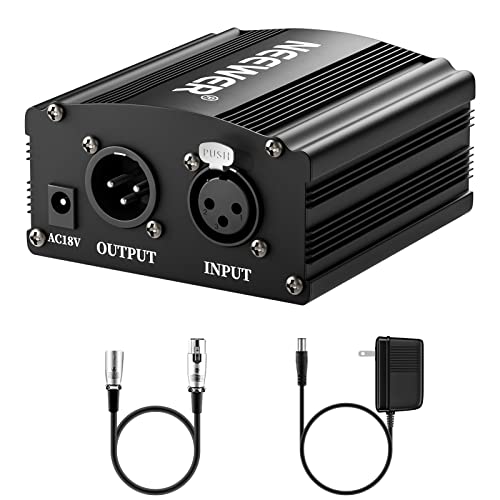 | NEEWER 1-Channel 48V Phantom Power Supply | Channels: 1 Phantom Voltage: 48V Operating Power: Included AC adapter Audio Connections: Balanced XLR input and output Included Cable: 1 XLR cable | Check Price on Amazon |
 | Xvive P1 Rechargeable Phantom Power Supply | Channels: 1 Phantom Voltage: 12V or 48V Operating Power: Internal rechargeable battery Runtime: 30-40 hours stated Included Cable: Charging cable; no XLR cable listed | Check Price on Amazon |
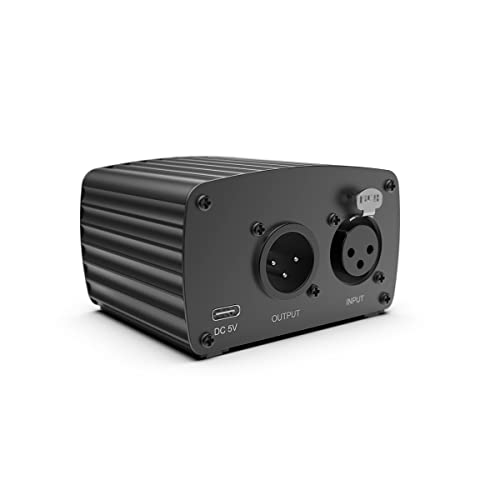 | FIFINE PM48 USB-C Phantom Power Supply | Channels: 1 Phantom Voltage: 48V Operating Power: USB-C Audio Connections: Balanced XLR input and output Included Cable: 3.5 ft USB-C cable | Check Price on Amazon |
 | Acogedor Dual-Channel 48V Phantom Power Supply | Channels: 2 Phantom Voltage: 48V Operating Power: External supply; details not stated Audio Connections: 2 balanced XLR input/output groups Included Cable: 2 XLR cables stated in title | Check Price on Amazon |
 | Mackie M48 Phantom Power Supply | Channels: 1 Phantom Voltage: 48V Operating Power: Included AC adapter or 9V battery Audio Connections: XLR input and output Indicators: Power and low battery | Check Price on Amazon |
 | MOPFOL Aluminum 48V Phantom Power Supply | Channels: 1 Phantom Voltage: 48V Operating Power: 110V US-plug adapter Audio Connections: Balanced 3-pin XLR input and output Included Cable: 1 XLR cable | Check Price on Amazon |
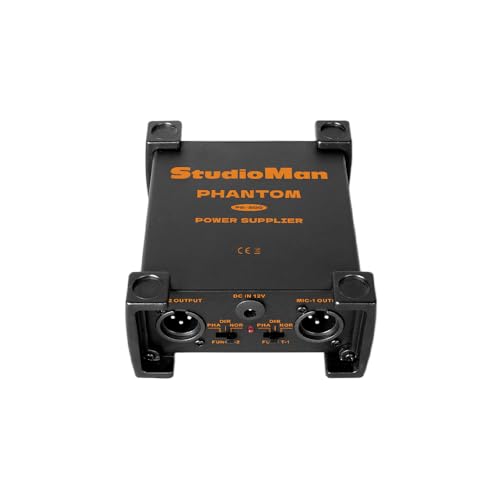 | StudioMan PS200 Two-Channel Phantom Power Supply | Channels: 2 Phantom Voltage: 12V, 24V, or 48V Operating Power: Included 12V 1A adapter Audio Connections: Dual XLR input and output Audio Specs: THD 0.03% or less; 20 Hz-20 kHz | Check Price on Amazon |
 | J&D 1-Channel 48V Phantom Power Supply | Channels: 1 Phantom Voltage: 48V Operating Power: Included adapter Audio Connections: Balanced XLR input and output Housing: Full metal | Check Price on Amazon |
1. NEEWER 1-Channel 48V Supply — Best Basic Inline Choice
If you record one condenser microphone into a mixer or sound card that lacks phantom power, the NEEWER is the simple fix. It is a one-microphone supply with balanced XLR input and output. It sits inline between the microphone and the mixer or sound card, is rated to apply a fixed 48V output, and passes the audio signal onward. An on/off switch and an LED indicator keep operation clear, with no extra voltage or channel settings to configure.
The package includes an AC adapter and one cable with male and female XLR connectors. The included cable covers one side of the signal path. You still need another balanced XLR cable, either between the microphone and the supply or between the supply and the destination, depending on which cable you already own. The microphone, stand, pop filter, and pictured 1/4-inch-to-XLR cable are not listed as included.
The plastic housing is less reassuring than the metal cases listed for several alternatives, but it may suit a stationary desk where the unit is not exposed to stage traffic. The listing gives no noise or current specification. The NEEWER is the best general pick for a single 48V condenser because its essential connections, power adapter, and one XLR lead are plainly described.
[accentbox color=”blue”]Best for one 48V condenser microphone feeding an existing balanced mic input in a home studio or fixed desk setup.[/accentbox]- Fixed 48V single-channel operation
- Balanced XLR input and output
- AC adapter and one XLR cable included
- Plastic rather than metal housing
- No detailed noise or output-current figures
2. Xvive P1 — Best Rechargeable Portable Supply
The Xvive P1 runs from an internal rechargeable battery, so it needs no wall outlet. The listed 30-to-40-hour operating time and 2.5-to-3-hour charge time suit field recorders, portable podcast kits, live stages, and temporary camera setups where mains power is inconvenient. Actual runtime can vary with microphone demand and battery condition, so treat the range as a planning figure rather than a guaranteed session length.
A switch selects 12V or 48V phantom power, so the P1 works with more microphones than fixed-48V units do, as long as the microphone explicitly accepts the lower standard. Balanced XLR input and output connect the P1 inline between the microphone and the destination. The all-metal chassis measures 1.7 x 1.3 x 4.1 inches, which makes the P1 the most clearly travel-oriented supply in this group.
The package includes the P1, a charging cable, and a user manual, but the listing does not list an XLR audio cable or wall charger. The product title mentions a mic preamp, yet the listing’s details describe a power device that sends the microphone signal on to a mixer, processor, or recorder, so do not assume it adds gain. Choose it for battery independence and selectable voltage, not as a replacement for the destination’s microphone preamplifier.
[accentbox color=”blue”]Best for a portable condenser or shotgun microphone setup that needs rechargeable 12V or 48V phantom power away from an outlet.[/accentbox]- Internal rechargeable battery
- Selectable 12V and 48V output
- 30-to-40-hour listed runtime
- XLR audio cable is not listed as included
- Does not replace a microphone preamp
3. FIFINE PM48 — Best USB-C-Powered Supply
The FIFINE PM48 draws operating power through USB-C rather than a dedicated AC barrel adapter. The included 3.5-foot USB-C cable can connect to a suitable power source, computer, or other powered device, which simplifies a desk already using USB power. The listing calls it a data cable, but the supply’s described purpose is receiving power. Do not mistake the PM48 for a USB audio interface or a digital microphone connection.
The PM48 provides fixed 48V phantom power through universal balanced XLR input and output. It is specifically listed for the FIFINE K669C as well as most compatible condenser microphones. A metal enclosure, a physical power switch, and an indicator light suit both indoor recording and mobile work. The bullets state no channel count, but the singular input and output and the product design description support treating it as a single-channel supply.
The listing gives no XLR cable, USB power adapter, required USB input rating, dimensions, or audio measurements. Buyers need a dependable USB power source and the necessary balanced audio leads. The PM48 is most attractive when USB-C power is already available beside a laptop or battery bank and a conventional outlet adapter would add clutter.
[accentbox color=”blue”]Best for a one-microphone laptop desk or portable setup that already has a dependable USB-C power source.[/accentbox]- USB-C-powered 48V operation
- 3.5-foot USB-C cable included
- Compact metal construction
- No XLR audio cable is listed
- Needs a dependable USB power source
4. Acogedor Dual 48V Supply — Best Simple Two-Microphone Option
If you need phantom power for two microphones at once, the Acogedor supplies two balanced input/output groups, so two 48V condenser microphones receive phantom power at the same time. It can simplify a two-person interview, co-hosted podcast, stereo microphone arrangement, or dual-instrument recording path when the destination has two mic inputs but neither supplies phantom voltage.
The listed circuitry includes multiplier filtering, low-pass filtering, shielding, and a slow power-on function intended to reduce turn-on shock sound. These descriptions come from the maker, and the listing does not provide measured noise, distortion, frequency response, current capacity, or test conditions. The title says the package includes two XLR cables, but the bullets do not list an adapter or detailed box contents, so check the listing for everything required to power the unit.
Both channels share the fixed 48V purpose. There is no listed 12V or 24V mode, battery option, direct bypass, or separate per-channel switch, so it is simpler than the StudioMan PS200 but less adaptable. The active-new offer was marked scarce, so availability may be a deciding factor. It is best for two standard 48V microphones when you accept limited documentation.
[accentbox color=”blue”]Best for powering two 48V condenser microphones through balanced XLR paths without paying for selectable voltage modes.[/accentbox]- Two balanced microphone channels
- Slow power-on and filtering are listed
- Title states two XLR cables are included
- No measured audio figures are supplied
- Active-new availability was listed as scarce
5. Mackie M48 — Best AC and 9V Battery Flexibility
The Mackie M48 suits a studio that stays plugged in but sometimes records on location. It offers fixed 48V phantom power through XLR input and output and runs from either the included AC adapter or a 9V battery. The two-source design works for a fixed studio most of the time while keeping an off-grid option for location recording. It also avoids depending on a proprietary internal battery once the cell reaches the end of its useful life.
Power and low-battery indicators help you avoid starting a session with an exhausted portable supply. Mackie describes the operation as transparent and noise-free and the enclosure as built like a tank, but the listing gives no numeric noise floor, distortion, runtime, or output-current specification. Battery endurance therefore cannot be compared directly with the Xvive P1’s listed 30-to-40-hour range.
The box includes an AC adapter. An XLR cable and 9V battery are not listed. The M48 is a strong choice for a single microphone when the same supply may move between a desk and an outlet-free location. Select it over a rechargeable design if you want a replaceable battery, and budget for a fresh 9V cell and both balanced audio cables.
[accentbox color=”blue”]Best for one 48V condenser microphone that needs routine AC operation plus a replaceable 9V battery option.[/accentbox]- Included AC adapter or 9V battery power
- Power and low-battery indicators
- Rugged construction claim
- Battery runtime cannot be compared directly with the Xvive P1
- XLR cable and 9V battery are not listed
6. MOPFOL Aluminum 48V Supply — Best Basic Metal Alternative
The MOPFOL is the metal alternative to the NEEWER. It is another single-channel fixed-48V design, but its circuit sits in an aluminum-alloy enclosure rather than the NEEWER’s listed plastic housing. Balanced three-pin XLR input and output connect inline between the condenser microphone and the destination. A dedicated on/off control and indicator show the basic operating state.
The title names a 110V US-plug power adapter, and the product details say one cable with male and female XLR connectors is included. A US desk setup therefore gets the main power hardware and one audio lead. The listing does not state cable length, adapter output, load current, noise, or distortion. It is also marked scarce for active-new availability.
The MOPFOL suits a buyer who wants a conventional wall-powered metal box without multiple voltage settings or battery management. Like every standalone supply here, it only powers a compatible microphone and passes the signal forward. The sound card, mixer, or recorder must still offer the correct microphone input and gain. Confirm the US mains format if the kit will travel internationally.
[accentbox color=”blue”]Best for a US-based one-microphone setup that wants a metal 48V supply with an adapter and one XLR cable.[/accentbox]- Aluminum-alloy enclosure
- 110V US adapter included
- One three-pin XLR cable included
- No detailed audio or current specifications
- Active-new availability was listed as scarce
7. StudioMan PS200 — Best Dual-Channel Multi-Voltage Supply
The StudioMan PS200 is the most configurable supply in this list. StudioMan specifies two dedicated input/output channels to power a microphone pair, while selectable 12V, 24V, and 48V modes suit equipment designed for different phantom standards. Together, the two channels and three modes make it useful for a mixed collection of condenser microphones, interviews, stereo recording, or a studio that changes equipment often.
The direct function passes the signal through when the PS200 is connected to a mixer that already provides phantom power, so the PS200 does not add a redundant supply. The included adapter is rated at 12V and 1A, and a power switch plus a bright LED provide basic status. The listing does not state whether voltage selection is shared or independent by channel, so buyers who need two simultaneous voltages should verify the control layout before purchase.
StudioMan supplies the only detailed audio figures in this group. The figures are total harmonic distortion of 0.03% or less from 20 Hz to 20 kHz and frequency response of +0/-1 dB across the same range. Both come from the maker rather than shared third-party tests, but they give more context than generic low-noise language. No XLR cables are listed, so a two-microphone setup may need four balanced leads in total.
[accentbox color=”blue”]Best for two-microphone studios that need selectable 12V, 24V, or 48V phantom power and a direct pass-through mode.[/accentbox]- Two balanced XLR channels
- Selectable 12V, 24V, and 48V modes
- Published THD and frequency-response figures
- XLR cables are not listed as included
- Per-channel voltage independence is not stated
8. J&D 1-Channel 48V Supply — Best Simple Full-Metal Design
For a fixed desk or studio with one compatible condenser, the J&D uses a full-metal shell around a basic one-channel 48V circuit. Balanced XLR input and output connect the microphone to a compatible mixer or other mic-level destination, while an on/off switch and LED provide visible control. The included power adapter suits a fixed installation, with no rechargeable battery to keep charged.
The listing says all necessary components are supplied, but it does not explicitly name an XLR cable. Treat the adapter as confirmed and verify the audio-cable contents before assuming the signal path is complete. No noise, distortion, frequency response, cable length, or load-current figures are listed. The maker also warns that voltage may attenuate over a long transmission distance, so use reasonable cable runs and sound balanced cabling.
The compatibility text says the unit is not compatible with dynamic microphones or unsupported devices and warns that incorrect connection may cause damage. Follow the specifications for the exact microphone rather than applying phantom power indiscriminately. The J&D is a suitable metal alternative for one compatible condenser when selectable voltage, battery operation, and a confirmed included cable are not priorities.
[accentbox color=”blue”]Best for a fixed single-microphone setup that wants a full-metal enclosure and simple fixed-48V operation.[/accentbox]- Full-metal enclosure
- Balanced single-channel XLR path
- Power adapter included
- XLR cable inclusion is not explicit
- No measured audio specifications are supplied
Buying Guide: Choosing an XLR Phantom Power Supply
Confirm the microphone actually needs phantom power
Check the microphone manual or its printed specification before connecting a supply. Many studio condensers require 48V, while some equipment accepts lower phantom standards or uses its own battery. Required voltage is the first compatibility check, and more selectable settings are useful only when the microphones need them.
Do not use a standalone supply to solve an unrelated low-level or noisy signal without confirming the cause. It supplies DC power through XLR but does not add microphone gain or convert analog audio to USB. A preamp and audio interface perform different jobs, even when marketing titles place those terms near a phantom supply.
Count channels across the full signal path
A single-channel model powers one microphone. The Acogedor and StudioMan supplies provide two balanced input/output paths for a pair. Every powered microphone needs its own phantom channel, plus a separate destination input capable of receiving and amplifying that mic-level signal.
Two supply channels do not mix the microphones into one output. They are separate balanced paths and need the appropriate number of cables and recorder channels. For a one-microphone voice desk, the extra hardware may add clutter. Buy the channel count the session actually records unless a second microphone is a near-term requirement.
Choose the right source of operating power
AC adapters suit permanent desks and long sessions. With USB-C, the FIFINE PM48 is easy to integrate with an existing powered hub or battery bank, subject to a suitable source. The Xvive uses an internal rechargeable cell, while Mackie states the M48 accepts an AC adapter or replaceable 9V battery for portable operation.
Portable power needs a session plan. Charge internal batteries before travel, carry a fresh 9V cell for the Mackie, and keep USB power capacity in the wider kit calculation. Battery runtime depends on microphone demand and cell condition, so leave margin beyond the expected recording duration.
Budget for every balanced XLR cable
An inline supply usually needs one XLR cable from the microphone to the supply and another from the supply to the mixer, recorder, or interface. A single microphone therefore needs two balanced audio connections around the power box. Some products include one lead, Acogedor’s title lists two, and several include none.
For a dual-channel unit, a complete two-microphone setup can require four cables. Avoid assuming that a pictured lead is in the box. Keep cable runs sensible, inspect connector locks, and route power separately where practical. The package list determines the true ready-to-record cost.
Power the system on and off carefully
Before changing connections, lower monitor levels, mute the destination channel, and switch off phantom power. Connect the balanced path securely, then enable the supply after the rest of the route is ready. Avoid plugging or unplugging XLR connectors with phantom voltage active, since switching transients can reach downstream equipment or monitors.
On shutdown, mute the channel, switch phantom power off, and allow the circuit to discharge before disconnecting. Follow the microphone and destination manuals when their instructions differ. The Acogedor lists slow power-on behavior, but good connection order is useful with every model.
Treat noise claims and measurements carefully
Most listings describe stable, clean, or noise-free operation without publishing a test method. StudioMan provides THD and frequency-response specifications, but those values are not directly comparable with unmeasured claims. A quiet supply cannot fix noise introduced elsewhere by the microphone, preamp, cable, grounding, or room.
Troubleshoot the complete chain if hum or hiss appears. Try known-good balanced cables, one power source, conservative gain staging, and a simplified route. Keep power adapters away from vulnerable audio cabling. Return or replace a supply that introduces repeatable noise after other parts of the path are ruled out.
Related Creator Audio and Video Guides
- Best LED video light panels for small creator studios
- Light stands for portable creator video kits
- Reflector holder arms for one-person product shoots
- Best HDMI capture dongles for laptop streaming
- HDMI loop-out capture cards for camera monitoring
- Best mirrorless camera cages for desk video rigs
- Best camera top handles for handheld creator rigs
- Overhead camera mounts for desk tutorials
Frequently Asked Questions
Does a phantom power supply make a microphone louder?
No. It powers compatible microphone electronics and is not intended to add adjustable gain. The destination still needs a microphone preamp to raise the balanced mic-level signal to a useful recording level. Phantom voltage and preamp gain are separate functions.
If the signal remains quiet after correct power is applied, inspect the preamp setting, cable route, microphone sensitivity, and recording input. Do not insert a second phantom supply in an attempt to make the signal louder. Use one appropriate power source per signal path.
Can 48V phantom power damage a microphone?
Compatible condenser microphones are designed to receive their specified phantom voltage through a correctly wired balanced XLR path. Unsupported, incorrectly wired, damaged, or unbalanced equipment may not be safe. Check the exact microphone and destination documentation before connection.
J&D’s listing explicitly warns against unsupported devices and lists dynamic microphones as incompatible with that product. Follow product-specific guidance rather than applying a broad rule to every microphone type. Switch power off before changing cables and use sound balanced connections.
Do I need one or two XLR cables?
A normal inline single-channel setup needs one cable from microphone to power supply and another from supply to the destination. If one cable is already permanently attached or included elsewhere, the shopping count may differ. Trace the physical route connector by connector before ordering.
A dual-channel supply normally doubles those signal connections for two microphones. Some products here include one or two cables, while others do not list any. Do not count the power or charging cable as an audio lead.
Is USB-C phantom power the same as a USB audio interface?
No. On the FIFINE PM48, USB-C supplies operating power to the phantom box. The microphone audio still travels through the balanced XLR input and output. The USB-C connection is not described as a digital recording input.
To record on a laptop, the XLR output still needs an appropriate sound card, mixer, recorder, or interface with a mic-level input. If that interface already supplies suitable phantom power, a separate box may be unnecessary. Check existing equipment before adding another stage.
Can two phantom supplies be connected in the same path?
Two supplies in one path are generally unnecessary and should be avoided unless the equipment manuals explicitly define such a configuration. Use the phantom source in the mixer, interface, recorder, or standalone box that correctly supports the microphone. One deliberate power source keeps the route easier to understand.
The StudioMan direct function is specifically described for integration with mixers that already provide phantom power. For other units, disable the redundant source and follow the product instructions. Never assume two active supplies improve voltage or audio quality.
Bottom Line
For a basic one-microphone desk, the NEEWER 1-Channel 48V Supply bundles the essential adapter and one XLR cable. The Xvive P1 is the best portable pick through rechargeable 12V/48V operation, while the Mackie M48 offers a replaceable 9V alternative. Two-microphone studios that need more voltage choices should start with the StudioMan PS200.