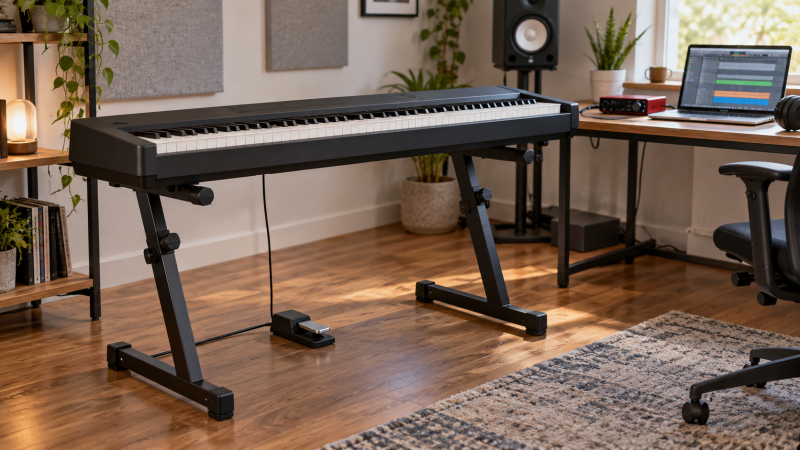
A good keyboard stand for home production holds the keys at a comfortable seated height, clears your knees and pedals, fits the keyboard’s depth and width, and stays steady during repeated playing. Storage is another concern when the same room serves as an office, bedroom, or recording space.
The eight picks here include Z-frame, single-X, and double-X designs for keyboards from compact MIDI controllers to full 88-key digital pianos. Published capacities reach as high as a manufacturer-rated 250 pounds, but weight alone does not decide fit. Measure the instrument base, decide on the key height you want, and compare where the stand’s support arms touch the chassis before you choose a frame style.
The Liquid Stands MS1078 is the best overall home-studio choice because Liquid Stands specifies a Z-frame with independent height and width settings, a 250-pound rating, anchoring straps, and flat storage. The tipatyard TD-001 is the best double-X option for a broad stated height range, while the Liquid Stands MS1080 adds wheels for a studio keyboard that must move without being lifted.- Best overall: Liquid Stands MS1078 adjusts from 22.5 to 33.5 inches in height and width and includes straps, pads, feet, and a headphone hook.
- Best double-X stand: tipatyard TD-001 offers seven height positions from 12.2 to 37.8 inches and folds for storage.
- Best rolling stand: Liquid Stands MS1080 combines a 250-pound rating with a wheeled Z-frame and independent fit adjustments.
Keyboard Stand Comparison
| Image | Product | Details | Check Price |
|---|---|---|---|
 | Liquid Stands MS1078 Z-Style Keyboard Stand | Frame: Z-style Height: 22.5-33.5 in Width: 22.5-33.5 in Max Load: 250 lb Included Features: 2 straps, adjustable feet, pads, headphone hook | Check Price on Amazon |
 | GLEAM Single-X Keyboard Stand | Frame: Single-X Height: 23.5-38.5 in; 7 positions Width: 12-33 in Max Load: 50 lb support / 100 lb maximum wording conflicts Included Features: Leveling sleeves and rear barriers | Check Price on Amazon |
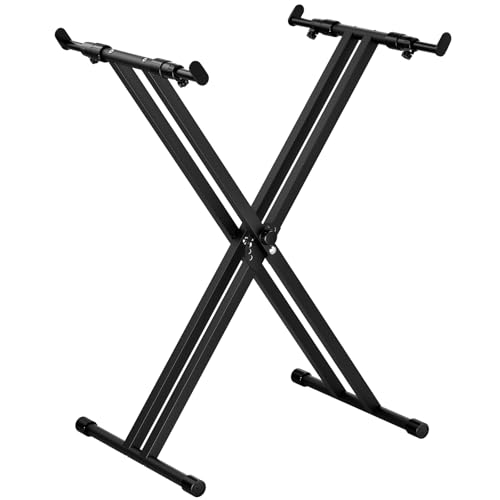 | tipatyard TD-001 Double-X Keyboard Stand | Frame: Double-X Height: 12.2-37.8 in; 7 positions Width: Not stated Max Load: Not stated Included Features: Rubber end caps; detachable support rod | Check Price on Amazon |
 | Liquid Stands MS1080 Rolling Z-Style Stand | Frame: Rolling Z-style Height: 22.5-33.5 in Width: 22.5-33.5 in Max Load: 250 lb Included Features: Straps, pads, feet, headphone hook; caster details unstated | Check Price on Amazon |
 | Stage Rocker SR524000 Single-X Stand | Frame: Single-X Height: 24.6-38.2 in Width: 13.3-31.9 in Support Depth: 19.3 in Max Load: Not stated | Check Price on Amazon |
 | Amazon Basics DF002 Single-X Stand | Frame: Single-X Height: 25.6, 30.3, 33.8, 37, or 39 in Width: Not stated Max Load: Not stated Weight: 6.6 lb | Check Price on Amazon |
 | RockJam RJX29 Double-Braced Keyboard Stand | Frame: Double-braced X Height: Adjustable; range not stated Width: Not stated Max Load: Not stated Included Features: Locking straps and quick release | Check Price on Amazon |
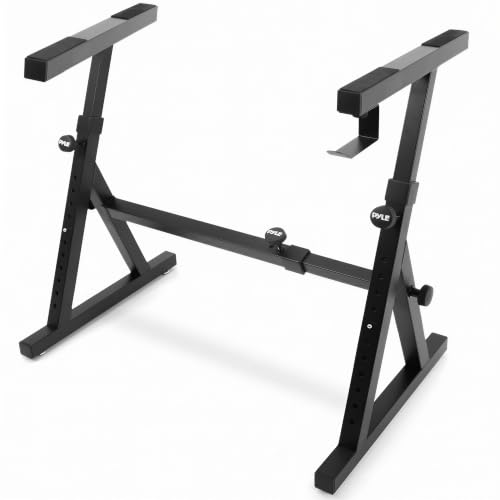 | Pyle PKST38.5 Folding Z-Frame Stand | Frame: Folding Z-style Height: 20-34 in wording conflicts with width claim Width: Sliding adjustment; confirmed range unclear Max Load: Not stated Included Features: Foam-padded arms and stability lock | Check Price on Amazon |
1. Liquid Stands MS1078 — Best Overall Home-Studio Stand
The Liquid Stands MS1078 is a Z-frame stand with independent adjustment for player height and instrument width. Liquid Stands states both dimensions span 22.5 to 33.5 inches, with 1.25-inch height steps and 2-inch width steps. Independent adjustment helps preserve knee room at a seated production desk, unlike an X-frame, whose width narrows as the keyboard rises.
Its listed 250-pound limit is the highest tier in this comparison, and it covers 54- to 88-key instruments. You can adjust the four feet for uneven floors, and anti-skid foam pads cushion the keyboard. Two anchoring straps add retention, and a headphone hook keeps studio headphones off the keys and the audio interface.
The stand packs flat, with setup and breakdown described as taking under a minute. The supplied record does not state folded dimensions, support-arm depth, steel gauge, or overall footprint. Those omissions are a bigger concern in a small room, but independent fit, high stated capacity, straps, and included accessories make this the most balanced home-production choice.
[accentbox color=”blue”]Best for a seated or standing home studio that needs a stable Z-frame for a wide range of keyboard sizes and weights.[/accentbox]- Independent 22.5-to-33.5-inch height and width adjustment
- 250-pound stated capacity
- Anchoring straps, adjustable feet, and headphone hook
- Support-arm depth and steel gauge are not stated
- Z-frame structure takes more floor space than a folded X stand
2. GLEAM Single-X Stand — Best Seven-Position Budget Frame
The GLEAM single-X stand provides seven locked positions that the manufacturer rates for 23.5 to 38.5 inches in height and 12 to 33 inches in width. A locking handle engages serrated iron plates at each setting. The top of the height range can suit standing play, and the lower positions cover many seated arrangements, subject to the keyboard’s own chassis thickness.
GLEAM specifies four rotating foot sleeves that adjust in thickness to suit uneven floors, and four wear-resistant rubber sleeves to support the instrument. Protective barriers on the two rear sleeves are intended to reduce backward sliding. The reinforced steel-tube frame folds more compactly than a Z-frame, which can help when you must clear the production room after a session.
The capacity wording conflicts. The title says 100 pounds, while a bullet says it reliably supports keyboards up to 50 pounds with a 100-pound maximum. The two figures may be a recommended working weight and an upper limit, but the source does not explain them. Treat 50 pounds as the more conservative planning figure until the manufacturer clarifies the 100-pound claim.
[accentbox color=”blue”]Best for a lighter keyboard when seven fixed positions and compact single-X storage count for more than maximum knee clearance.[/accentbox]- Seven positions across a wide height range
- Rotating leveling sleeves
- Rear barriers help resist keyboard movement
- 50-pound support and 100-pound maximum claims conflict
- Single-X frame reduces width as height rises
3. tipatyard TD-001 — Best Double-X Height Range
The tipatyard TD-001 has a double-X metal frame that reinforces the X shape. Seven settings cover a manufacturer-stated 12.2-to-37.8-inch height range, the broadest low-to-high span in this comparison. The very low end may suit storage or a specialized low setup more than normal seated playing, but it adds positioning choices for children, floor seating, and standing arrangements.
You adjust the stand with a pull knob that releases and locks the center pin. Rubber end caps touch the instrument and the floor, and coated steel forms the main structure. The stand folds, and you can detach the support rod to reduce package size for transport or closet storage. The tipatyard listing names 54-, 57-, 61-, and 88-key instruments across its title and bullets.
No numeric weight capacity, support width, arm depth, folded dimensions, or strap details are supplied. One bullet refers to a “raffle” securing the keyboard, wording that does not identify a clear component. Do not assume anchoring straps are included. Choose this model for its double-X structure and height range only after you confirm that it supports the keyboard’s weight.
[accentbox color=”blue”]Best for a home producer who wants double-X reinforcement and an unusually broad seven-position height range.[/accentbox]- Reinforced double-X design
- Seven heights from 12.2 to 37.8 inches
- Foldable with a detachable support rod
- No weight capacity is stated
- Lowest positions may suit storage more than seated playing
4. Liquid Stands MS1080 — Best Rolling Z-Frame
The Liquid Stands MS1080 is a Z-frame stand with wheels, so a producer can move a substantial keyboard between a playing position and a wall or alternate workstation. Liquid Stands states the height adjusts from 22.5 to 33.5 inches in 1.5-inch steps, and width covers the same range in 2-inch steps. It fits the listed 54- to 88-key category.
The manufacturer-rated 250-pound capacity matches the stationary MS1078, according to Liquid Stands. Anti-skid foam pads, anchoring straps, a headphone hook, and four adjustable feet are also described. The title clearly presents a wheeled model, but the bullets do not state caster count, wheel diameter, lock mechanism, or how the wheels relate to the adjustable feet. Confirm that the current package includes locking casters suitable for the studio floor.
A rolling stand is useful when one keyboard serves recording, practice, and room-storage positions. It is a poorer fit if small movements under force affect your playing or if cables cannot travel safely with the stand. Liquid Stands states the frame packs flat in under a minute but gives no folded size. Choose it when you have a specific reason to move the keyboard, not merely because wheels sound convenient.
[accentbox color=”blue”]Best for a heavy home-studio keyboard that regularly moves between playing, recording, and storage positions.[/accentbox]- Rolling Z-frame design
- 250-pound stated capacity
- Straps, pads, feet, and headphone hook included
- Caster locks and wheel dimensions are not stated
- Wheels add another possible movement point
5. Stage Rocker SR524000 — Best Dimensioned Single-X Stand
The Stage Rocker has the clearest fit dimensions among the single-X choices. Stage Rocker specifies a width adjustment from 13.3 to 31.9 inches, a height range of 24.6 to 38.2 inches, and a support depth of 19.3 inches. With those figures, you can compare the contact area with your keyboard’s base instead of relying only on a key-count claim.
The bolted X-frame has cushioned feet and keyboard rests. The stand arrives as an X-frame, floor supports, support arms, and an Allen wrench, with a four-step assembly process. Once assembled, the stand folds into a slim shape for transport or storage. It suits a home studio that switches between seated production and standing performance but needs the frame out of the room at other times.
No load rating, stand weight, folded size, retention straps, or number of locked positions is stated. Maximum dimensions alone do not prove compatibility with a heavy 88-key piano. Still, the specified depth and height-width ranges make this stand easier to match physically than several generic stands, provided you confirm the instrument’s weight independently.
[accentbox color=”blue”]Best for a buyer who wants explicit width, height, and support-depth measurements before choosing a folding single-X frame.[/accentbox]- Explicit height, width, and 19.3-inch depth
- Bolted frame with cushioned contact points
- Folds into a slim storage shape
- No load rating is stated
- No anchoring straps are listed
6. Amazon Basics DF002 — Best Lightweight Simple Stand
The Amazon Basics DF002 is listed as a 6.6-pound single-X stand with five stated heights: 25.6, 30.3, 33.8, 37, and 39 inches. Five fixed heights suit a producer who does not need fine incremental adjustment and wants a stand light enough to carry between rooms or fold away after a session.
The frame and contact surfaces use steel and PVC, with a plastic PP bottom. The product dimensions are listed as 12.17 x 16.1 x 39.13 inches, but the source does not clarify whether those measurements describe a particular open position, package, or maximum envelope. No supported width range, arm depth, load capacity, straps, or folded size is given.
Without a load rating, this stand is easier to recommend for a lighter MIDI controller or portable keyboard than for a heavy hammer-action piano. Measure the instrument base and check that its weight is explicitly acceptable in the current product guidance. The low stand weight is an advantage only when it does not come at the expense of proper support.
[accentbox color=”blue”]Best for a lighter home-studio keyboard when low stand weight and five simple height settings are enough.[/accentbox]- Five clearly listed height positions
- 6.6-pound stand weight
- Steel-and-PVC construction
- No load rating or supported width range
- Low stand weight is an advantage only if support does not suffer
7. RockJam RJX29 — Best Folding Stand with Straps
The RockJam RJX29 is an X-frame stand with double-braced legs and includes locking straps to hold a compatible keyboard in place. A quick-release mechanism lets you change playing height for seated or standing practice. It is listed for 49-, 54-, 61-, and 88-key digital pianos and MIDI controllers.
The frame folds flat for lessons, travel, gigs, and home storage. Straps are particularly useful in a multipurpose room where the stand may be bumped, although they must attach to suitable points on the instrument and should not substitute for correct arm placement. The source does not state how the straps connect or whether every named keyboard has compatible mounting locations.
No height range, width range, support depth, load limit, material specification, or number of positions is supplied. Because none of these figures is supplied, the RJX29 is a pick based on its features, not on precise dimensions. Choose it when included straps and double bracing are priorities, after you confirm the exact instrument fit and weight.
[accentbox color=”blue”]Best for a folding home-practice setup that values double bracing and included keyboard retention straps.[/accentbox]- Double-braced X-frame
- Locking straps included
- Quick release and flat-folding design
- No height, width, or load specifications
- Straps need compatible attachment points on the keyboard
8. Pyle PKST38.5 — Best Folding Z-Frame Alternative
The Pyle PKST38.5 is a reinforced Z-frame stand with foam-padded arms and a stability lock. Its width is described as infinitely adjustable through a sliding lock, an appealing feature for fitting compact controllers and full keyboards without being restricted to fixed notches. The stand folds into a compact Z shape and is described as setting up in under a minute.
The dimensional wording is internally inconsistent. The width-adjustment bullet says the stand can be adjusted to any height between 20 and 34 inches, which mixes up the two dimensions. Without clarification, 20 to 34 inches cannot be reported as either the confirmed width or height range. The title names 54- to 88-key pianos, but a key count does not settle the physical measurements.
No load capacity, stand weight, arm depth, footprint, folded size, or anchoring straps are given. Foam pads protect the keyboard finish and reduce slipping, while the Z layout should preserve more central knee space than an X frame. Choose this stand as a folding Z-frame alternative only after you verify both adjustment axes for your exact keyboard and playing posture.
[accentbox color=”blue”]Best for a buyer who prefers a folding padded Z-frame and can verify the listing’s ambiguous width and height measurements.[/accentbox]- Folding reinforced Z-frame
- Sliding width adjustment
- Foam-padded keyboard arms
- Width and height wording conflicts
- No load capacity is stated
Buying Guide: Choosing a Keyboard Stand for Production
Set seated key height before comparing stands
Sit on your actual studio chair or bench with your shoulders relaxed and your forearms near level when your fingers rest on the keys. Measure from the floor to where you want the underside of the keyboard, then add the chassis thickness. Key-surface height is the ergonomic target, and stand height is only one part of it.
Check that one of the listed fixed positions can reach that target. A stand with fine increments helps when the bench does not adjust. Standing capability can be useful, but it should not compromise the main seated posture. Choose for the position used during long production sessions, not the tallest advertised setting.
Measure keyboard width, depth, and contact points
Overall instrument width does not have to equal stand width. What you need to measure is the flat, supported area under the chassis and the distance between safe contact zones. Support arms must avoid vents, connectors, speakers, and uneven bottom panels.
Depth is a concern because shallow arms can leave a deep digital piano poorly supported. Stage Rocker states a 19.3-inch support depth, while most other manufacturer records omit it. Compare your keyboard’s actual base dimensions with the stand diagram. Key count is a rough category, not a complete fit specification.
Treat capacity as only one stability measure
The Liquid Stands Z-frames list 250 pounds, while GLEAM gives conflicting 50- and 100-pound language and several products provide no rating. Stay below the confirmed limit and center the instrument on the stand. A high capacity does not correct incorrect width or shallow support.
Playing force, pedals, cables, floor level, and frame geometry also affect movement. Adjust every foot and engage every lock before use. If the keyboard rocks, solve the support problem rather than pushing it against a wall. Stable contact at all feet is essential for repeatable playing.
Choose Z-frame or X-frame around legroom
A Z-frame keeps the central area more open and lets width and height change independently, which can improve knee and pedal clearance at a seated workstation. It also tends to occupy a more defined floor footprint. Z-frames suit permanent or semi-permanent home-studio stations.
An X-frame folds quickly and stores narrowly, but raising it usually narrows the top supports. Double-X bracing adds structure without changing that geometry. X-frames suit rooms where the stand is packed away often, provided the chosen position supports the instrument correctly.
Account for pedals, cables, and nearby furniture
Place sustain and expression pedals where both feet can reach them without hitting crossbars. Route power, USB, MIDI, and audio cables with a little slack, then secure them away from pedal travel. The stand must fit the complete playing position, not just the keyboard chassis.
Check monitor stands, desk drawers, chair arms, and wall clearance before choosing a wide footprint. A rolling stand needs extra cable slack or a routine for unplugging cables before it moves. Never let movement pull on instrument ports, particularly when several cables run to a laptop desk.
Use straps, pads, and wheels correctly
Anchoring straps can reduce accidental movement when the keyboard has compatible attachment points. Foam and rubber pads protect the finish and add friction, but you should replace damaged or compressed pads. Retention accessories supplement correct support geometry rather than making a poor fit safe.
For wheeled stands, lock every caster before playing and confirm the stand does not drift on your floor. Move the instrument slowly and guide cables separately. The MS1080 record does not specify its lock design, so verify it. Mobility is useful only when the playing position becomes stationary.
Related Home Music Production Guides
- MIDI expression pedals for hands-free DAW control
- Top standalone microphone preamps for laptop recording
- XLR-to-USB adapters for dynamic microphones
- Best XLR phantom power supplies for condenser microphones
- XLR microphone cable snakes for podcast desks
- Best LED video light panels for small creator studios
- Light stands for portable creator video kits
- Overhead camera mounts for desk tutorials
Frequently Asked Questions
Is a Z-frame better than an X-frame for seated production?
A Z-frame often provides more central knee space and lets width and height adjust independently. Independent adjustment makes it easier to keep a seated position across different keyboard widths. The tradeoff is a larger floor structure than a folded X stand.
An X-frame can still work well when its cross point and supports clear the player’s legs. It stores more compactly and may cost less. Fit and posture count for more than frame style alone.
How much weight capacity does a MIDI keyboard need?
Use the keyboard’s actual weight and leave a margin below a clear stand rating. Compact MIDI controllers may be light, while hammer-action 88-key pianos can be much heavier. Never estimate instrument weight from key count.
Several products here omit capacity, so you need to confirm the weight limit before placing a heavy keyboard on them. The Liquid Stands models list 250 pounds. A rating does not override width, depth, and balance requirements.
Can I place a laptop or audio interface on the same stand?
Only if the stand or an approved accessory is designed for a second tier or shelf. The main arms should support the keyboard as intended. Do not balance loose electronics on unused arm space, where playing vibration or cable tension can move them.
A separate desk, side shelf, or model-specific second tier usually gives safer access and clearer cable management. Include the extra hardware in the load calculation. Keep ventilation openings and keyboard controls unobstructed.
Do anchoring straps fit every keyboard?
No. Straps need compatible attachment points or a manufacturer-approved routing method. Liquid Stands and RockJam list straps, but listing straps does not prove every keyboard chassis can accept them. Check the instrument base before relying on strap retention.
Never route a strap over keys, controls, vents, or delicate trim. The keyboard should remain stable on the padded arms even before straps are tightened. Straps are backup retention, not the primary support.
Should a home-studio stand have wheels?
Wheels help when a heavy keyboard moves between a wall, workstation, and playing area. They also add another possible movement point. Every caster should lock firmly before playing, and you need enough cable slack for the planned travel.
A stationary stand is simpler when the instrument never moves. The MS1080 is the wheeled choice here, but its caster details are not stated in the supplied record. Verify locks and floor suitability before choosing mobility.
Bottom Line
The Liquid Stands MS1078 is the best overall stand for its independent adjustment, accessories, and high stated capacity. The tipatyard TD-001 has the broadest listed height range in a folding double-X shape, while the Stage Rocker SR524000 has the clearest single-X fit dimensions. Choose the Liquid Stands MS1080 only when moving a heavy keyboard is part of the room plan, and verify its caster locks before relying on it.