Compare battery method, runtime, output, and controls.
Match power and output.| Image | Product | Details | Check Price |
|---|---|---|---|
 | Movo VXR10-AI v2 | Best fit: USB-C digital audio and AI reduction Battery: Rechargeable, 30h or 10h AI mode Output: 3.5mm and USB-C Audio: 24-bit/48kHz | Check Price on Amazon |
 | tikysky TML-MIC05 | Best fit: Close DSLR interviews Battery: AAA Pickup: 0 to 5m Output: 3.5mm TRS camera only | Check Price on Amazon |
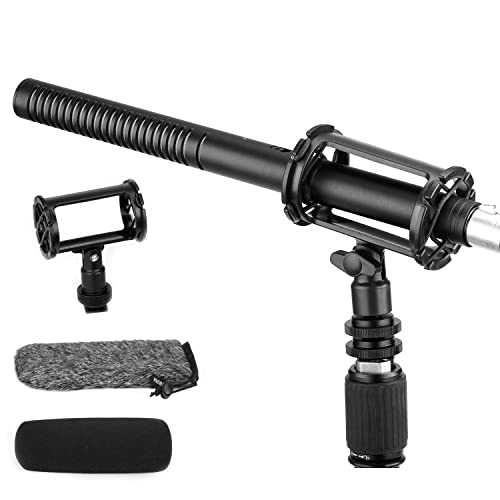 | BOYA BY-BM6060 | Best fit: XLR camera and recorder work Power: One AA or 24-48V phantom Output: 3-pin XLR Mount: Cold shoe with 1/4-inch thread | Check Price on Amazon |
 | COMICA CVM-V30PRO | Best fit: Low-cut and boosted camera audio Battery: Two AAA Controls: Low cut and +10dB Mount: TPU shock mount | Check Price on Amazon |
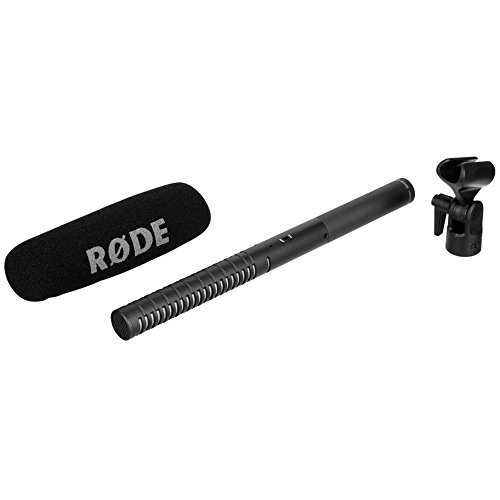 | Rode NTG2 | Best fit: AA or phantom-powered XLR rigs Power: AA or P48 Filter: 80Hz high-pass Pattern: Highly directional | Check Price on Amazon |
 | COMICA VM20 | Best fit: Long rechargeable runtime Battery: 300mAh, up to 60h Charging: 3h, usable while charging Controls: 10 gain levels, 75/150Hz filters | Check Price on Amazon |
Pair a shotgun microphone with a wireless lavalier system for interviews or a compact camera tripod for presenters.
Buying Guide
Power Source Variability
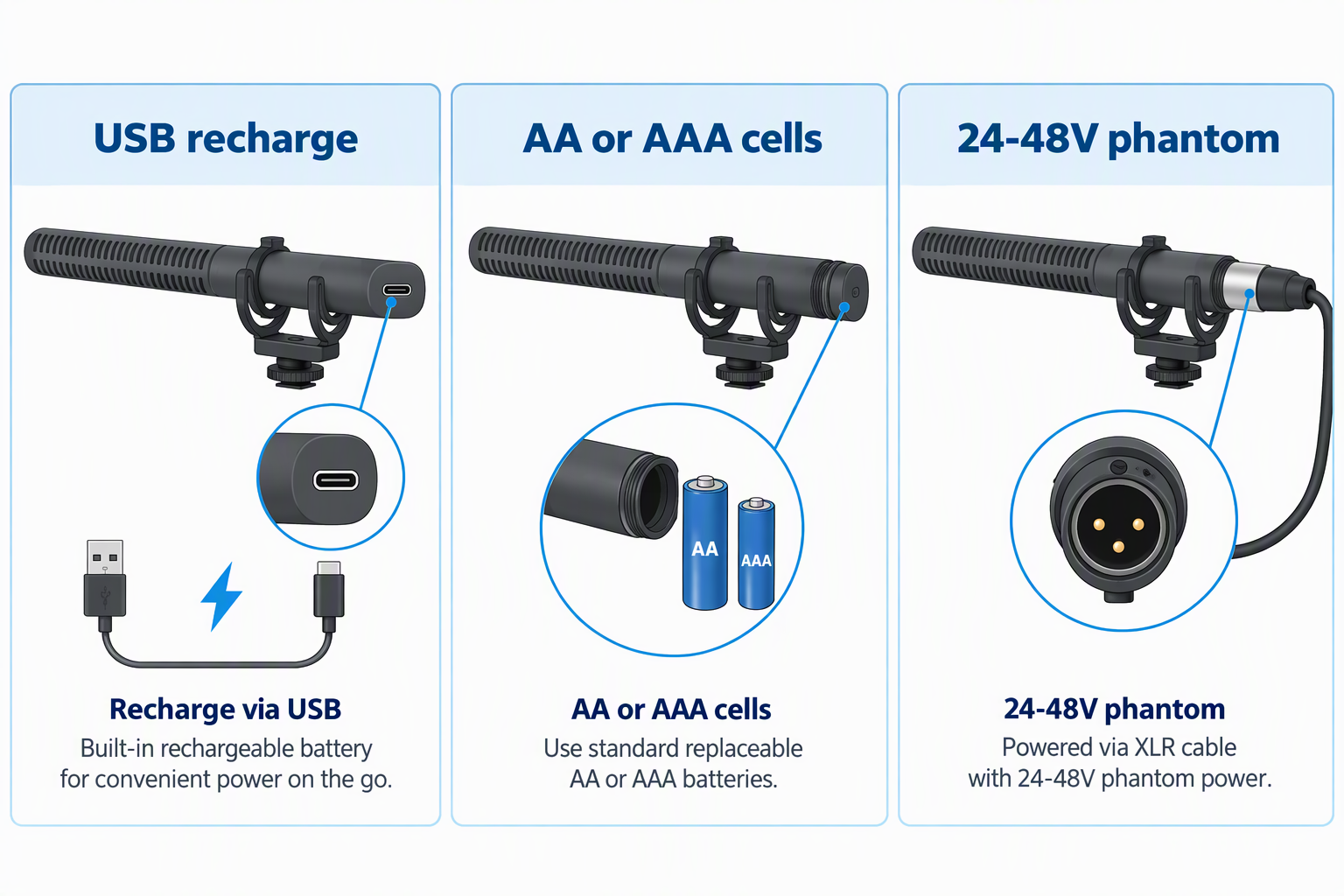
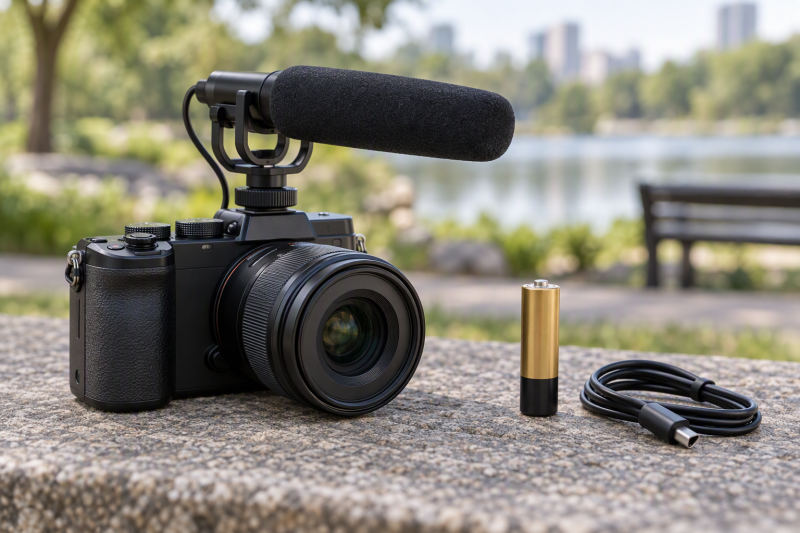
Battery-powered shotgun microphones run on either an internal rechargeable lithium-ion cell or user-replaceable alkaline batteries. Comica specifies that the VM20 uses an integrated 300mAh battery. COMICA rates the V30PRO for two AAA batteries, while Rode and BOYA specify a single AA for their respective models.
Your field workflow decides between the two. Integrated batteries keep the body slim and charge over USB, while replaceable batteries let you swap power on the spot. Movo rates its microphone for 30h in standard mode and 10h when using its AI features. According to Comica, the VM20 offers up to 60h after a full 3h charge cycle.
Digital and Analog Output Options
The output decides which devices the microphone can connect to directly. The tikysky listing specifies a 3.5mm camera connection, which suits simple DSLR setups. Movo specifies both 3.5mm and USB-C outputs and 24-bit/48k digital audio for direct recording to smartphones or computers.
The Rode NTG2 and the BOYA provide XLR outputs for balanced signals. Both can operate on 24-48V phantom power if the internal battery is not in use. Phantom power lets either microphone serve as a battery-powered “run-and-gun” tool on location and as a permanent studio fixture powered by an audio interface.
Gain and Signal Boost Capabilities
Managing signal-to-noise ratios often requires gain control on the microphone before the audio reaches the camera’s preamps. The VM20 has an analog dial with 10 gain levels for precise sensitivity calibration. The COMICA V30PRO has a +10dB boost switch designed to overcome the noisy preamps found in many entry-level mirrorless cameras.
Sensitivity also dictates the effective pickup distance. The tikysky listing rates its usable range at 0-5m, which suits vlogging or close-range interviews. In more complex environments, a physical gain dial keeps the output signal strong without the digital hiss that comes with post-production amplification.
Noise Reduction and Filtering
Wind and low-frequency traffic rumble can be reduced with a high-pass or low-cut filter built into the microphone body. Rode documents an 80Hz high-pass filter for the NTG2, while Comica lists a low-cut toggle for the V30PRO. Both filters keep low-end frequencies out of the recording at the source.
Advanced models offer multiple stages of filtering for different environments. Comica specifies two VM20 filter settings, 75Hz and 150Hz, so you select the cutoff based on the severity of the ambient noise. Filtering in the hardware is essential for maintaining clarity when recording in unpredictable outdoor locations.
Power Redundancy and Reliability
Microphones with dual-power configurations are more dependable in the field. The BOYA and the Rode NTG2 run on a single AA battery or on 24-48V phantom power. If the battery dies during a shoot, the microphone can continue to operate as long as it is connected to a professional recorder or mixer.
Simple consumer models have no backup power source and rely solely on AAA or AA cells. The cells keep the weight low, but you have to carry spares. The Movo’s rechargeable system and the VM20’s 60h battery life focus on long-term endurance, though both need a 3h recharge window once the 300mAh or similar internal cells are depleted.
Frequently Asked Questions
Which microphones support digital recording directly to computers?
The Movo is the one to choose for digital recording to a computer, because it has a USB-C output alongside its standard 3.5mm jack. With that output it bypasses external interfaces and delivers 24-bit/48k audio directly to a laptop or mobile device. Most other models in this roundup, such as the tikysky, are strictly analog and require a 3.5mm or XLR input.
Analog-only models like the COMICA V30PRO and the Rode NTG2 rely on the recording device’s analog-to-digital converters. The setup is standard for camera-top use, but it lacks the plug-and-play digital convenience of the Movo’s hybrid design, which is optimized for modern content creators.
What is the typical operational range for budget shotgun mics?
Budget-friendly options like the tikysky are engineered for a localized pickup range of 0-5m. Within that distance, the super-cardioid or hyper-cardioid patterns effectively isolate the subject’s voice from background noise. Beyond that range, the signal-to-noise ratio typically degrades, because the microphone is not designed for long-distance pickup.
Mid-range and professional models like the Rode NTG2 or VM20 offer better off-axis rejection, but the 0-5m rule remains a practical standard for most battery-powered shotgun microphones. For optimal clarity, use the 10 gain levels or +10dB switches to make sure the subject’s voice is adequately captured within that window.
Do these microphones require external phantom power?
No, all six products in this roundup are designed to operate independently using internal power. The COMICA V30PRO uses two AAA batteries, and the BOYA and the Rode NTG2 use a single AA. The BOYA and the Rode are also dual-power microphones, so they can accept 24-48V phantom power if the internal battery is removed or depleted.
The Movo and the VM20 use integrated rechargeable batteries, and the VM20 has a 300mAh cell. Both microphones never require phantom power, and both charge over USB. The tikysky is purely battery-dependent and needs AAA cells to work, because it is compatible only with 3.5mm camera inputs, which do not provide sufficient voltage for phantom-only mics.
How long does a full charge take for integrated batteries?
The VM20 requires approximately 3h to reach a full charge, which then provides up to 60h of continuous use. For microphones with internal lithium-ion cells, charging time is relatively brief compared to total runtime. The short charge suits long-form documentary work where charging opportunities are limited.
The Movo’s runtime depends on its active features. It lasts 30h under normal conditions and drops to 10h when the AI processing is engaged. Plan your shoots around those durations, and keep a power bank available to top off the 300mAh internal batteries during breaks.
Which models offer multiple filter stages?
The VM20 provides the most granular control over frequency response, with a dual-stage low-cut filter offering settings at 75Hz and 150Hz. The two settings let you target specific types of noise, such as low-end motor hum or higher-frequency wind turbulence. In contrast, the Rode NTG2 uses a single fixed high-pass filter at 80Hz.
Other models like the COMICA V30PRO include a basic low-cut switch without specified frequency increments, aimed at general rumble reduction. The Movo relies more on its digital AI for noise management. The tikysky lacks hardware filters entirely, so all noise correction has to happen during the post-production phase.
Bottom Line
The microphones in this roundup fall into three groups: digital-hybrid, professional analog, and budget entry. Choose the Movo for digital workflows, with its 24-bit/48k USB-C output and 30h/10h AI runtime. Choose the VM20 for the most refined hardware control, with 10 gain levels and a 60h battery.
If you need XLR and 24-48V phantom power redundancy, look at the Rode NTG2 or the BOYA. On a strict budget, the tikysky provides essential 0-5m coverage on AAA power, and the COMICA V30PRO offers a middle ground with a +10dB boost for improved camera audio.
1. Movo VXR10-AI-V2 — Best for High-Tech Noise Cancellation
The Movo VXR10-AI-V2 is a supercardioid shotgun microphone for creators who need professional audio in unpredictable environments. Movo states that its AI noise cancellation was trained on over 700,000 real-world samples and isolates voices while removing background distractions like traffic, wind, and crowd noise. The manufacturer rates the unit for 24-bit/48kHz capture for YouTube, podcasting, and mobile filmmaking projects.
Movo specifies both a 3.5mm TRS camera cable and USB-C digital output for direct connection to smartphones and computers. According to the manufacturer, the internal rechargeable battery provides up to 30 hours in standard mode and 10 hours with AI noise reduction active. The kit includes a Rycote Lyre shock mount, a furry windscreen, and a carry pouch.
- Internal rechargeable battery provides up to 30 hours of use for extended professional location recording sessions.
- Supercardioid pickup pattern isolates specific subjects to minimize unwanted off-axis noise during complex outdoor filming projects.
- AI-powered noise cancellation utilizes 700,000 samples to remove background traffic and crowd sounds for cleaner audio.
- USB-C digital output allows for 24-bit/48kHz recording directly into smartphones or computers without needing external adapters.
- Included Rycote Lyre shock mount reduces handling noise and vibration to maintain stable audio quality while moving.
- Activating the AI noise reduction feature decreases the battery life significantly from 30 hours to 10 hours.
- Higher technical complexity from digital processing may be unnecessary for users who only require simple analog recording.
- Compact shotgun design prioritizes portability, which might capture less low-end depth compared to larger studio microphones.
- Internal battery requires periodic recharging, which could halt production if the unit runs out of power mid-shoot.
- Included furry windscreen is necessary for outdoor wind protection but adds bulk to the mobile camera rig.
2. tikysky TML-MIC05 — Best Budget Option for Close-Up Interviews
The tikysky TML-MIC05 is a shotgun condenser microphone for DSLR cameras with 3.5mm TRS jacks. Its listing describes a super-cardioid pickup pattern and single-head mutual complementary sound pickup technology. tikysky rates it for close-up work with an effective pickup range of 0 to 5 meters and best performance within 3 meters, which suits interviews and vlogging.
The tikysky runs on standard AAA alkaline batteries, which support long standby times and easy replacement in the field. A built-in low power indicator warns you when the battery is running low during a shoot. The microphone is incompatible with mobile phones, tablets, or computers, and it also does not work with certain camera models like the Canon Rebel T5, T6, or T7.
- AAA alkaline battery power allows for quick swaps in the field to ensure continuous recording without recharging.
- Super-cardioid pickup pattern delivers high-definition sound resolution for creators focusing on close-up interviews within three meters.
- Integrated low power indication function alerts the videographer when battery levels are dropping to prevent unexpected shutdowns.
- Standard 3.5mm TRS stereo plug ensures easy connectivity with most major DSLR camera brands like Sony and Panasonic.
- Effective five-meter pickup range captures clear audio for Facebook Live and TikTok vlogs in relatively quiet environments.
- Incompatibility with specific models like Canon Rebel T5, T6, and T7 limits usage for certain DSLR owners.
- Not suitable for recording in noisy concert environments or long-distance venues where sound sources are far away.
- Lack of mobile phone or tablet compatibility prevents this microphone from being used with standard smartphone rigs.
- Manual power switch requires users to remember to turn the unit off to avoid draining AAA batteries.
- Absence of USB or XLR connectivity restricts the device to analog camera jacks rather than professional interfaces.
3. BOYA BY-BM6060 — Best for Professional Broadcast Production
The BOYA BY-BM6060 is a shotgun condenser microphone for formal video production, including independent films, documentaries, and broadcast audio acquisition. BOYA lists a super-cardioid polar pattern, low-noise circuitry, and a 3-pin XLR output for recording interfaces and cameras.
BOYA states that the BY-BM6060 accepts 24-48V phantom power or a single AA battery when a device does not supply voltage. The listing specifies a suspension shock mount, fur and foam windshields, and a cold-shoe mount with a 1/4-inch thread. Those accessories and both power options suit studio recordings and electronic field production (ENG/EFP).
<div class="pros">
    <ul>
        <li>Super-cardioid polar pattern focuses audio capture directly in front to minimize unwanted background noise during recording.</li>
        <li>Dual power capability supports 24-48V phantom power or one AA battery for flexible field operation options.</li>
        <li>Professional 3-pin XLR output ensures compatibility with high-end broadcast equipment and audio interfaces for clean signals.</li>
        <li>Included suspension shock mount reduces handling noise while the fur windshield effectively blocks wind during outdoor shoots.</li>
        <li>Integrated cold-shoe mount featuring a 1/4-inch thread allows for secure attachment to cameras or standard tripods.</li>
    </ul>
</div>
<div class="cons">
    <ul>
        <li>Single AA battery requirement means users must carry spares to ensure continuous power during long filming days.</li>
        <li>Large shotgun form factor may be cumbersome for small mobile rigs compared to more compact microphone alternatives.</li>
        <li>Focus on XLR connectivity requires specific adapters or recorders for creators using standard 3.5mm input devices.</li>
        <li>Super-cardioid characteristics demand precise microphone positioning to capture the best sound quality from the intended subject.</li>
        <li>The listed twelve-month limited warranty provides less long-term coverage than some premium-brand policies.</li>
    </ul>
</div>
4. COMICA VF-CVM-V30PRO B — Best for Vlogging and Outdoor Content
The COMICA CVM-V30 PRO is made for high-energy creators. Its super-cardioid polar pattern delivers clear and natural audio for vlogs and YouTube videos. A patented TPU shock-absorbing mount is built to minimize vibration and cable-borne noise during handheld movement. The body is a blend of metal and lightweight PC materials, so it is durable enough for daily use without adding excessive weight to a mobile rig.
Comica specifies that the CVM-V30 PRO has a switchable low-cut filter and a +10dB sensitivity adjustment. The manufacturer rates it for two AAA batteries and includes a red replacement indicator, universal cold shoe, and 3.5mm-to-XLR audio output cable for camcorders and external audio gear.
<div class="pros">
    <ul>
        <li>Switchable +10dB sensitivity adjustment provides flexible gain control to adapt audio levels for various recording environments.</li>
        <li>Integrated low-cut filter effectively removes low-frequency background hums from wind or traffic during outdoor video sessions.</li>
        <li>Patented TPU shock-absorbing mount minimizes unwanted vibrations and handling noise for much smoother and cleaner audio tracks.</li>
        <li>Lightweight PC and metal construction ensures the microphone remains portable and comfortable for extended hand-held filming.</li>
        <li>Included wind muffs significantly reduce ambient noise interference when recording content in challenging or breezy outdoor conditions.</li>
    </ul>
</div>
<div class="cons">
    <ul>
        <li>Explicit lack of compatibility with Canon T6 cameras restricts usage for owners of that specific DSLR model.</li>
        <li>Dual AAA battery requirement adds weight and requires monitoring the indicator light to prevent sudden power loss.</li>
        <li>Absence of included batteries means users must purchase power separately before they can begin using the microphone.</li>
        <li>Super-cardioid pattern requires strict on-axis positioning to avoid losing audio clarity from subjects moving off-center.</li>
        <li>Focus on 3.5mm to XLR output cable might necessitate extra adapters for rigs using different connection types.</li>
    </ul>
</div>
5. Rode NTG2 — The Professional Choice for Flexible Powering
The Rode NTG2 is a dual-powered shotgun microphone for mobile and field recording. Rode specifies that its power circuit runs on P48 phantom power or a single AA 1.5V battery. The two power options suit mobile rigs where phantom power might not be available from the camera or interface.
Beyond power, the microphone has a directional pickup pattern to isolate subjects. Rode specifies a selectable 80Hz high-pass filter to mitigate unwanted low-end interference. Its metal construction suits regular outdoor video work.
<ul>
  <li>The dual-power design allows users to switch between phantom power and AA batteries for maximum setup flexibility.</li>
  <li>Its highly directional pickup pattern focuses on the subject's voice while rejecting unwanted background noise for clarity.</li>
  <li>An integrated 80Hz high-pass filter effectively removes low-frequency hum from air conditioners or traffic during outdoor recording.</li>
  <li>The low noise floor ensures that your recordings remain clean and professional even when capturing quiet sources.</li>
  <li>Full frequency response coverage captures a wide range of sound details, providing natural audio for high-quality video.</li>
</ul>
<ul>
<li>Reliance on AA batteries means mobile users must carry spares to ensure uninterrupted operation during long shoots.</li>
<li>The physical length of the shotgun design may require a larger mobile rig or specific mounting hardware.</li>
<li>Lack of a built-in OLED screen means users cannot visually monitor battery levels or gain settings directly.</li>
<li>Absence of included TRS to TRRS adapters requires additional purchases for direct connection to most mobile smartphones.</li>
<li>The lack of a stepless gain knob limits the ability to make precise volume adjustments on the fly.</li>
</ul>6. COMICA VM20 — The Tech-Forward Pick for Real-Time Monitoring
The COMICA VM20 is a shotgun microphone with an OLED power display for checking battery status. Comica specifies a 300mAh rechargeable lithium battery with up to 60 hours of use after a three-hour charge.
Comica rates the VM20’s stepless gain knob from -43dB to -23dB for volume control. It also specifies low-cut filtering at 75Hz and 150Hz. The included 3.5mm TRS and TRRS cables connect it to smartphones, laptops, and DSLR cameras.
<ul>
  <li>An integrated OLED screen provides real-time battery and power monitoring so creators can avoid unexpected mid-shoot shutdowns.</li>
  <li>The built-in 300mAh lithium battery offers up to 60 hours of use, supporting long production days without recharging.</li>
  <li>USB-C charging functionality allows the microphone to be used while plugged in, extending working time for stationary setups.</li>
  <li>A stepless gain knob provides ten levels of adjustment between -43dB and -23dB for precise volume control management.</li>
  <li>Dual 75Hz and 150Hz low-cut filters help shooters eliminate environmental hum or wind noise during outdoor mobile filming.</li>
</ul>
<ul>
<li>The internal lithium battery is not user-replaceable, which could limit the microphone's total lifespan over several years.</li>
<li>A three-hour charging time is required to reach full capacity, necessitating forward planning before starting a shoot.</li>
<li>The full-metal microphone body adds weight compared with compact plastic-bodied camera microphones during handheld rig use.</li>
<li>Sensitivity ranges from -43dB to -23dB might require careful balancing with camera preamps to avoid unwanted digital hiss.</li>
<li>Inclusion of multiple cables like TRS and TRRS adds complexity to gear management for minimalist mobile video setups.</li>
</ul>