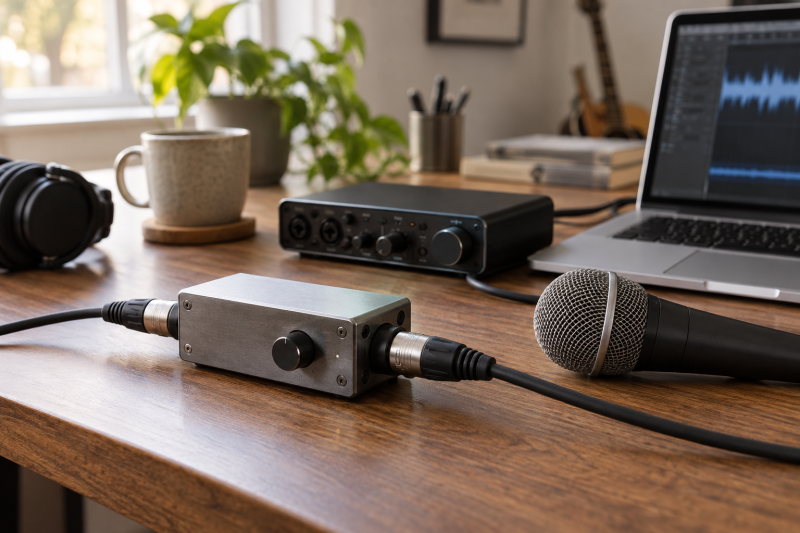
A standalone microphone preamp adds gain before an existing audio interface, recorder, mixer, or sound card. It can raise a quiet dynamic microphone above the noisiest part of an interface’s gain range, provide phantom power for a compatible condenser, or add input and output choices for a small recording chain. It does not automatically create a USB audio connection to a laptop.
This list includes full preamps with up to 66 dB of adjustable gain and compact inline boosters with fixed 25, 28, or 29 dB lift. The two types connect differently. A desktop preamp normally feeds a line input, while a phantom-powered inline activator sits between a low-output dynamic microphone and a preamp-equipped interface. Choose the signal path first, then compare gain, microphone type, power, and output connector.
The Rodyweil RO03 is the best full preamp for laptop recording because it combines 19 to 66 dB of gain, microphone and instrument inputs, USB-C power, and multiple analog outputs. The StudioMan CL-100 is a compact fixed-gain alternative, while the StudioMan DPM1 is the clearest inline choice for dynamic and passive ribbon microphones when the interface already supplies 48V phantom power.- Best overall full preamp: Rodyweil RO03 provides 19 to 66 dB of gain, USB-C power, a 1-megohm instrument input, and line-level output choices.
- Best compact 25 dB booster: StudioMan CL-100 uses balanced XLR connections in a 5.8-inch metal housing.
- Best inline dynamic-mic activator: StudioMan DPM1 adds 29 dB, requires 48V from the destination, and does not pass that power to the microphone.
Standalone Microphone Preamp Comparison
Manufacturer-rated specifications:
| Image | Product | Details | Check Price |
|---|---|---|---|
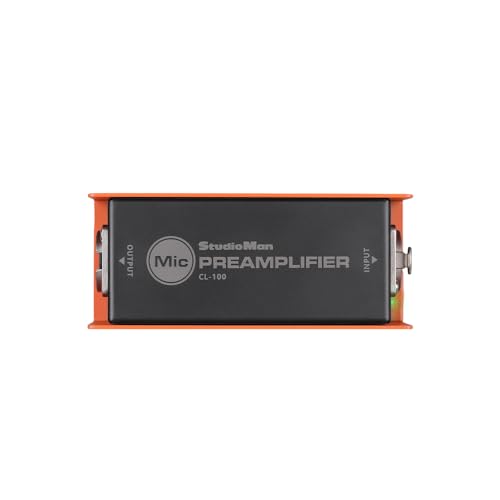 | StudioMan CL-100 XLR Microphone Preamp | Gain: +25 dB fixed Microphone Fit: Dynamic and passive ribbon Input and Output: Balanced XLR Power: 48V compatible; exact behavior not stated Published Audio Spec: 10 Hz-20 kHz frequency response | Check Price on Amazon |
 | FOSA 20 dB Microphone Preamp | Gain: +20 dB Microphone Fit: Dynamic and condenser Input and Output: XLR output; full I/O details not stated Power: 48V condenser power listed; operating source not stated Housing: Black metal | Check Price on Amazon |
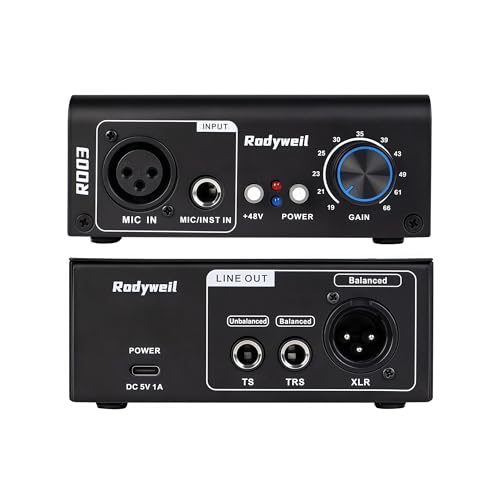 | Rodyweil RO03 Microphone and Instrument Preamp | Gain: 19-66 dB adjustable Microphone Fit: Dynamic, condenser, and ribbon Input and Output: Mic or 1 MOhm instrument in; XLR/TRS/TS line out Power: USB-C Published Audio Spec: -120 dB EIN stated | Check Price on Amazon |
 | VBESTLIFE 3-Input 60 dB Microphone Preamp | Gain: Up to +60 dB Microphone Fit: Dynamic and condenser Input and Output: 3-input wording; XLR, 3.5 mm, and 6.35 mm outputs Power: 48V support; operating source not stated Included Cable: 3.5 mm sound cable | Check Price on Amazon |
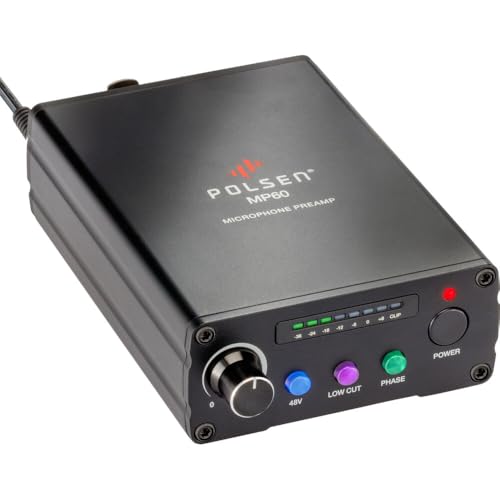 | POLSEN 60 dB Dynamic Microphone Preamp | Gain: Up to +60 dB Microphone Fit: Dynamic microphones Input and Output: XLR input and output Power: Not stated Housing: Compact rugged design | Check Price on Amazon |
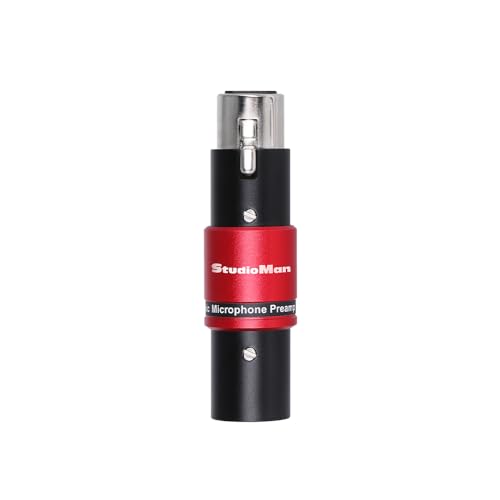 | StudioMan DPM1 Inline Microphone Preamp | Gain: +29 dB fixed Microphone Fit: Dynamic and passive ribbon; not condenser Input and Output: Inline XLR Power: Requires 48V phantom from interface Phantom Pass-Through: No | Check Price on Amazon |
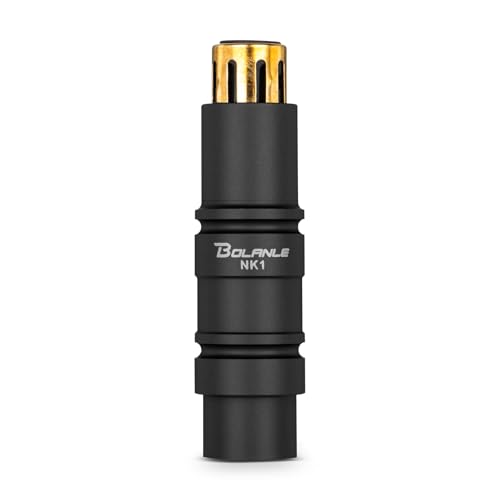 | Bolanle NK1 Inline Microphone Preamp | Gain: +28 dB fixed Microphone Fit: Dynamic; not condenser Input and Output: Inline XLR male-to-female Power: 48V phantom compatible Housing: Alloy-shielded one-piece case | Check Price on Amazon |
1. StudioMan CL-100 — Best Compact Fixed-Gain Booster
The StudioMan CL-100 is for a low-output dynamic or passive ribbon microphone that needs more level. StudioMan states it adds a fixed 25 dB of gain, and its balanced XLR input and output place it inline ahead of an audio interface, mixer, or recorder. The fixed lift can let the destination preamp operate at a lower setting, but the booster itself has no gain knob for fine adjustment.
StudioMan specifies the metal chassis measures 5.8 x 2.5 x 2.5 inches, a manageable size for a laptop desk or mobile recording case. StudioMan lists a 10 Hz to 20 kHz frequency response, 7-kilohm input impedance, and 2-kilohm output impedance. Those specifications offer more context than generic clean-gain language, although no EIN, THD, maximum input, or maximum output level is given.
The listing says the CL-100 supports 48V phantom power for its XLR integration, but it does not state as directly as the DPM1 whether phantom power is required for operation or whether it is passed to the microphone. Check the phantom-power behavior against your exact setup before buying. The CL-100 suits a creator who wants a compact fixed-gain XLR stage and already has an interface for the laptop.
[accentbox color=”blue”]Best for a low-output dynamic or passive ribbon microphone that needs a compact fixed 25 dB lift before an existing interface.[/accentbox]- Fixed 25 dB gain for dynamic and passive ribbon microphones
- Balanced XLR input and output
- Compact metal enclosure
- No adjustable gain control
- Phantom requirement and pass-through are not explicit
2. FOSA 20 dB Preamp — Best Basic Dynamic-and-Condenser Booster
The FOSA preamp supplies 20 dB of gain through a fully balanced circuit. It is listed for dynamic and condenser microphones and says 48V power is provided for compatible condensers. Supporting both microphone types separates it from inline activators that explicitly reject condensers, but the FOSA listing does not explain whether 48V is switchable, what powers the preamp itself, or whether phantom can be disabled for a dynamic microphone.
Its compact black metal case is intended to reduce electromagnetic interference while remaining easy to carry between a desk, podcast set, and live-stream setup. The listing describes low noise and transparent gain but provides no equivalent-input-noise figure, frequency response, distortion, connector list beyond XLR output in the title, dimensions, or weight. The 20 dB gain figure is the main concrete performance specification.
The FOSA can suit a creator who wants one small preamp to serve compatible dynamic and condenser microphones, provided the product details confirm the full power and connection arrangement. It offers less gain than every other product here, which may be enough for a moderate-output microphone but leaves less headroom for an especially quiet dynamic. Match the required gain before choosing it for compactness alone.
[accentbox color=”blue”]Best for a compact mixed-microphone setup that needs a modest 20 dB boost and listed 48V condenser support.[/accentbox]- 20 dB balanced gain
- Listed for dynamic and condenser microphones
- Compact metal housing
- Operating-power method is not stated
- 48V control and audio I/O details are incomplete
3. Rodyweil RO03 — Best Overall Full Preamp
The Rodyweil RO03 is the most complete standalone preamp in this comparison. Its revised gain range runs from 19 to 66 dB, which gives creators substantially more control than a fixed inline booster. The maker explicitly says an earlier 75 dB claim was not attainable in practical use and positions the revised maximum as a realistic limit with improved behavior near the top of the control.
It accepts dynamic, condenser, and ribbon microphones as well as an instrument input. The updated TS instrument input has 1-megohm impedance, which reduces the mismatch risk for passive guitar or bass pickups. The microphone and instrument inputs cannot operate simultaneously, so the RO03 handles one source at a time and is not a two-channel recording mixer. The XLR, TRS, and TS line-output choices make it easier to match the line input on an existing interface.
USB-C supplies operating power, but the audio remains analog. The Type-C port is not described as a laptop recording interface. Rodyweil reports -120 dB EIN for the updated version and recommends feeding an interface’s TRS line input rather than its XLR mic input for lower noise. The RO03 is the strongest option for a creator who wants adjustable gain before a line-capable interface.
[accentbox color=”blue”]Best for an existing laptop interface with a true line input and a need for adjustable microphone or instrument gain.[/accentbox]- Adjustable 19-to-66 dB gain
- Microphone and 1-megohm instrument inputs
- XLR, TRS, and TS line outputs
- Microphone and instrument inputs cannot work together
- USB-C supplies power, not digital audio
4. VBESTLIFE 3-Input Preamp — Best Connector Variety
The VBESTLIFE preamp lists up to 60 dB of gain and support for both dynamic and condenser microphones through onboard 48V power. Its three-input wording and multiple connector formats make it the broadest connection-focused product after the Rodyweil. The VBESTLIFE listing does not identify all three input sockets clearly or confirm that they can operate simultaneously, so it should not be assumed to be a three-channel mixer.
Output options include balanced XLR plus 3.5 mm and 6.35 mm microphone or line connections. The range of connectors can help with a mixer, console, sound interface, powered speaker, or other analog destination, provided input level and wiring are matched correctly. Feeding a laptop still requires an audio interface or sound device with an appropriate analog input. None of these connectors is described as a direct USB recording output.
The black metal housing is described as compact, lightweight, and resistant to interference. A 3.5 mm sound cable is named in the title, but the listing does not state operating power, gain-control steps, input impedance, output impedance, noise, frequency response, dimensions, or weight. Choose it when you need connector flexibility and the listing clearly identifies the inputs and the power supply.
[accentbox color=”blue”]Best for a creator who needs XLR, 3.5 mm, and 6.35 mm analog connection choices around one preamp stage.[/accentbox]- Up to 60 dB of gain
- 48V support for compatible condensers
- XLR, 3.5 mm, and 6.35 mm outputs
- Three-input wording does not confirm simultaneous use
- Operating-power method is not stated
5. POLSEN 60 dB Preamp — Best Simple High-Gain XLR Path
The POLSEN is a dynamic-microphone preamp offering up to 60 dB of gain through XLR input and output. Its listing specifically mentions compatibility with popular low-output microphone types such as the SM7B. The intended use is to raise a quiet vocal microphone before the signal reaches an existing recorder, mixer, or laptop interface.
Compact, rugged construction supports fixed and portable use, and the product is positioned for podcasting, streaming, studio work, and live applications. The POLSEN listing does not state whether the 60 dB is continuously adjustable, how the preamp is powered, whether it requires phantom power, whether phantom passes to the microphone, or whether any adapter or cable is included. These setup details are substantial rather than minor omissions.
This pick makes sense only after you confirm the power requirements in the package information. On the available specifications, its advantage is a high stated gain ceiling in a simple XLR path, and there are no published EIN, frequency-response, THD, impedance, dimensions, or weight figures for direct comparison with the Rodyweil or StudioMan products.
[accentbox color=”blue”]Best for a low-output dynamic microphone that needs a compact XLR preamp with a high stated gain ceiling.[/accentbox]- Up to 60 dB of stated gain
- XLR input and output
- Compact rugged design
- Power method and phantom behavior are not stated
- Power behavior and published measurements need confirmation
6. StudioMan DPM1 — Best Inline Dynamic-Mic Activator
The StudioMan DPM1 provides a fixed 29 dB gain boost for low-output dynamic and passive ribbon microphones. It plugs inline through standard XLR connections between the microphone and an interface or mixer. Because it sits near the microphone, the lift is intended to improve the signal level before the destination’s own gain stage must be turned near its upper limit.
The DPM1 requires 48V phantom power from the interface or mixer to operate, but the listing explicitly says that power does not pass to the microphone. It is strictly not for condenser microphones. The clear boundary makes it easier to match than products with vague phantom wording. The destination must supply phantom, and the connected microphone must be a compatible dynamic or passive ribbon model.
Its compact metal case provides physical protection and interference shielding without adding a separate desktop box or power cable. There is no gain adjustment, bypass, frequency response, EIN, THD, impedance, dimension, or weight figure in the listing. Choose it when an existing interface has phantom power and adequate remaining gain, but needs a fixed clean lift for one compatible low-output microphone.
[accentbox color=”blue”]Best for a dynamic or passive ribbon microphone feeding an interface that already provides 48V phantom power.[/accentbox]- Fixed 29 dB gain
- Clear 48V operating requirement
- Does not pass phantom power to the microphone
- Not compatible with condenser microphones
- No gain adjustment or bypass
7. Bolanle NK1 — Best One-Piece 28 dB Booster
The Bolanle NK1 is a one-piece inline preamp that the manufacturer rates for 28 dB of fixed gain through a Class A transistor circuit. It targets low-sensitivity dynamic microphones and names popular broadcast and stage models as examples. The manufacturer includes gold-plated copper XLR pins that connect directly between male and female XLR equipment, reducing the need for a separate enclosure on the desk.
Like the DPM1, it works with 48V phantom power from a supply, mixer, or interface and does not support condenser microphones. The listing does not explicitly say whether phantom is blocked from reaching the connected dynamic microphone, so confirm that behavior before pairing it with sensitive or vintage equipment. The alloy shielding is intended to resist electromagnetic interference, and the listed insulation resistance is greater than 1000 megohms.
The NK1 gives one decibel less stated boost than the DPM1 and three decibels more than the CL-100, a small difference compared with microphone output and placement. There is no adjustable control, noise figure, frequency response, impedance pair, maximum level, size, or weight specification. It is a compact alternative when a fixed 28 dB lift and direct XLR form suit the existing interface.
[accentbox color=”blue”]Best for a compact dynamic-microphone chain that needs a one-piece 28 dB XLR booster powered by an existing phantom source.[/accentbox]- Fixed 28 dB Class A gain stage
- Compact one-piece XLR design
- Metal shielding and gold-plated copper pins
- Not compatible with condenser microphones
- Phantom pass-through behavior is not explicit
Buying Guide: Choosing a Standalone Microphone Preamp
Map the entire path to the laptop
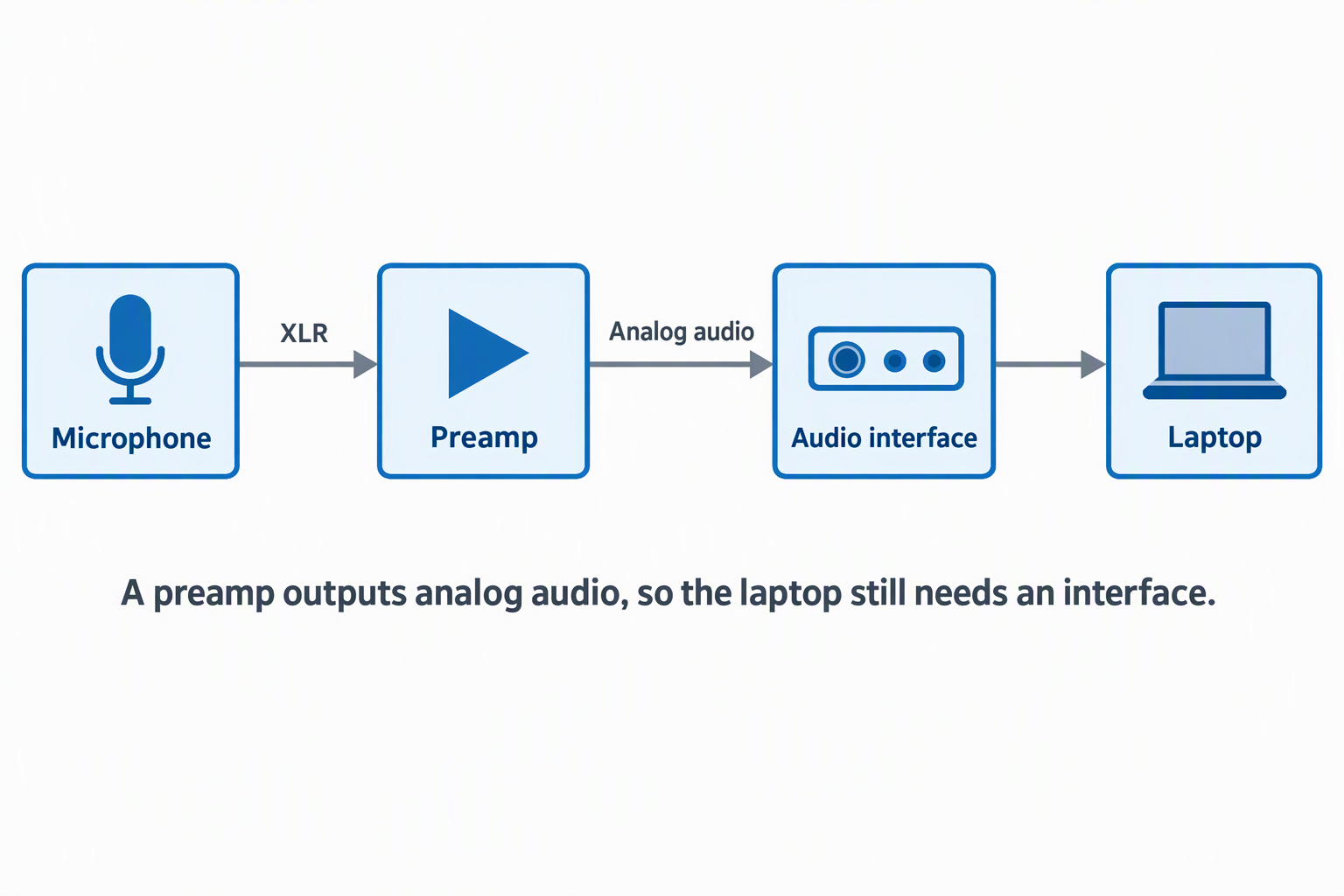
A standalone preamp outputs analog audio. The laptop still needs an audio interface, recorder used as an interface, mixer with USB output, or another supported analog-to-digital path. USB-C power does not imply USB audio, which is especially important with the Rodyweil RO03.
Draw the route from microphone to preamp to interface to laptop. Label every connector, and note whether the receiving interface input operates at mic or line level. A full preamp should normally feed a suitable line input, which avoids unnecessary amplification through a second mic preamp when the equipment instructions support that route.
Distinguish a full preamp from an inline activator
The Rodyweil, FOSA, VBESTLIFE, and POLSEN products are presented as broader preamps, though their control details vary. The StudioMan DPM1 and Bolanle NK1 are phantom-powered inline activators with fixed gain, while the CL-100 occupies a compact booster role with less explicit power wording. Fixed boosters depend heavily on the destination interface.
Choose a full preamp when you need adjustable gain, an instrument input, multiple outputs, or condenser support. Choose an activator when one low-output dynamic or passive ribbon microphone simply needs more level before an existing preamp. Do not buy an inline booster as a substitute for an audio interface.
Match gain to microphone output and recording distance
Gain requirements change with microphone sensitivity, voice level, source distance, and desired peaks. The listed maximums range from 20 dB of added lift to 66 dB in the Rodyweil. More maximum gain is not automatically better if the circuit clips, adds noise, or cannot be adjusted to the required level.
Place the microphone correctly before solving every level problem electronically. A close vocal position normally produces more signal than a distant one, subject to tone and plosive control. Leave headroom for louder moments. Set gain from the loudest expected source, not from silence or an unusually quiet test phrase.
Check phantom-power direction
Some condenser microphones need phantom voltage delivered from a full preamp. In contrast, inline activators may consume 48V from the interface solely to run their own electronics. The DPM1 clearly states that it requires phantom but does not pass it to the microphone, and it excludes condensers.
Do not infer identical behavior from every device labeled phantom compatible. Confirm whether the product supplies, consumes, blocks, or passes phantom power, then compare that with the microphone requirement. Power behavior must be correct on both sides of the preamp before the XLR cable is connected.
Use the correct interface input
Rodyweil recommends connecting its output to a TRS line input rather than the interface’s XLR mic input for the lowest noise in its tested arrangement. A line input avoids sending an already amplified line-level signal through another microphone preamp. Combo jacks can change level behavior by connector, so read the interface labels instead of assuming XLR and TRS are equivalent.
An inline activator is different. It normally remains ahead of the interface’s microphone input and its phantom source. Keep input level, connector wiring, and cable balance correct throughout. Mismatched level is a common cause of clipping or excess noise, even when every individual product works as intended.
Compare noise specifications cautiously
Rodyweil publishes -120 dB EIN for the RO03, while other products rely mainly on clean or low-noise descriptions. EIN values depend on source impedance, bandwidth, weighting, and gain conditions. Numbers without matching test conditions are not perfect cross-product rankings.
The room, microphone self-noise, interface, computer power, cables, and gain staging all contribute to the recording. Test with known-good balanced connections and reasonable levels. A preamp cannot remove noise already captured by the microphone, nor can it repair acoustic reflections or laptop fan sound.
Decide whether instrument input belongs in the purchase
Only the Rodyweil clearly identifies a revised 1-megohm TS instrument input, intended to avoid loading passive pickups. The instrument input can make one box useful for both spoken-word recording and direct guitar or bass capture, though the microphone and instrument inputs cannot run together.
If the setup records vocals only, the extra input may not justify a larger control box. If instruments are part of the workflow, impedance and line-output routing are as important as microphone gain. Do not plug a passive instrument into an unspecified mic input and assume the frequency response will remain intact.
Related Laptop Recording Guides
- Best XLR phantom power supplies for condenser microphones
- Best HDMI capture dongles for laptop streaming
- HDMI loop-out capture cards for camera monitoring
- Best LED video light panels for small creator studios
- Light stands for portable creator video kits
- Overhead camera mounts for desk tutorials
- Best mirrorless camera cages for desk video rigs
- Camera battery cases for organized creator shoots
Frequently Asked Questions
Can a standalone preamp connect directly to a laptop?
Not unless it also contains a documented digital interface, and none of the listings for these seven products documents one. The products output analog audio through XLR, TRS, TS, 3.5 mm, or 6.35 mm connections. A laptop still needs compatible analog-to-digital hardware.
USB-C on the Rodyweil is described as operating power, not audio transport. Connect its analog line output to an interface’s proper line input, then connect that interface to the laptop. Do not treat a power connector as a recording port.
Does an inline activator work with a condenser microphone?
The StudioMan DPM1 and Bolanle NK1 explicitly exclude condenser microphones. They use phantom power from the interface to operate their own gain circuits and are intended for compatible dynamic microphones. The DPM1 also names passive ribbons. Follow the model-specific microphone restriction.
For a condenser, choose a preamp that explicitly supplies its required phantom voltage, such as the FOSA or VBESTLIFE descriptions, and verify controls before connection. Phantom-powered and phantom-supplying are not the same role.
How much gain does a quiet dynamic microphone need?
There is no single number because microphone sensitivity, source loudness, distance, and interface performance differ. A fixed 25-to-29 dB booster can supplement an existing interface, while a full preamp with up to 60 or 66 dB can provide broader adjustment. Use the microphone and interface specifications as the starting point.
Set levels with the actual speaker or instrument at the intended distance. Leave headroom and listen for noise or clipping. A higher maximum gain claim does not guarantee a better recording when the setup needs only a moderate increase.
Should a preamp feed an XLR or TRS interface input?
For the Rodyweil RO03, the maker recommends a suitable TRS line input and reports more noise when feeding an interface XLR input. The maker’s advice matches the practice of sending a line output into a line input. Check how the interface assigns level by connector.
An inline activator normally feeds the XLR microphone input because it still relies on the interface preamp and phantom source. The correct answer therefore depends on device type. Do not apply full-preamp routing to a phantom-powered activator.
Will a preamp eliminate hiss from laptop recordings?
It may improve gain staging when an interface becomes noisy near its maximum setting, but it cannot remove room noise, microphone self-noise, electrical interference, or hiss already present upstream. Noise performance belongs to the complete recording chain.
Use balanced cables, correct line or mic inputs, sensible gain, and clean power. Record a controlled test with each stage added one at a time. A repeatable noise diagnosis is more useful than adding gain boxes blindly.
Bottom Line
The Rodyweil RO03 is the strongest full preamp for an existing laptop interface with a line input, with adjustable gain, instrument support, USB-C power, and several analog outputs. The StudioMan DPM1 is the clearest fixed-gain choice when a dynamic or passive ribbon microphone needs a lift and the interface already supplies 48V. The StudioMan CL-100 and Bolanle NK1 provide other compact XLR paths, but the phantom behavior of both needs careful confirmation.