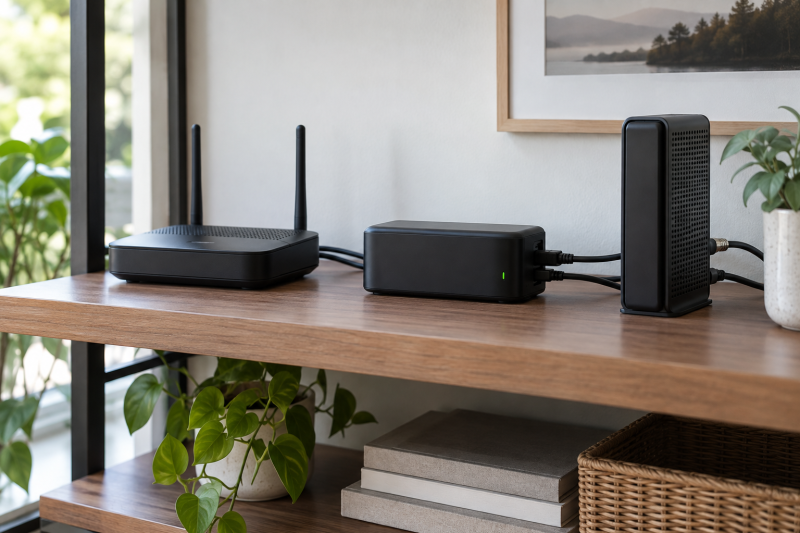
A mini DC UPS can keep a router, modem or fibre terminal powered through a short outage when its output voltage, connector size and current limit match the equipment. It is not interchangeable with a desktop UPS. These compact units are intended for low-voltage DC gear.
Read the label on every device before ordering. A router and modem often need different voltages, and adding their wattage can exceed a small battery pack’s output. Match the power label before the battery capacity.
Use the voltage printed on the router or modem power adapter. Do not guess from the barrel connector shape alone.Mini UPS Units Compared
| Image | Product | Details | Check Price |
|---|---|---|---|
 | TalentCell 97.2Wh | Best fit: Large 12V capacity Battery: 97.2Wh listed Outputs: 12V, 9V, USB Limit: 37W continuous listed | Check Price on Amazon |
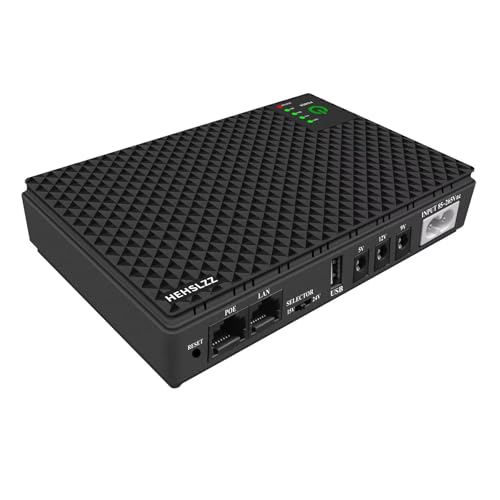 | HEHSLZZ 10400mAh | Best fit: Multi-voltage budget Battery: 10400mAh listed Outputs: 5V, 9V, 12V DC PoE: 15V and 24V listed | Check Price on Amazon |
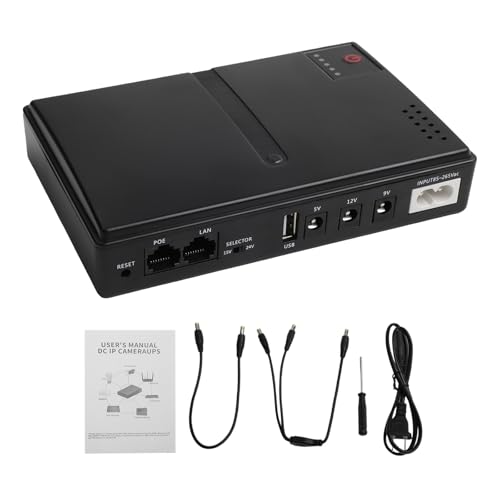 | Multi-Voltage DC UPS | Best fit: PoE output flexibility Outputs: 5V, 9V, 12V DC PoE: 15V and 24V listed DC limit: 2A listed | Check Price on Amazon |
 | SKE DC20000 Plus | Best fit: 20000mAh router option Battery: 20000mAh listed Outputs: 5V, 9V, 12V Extras: USB and Type-C | Check Price on Amazon |
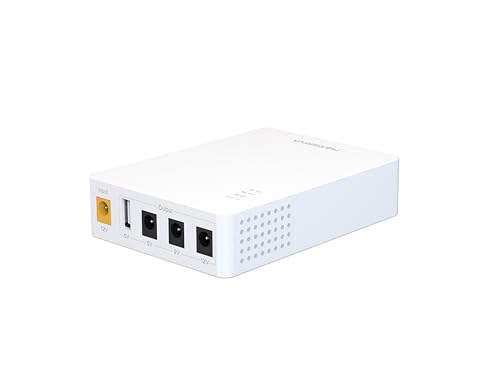 | MARSRIVA KP3 | Best fit: Simple router backup Battery: 10000mAh, 36Wh Use: Router and modem listed Design: Compact | Check Price on Amazon |
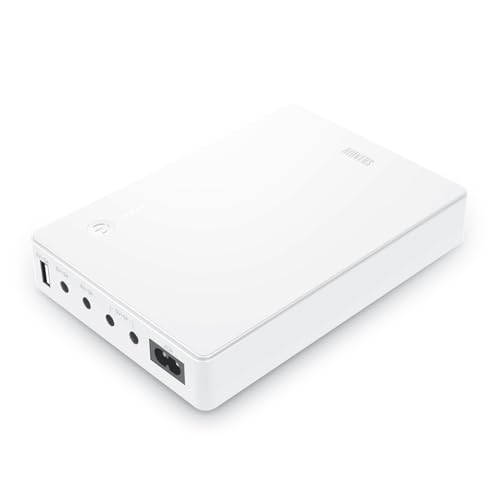 | 60W Mini UPS | Best fit: Higher-output DC option Battery: 20000mAh, 74Wh Output: 60W maximum listed DC ports: 5V, 9V, 12V | Check Price on Amazon |
1. TalentCell 97.2Wh — Best Large 12V Capacity
TalentCell lists a 97.2Wh lithium-ion pack with 12V, 9V and USB outputs. Its listed 5.5 x 2.1mm DC ports make it a candidate for a router or modem that uses that exact connector and an appropriate voltage.
The listing says loads above 37W cannot be powered continuously. Add the labelled draw of every device before treating it as a solution for both a router and a modem, and confirm that each device can use its intended output.
Our Take Buy the TalentCell if a compatible 9V or 12V network device needs a larger listed battery pack and the total load stays within its stated limit.
- 97.2Wh listed capacity.
- 9V and 12V outputs listed.
- Connector must match.
- Listed 37W continuous limit.
2. HEHSLZZ 10400mAh — Best Multi-Voltage Budget Pick
HEHSLZZ lists a 10400mAh mini UPS with 5V, 9V and 12V DC outputs, plus 15V and 24V PoE ports. It includes multiple connector tips, but a supplied tip does not replace checking the voltage and polarity on the device label.
Its RJ45 listing is 100Mbps. The RJ45 speed is relevant if the installation relies on the PoE port for network traffic, while the DC outputs are a separate connection path for ordinary routers and modems.
Our Take Buy the HEHSLZZ if the exact DC voltage and connector of your low-power router are known. Treat the PoE feature as a separate compatibility check.
- Multiple DC voltages listed.
- Connector tips included.
- Verify polarity and tip fit.
- RJ45 listing is 100Mbps.
3. Multi-Voltage DC UPS — Best PoE Output Flexibility
This mini UPS lists 5V, 9V and 12V DC outputs plus 15V and 24V PoE options. It is a possible fit for a small home network where the buyer has confirmed the voltage and connector for every powered device.
The listing describes 2A DC outputs. A router label and a modem label need to be checked individually. Do not connect both merely because their plugs look alike.
Our Take Buy the Multi-Voltage DC UPS only after you map every device’s voltage and current need. Its appeal is output flexibility, not a universal router-and-modem guarantee.
- Several DC outputs listed.
- 15V and 24V PoE listed.
- Check 2A limit.
- Not a standard AC UPS.
4. SKE DC20000 Plus — Best 20000mAh Router Option
SKE lists the DC20000 Plus Altair as a 20000mAh mini DC UPS for routers and modems, with 5V, 9V and 12V outputs plus USB and Type-C charging. It suits a compact network shelf when the device labels align with those outputs.
Capacity alone cannot predict runtime because the connected load changes it. Plan around the essential internet path first, then add a second device only if the power and connector requirements are documented.
Our Take Buy the SKE if your router or modem is known to be compatible and a compact multi-output battery is more useful to you than a full AC UPS.
- 20000mAh listed.
- 5V, 9V and 12V outputs.
- Runtime depends on load.
- Confirm each connector.
5. MARSRIVA KP3 — Best Simple Router Backup
MARSRIVA lists the KP3 as a 10000mAh 36Wh mini UPS for routers, modems and low-power DC devices. It is a straightforward option when the network path is small and its output details match the equipment.
The listing describes uninterrupted transfer, but installation should still be tested on the actual router and modem before an outage. The useful proof is whether the full internet path stays connected with the intended cables.
Our Take Buy the KP3 if you have one low-power network device that is known to be compatible. Test the complete connection before relying on it for remote work.
- 36Wh listed battery.
- Router and modem use listed.
- Lower listed capacity.
- Test with real hardware.
6. 60W Mini UPS — Best Higher-Output DC Option
The manufacturer lists a 20000mAh 74Wh battery and a maximum 60W output, with 5V, 9V and two 12V outputs. It is the higher-output option for compatible equipment, but the setup still depends on the individual voltage and shared-output limits.
The listing includes router and modem use, yet both devices should be checked against the power outputs rather than assumed to work together. Use only the connectors and voltage settings documented for the hardware.
Our Take Buy this mini UPS if its listed 60W ceiling and output layout match a documented DC network load. Do not use capacity to infer compatibility.
- 60W maximum listed.
- Two 12V outputs listed.
- Shared output requires planning.
- Confirm voltage and polarity.
Buying Guide
Copy the voltage and connector from the power label
The output voltage must match the device requirement. A 12V router should not be connected to a 9V output because the barrel plug fits, and a 9V modem should not be treated as a 12V device. Read the label on the original adapter and the device itself.
Connector diameter and polarity need checking as well. Some mini UPS listings include several tips, but a tip set does not establish electrical compatibility. Use an adapter only where its fit and polarity are documented for the network device.
Start with one essential device. A router, fibre terminal and modem can each have different requirements. Map every voltage, current and connector before trying to keep the entire home network alive from one compact battery.
Treat capacity as a runtime estimate, not a promise
Watt-hours describe stored energy more directly than a large mAh figure. Battery voltage and the connected load affect the usable result. A 97.2Wh pack and a 36Wh pack are different starting points, but neither number states the runtime of an unknown router.
The connected load determines the backup period. A basic router can draw less than a router, modem and fibre terminal together. Add only devices that the unit supports, then test the expected setup instead of relying on a product title.
Charging and outage behavior need an actual check. Let the battery reach its normal charged state, confirm the network comes online, then test the expected switch-over with noncritical work. A test is more useful than assuming an indicator light proves a full path is protected.
Keep the network path simple
A DC mini UPS is for low-voltage equipment, not a desktop setup that runs on wall power. It cannot take the place of a conventional AC UPS for a monitor, desktop PC or powered network switch. Keep the scope to the small DC equipment the listing documents.
PoE ports are a separate compatibility question. A 15V or 24V PoE output may help a specific network device, but it should not be connected to a normal Ethernet port without confirming both sides of the connection. A PoE injector serves a different one-cable power job.
Use a short, known-good network path while testing. A USB-C Ethernet adapter can help a laptop check the router connection, but it does not prove the modem or external service will stay online during an outage.
Frequently Asked Questions
Can one mini UPS run both a router and a modem?
Sometimes one unit does, if both devices use outputs with the correct voltage, current, connector and polarity and the combined load stays within the unit’s stated limit. The checks are separate for each device.
Do not split a cable by default just because it looks compatible. The same barrel size can appear on equipment with different voltage needs. Use the unit’s intended output and the original adapter labels to decide whether two devices can be powered.
Test the complete internet path before relying on it. A router may remain powered while an upstream modem, fibre terminal or provider equipment does not. The practical test is whether the connection you need stays available.
Is a mini DC UPS the same as a computer UPS?
No. These units provide low-voltage DC outputs for listed devices such as routers, modems and cameras. They do not supply ordinary AC wall outlets for a desktop computer or monitor.
A small unit is intended for a small load. A small battery can be useful for a modest network device without being suitable for a workstation. Pick the backup type from the device power input, not just the word UPS.
Keep the original power adapter information. It is the quickest reference for voltage, current, plug and polarity. If those details are unclear, do not connect an unfamiliar output.
Bottom Line
Choose TalentCell 97.2Wh for a compatible larger DC load, SKE DC20000 Plus for a compact multi-output setup or MARSRIVA KP3 for a simple known-compatible router path. Verify every power label before connecting it.