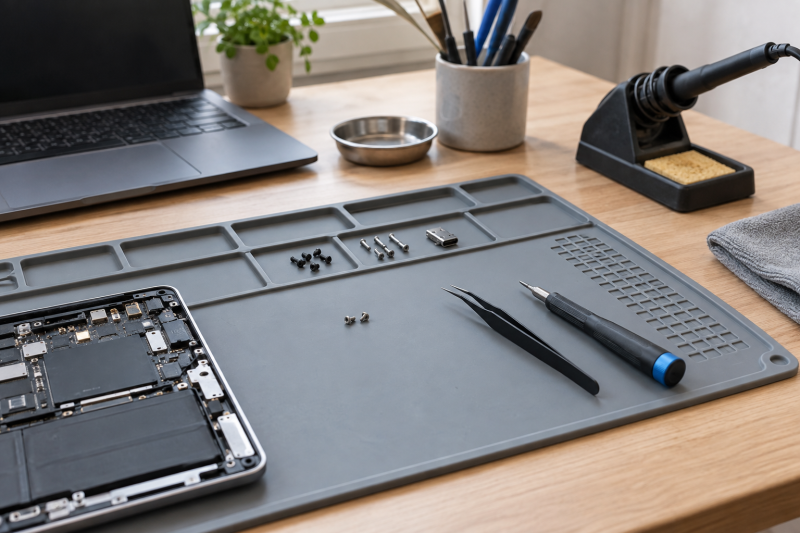
A silicone soldering mat does two useful jobs on a USB-C repair desk. It gives hot tools a stated heat-resistant surface, and it keeps screws, connectors, and small parts from spreading across the table. The important differences are usable size, the number of screw or parts zones, and whether magnetic areas or covered boxes fit the way you sort a disassembly.
All six mats here list a 932 F / 500 C heat rating, but the organization layouts are very different. A compact 30 x 20 cm mat can work beside a laptop and a small driver kit, while a 17.7-inch mat gives more room for a board, parts trays, and tools. Choose the layout that keeps your next repair orderly rather than buying the largest number of compartments by default.
Pick a mat by its stated working area and parts layout first; the heat rating tells only one part of the desk-setup story.Silicone Soldering Mats Compared



1. Kaisi S130 Silicone Soldering Mat — Best Screw Positions and Notches
Kaisi lists a 13.8-by-9.8-by-0.14-inch silicone mat with a 0 to 25 cm ruler, 124 screw positions, and eight notches. The layout suits a laptop repair that produces many small fasteners and connectors that need their own temporary location instead of one shared loose tray.
The listing also describes an anti-slip design on both sides, stated resistance to 932 F / 500 C, and no magnetic surface. Choose it when screw positions and notches count for more than magnetic zones or covered storage boxes. Its compact rectangle leaves room around it for a laptop, driver, or magnetic screw mat.
Our TakeBuy Kaisi when 124 screw positions and eight notches fit the way you separate a detailed repair. It has one of the clearest layouts for sorting screws here, but the listing says the 13.8-inch mat is not magnetic.
- Its 124 screw positions and eight notches give many separately listed places for small repair parts.
- A built-in 0 to 25 cm ruler adds a stated reference edge to the 13.8-by-9.8-inch mat.
- Both sides have a listed anti-slip design for a mat that stays in one desk position.
- The listing gives a 932 F / 500 C heat-resistance figure for soldering work.
- The listing explicitly says this version is without magnetic areas for screws or metal components.
- Its 13.8-by-9.8-inch size is smaller than the 17.7-inch PAFOWO work surface.
2. WWZMDiB S-130 Silicone Work Mat — Best Compact 30 x 20 cm Mat
WWZMDiB lists this S-130 mat at 11.8 by 7.9 inches, or 30 by 20 cm. It is the compact option when a repair desk already has a parts tray and only needs a silicone area for a soldering station, a small board, or one device component rather than a full laptop teardown.
The listing specifies 932 F / 500 C heat resistance, anti-slip surfaces, silicone material, and cleaning with water or rubbing alcohol. It describes the product as a magnetic soldering station mat, although it gives fewer specific compartment and screw-position numbers than Kaisi, PAFOWO, HTM-201, or STREBITO.
Our TakeBuy WWZMDiB when a compact 30 by 20 cm silicone work area is enough beside an existing tool tray. It takes the least room, but its listing describes fewer dedicated parts zones than the larger mats.
- The stated 30-by-20-cm footprint fits a small desk area beside a soldering station or laptop.
- A 932 F / 500 C heat-resistance figure is listed for the compact silicone surface.
- Both sides are described as anti-slip, helping the mat remain positioned on a counter or station.
- The listing says the silicone mat cleans with water or rubbing alcohol for routine desk cleanup.
- Its smaller size is easier to store than the two 17-inch mats on this page.
- The listing gives no counted screw positions, covered boxes, or compartment total for a detailed teardown layout.
- An 11.8-by-7.9-inch work area leaves less room for a laptop bottom cover than the larger mats.
- It does not list the three magnetic areas and 70 compartments that STREBITO specifies.
3. PAFOWO Large Silicone Soldering Mat — Best Covered Part Boxes
PAFOWO lists a 17.7-by-11.8-inch silicone mat with a 0 to 36 cm ruler, three covered parts boxes, four magnetic areas, 124 screw positions, 42 spare units, and 15 notches. The mix suits a repair in which loose screws, ports, shields, and small connectors need more than one kind of storage while the board work stays on the same mat.
The listing gives the same 932 F / 500 C heat-resistance figure as the other choices, but its larger surface and covered boxes are the practical distinction. The covered boxes are useful for a repair that pauses between steps, because they give a stated place for sorted pieces instead of making every compartment an open tray.
Our TakeBuy PAFOWO when three covered boxes, four magnetic areas, and a 17.7-inch surface match a longer disassembly. Its layout is busy, so it is better for a dedicated repair area than a small desk corner.
- Three covered parts boxes give listed storage for components that should remain separated during a paused repair.
- Four magnetic areas provide specified places for screws and small metal parts beside the main work surface.
- The 17.7-by-11.8-inch mat gives a larger stated area for a laptop panel, tools, and sorted pieces.
- Its 124 screw positions, 42 spare units, and 15 notches create several kinds of dedicated organization.
- A 0 to 36 cm ruler is printed along the listed silicone work surface.
- The 17.7-inch footprint needs more clear desk space than a compact 30-by-20-cm mat.
- Its many listed zones can be unnecessary when a repair only needs one small board and a tool rest.
- The listing describes several storage areas, so buyers should decide their own sorting order before filling them.
4. HTM-201 Black Silicone Repair Mat — Best Simple 14-Inch Work Surface
HTM-201 lists a 14-by-10-inch black silicone mat with a 13.3-by-8.2-inch working area, a 0 to 25.4 cm and 0 to 10 inch ruler, 33 screw positions, and five parts areas. It is a middle-size choice for someone who wants a defined repair surface and some parts sorting without the long edge and dense layout of the largest mats here.
Its listing also states a 932 F / 500 C heat rating, a silicone surface, cleaning with water, and resistance to weak acid and weak base. The black surface and straightforward zone count make it a sensible fit when the workbench needs a conventional repair mat rather than covered boxes, a large magnetic layout, or dozens of compartments.
Our TakeBuy HTM-201 when you want a 14-by-10-inch mat with 33 screw positions and five parts areas. It is a more structured work surface than a plain pad, with a layout simpler than the mats with covered storage.
- A stated 13.3-by-8.2-inch working area keeps the 14-inch mat focused on one repair station.
- Thirty-three screw positions and five parts areas provide counted sorting zones without an unusually dense layout.
- Both metric and imperial rulers are listed, reaching 25.4 cm and 10 inches respectively.
- The listing supplies a 932 F / 500 C heat-resistance figure and says the mat cleans with water.
- The listing provides only five parts areas, which may be limiting for a laptop teardown with many separate assemblies.
- It does not list covered storage boxes for components that need to be set aside between repair sessions.
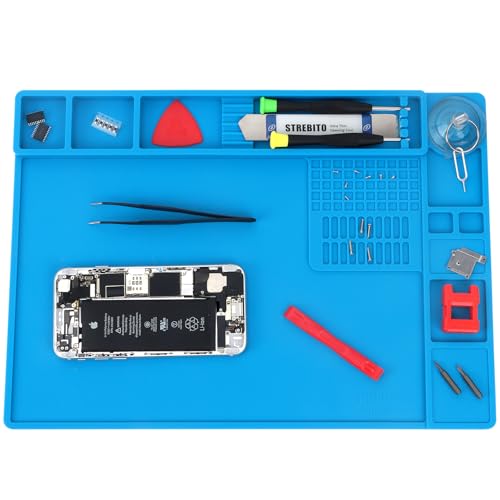
5. STREBITO Silicone Soldering Mat — Best 70 Small-Part Compartments
STREBITO lists a 13.78-by-9.84-inch silicone mat with seven accessory zones, one tool zone, three magnetic zones, 70 compartments, raised edges, and metric and imperial rulers. The mat is built around many small containers, which is useful when USB-C repair work involves screws, brackets, connector pieces, and several driver bits that benefit from individual places.
The listing states a 932 F heat rating, non-slip surfaces on both sides, and a surface that can be cleaned with water or alcohol. It also explicitly says this is not an anti-static mat and does not prevent static, so do not buy it for static control, which the listing itself does not claim.
Our TakeBuy STREBITO when 70 compartments plus three magnetic zones suit how you sort many tiny parts as you work. Its listed static limitation means static control is not a reason to buy it. Choose it for organization and heat resistance.
- Seventy listed compartments give small screws, connector pieces, and driver bits separate places during a detailed repair.
- Three magnetic zones add specified storage for metal fasteners without using every compartment for screws.
- Seven accessory zones and one tool zone distinguish tools from the many smaller parts containers.
- Raised edges are listed around the 13.78-by-9.84-inch silicone mat for its organized work surface.
- Both sides have a stated non-slip design, and the listing allows water or alcohol cleanup.
- The listing supplies a 932 F heat-resistance figure for a soldering-focused desk mat.
- The listing explicitly says this is not an anti-static mat and does not prevent static.
- Its many compartments may require more sorting discipline than a simpler mat with a few broad zones.
- The listed 13.78-by-9.84-inch footprint leaves less open surface than a 17-inch repair mat.
- Three magnetic zones may not suit a workflow that prefers every fastener in a labeled screw position.
6. Premium 17.3-Inch Magnetic Silicone Mat — Best Large Magnetic Work Area
The Premium mat is listed at 17.3 by 11.8 inches, or 44 by 30 cm, with a built-in ruler, compartments, trays, and magnetic areas. It is the broad work-surface option when the repair setup needs room for a laptop component, a small board, and several groups of parts without making the mat itself a tightly divided grid.
The listing gives a 932 F / 500 C heat-resistance figure and describes the silicone construction as flexible enough to roll for storage. The product details are less specific about the count of each tray or compartment than PAFOWO and STREBITO, so buy it for the stated large magnetic workspace rather than for a promised number of individual sorting positions.
Our TakeBuy the Premium mat when a 17.3-by-11.8-inch magnetic silicone surface is more useful to you than a fixed compartment count. It suits larger desk space, but the listing is less precise about how many individual storage zones you get.
- The stated 17.3-by-11.8-inch, 44-by-30-cm size creates a broad repair surface for parts and tools.
- Magnetic areas, compartments, and trays are all listed on the same silicone work mat.
- A built-in ruler adds a stated measurement reference along the large work surface.
- The listing does not state individual counts for its compartments, trays, or magnetic areas.
- Its large 17.3-inch footprint is less convenient for a shallow desk or a portable repair kit.
Buying Guide
Match the mat size to the repair space you actually have
The first decision is the surface you can keep clear. WWZMDiB’s 30-by-20-cm footprint is the compact option when a laptop, soldering station, and driver kit already divide the desk. It gives you a silicone area without claiming to replace a full teardown organizer. The Kaisi and STREBITO mats both sit around fourteen inches wide, which is a practical middle ground for a single device and a controlled group of parts.
For a longer desk or a more involved disassembly, the 17.7-by-11.8-inch PAFOWO and the 17.3-by-11.8-inch Premium mat have more stated space. Extra space helps when a laptop bottom cover, a board, and several groups of fasteners need to stay visible together. A larger mat is not automatically better, though, because unused space still takes desk room. Choose a compact mat when your usual repair does not need a broad layout.
Choose the parts layout before counting heat ratings
Every mat on this page lists a heat-resistance figure of 932 F / 500 C, so that number does not separate these six choices as much as their storage layouts do. Kaisi is strong on explicit screw sorting with 124 screw positions and eight notches. HTM-201 uses a simpler arrangement of 33 screw positions and five parts areas, which is easier to understand when you do not want a compartment for every small object.
STREBITO is built the opposite way, with 70 compartments, seven accessory zones, and a separate tool zone. PAFOWO combines three covered boxes, four magnetic areas, 124 screw positions, and 15 notches, which gives it several ways to separate parts. Pick the layout that follows your repair sequence. A few broad areas can be faster for a short port repair, while counted positions can help when many nearly identical screws need to return to particular locations.
Decide whether magnetic areas solve your fastener problem
Magnetic storage is useful only if it matches the parts you want to hold. PAFOWO lists four magnetic areas, STREBITO lists three, and the Premium mat lists magnetic areas without a count. Magnetic areas are the specified place for metal screws, while trays and compartments can hold nonmetal pieces, labels, or tools. WWZMDiB is described as magnetic, though its listing gives fewer details about the layout.
Kaisi is the important exception. Its listing says it is without magnetic areas, but Kaisi can still be the right choice if its 124 screw positions and eight notches are more useful than a magnetic zone. Decide whether you normally group fasteners on a magnetic surface or separate them into indexed positions, because the two systems are different ways of keeping track of a repair.
Use covered boxes and raised edges for pauses, not as a universal upgrade
Covered storage is a different feature from ordinary open compartments. PAFOWO lists three covered parts boxes, so it is the clearest option when a job may stop mid-disassembly and components need their own enclosed spaces. It also has open screw positions and magnetic areas, so the covered boxes do not need to hold every small item.
STREBITO lists raised edges and 70 compartments, while the Premium mat lists trays and compartments without a count. These layouts can keep a desk organized during a continuous repair, but they do not offer the same stated covered storage. If your work usually ends in one session, a simpler Kaisi, HTM-201, or WWZMDiB layout may be easier to reset. If you regularly leave projects set up, covered boxes are a more relevant decision point.
Keep the static-control claim separate from the mat decision
Silicone and a stated heat rating do not automatically establish a static-control feature. STREBITO specifically says its mat is not anti-static and does not prevent static, which is useful information for a buyer who would otherwise read a general repair mat description as a different product category. The other listings on this page describe silicone surfaces, heat figures, parts storage, cleaning, or non-slip designs, and the comparison rests on those details.
If static-control equipment is part of your repair setup, choose that equipment by its own stated properties rather than assuming a soldering mat provides it. Our anti-static work mat guide covers that separate decision. For this purchase, compare Kaisi’s 124 screw positions, PAFOWO’s covered boxes, HTM-201’s five parts areas, STREBITO’s 70 compartments, or the large Premium surface. The listed features are the differences in how each mat organizes a USB-C repair desk.
Frequently Asked Questions
Which mat is best for sorting many laptop screws?
Kaisi is the most direct choice when your workflow depends on numbered or separate positions. Its listing gives 124 screw positions and eight notches, along with a 0 to 25 cm ruler. The positions make it a reasonable fit for a laptop teardown where screws, clips, and small connectors need their own places instead of a single shared tray.
PAFOWO also lists 124 screw positions, but adds covered boxes, magnetic areas, spare units, and notches. Choose it when the desk has room for a 17.7-inch mat and you want several kinds of storage. HTM-201’s 33 positions suit a simpler job with fewer separated groups.
Which choice has the most compact footprint?
WWZMDiB is listed at 11.8 by 7.9 inches, or 30 by 20 cm, making it the smallest stated surface in this comparison. It is a practical choice when a repair bench already has a parts tray and only needs a compact silicone work area near the soldering station.
The smaller footprint also means less room for a laptop panel and fewer specified organization zones. If you need a compact mat with many counted positions, Kaisi’s 13.8-by-9.8-inch layout offers 124 positions and eight notches while remaining smaller than the two 17-inch mats.
Do any of these mats have covered component storage?
PAFOWO is the product that explicitly lists three covered parts boxes. Those boxes are the feature to prioritize when a repair may pause and a buyer wants a stated enclosed place for components. The same mat also lists four magnetic areas, 124 screw positions, and 15 notches, so it provides open sorting areas as well.
The other listings describe open parts areas, trays, compartments, notches, or magnetic areas rather than covered boxes. STREBITO has 70 compartments and raised edges, while the Premium mat has listed trays and compartments. Both layouts can suit a continuous session, but their product details do not make the same covered-storage claim.
Is any mat on this page for static control?
Do not choose STREBITO for that purpose, because its listing explicitly says the mat is not anti-static and does not prevent static. That wording is more specific than a general silicone or soldering mat description, so it is the relevant fact for its use on a repair desk.
The other product listings here describe their own features such as silicone material, listed heat rating, rulers, compartments, screw positions, or magnetic areas. The comparison does not treat those details as a static-control specification. Select a mat for its stated working surface and organization system, then assess any separate static-control equipment on its own listed evidence.
Which mat gives the largest listed workspace?
PAFOWO is listed at 17.7 by 11.8 inches, which is the largest stated size here. Its surface also includes covered boxes, magnetic areas, screw positions, spare units, and notches, so it is a strong fit for a fixed desk that supports longer device disassembly.
The Premium mat is close behind at 17.3 by 11.8 inches, or 44 by 30 cm, and lists magnetic areas, trays, compartments, and a ruler. Choose Premium when you prefer a broad magnetic layout, or PAFOWO when the specifically counted storage features are the deciding factor.
Bottom Line
Start with the parts layout you will actually use, then make size and magnetic storage the tie-breakers.
For an indexed screw layout, Kaisi is the best fit.
For a large desk with covered storage, PAFOWO is the most complete choice.
For a high compartment count, STREBITO is the strongest option.