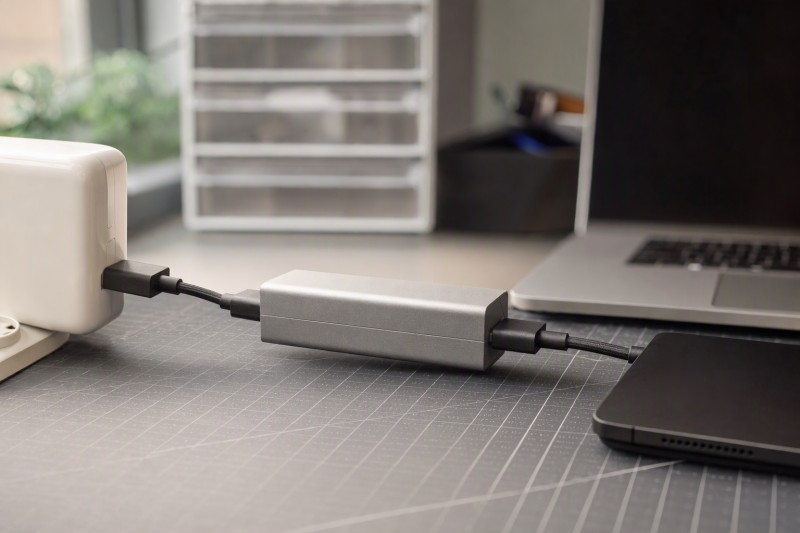
An electronic load gives a charger or power bank a controlled current demand. It differs from a USB-C meter, which sits in the path and reports what is happening but does not necessarily create the demand. For a useful charger bench, buyers need to separate load capacity, protocol triggering, measurement, cooling, auxiliary power, and connector support.
The correct setup also keeps every cable and adapter within its own published electrical limits.
The UCTRONICS RS2818 is our best overall choice because its listing combines a 35-watt electronic load, 4 to 25-volt operating range, 0.03 to 5-amp current adjustment, several protection modes, USB-C input, and triggers for QC2.0, QC3.0, AFC, and FCP. The Treedix TRX5-0903-D reaches much higher individual ceilings of 50 volts, 15 amps, and 120 watts, but it also requires a separate 12-volt supply and cannot take auxiliary power through a USB-C-to-USB-A cable.
The DROK LD25 is rated as a smaller 25-watt option, while Eversame specifies a 35-watt load and meter with coarse and fine current controls. MakerHawk’s N20 is the outlier. Its supplied record describes a USB-C meter with alarms and protocol support, not a built-in adjustable load. It works as a companion display for an external discharge load, not as a substitute for one.
| Image | Product | Details | Check Price |
|---|---|---|---|
 | DROK LD25 | Best fit: Compact lower-power charger checks Voltage ceiling: 25V Current ceiling: 4A Power ceiling: 25W Inputs: USB and USB-C | Check Price on Amazon |
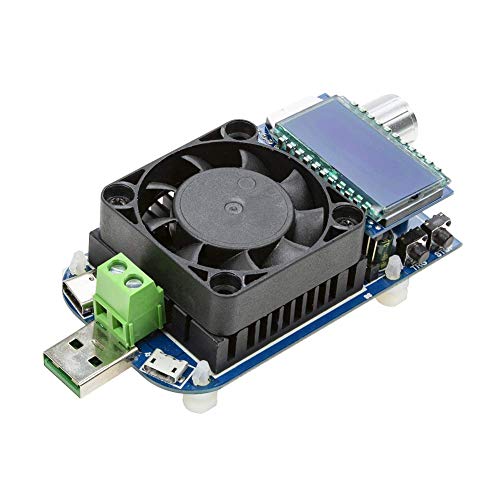 | UCTRONICS RS2818 | Best fit: All-around fast-charge bench load Voltage range: 4 to 25V Current range: 0.03 to 5A Power ceiling: 35W Protocols: QC2.0; QC3.0; AFC; FCP | Check Price on Amazon |
 | MakerHawk N20 | Best fit: Companion meter for an external load Display: 1.54-inch; 240 x 240 Internal load: Not stated Alarm thresholds: 45°C; below 3.8V; above 30V or 3A Protocols: PD; QC2.0; QC3.0; QC4.0; MTK stated | Check Price on Amazon |
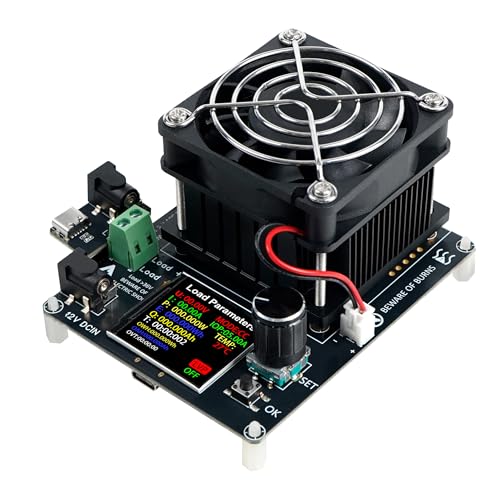 | Treedix TRX5-0903-D | Best fit: Higher-power charger and power-bank tests Voltage ceiling: 50V Current ceiling: 15A Power ceiling: 120W Auxiliary power: 12V DC or USB-C PD 12V | Check Price on Amazon |
 | Eversame 35W Load Tester | Best fit: Coarse and fine current adjustment Voltage range: 3 to 21V Current range: 0 to 3A; ±0.2A fine trim Power ceiling: 35W Included trigger: QC2.0 and QC3.0 | Check Price on Amazon |
How we compared these USB-C bench tools
All five products have a New offer and are presented for chargers, cables, power banks, batteries, computers, or discharge-load testing. We compare maximum voltage, current, and power, adjustment range, fast-charge triggering, connector support, display, protection, fan behavior, and auxiliary-power requirements.
Maximum voltage, current, and power are separate operating boundaries, and you can’t always reach all three together. Test a charger only within the capabilities and procedures established for the source, load, cables, and connectors. The product’s own manual remains the authority for wiring and safe operation.
1. DROK LD25 — Best Compact 25W USB-C Load
Our take: The DROK LD25 suits buyers who check lower-power chargers and cables. It provides constant-current discharge through USB and USB-C interfaces with separate stated ceilings of 25 volts, 4 amps, and 25 watts. The operating point you pick has to stay within all three limits.
A precision potentiometer adjusts current, and a four-digit LED display cycles voltage, current, and power. The cooling fan uses intelligent temperature control. DROK says the load can resume manually or automatically after a protection condition clears and that the boot state can default to on or off.
The listing names overvoltage, over-power, and over-temperature protection, but its detailed OPP and OTP sentences appear to swap the temperature and power labels. It clearly states that temperatures above 80 degrees Celsius stop the device and power above 25 watts stops it, yet buyers should rely on the manual for the exact displayed codes. The module has no reverse-polarity protection, and DROK warns that reversed input can permanently damage it.
Pros
- The 25V, 4A, and 25W ceilings fit modest charger and cable tests.
- USB and USB-C inputs support common bench connections.
- The LED shows voltage, current, and power values.
- Fan control and configurable protection recovery support repeated checks.
Cons
- There is no reverse-polarity protection for external connections.
- The listing appears to swap OPP and OTP labels in its detailed explanation.
- A single potentiometer offers less control detail than coarse and fine knobs.
2. UCTRONICS RS2818 — Best Overall Charger Load Tester
Our take: Buy the UCTRONICS RS2818 for the most balanced set of load, connection, trigger, and protection features. UCTRONICS rates the operating range at 4 to 25 volts and 0.03 to 5 amps, with a maximum discharge power of 35 watts. A fan manages cooling under load.
According to the manufacturer, connection options include USB, Micro-USB, USB-C, and an external wiring port. The module can test and trigger QC2.0, QC3.0, AFC, and FCP, with output selections listed at 5, 9, 12, and 20 volts. The protocol coverage is broader than DROK’s supplied description and more integrated than the separate trigger included with Eversame.
UCTRONICS lists reverse-polarity, overvoltage, overcurrent, over-power, low-voltage, and over-temperature protection. The protections do not raise the 35-watt ceiling or make every combination of voltage and current valid. It is the clearest choice when the bench needs a compact multi-input load with integrated fast-charge triggering.
Pros
- A 4 to 25V, 0.03 to 5A range supports varied low-voltage sources.
- USB, Micro-USB, USB-C, and external wiring inputs are listed.
- QC2.0, QC3.0, AFC, and FCP triggering is built in.
Cons
- The 35W limit prevents using the maximum current at higher voltages.
- USB Power Delivery triggering is not listed among the supported protocols.
3. MakerHawk N20 — Best Companion Meter for an External Load
Our take: MakerHawk’s N20 is best treated as the observing instrument in a load setup. Its supplied features describe voltage, current, power, capacity, cable-resistance, and protocol measurements, but they do not state an adjustable internal discharge load. A separate load or powered device must create current demand.
The 1.54-inch LCD has a 240 x 240 resolution, four buttons, five interfaces, and software-controlled 360-degree screen rotation. MakerHawk lists USB-C Power Delivery plus QC2.0, QC3.0, QC4.0, and MTK protocol compatibility. USB-A supports USB 3.0, and the product record also cites USB 2.0 at 500 megabits per second.
Alarm thresholds flash above 45 degrees Celsius, below 3.8 or above 30 volts, and above 3 amps. The listing notes that a USB-C PD source may not power the screen until a load or fast-charge device requests power, and it recommends flipping the connector as one troubleshooting step. Pick it for detailed observation, not controlled loading by itself.
Pros
- The 1.54-inch 240 x 240 display rotates for easier viewing.
- Five interfaces and several fast-charge protocols support broad observation.
- Temperature, voltage, and current alarm thresholds are stated.
Cons
- No adjustable internal electronic load is described in the supplied record.
- USB-C PD may not energize the display without a requesting load.
- The current alarm begins above 3A, below some dedicated-load ceilings.
4. Treedix TRX5-0903-D — Best High-Power Mini Load
Our take: Treedix publishes the highest individual capacity figures here: 50 volts, 15 amps, and 120 watts. The three figures are independent ceilings, not permission to combine 50 volts and 15 amps. The module can set discharge energy, capacity, and time as part of charger, power-bank, battery, and adapter aging tests.
Protection functions include overvoltage, undervoltage, overcurrent, and over-power monitoring. A 1.54-inch color screen reports the operating parameters. The compact enclosure measures 10 x 8 x 5 cm, which makes it easier to place than a full-size bench load, but it still needs ventilation around its cooling system.
The load needs auxiliary 12-volt power. Treedix supports a DC 12-volt input or a USB-C-to-USB-C Power Delivery source providing 12 volts, and explicitly says USB-C-to-USB-A cables cannot power the instrument. The need for an extra supply is the main difference from loads powered through their test path.
Pros
- Separate ceilings of 50V, 15A, and 120W cover higher-power sources.
- Discharge energy, capacity, and time can be set for structured tests.
- The compact 10 x 8 x 5 cm body has a 1.54-inch color screen.
- Overvoltage, undervoltage, overcurrent, and over-power protection are listed.
Cons
- The module requires a separate 12V auxiliary power source.
- USB-C-to-USB-A cables cannot power the instrument.
- Maximum voltage and current cannot be applied together within 120W.
5. Eversame 35W Load Tester — Best Coarse and Fine Current Control
Our take: Eversame suits buyers who want a 35-watt electronic load with measurement and a separate QC2.0/QC3.0 trigger. Its distinguishing feature is two-pot current adjustment. Eversame specifies that one knob covers 0 to 3 amps, while a second provides plus or minus 0.2-amp fine trimming.
The manufacturer rates the working range at 3 to 21 volts and 0 to 3 amps, again bounded by the 35-watt maximum. The OLED reports current, charge or discharge voltage, resistance, capacity, board temperature, and time. An external screw terminal supports voltage measurement from batteries or other sources.
The included trigger offers manufacturer-listed load points of 5V/3A, 9V/2A, 12V/1.25A, and 20V/1.5A, but it is intended for QC2.0 and QC3.0 chargers rather than ordinary chargers. According to the manual, a copper-roll fan starts above 55 degrees Celsius and stops below 45 degrees. Eversame instructs users to turn both adjustment knobs fully counterclockwise before testing.
Pros
- Coarse 0 to 3A and fine ±0.2A controls simplify current adjustment.
- The OLED combines load values, capacity, temperature, and time.
- A separate QC2.0/QC3.0 trigger is included.
Cons
- The load is limited to 35W and 3A despite a 21V ceiling.
- The supplied trigger does not apply to ordinary non-QC chargers.
- Both knobs need to start fully counterclockwise before a test.
Buying Guide: Choosing a USB-C Electronic Load
Calculate the valid operating point from all three limits
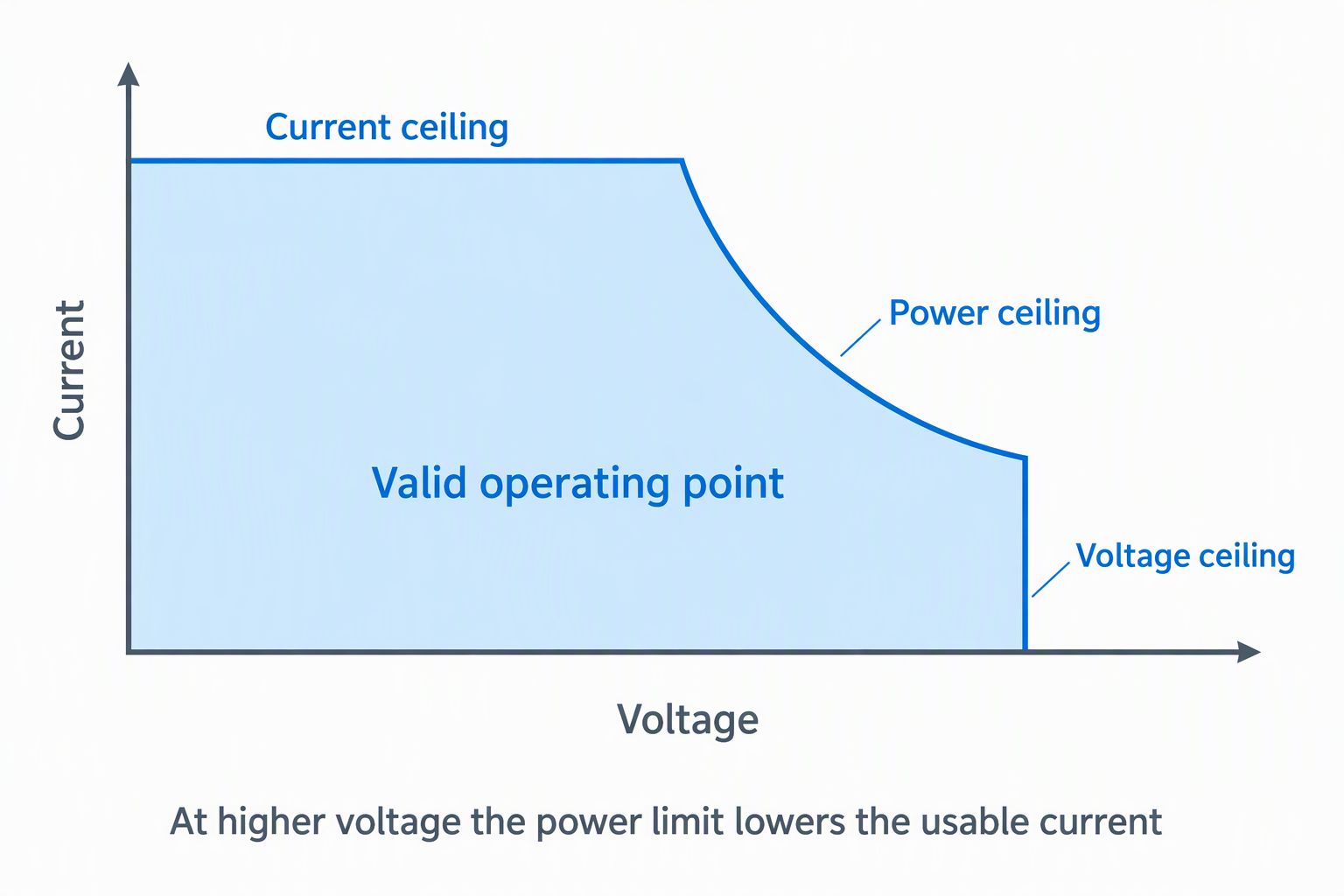
Voltage, current, and power ceilings must all be respected. The listed ceilings are 25V, 4A, and 25W for DROK, 25V, 5A, and 35W for UCTRONICS, 50V, 15A, and 120W for Treedix, and 21V, 3A, and 35W for Eversame. At higher voltage, the power limit usually reduces the usable current below the current ceiling.
Choose margin based on the planned source, not the largest printed number. A 100-watt USB-C charger does not require a 120-watt test point for every check, and the correct load profile depends on its supported modes. Use appropriate cables and follow the manuals. A USB4 cable guide can help separate cable capability from what the electronic load itself can demand.
Separate protocol triggering from loading
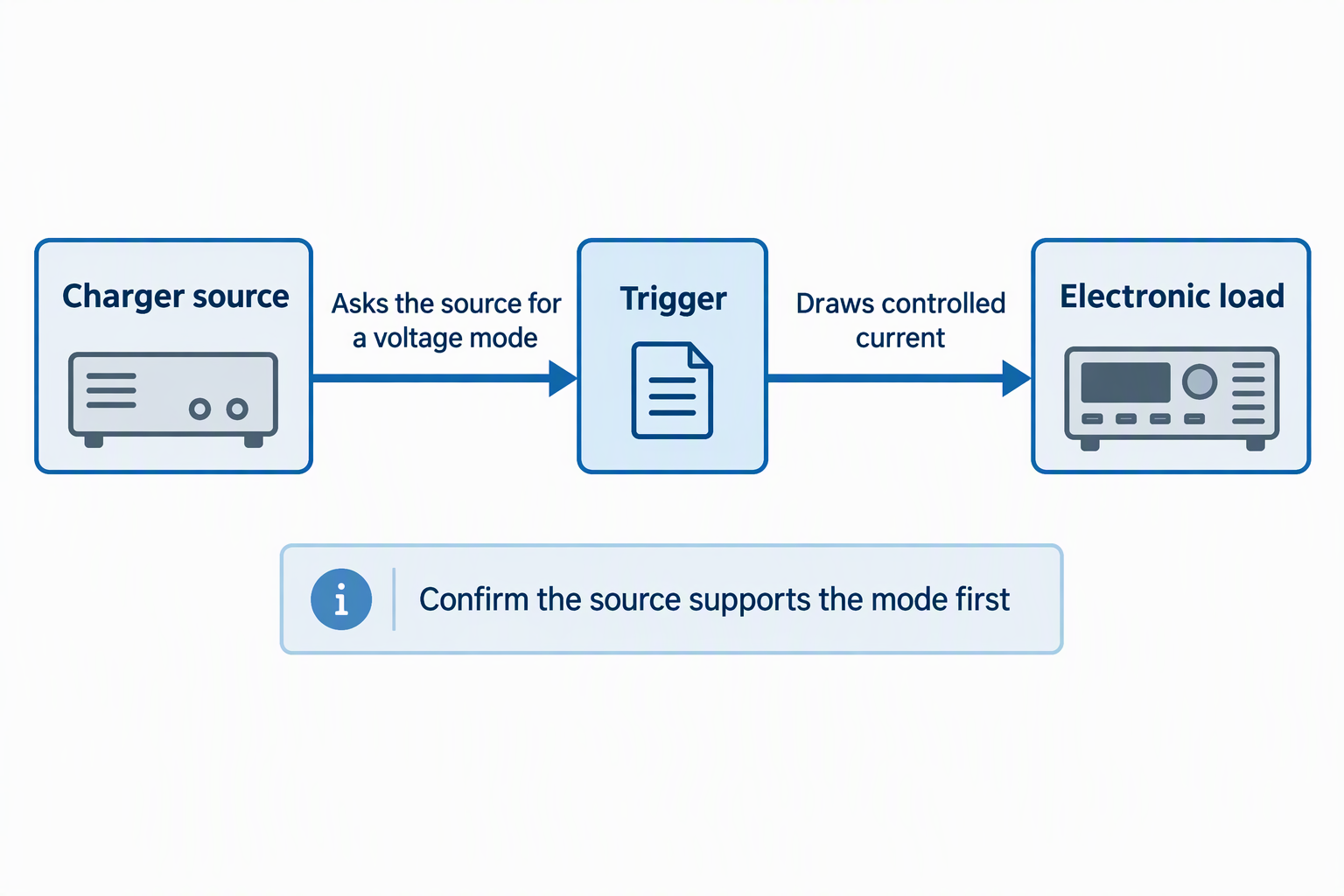
A trigger asks a compatible source for a voltage mode, and the load then draws controlled current. UCTRONICS specifies QC2.0, QC3.0, AFC, and FCP triggering at 5, 9, 12, and 20 volts. Eversame includes a separate QC2.0/QC3.0 trigger for its listed test points.
Protocol support on a meter does not create an electronic load. MakerHawk can observe several fast-charge protocols and a separate connected load, but its supplied description does not state an adjustable internal discharge element. Do not confuse a displayed negotiated mode with a validated loaded result.
Write down the requested mode before adjusting current. UCTRONICS lists 5, 9, 12, and 20-volt trigger outputs, while Eversame supplies four stated QC test points. Confirm that the source supports the requested protocol and voltage before the load is increased, since the load’s electrical ceiling does not make an unsupported charger mode available.
Check auxiliary power and connector paths
Some modules run from the source under test, while others need separate power. Treedix documents a requirement for a 12-volt auxiliary input through DC or USB-C-to-USB-C PD. It cannot be powered with a USB-C-to-USB-A cable. This supply path should remain distinct from the load input.
Connector variety does not override electrical limits. UCTRONICS accepts USB, Micro-USB, USB-C, and external wiring, while DROK supports USB and USB-C. MakerHawk has five interfaces but remains an observing meter. Keep nearby Thunderbolt docks outside the load circuit unless the exact test procedure calls for them.
Treat cooling and protection as operating controls
A fan removes heat generated by the load, so its airflow needs space. DROK, UCTRONICS, and Eversame use fan cooling. According to manufacturer specifications, the Eversame starts its fan above 55°C and stops below 45°C. Do not block vents or assume a nearby desktop fan raises the product’s rated load.
Protection states are boundaries, not routine targets. DROK stops above stated temperature or power limits, UCTRONICS lists six protection types, and Treedix monitors four. Investigate why a protection activates before resuming. DROK’s listing also warns that reversed polarity can cause permanent damage.
Plan measurement and documentation
Integrated displays vary in what they can report. DROK shows voltage, current, and power. Eversame adds resistance, capacity, temperature, and time. Treedix lists energy, capacity, discharge time, and temperature. MakerHawk offers a detailed 1.54-inch meter display when paired with an external load.
Independent heat observation can support a bench procedure without replacing the load’s sensors. A thermal imaging camera can show heat patterns around connectors or modules, while an ESD wrist strap addresses static control at a component bench. Neither changes voltage, current, or power ratings.
Choose the display around the value that settles the check. A quick charger screen may need only voltage, current, and power, which DROK supplies. Capacity or timed-discharge work benefits from Treedix or Eversame because their records include energy, capacity, or time functions. MakerHawk is useful when protocol observation and a rotating color display are more important than an internal load.
Frequently Asked Questions
Is a USB-C power meter the same as an electronic load?
No. A meter observes electrical values, while an electronic load creates a controlled demand. UCTRONICS, DROK, Treedix, and Eversame explicitly provide adjustable loading. MakerHawk’s supplied record describes measurement, alarms, and protocols without stating a built-in adjustable load.
A complete bench may use both tools in one path when the products and procedure support it. The meter can record negotiated voltage and current while the load supplies demand. Connector compatibility and ratings must remain valid for every device in that path.
Can a 35W load test a 100W USB-C charger?
It can apply test points within its own 35-watt envelope, but it cannot validate a full 100-watt output by loading to 100 watts. UCTRONICS and Eversame are both rated for 35-watt maximums despite higher voltage or current ceilings.
Treedix reaches 120 watts but requires separate 12-volt power and its own valid connection and operating setup. Matching headline wattage alone is not enough. The trigger, cable, voltage mode, current range, and cooling must all support the planned point.
Why does a USB-C PD meter stay dark with no device attached?
MakerHawk says a PD source may not supply power until a fast-charge device or load requests it. Its suggested first checks include flipping the USB-C connector and confirming that the proper built-in USB-C interface and charger are being used.
A dark screen does not prove the charger is defective. USB-C negotiation and the meter’s own power path affect the display. Add only equipment called for by the meter and load instructions rather than improvising a connection.
Which product has the broadest load capacity?
Treedix publishes the highest separate ceilings at 50 volts, 15 amps, and 120 watts. The three limits are not simultaneous, because 50 volts times 15 amps would exceed 120 watts. The valid point must stay below every ceiling.
UCTRONICS is rated for 35 watts and 5 amps, Eversame specifies 35 watts and 3 amps, and DROK lists 25 watts and 4 amps. The best capacity is the smallest safe range that fully covers the intended sources and protocols.
What should I do before turning on an adjustable load?
Set the load according to its manual and verify wiring, polarity, limits, and cooling clearance. Eversame specifically tells users to turn both knobs fully counterclockwise before testing. DROK warns that reversed input polarity causes permanent damage.
Use cables and connectors rated for the planned point, and do not exceed the source or load. Keep exposed conductors and hot components away from loose metal. Stop and investigate if a protection state, unexpected heating, unstable reading, or damaged connector appears.
Final recommendation
The UCTRONICS RS2818 is the best all-around bench load because it combines a 35-watt range, USB-C and external inputs, fast-charge triggering, and extensive protections. DROK is the simpler 25-watt alternative, while Eversame gives finer manual current trimming.
Choose Treedix when a properly powered 120-watt module is needed, and use MakerHawk as a companion meter with a separate load. The right choice starts with a valid operating point and a known protocol path, not the highest current or voltage number in isolation.