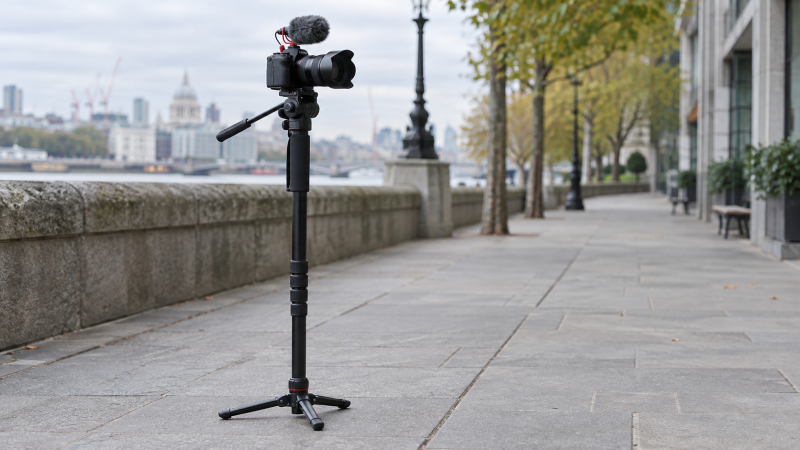
A monopod supports a camera without the setup time and floor space of a full tripod. For event coverage, travel video, interviews, sports, and fast creator work, it can reduce arm fatigue while letting the operator move quickly. A video monopod with a fluid head and folding feet can also make controlled pans and tilts easier, while a simple pole is lighter and better suited to quick static framing.
Small feet can steady a monopod, but they do not turn it into an unattended full-size tripod. Likewise, a high payload number does not guarantee smooth video movement if no fluid head is included. Eight active-new products were compared using the supplied records, focusing on working and folded height, weight, stated capacity, head and base design, locking method, and what is actually included.
The COMAN KX3232-Q6 is our best overall choice because the manufacturer includes an upgraded fluid head, removable feet, a 73-inch working height, and a 22 lb stated load. The NEEWER TP78 reaches a manufacturer-rated 74.8 inches and adds damping control, a reversible handle, and a detachable tabletop base. For a light pole with more capacity margin and no video head, the ULANZI TB12 weighs a listed 0.83 lb while supporting a stated 11.02 lb.
Camera Monopod Comparison
| Image | Product | Details | Check Price |
|---|---|---|---|
 | COMAN KX3232-Q6 Professional Video Monopod | Height range: 26 to 73 inches Product weight: 3.9 lb Stated payload: 22 lb Head: Q6 fluid head; 360-degree pan; -60 to +90-degree tilt Base: Detachable three-foot tilting base | Check Price on Amazon |
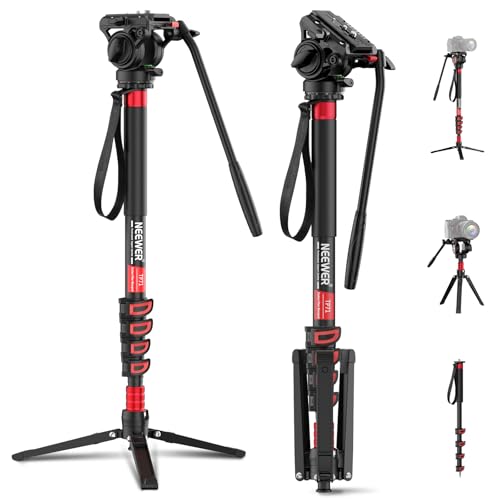 | NEEWER TP78 Professional Video Monopod | Height range: 26.8 to 74.8 inches Product weight: Not stated Stated payload: 13.2 lb Head: Damped fluid head; 360-degree pan; -70 to +90-degree tilt Base: Detachable three-foot base | Check Price on Amazon |
 | Manfrotto XPRO Plus Video Monopod with Video Head | Height range: Not stated Product weight: Not stated Stated payload: Not stated Head: Video head included; exact range not stated Base: FLUIDTECH base with 3 retractable feet | Check Price on Amazon |
 | SIRUI AM-MDP02 Video Monopod with Feet | Height range: 24.8 to 74 inches Product weight: 4.4 lb Stated payload: 17.6 lb Head: Damped fluid head; 360-degree pan; -60 to +90-degree tilt Base: Three-foot base; 360-degree swivel; 36-degree tilt | Check Price on Amazon |
 | Koolehaoda YT-288 Monopod with Fluid Head | Height range: 22.4 to 58 inches Product weight: 2.2 lb Stated payload: 6.6 lb Head: ABS fluid head; 360-degree pan; -85 to +90-degree tilt Base: Removable tabletop base; 20-degree tilt | Check Price on Amazon |
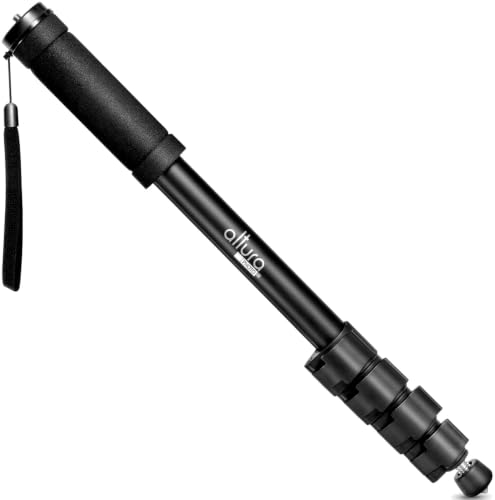 | Altura Photo UZ0313 62-Inch Camera Monopod | Height range: 16.75 to 62 inches Product weight: 0.59 lb Stated payload: 5 lb Head: Not included Base: Rubber foot with retractable spike | Check Price on Amazon |
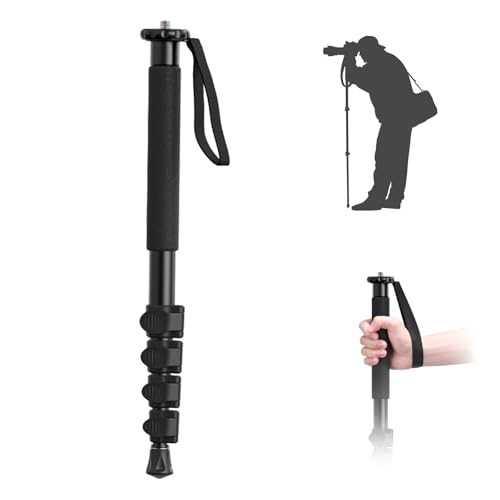 | ULANZI TB12 61-Inch Camera Monopod | Height range: 16.9 to 61 inches Product weight: 0.83 lb Stated payload: 11.02 lb Head: Not included Base: Single monopod foot; stabilizing feet not listed | Check Price on Amazon |
 | IFOOTAGE Cobra 3 A180T Aluminum Monopod | Height range: 27.2 to 71.7 inches Product weight: 2.76 lb Stated payload: 17.6 lb Head: Not listed as included Base: Quick-disconnect three-foot folding base | Check Price on Amazon |
Payload is only one part of the decision. A heavier monopod with a fluid head and feet is more complete for video, while a sub-one-pound pole may require a separate head and constant operator support. The feet listed here are stabilizing bases for controlled use, not a reason to leave a camera unattended.
1. COMAN KX3232-Q6 Video Monopod — Best Overall
The COMAN KX3232-Q6 is a five-section aluminum monopod supplied with a Q6 fluid head and detachable three-foot base. It folds to 26 inches, extends to 73 inches, and weighs 3.9 lb. It is a substantial carry compared with simple poles, but it includes the hardware needed for panning, tilting, and a steadier planted position.
COMAN lists a 22 lb maximum load, the highest stated figure among these eight products. The fluid head pans through 360 degrees and tilts from -60 to +90 degrees. Its plate drops in from above and locks through the head, with a side pull-bolt release and a stored hex key for faster camera installation.
The base can rotate through 360 degrees and tilt 45 degrees. It detaches for use as a low-angle tabletop support, while the monopod can be used with the feet fixed or in a freer moving configuration. A one-touch vertical lock helps restrain base movement. For more height and a lower stated capacity, compare the NEEWER TP78.
[greenbox] Best for a full run-and-gun video kit that needs a fluid head, stabilizing feet, and high stated payload in one package. [/greenbox] Our TakeThe KX3232-Q6 is the pick for a video shooter who wants the most complete feature set and the highest stated capacity in one kit. Its 3.9 lb weight is the tradeoff for carrying a head, five-section column, and detachable base together.
- Q6 fluid video head included
- 22 lb stated capacity
- Detachable base works as a low support
- Heavier than simple travel monopods
- 26-inch folded size is not backpack compact
2. NEEWER TP78 Video Monopod — Best for Maximum Height
The NEEWER TP78 extends from 26.8 to 74.8 inches, making it the tallest option by the supplied figures. Five aluminum sections use flip locks for quick changes. A lanyard and carrying bag are included, which helps manage the longer video kit between locations.
Its fluid head provides 360-degree pan and -70-to-+90-degree tilt with damping control. The removable pan handle can be placed for the operator’s dominant hand, and a bubble level helps set the horizon. The Manfrotto-compatible quick-release plate has 1/4-inch and 3/8-inch screws plus a built-in L-shaped hex key.
NEEWER states a 13.2 lb or 6 kg capacity. The three-foot base steadies the monopod on uneven ground, tilts through its joint, and detaches for use as a small desktop support. A side 1/4-inch thread can accept a light, magic arm, or another compact accessory, though every addition counts toward the load. For a higher capacity in a slightly shorter package, the COMAN KX3232-Q6 is the stronger fit.
[bluebox] Best for tall operators or elevated framing that benefits from a 74.8-inch maximum and an included damped head. [/bluebox] Our TakeThe TP78 is the pick for a tall operator who wants the greatest stated height without giving up a proper fluid head or removable feet. Its 13.2 lb limit is ample for many creator rigs, but all attached accessories must be counted.
- Tallest listed maximum at 74.8 inches
- Damping control and reversible pan handle
- Carrying bag included
- 26.8-inch minimum is relatively long
- Lower capacity than the COMAN
3. Manfrotto XPRO Plus Video Monopod — Best Fluid Base Design
The Manfrotto XPRO Plus combines a four-section aluminum monopod, video head, and FLUIDTECH base. The base is designed for pan, tilt, and swivel movement at ground level. Three retractable feet fold for transport, so the monopod can move through a crowded venue more easily than a full tripod.
D-shaped aluminum tubes add anti-rotation resistance during quick operator movement. Manfrotto’s Power Quick Lock closes against the flat side of the tube to restrain the section and reduce jerky movement caused by poor locking. Both details help in fast event work where the monopod changes height repeatedly.
The supplied record lists a 79.92-inch height and 4.63 lb weight, but it does not state folded length, payload, or exact video-head movement range. The XPRO Plus therefore suits buyers who prioritize its fluid-base approach over a documented capacity advantage. Creators who need clearly stated dimensions and load can compare the SIRUI AM-MDP02.
[greenbox] Best for operators who value fluid movement at the base and anti-rotation tube design over the most detailed published specifications. [/greenbox] Our TakeThe XPRO Plus is the pick for an event shooter who wants a FLUIDTECH base, retractable feet, and D-shaped tubes. The limited supplied specifications mean height and payload must be confirmed before matching it to a camera rig.
- FLUIDTECH pan, tilt, and swivel base
- D-shaped anti-rotation tubes
- Retractable support feet
- Payload and folded length are not stated
- Exact head movement range is not stated
4. SIRUI AM-MDP02 Video Monopod — Best High-Capacity Alternative
The SIRUI AM-MDP02 is a four-section video monopod with a damped fluid head and three-foot base. Sirui specifies that the head pans through 360 degrees and tilts from -60 to +90 degrees, with a side-release plate, removable handle, and bubble level. The base is rated to swivel through 360 degrees and tilt 36 degrees in any direction.
Its working range is rated at 24.8 to 74 inches, and the supplied details state a 17.6 lb capacity at a 4.4 lb product weight. Flip locks control the column sections. A side 1/4-inch thread accepts an arm, light, or monitor, while the plate includes 1/4-inch and 3/8-inch screws and a stored hex key.
The source contradicts itself on material. The product title says carbon fiber, but the feature text twice describes aluminum or aluminum alloy. The article and table do not resolve that inconsistency, so verify the delivered version before buying. The IFOOTAGE Cobra 3 A180T offers a similar 17.6 lb capacity without a listed fluid head.
[bluebox] Best for a high-capacity video setup when the buyer verifies the conflicting material description before ordering. [/bluebox] Our TakeThe AM-MDP02 is the pick for a high-capacity video shooter who wants a damped head, tall reach, a tilting base, and a 17.6 lb capacity in one kit. The carbon-fiber-versus-aluminum conflict is significant enough to check rather than guess.
- 17.6 lb stated capacity
- Damped head and tilting base
- 24.8-inch collapsed length
- Source contradicts itself on construction material
- 4.4 lb weight is the heaviest stated here
5. Koolehaoda YT-288 Video Monopod — Best Lightweight Fluid-Head Kit
Koolehaoda specifies a 2.2 lb kit weight for the YT-288, which includes a fluid head and removable foot base. The manufacturer lists a 22.4-inch collapsed length and a 58-inch maximum extension for the four aluminum sections. Flip locks support one-handed height changes, and a carrying bag is included for transport.
The ABS fluid head provides 360-degree pan and -85-to-+90-degree tilt with a built-in counterweight system and damping. The 6.6 lb capacity is lower than the larger video monopods, but it can suit a compact mirrorless camera, camcorder, or action-camera build when the complete load remains within the limit.
The support base detaches for use as a low tabletop tripod and provides 360-degree rotation with 20-degree tilt when mounted to the monopod. The listing also describes use as an audio boom. For a still lighter pole without a supplied head or feet, consider the Altura Photo UZ0313.
[graybox] Best for a compact creator kit that needs a fluid head and feet but cannot justify a four-pound support. [/graybox] Our TakeThe YT-288 is the pick for a lightweight video shooter who wants a complete 2.2 lb kit. Its 58-inch maximum and 6.6 lb limit are modest, and the ABS head will be the deciding compromise for heavier use.
- Fluid head and removable base included
- 2.2 lb complete weight
- 22.4-inch folded length
- Shorter 58-inch maximum
- 6.6 lb capacity
6. Altura Photo UZ0313 Travel Monopod — Best Ultralight Budget Pole
The Altura Photo UZ0313 is a basic single-foot aluminum support rather than a complete video monopod. Altura Photo states it weighs only 0.59 lb, collapses to 16.75 inches, and extends to 62 inches. A carry pouch, foam grip, and wrist strap make it easy to add to a lightweight travel kit.
Its universal 1/4-inch mount is rated to support up to 5 lb, and a 3/8-inch screw adapter is included. A ball head or video head can be attached, but neither is listed as part of the package. The ground end combines a nonskid rubber foot with a retractable spike for indoor or outdoor terrain.
The UZ0313 works best as operator-held support for a small camera or as a walking pole between shots. It has no stabilizing feet, pan handle, damping, or quick-release plate in the supplied record. The ULANZI TB12 weighs slightly more but more than doubles the stated capacity.
[greenbox] Best for creators who want the lightest and shortest-folding monopod and already own a suitable head if one is needed. [/greenbox] Our TakeThe UZ0313 is the pick for a traveler who wants a pole that packs into a bag at 0.59 lb and 16.75 inches. It should be compared with simple support poles, not fluid-head video kits.
- Lightest stated weight at 0.59 lb
- Compact 16.75-inch folded size
- Rubber foot and retractable spike
- No head or support feet included
- 5 lb capacity is the lowest stated
7. ULANZI TB12 Lightweight Monopod — Best Lightweight Capacity Balance
The ULANZI TB12 is another plain aluminum pole, but it pairs low weight with a higher stated capacity. It weighs 0.83 lb, folds to 16.9 inches, and extends to 61 inches. Five sections offer fixed listed positions at 16.9, 29.9, 41.3, 51.6, and 61 inches.
ULANZI states an 11.02 lb or 5 kg payload, a strong weight-to-capacity figure in this group. The record describes use as a standard monopod, selfie stick, walking stick, hiking stick, or trekking pole. It does not list a fluid head, quick-release plate, foot base, or carry bag.
The TB12 suits a creator who needs one support pole that can stay in a carry-on. Video movement will depend on the chosen camera connection and operator technique rather than an included damped head. For a pole with quick-disconnect modularity and stabilizing feet, the IFOOTAGE Cobra 3 A180T is the more production-oriented option.
[bluebox] Best for a travel creator who wants low carry weight and more payload margin than the lightest basic monopod. [/bluebox] Our TakeThe TB12 is the pick for a creator who wants the best capacity-to-weight ratio among the headless poles. It still requires continuous operator control and a separate head or plate if the camera setup needs one.
- 0.83 lb product weight
- 11.02 lb stated capacity
- 16.9-inch folded length
- No fluid head listed
- No stabilizing base or bag listed
8. IFOOTAGE Cobra 3 A180T Monopod — Best Modular Headless System
The IFOOTAGE Cobra 3 A180T uses five aluminum sections, twist-lock joints, and a quick-disconnect system. Its two-step height adjustment is designed to work without separating components, while the modular connection releases and locks automatically in one step. The included three-foot base detaches and folds for transport.
IFOOTAGE specifies the monopod reaches 71.7 inches, folds to 27.2 inches, and supports a stated 17.6 lb. At a rated 2.76 lb, it is heavier than the ultralight poles and lighter than the larger fluid-head kits. The foot base can also serve as a small separate support, giving the system three configurations.
No fluid head is listed in the supplied title or feature details, so do not assume one is included. Without one, the A180T is a modular support foundation for a creator who already owns a head or wants to choose one separately. Buyers wanting a head in the box should look at the Koolehaoda YT-288 or a larger complete video model.
[graybox] Best for creators who want a high-capacity modular pole and detachable base while selecting their own camera head. [/graybox] Our TakeThe Cobra 3 A180T is the pick for a creator who already owns a head and wants a 17.6 lb capacity with fast modular connections. Its 27.2-inch folded size is long, and the missing fluid head keeps it from ranking as a complete video kit.
- 17.6 lb stated payload
- Quick-disconnect modular design
- Detachable folding foot base
- No fluid head listed
- Longest stated folded size at 27.2 inches
Buying Guide: Choosing a Camera Monopod for Creator Video
Decide whether a fluid head is required
A fluid head adds controlled resistance to pan and tilt movement. It helps when the shot follows a speaker, athlete, performer, or moving subject. The COMAN, NEEWER, Manfrotto, SIRUI, and Koolehaoda products include a video or fluid head in their supplied descriptions. Choose an included fluid head for ready-to-use video movement.
A plain monopod is lighter and can be enough for static framing, quick stabilization, or a camera with its own suitable head. The Altura, ULANZI, and IFOOTAGE listings do not identify an included fluid head. Adding one changes total weight, folded bulk, and payload. Compare complete working systems rather than pole prices alone.
Treat the foot base as support, not a tripod
Three small feet spread the contact area and allow a monopod to swivel or tilt around its base. They help with controlled movement and brief repositioning, and some detach as tabletop supports. Monopod feet do not provide full-tripod stability, especially with a tall camera or uneven ground.
Keep a hand on the support, lock movement when appropriate, and avoid leaving the rig unattended. Wind, a cable tug, a bumped foot, or a tilted column can move the center of gravity outside the small base. Use a full tripod when the camera must stand independently. Operator control remains part of the support system.
Calculate the complete payload
Add the camera, lens, cage, battery, microphone, monitor, plate, handle, and head if it is not already part of the specified kit. A 5 kg camera body and lens do not fit safely on an 11 lb support once accessories push the complete rig beyond that figure. Payload applies to everything above the rated point.
A high capacity does not guarantee smooth motion or a stiff fully extended column. Use margin rather than building to the limit, particularly with a long lens or side-mounted monitor. Keep accessories near the axis to reduce twisting. Balance and distribution affect the result along with total weight.
Balance working height against folded size
The tallest products reach about 74 inches, which can help tall operators and elevated shots. Maximum height also means more sections or a longer folded package. More sections can pack shorter at a similar height, but each adds another lock to operate. Choose only the height the shooting style needs.
For travel, Altura and ULANZI specify folding heights below 17 inches, while the complete video models fold from roughly 22 to 27 inches where figures are supplied. A monopod that fits inside the planned bag is more useful than a taller one left behind. Measure the transport space before prioritizing reach.
Compare flip locks, twist locks, and quick releases
Flip locks make the section state visible and support rapid adjustment. Twist locks give the tube a cleaner exterior and can release multiple sections with practiced handling. Neither type is automatically better; maintenance and correct tension matter. The fastest lock is the one the operator can verify confidently.
Quick-release plates and modular couplings affect camera and base changes. Confirm plate compatibility rather than relying on similar appearance, and test every latch after attachment. Stored hex keys reduce tool searching but still need to be returned securely. A locked connection should be checked before lifting the camera.
Match pan and tilt range to the work
A 360-degree pan is common among the video models, while tilt ranges vary. Positive tilt helps frame above the horizon, and negative tilt supports downward shots. A base that tilts lets the whole column move, while a head tilt changes camera angle at the top. Head movement and base movement serve different purposes.
For fast subjects, a removable pan handle and adjustable damping can improve control. For static interviews, simple resistance may be enough. Do not infer counterbalance performance from a payload rating unless the supplied information states it. Choose motion features from the shot list, not the largest number.
Related Creator Rig Guides
These guides cover adjacent handheld, mounting, capture, and monitoring choices for mobile video work:
- Camera top handles for handheld creator rigs
- Mirrorless camera cages for desk video rigs
- Camera suction mounts for vehicle creator shots
- Overhead camera mounts for desk tutorials
- HDMI loop-out capture cards for camera monitoring
- HDMI capture dongles for laptop streaming
- BNC cables for SDI camera and monitor runs
- SDI distribution amplifiers for multi-monitor production
Frequently Asked Questions
Is a monopod stable enough for video?
Yes, a monopod can reduce vertical movement and arm fatigue while keeping the operator mobile. A fluid head and tilting base can support smoother pans and angle changes. It is a supported handheld tool rather than a fully independent platform.
The operator still controls side-to-side movement and keeps the rig upright. Small feet increase the contact area but do not provide the stability of a full tripod. Use a tripod for unattended recording, long locked shots, or conditions where the support may be bumped.
Do monopod feet let the camera stand by itself?
They may hold a balanced light setup briefly under controlled conditions, but relying on them unattended is unsafe. The narrow base can tip when the column tilts or the center of gravity shifts. Wind, cables, uneven ground, and people moving nearby add risk.
Keep a hand on the monopod and follow the product instructions for base locking. Several bases detach for tabletop use, where the shorter camera height can be more stable. Even then, verify the load and surface before letting go.
How much monopod payload is enough?
Choose a rating above the full assembled rig weight, including the head, camera, lens, cage, battery, plate, microphone, monitor, and arms. Leave capacity margin for movement and configuration changes. A creator setup often weighs more than the camera-and-lens specification suggests.
Payload alone cannot describe head smoothness, tube stiffness, or base stability. A lighter camera on a well-matched fluid head may produce better results than a heavy rig placed on the highest-rated pole. Consider capacity as a pass-or-fail requirement, then compare handling.
Is aluminum or carbon fiber better for a monopod?
Aluminum is a common durable choice and appears across this product set. Carbon fiber can reduce weight in some designs, but the supplied SIRUI record contradicts itself by naming carbon fiber in the title and aluminum in the features. Verify the exact material for the listing and delivered model.
Material alone does not decide portability. Section count, head, base, locks, and tube diameter all affect weight and packed length. Compare the complete product weight and the features required for the job.
Can a monopod replace a gimbal?
No. A monopod supports weight and can guide pans or tilts, while a powered gimbal actively controls camera orientation across movement. They solve different stabilization problems. A monopod is useful for planted or pivoting shots, not for floating movement while walking.
Some monopods accept gimbals through standard screws or compatible plates, but the combined load must remain inside every limit. That setup also changes balance and height. Use it only when the workflow benefits from both systems.
Bottom Line
The COMAN KX3232-Q6 is our best overall run-and-gun video monopod because it combines a Q6 fluid head, detachable feet, a listed 73-inch height, and 22 lb stated load. The NEEWER TP78 is the taller alternative with damping control and a rated 13.2 lb capacity, while the SIRUI AM-MDP02 offers a 17.6 lb rating if its conflicting construction description is resolved before purchase.
For a lighter complete kit, the Koolehaoda YT-288 includes a fluid head and base at a listed 2.2 lb. Creators who do not need an included head should choose between the Altura, rated at 0.59 lb for minimum carry weight, the ULANZI TB12 for a stronger weight-to-capacity balance, and the modular IFOOTAGE Cobra 3 for detachable feet and a higher payload. Keep control of the monopod, use capacity margin, and choose a full tripod whenever the camera must stand unattended.
Product dimensions, stated payloads, head and base features, included accessories, and availability were checked against the supplied Amazon product records dated October 14, 2026. Verify current specifications, package contents, and camera compatibility before purchase.