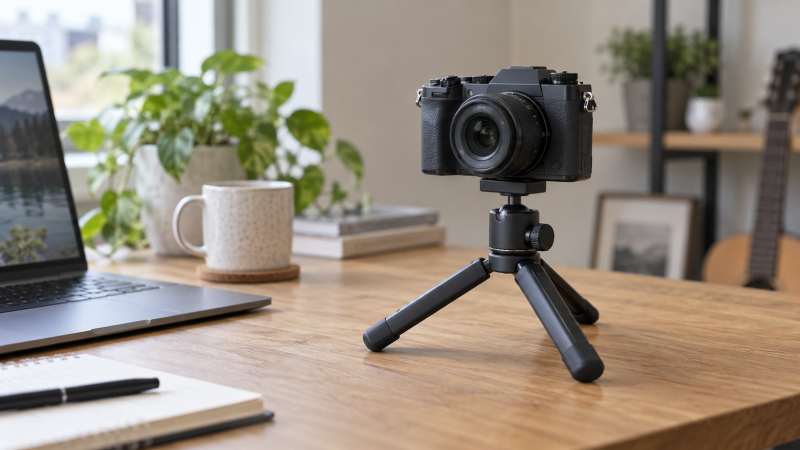
A mirrorless camera on a desk needs a support that fits the frame without occupying the keyboard space. A tiny tripod can put the lens too low, and a taller one may wobble when the desk moves. The useful choice is working height, leg footprint and the weight of your complete camera kit, not the biggest load number in a listing.
These five tabletop tripods serve different jobs: a fixed low shot, an adjustable eye line, low-angle product detail, a broad mini-tripod stance and a handheld-to-tabletop hybrid. All had active New Amazon US offers. Their specifications come from the exact seller listings, not from hands-on stability tests. A listed load ceiling does not guarantee steady footage with a long lens, raised center column or vibrating desk.
Before buying, put a book or box at the proposed camera height. If the lens still looks up at your face or blocks your monitor, choose a taller support or move the camera off the desk.Tabletop Mirrorless Tripods Compared
| Image | Product | Details | Check Price |
|---|---|---|---|
 | SmallRig VT-20 | Best fit: Adjustable seated frame Working height: 17–52 cm stated Load: 6 kg stated Head: Arca-type ball head Low-angle option: Reversible center column | Check Price on Amazon |
 | Manfrotto PIXI Mini | Best fit: Fixed low tabletop shot Mount: 1/4 in screw stated Head: Push-button ball lock Handgrip: Folded legs Height: Fixed low profile | Check Price on Amazon |
 | SIRUI AM-TT50 | Best fit: Low detail and adjustable framing Working height: 7–20 in stated Load: 17.64 lb stated Head: Arca-type ball head Low-angle option: Reversible center column | Check Price on Amazon |
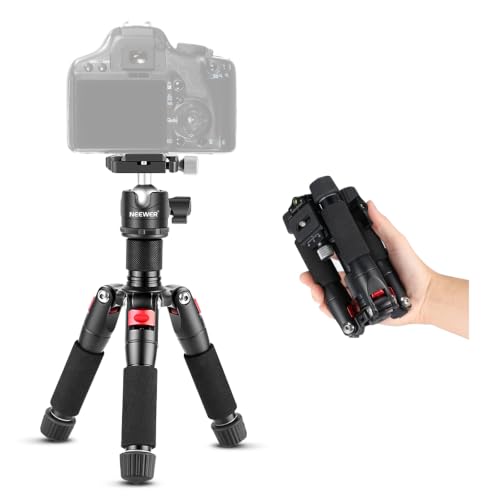 | NEEWER 20-Inch Mini | Best fit: Adjustable three-angle stance Working height: 17–50 cm stated Load: 5 kg stated Head: Arca-type ball head Legs: Five sections | Check Price on Amazon |
 | ULANZI MT-16 | Best fit: Light tabletop and handheld kit Folded length: 22.5 cm stated Weight: 170 g stated Vertical load: 500 g stated Accessory: Cold shoe listed | Check Price on Amazon |
1. SmallRig VT-20 — Best Adjustable Eye Line
SmallRig describes the VT-20 as a five-section aluminum mini tripod with a 17 to 52 cm (6.7 to 20 inch) working-height range. The adjustable height is useful when a desk-level camera points up at a presenter but a full floor tripod is unnecessary. The legs have a three-position angle adjustment for the footprint, and the center column can be reversed for a lower view of a product on the table.
The listing includes an Arca-type ball head, a phone holder, a hook and an Allen wrench. SmallRig states a 6 kg (13.2 lb) maximum load, but do not mistake that figure for a promise of vibration-free video at 52 cm. Raise the camera only as far as framing requires and spread the legs on a clear surface. Keep the lens over the support rather than hanging it far beyond one foot. A heavy zoom can shift the balance even when the stated weight is below the ceiling.
For a seated talking-head frame, set the leg angle and camera height with your chair and monitor in their normal positions before recording.Our Take The VT-20 is a flexible starting point here if the lens must rise toward eye level. The adjustable sections mean more settings to lock, so record a short test clip before a long tutorial.
- 17–52 cm seller-stated working range.
- Three leg-angle choices and reversible column.
- Arca-type head and phone holder listed.
- Extended sections need careful locking.
- Stated load does not establish desk stability.
2. Manfrotto PIXI Mini — Best Fixed Low Angle
The PIXI is a compact tabletop tripod that closes into a handgrip. Its listing describes a universal 1/4-inch camera screw and a ball head that locks when the release button is let go. With no telescoping leg sections to set, it suits a camera left at a consistent low angle for desk demonstrations or product close-ups, and it fits a travel kit that occasionally becomes a studio support.
The simple design is also its constraint. The PIXI cannot raise a lens to seated eye level on its own. Put it on a stable riser only if the entire surface is suitable. A pile of books near a desk edge is not a safe substitute for a higher tripod. The listing calls out compact system and entry-level DSLR compatibility, but that wording does not verify the balance of every mirrorless body and lens. Check the current manufacturer’s load guidance for the full kit before treating compatibility language as a capacity claim.
Our Take Choose PIXI for a repeatable low tabletop position and quick handgrip conversion. Choose an adjustable model if your desk recording alternates between product details and eye-level speech.
- Simple ball-lock control.
- Legs close into a handgrip.
- Compact support needs little desk space.
- Fixed low height may look up at a presenter.
- Exact camera-and-lens balance still needs checking.
3. SIRUI AM-TT50 — Best for Low Detail Shots
SIRUI’s AM-TT50 has a stated 7 to 20 inch working-height range and three leg-angle positions. Its detachable center column can be reversed, which is useful when the camera must look across a keyboard or a small product, such as a circuit board, close to tabletop level. The listing also describes an Arca-type quick-release ball head with a U-shaped notch for portrait orientation.
At 20 inches, the AM-TT50 can also serve a higher desk-level frame, though the lens height still depends on the camera and head. SIRUI states a maximum load of 17.64 lb. Treat the figure as a seller-stated ceiling, not proof that a tall, top-heavy rig remains steady when you type or touch the table. The product folds to a stated 7 inches and weighs less than 1.7 lb, so it is easier to stow when the desk becomes a work surface again.
Our Take SIRUI makes sense when low detail framing is a recurring job rather than an occasional trick. Do not let its high stated load stand in for checking leg spread, camera balance and desk vibration.
- Reversible column for low-angle work.
- Three stated leg-angle positions.
- Arca-type quick-release head listed.
- Column and leg settings take setup time.
- Maximum-load claim is not a video-stability test.
4. NEEWER 20-Inch Mini — Best Broad Leg Stance
NEEWER’s aluminum mini tripod adjusts from a stated 17 to 50 cm (6.7 to 19.7 inches) with five leg sections. The legs have three angle settings for placing the feet around a keyboard or other desk gear while the camera stays centered. The supplied ball head has a bubble level and an Arca-type quick-release plate, which can speed repeated removal and reattachment of the same camera.
The listing states an 11 lb (5 kg) maximum load and non-slip feet. The load and feet are product claims, not a guarantee that a monitor stand or flexible desk top will resist movement. Start with the lowest height that frames the shot and verify every leg section is locked. Then watch the monitor image when you type or lean on the desk. If the tabletop moves, changing the tripod may not fix the support surface. The broad stance occupies space that a smaller support such as the PIXI leaves free.
Check the real foot positions with the laptop open, microphone placed and hands at the keyboard; a tripod that fits an empty desk may not fit the working desk.Our Take This NEEWER model is a practical adjustable option when you want three-position legs and an Arca-type plate. It trades desk footprint for placement flexibility, so measure the surface before choosing it.
- 17–50 cm seller-stated height range.
- Three leg angles and Arca-type plate.
- Bubble level and non-slip feet listed.
- Five sections need locking checks.
- Leg footprint can crowd a small desk.
5. ULANZI MT-16 — Best Lightweight Handgrip Hybrid
ULANZI sells the MT-16 as a lightweight mini tripod, handgrip and selfie stick. The listing describes an extendable shaft, a rotating ball head and a cold shoe for a small microphone or light. It states a 22.5 cm folded length and 170 g weight, which suits a desk kit that is packed away after each recording rather than left assembled.
This ULANZI model is the cautious pick for a very light mirrorless setup, not the one to select from a long list of compatible cameras. The listing explicitly states a 500 g limit in vertical mode and says a phone holder is not included. Check the complete camera, lens, battery, plate and any cold-shoe accessory before using portrait orientation. A cold-shoe light also changes the balance above the ball head. If the kit is heavier or the camera must remain on a desk through a long session, choose a more substantial support with suitable manufacturer guidance.
Our Take The MT-16 suits a creator who switches between a light tabletop shot and handheld clips. For a heavier mirrorless camera left on a desk, the other adjustable tripods are easier to justify given its vertical-mode limit.
- Tripod-to-handgrip format.
- Cold shoe listed for a small accessory.
- Compact stated folded length and weight.
- 500 g seller limit in vertical mode.
- Phone holder is not included.
- Camera examples do not prove your kit is safe.
Buying Guide
Match working height to the shot
For a talking-head desk video, place the lens near the presenter’s eye line. A fixed low tripod such as PIXI may look up at the face, while the VT-20, SIRUI and NEEWER models have stated working heights around 20 inches. A tall working height does not mean the camera will automatically sit at eye level, because chair height, desk height, camera body and ball head all add to the geometry. Mock up the camera position before selecting a tripod.
For product details or keyboard work, a low angle can be useful. A reversible center column gives more choices for low positions but also requires careful clearance and balance. Keep the lens close enough to the subject without placing the tripod where hands, cables or the product will hit a leg. If you need a true overhead view beyond the desk edge, compare a camera clamp arm or C-stand instead of forcing a tabletop tripod into that job.
Weigh and balance the complete camera
The camera body is only part of the load. Add the lens, battery, mounting plate, cage and anything attached to a cold shoe. Put the complete kit on a scale, then compare it with the exact product’s maker guidance for the chosen orientation. The MT-16 listing singles out a 500 g limit in vertical mode. Load figures for the larger mini tripods are higher, but they do not verify balance with a long lens or a raised column.
The center of gravity is as important as the number. Point a zoom lens forward and the rig can lean even below a published maximum. Open the legs fully and keep the head over the center of the footprint. Use the lowest practical column height. Test the frame while operating the desk normally. If the tabletop itself shakes, move the camera to a separate camera desk mount or floor support rather than blaming only the tripod.
Check the mount and desk footprint
Most of these products use a 1/4-inch camera attachment, but the speed of moving the camera between setups depends on the plate and quick-release head. The SmallRig, SIRUI and NEEWER listings describe Arca-type quick-release hardware. Match the camera’s plate to the actual head rather than assuming every plate labeled Arca is interchangeable in every clamp. Lock the head and confirm the camera cannot slide before letting go.
The usable workspace depends on leg spread. A wide stance may clear the laptop screen but interfere with a mouse, notebook or microphone stand. Trace the foot positions on the desk with the recording layout in place. Leave room for HDMI or USB cables to exit the camera without pulling on the ball head, and keep the tripod clear of the desk edge and any moving monitor arm.
Frequently Asked Questions
Can a tabletop tripod hold a mirrorless camera for long recordings?
Yes, if the complete kit fits the exact tripod’s load and balance guidance and the desk remains stable. A long recording adds practical demands. The camera should not drift as it warms, the desk should not shake when you type, and cables must not tug on the head. A high load number in a listing proves none of those outcomes by itself.
Run a short recording with normal desk movement before a long take. Watch the frame while typing, adjusting lights and moving the chair. If it shifts, lower the column, reposition the tripod or move the camera to a different support. Do not leave a poorly balanced camera perched near an edge.
Is an Arca-type plate necessary for desk video?
No, an Arca-type plate is a convenience, not a requirement for a steady shot. It makes it easier to remove the camera for charging, handheld work or a second support without repeatedly turning the mounting screw. The SmallRig, SIRUI and NEEWER listings include Arca-type quick-release arrangements. PIXI and MT-16 emphasize simpler direct mounting.
Check the exact plate and clamp before purchase if you already own a camera cage or other Arca-type hardware. Similar-looking plates can differ in dimensions or safety-stop details. After every reattachment, tighten the clamp and gently check that the camera cannot slide.
Should I use a tabletop tripod or a desk clamp arm?
A tripod is the simpler choice for a camera resting over the desk. It needs clear space for the legs but does not require a clampable edge. A clamp arm clears the tabletop and can reach over a subject, but the clamp needs a desk edge it fits, and the arm adds more joints and greater pull on the desk. Neither option fixes a flexible table.
Choose the support around the actual frame. A seated presenter may need the adjustable height of a mini tripod. An overhead product shot may need the reach of an arm or a separate stand. If the camera is expensive or directly above someone, follow the maker’s mounting and retention guidance rather than improvising a safety claim from a load rating.
Bottom Line
Start with lens height and the complete camera weight. SmallRig VT-20 offers the broadest stated height range in this set. PIXI is the quick low-profile choice, and SIRUI adds low-angle column options. NEEWER offers three-position adjustable legs, and ULANZI suits only a light kit when handheld conversion is the goal. Measure the working desk, not an empty one, before buying.