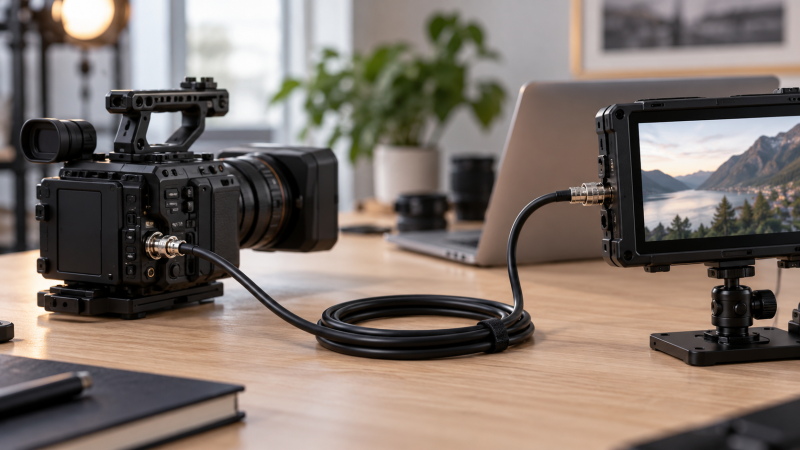
An SDI cable links a camera, switcher, recorder, converter, or production monitor through locking BNC connectors and 75-ohm coax. The right cable depends on the SDI rate, run length, connector orientation, flexibility, shielding, environment, and whether the cable lives on a camera rig or crosses a room.
The eight products below range from a 19-inch right-angle 12G jumper to a 75-foot RG59 run. Do not choose by a 4K or 8K label alone. Match the cable’s stated SDI rate to both endpoints, use the shortest practical length, and leave routing margin without tight bends or connector strain.
Choose a true 75-ohm BNC cable by SDI rate, measured route, coax construction, and connector direction, then test the complete camera-to-monitor path before production.BNC Cables for SDI Camera and Monitor Runs Compared
| Image | Product | Details | Check Price |
|---|---|---|---|
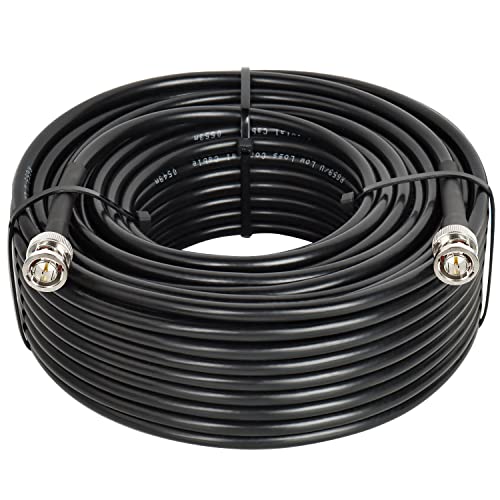 | XRDS-RF RG59 75-Foot Cable | Length: 75 feet Coax: RG59 Impedance: 75 ohms Shielding: Tinned-copper braid and aluminum foil | Check Price on Amazon |
 | Monoprice Viper 116183 | Length: 6 feet Coax: RG6, 18 AWG pure copper Impedance: 75 ohms Stated rate: 3 Gbps | Check Price on Amazon |
 | Superbat Belden 1694A | Length: 10 feet Coax: Belden 1694A RG6, 18 AWG Impedance: 75 ohms Stated rates: SD, HD, 3G, 6G, 12G-SDI | Check Price on Amazon |
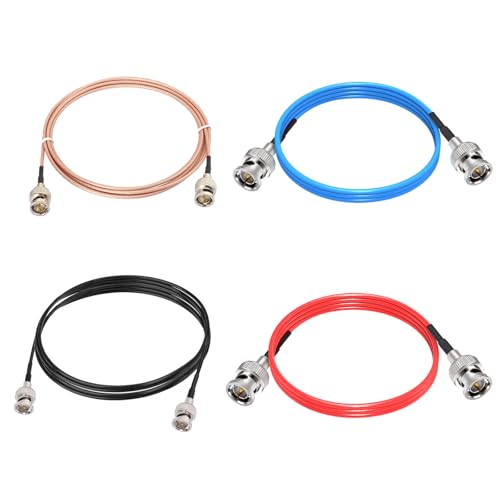 | Superbat RG179 Four-Pack | Quantity: 4 color-coded cables Length: 6 feet each Coax: RG179 with PTFE insulation Stated rate: HD and 3G-SDI | Check Price on Amazon |
 | Superbat GP-AC-SDI-79 Two-Pack | Quantity: 2 cables Length: 20 inches each Impedance: 75 ohms Stated rate: HD and 3G-SDI | Check Price on Amazon |
 | THE CIMPLE CO RG6 Cable | Length: 15 feet Coax: RG6, 18 AWG solid conductor Impedance: 75 ohms Environment: Indoor and outdoor | Check Price on Amazon |
 | XRDS-RF 12G 6-Foot Cable | Length: 6 feet Coax: RG6 Impedance: 75 ohms Stated rates: HD, 3G, 6G, 12G-SDI | Check Price on Amazon |
 | Alvin's Cables Right-Angle 12G Cable | Length: 19 inches Connectors: Right-angle BNC male to male Impedance: 75 ohms stated Stated mode: 12G-SDI, 4K60 | Check Price on Amazon |
1. XRDS-RF RG59 75-Foot SDI Cable — Best Long Fixed Run
A long fixed route from a camera to a control room needs a cable that reaches, and at 75 feet the XRDS-RF is the longest option in this group. XRDS-RF specifies RG59 75-ohm coax with 75-ohm BNC male connectors, which suits SDI equipment, unlike 50-ohm radio-frequency parts. The length also suits a switcher-to-monitor route where shorter cables cannot reach.
Its dual shielding uses a tinned-copper braid and aluminum foil. XRDS-RF describes the construction as reducing attenuation and protecting the signal. The title states HD-SDI, 3G, 6G, 4K, and 8K support, but the detailed bullets do not supply data rates, standards, or distance limits for those higher modes.
Over 75 feet, a missing distance limit is a problem for planning. A cable can be 75 ohms and still have different loss at higher frequencies, so do not plan a 6G or higher critical link solely from the title. Confirm the exact specification for the intended SDI rate and test the full installed run with the actual source and receiver.
The listing names cameras, monitors, recorders, SDI-to-HDMI converters, SDI capture cards, routers, switchers, and frame synchronizers. The cable only carries the signal. It does not amplify, reclock, split, or convert it.
Choose this 75-foot RG59 cable for a measured long route only after confirming that the exact offer supports the required SDI rate at that distance. Our TakeBuy the XRDS-RF 75-foot cable when one continuous 75-ohm run is preferable to couplers or extensions and the target rate has been verified. Its dual shield and long length suit fixed routing. For documented 12G construction, use the shorter Superbat Belden 1694A or XRDS-RF 12G cable instead.
- Longest option here at 75 feet.
- RG59 75-ohm coax and 75-ohm BNC male connectors.
- Tinned-copper braid and aluminum-foil shielding.
- Detailed bullets give no high-rate distance limit.
- Long RG59 run needs full-path testing at the target format.
2. Monoprice Viper 116183 6-Foot Cable — Best 3G-SDI Desk Cable
The Monoprice Viper is a six-foot RG6 cable for short desk, cart, or rack connections. Both ends use true 75-ohm BNC male connectors, and the listing states 3 Gbps bandwidth. The stated rate fits HD-SDI and 3G workflows where the endpoints do not require 6G or 12G.
Its RG6 construction uses an 18 AWG pure-copper center conductor with dual copper and aluminum shielding. The cable has a stated diameter of 0.303 inches and is 100 percent sweep tested. The diameter and the sweep test give buyers more construction detail than a general high-speed claim.
Six feet reaches a source and monitor on the same desk or nearby rack units without the unused coil that a 15, 50, or 75-foot cable leaves behind. RG6 with an 18 AWG conductor can be less comfortable on a small moving camera rig than thin RG179, so choose based on routing and motion as well as signal rate.
The Monoprice cable is stated for 3 Gbps, so do not treat it as a 6G or 12G cable merely because it uses RG6 and 75-ohm connectors. Our TakeBuy the Monoprice Viper for a six-foot HD-SDI or 3G-SDI connection where true 75-ohm connectors, pure copper, and sweep testing matter. It is a sensible desk or rack cable for 1080p production. Choose a stated 12G cable for single-link 4K equipment.
- True 75-ohm BNC male connectors.
- 18 AWG pure-copper RG6 construction.
- 100 percent sweep tested with stated 3 Gbps bandwidth.
- No 6G or 12G support is stated.
- Thicker RG6 may be cumbersome on a small rig.
3. Superbat Belden 1694A 10-Foot Cable — Best Overall for 12G-SDI
This Superbat cable is the strongest all-around option because it pairs a manageable 10-foot length with named Belden 1694A coax and explicit SD, HD, 3G, 6G, and 12G-SDI data rates. The listing names ST 259 at 270 Mbps, ST 292 at 1.483 Gbps, ST 424 at 2.97 Gbps, ST 2081 at 5.94 Gbps, and ST 2082 at 11.88 Gbps.
The listing specifies gold-plated 75-ohm BNC male connectors on both ends. Superbat notes the RG6-type cable has an 18 AWG solid 0.040-inch bare-copper conductor, gas-injected foam polyethylene dielectric, a tinned-copper braid with 95 percent coverage, and Duofoil foil-poly-foil shielding with 100 percent coverage.
Superbat states 4.5 GHz bandwidth and low attenuation. The title says the cable is also offered in several lengths, but the listing describes the 10-foot version, so the comparison here is limited to that size. A different length can have a different practical margin at 12G.
The listing also names component, composite, MADI, word clock, and sync uses. For camera and monitor work, the job is a 75-ohm BNC SDI path between compatible video equipment. Ten feet offers more route flexibility than the six-foot cables without becoming a long facility run.
Buy the Superbat Belden 1694A 10-foot cable for a documented 12G-SDI path between nearby cameras, switchers, converters, recorders, or monitors. Its conductor, dielectric, shielding, bandwidth, and standards are clearly stated. For a compact camera rig, use the thinner right-angle Alvin’s Cables jumper.
- Explicit SD, HD, 3G, 6G, and 12G-SDI support.
- Belden 1694A RG6 with 18 AWG bare-copper conductor.
- Detailed braid and foil shielding specifications.
- RG6 is less flexible than thin camera-rig coax.
- Only the supplied 10-foot version is assessed here.
4. Superbat RG179 6-Foot Four-Pack — Best Color-Coded Multi-Cable Set
This Superbat package contains four six-foot RG179 cables in different colors. Color coding helps trace camera, return, recorder, and monitor connections quickly around a compact cart or desk. Each cable uses 75-ohm BNC male connectors and is intended for short device-to-device runs.
The thinner RG179 coax uses PTFE insulation, a copper conductor, and silver-plated braid shielding. Superbat describes it as lightweight, flexible, heat resistant, and corrosion resistant. The connectors use brass bodies with nickel plating and gold-plated brass contact points, with a stated mating life above 1,000 cycles.
The listing states HD-SDI and 3G-SDI support up to 1080p. The title and marketing may mention broader video labels, but the listing gives no 6G or 12G rate. Treat these as flexible short 3G cables for nearby monitors or external video recorders, not as substitutes for the Belden 1694A 12G option.
The four colors make tracing easier, while RG179 flexibility suits short patches, but the stated ceiling is 3G-SDI and 1080p. Our TakeBuy the Superbat six-foot four-pack when a 3G-SDI cart or desk needs several easy-to-identify flexible links. The package reduces labeling confusion and gives four matching cables. It is not the choice for a documented 6G or 12G camera-to-monitor path.
- Four color-coded six-foot cables.
- Flexible RG179 with PTFE insulation.
- 75-ohm brass BNC connectors with gold-plated contacts.
- Only HD-SDI and 3G-SDI are stated.
- Thin RG179 is intended for short runs.
5. Superbat GP-AC-SDI-79 20-Inch Two-Pack — Best Short 3G Patch Pair
The GP-AC-SDI-79 package contains two short cables, each 50 cm or 20 inches long. This size suits adjacent camera accessories, a converter beside a monitor, or neighboring rack devices where a six-foot loop would create clutter. Both ends use straight 75-ohm BNC male connectors.
Like the six-foot four-pack, these cables use flexible PTFE-insulated coax with a copper conductor and silver-plated shielding braid. Brass connectors have nickel-plated bodies and gold-plated brass contact points, with a mating-life claim above 1,000 cycles.
The detailed listing states HD-SDI and 3G-SDI support up to 1080p, along with component, composite, MADI, word clock, and sync. The product title mentions 4K and 8K video, but the listing gives no 6G or 12G data rate. Use the explicit 3G specification for planning.
Twenty-inch cables reduce excess loops between nearby 3G-SDI devices, but they leave little room for stand movement or service access. Our TakeBuy the Superbat 20-inch two-pack for very short 3G-SDI patches between adjacent devices. The flexible construction and pair quantity fit a compact camera or rack layout. Measure the routed distance carefully because 20 inches can become too short once connectors, turns, and strain relief are included.
- Two compact 20-inch cables.
- Flexible PTFE insulation and silver-plated braid.
- Stated HD-SDI and 3G-SDI support.
- Too short for many moving rigs or desk routes.
- No explicit 6G or 12G data rate is supplied.
6. THE CIMPLE CO RG6 15-Foot Cable — Best Indoor and Outdoor HD-SDI Run
THE CIMPLE CO offers a 15-foot RG6 cable intended for both indoor and outdoor use. Weather-stabilized connectors and a PVC outer jacket distinguish it from studio-only patch cables. The listing names HD-SDI, TVI, CCTV, monitors, surveillance, networking, audio, and video applications.
The 75-ohm cable uses an 18 AWG solid center conductor with aluminum braid and shielding. It is swept to 3.0 GHz and is stated to maintain signals down to 2.3 MHz. Solid metal BNC male connectors terminate both ends.
The listing does not explicitly state 3G, 6G, or 12G-SDI standards, maximum resolution, or an SDI distance rating. Its clearest fit is an HD-SDI outdoor or mixed-environment run within the stated 15 feet, rather than an assumed 4K production connection.
Outdoor-ready construction does not make a temporary connector weatherproof in every installation. Protect couplings and equipment ports from water, strain, and foot traffic, and follow the current product instructions for exposed routing.
Choose this 15-foot cable for stated indoor or outdoor HD-SDI use, not for an undocumented 6G or 12G link. Our TakeBuy THE CIMPLE CO cable when a 15-foot HD-SDI run crosses an indoor and outdoor production area and weather-stabilized construction matters. Its 18 AWG RG6 build and 3.0 GHz sweep are clearly stated. Select a cable with an explicit 12G standard for a single-link 4K camera workflow.
- Rated for indoor and outdoor use.
- 15-foot RG6 with 18 AWG solid conductor.
- 75-ohm cable swept to 3.0 GHz.
- No explicit 3G, 6G, or 12G standard is stated.
- Outdoor connector protection still needs planning.
7. XRDS-RF 12G 6-Foot Cable — Best Six-Foot 12G Option
The XRDS-RF six-foot cable is a conventional 12G option that is shorter than the Superbat Belden. The manufacturer specifies RG6 75-ohm coax and 75-ohm BNC male connectors. The listing explicitly states HD, 3G, 6G, and 12G-SDI support and conformance to ST 2082 at 12 Gb/s.
The cable features nickel-plated copper connectors, while XRDS-RF lists a tinned-copper braid and aluminum foil. XRDS-RF says additional shielding supports 12 GHz performance and low attenuation. The construction targets professional SDI cameras, monitors, converters, recorders, and video matrices.
Six feet works between nearby equipment while allowing more movement and service access than a 19-inch jumper. It also avoids the larger unused coil of a 10-foot cable on a small desk. The listing does not give a conductor gauge, a sweep-test result, or a detailed attenuation chart.
Buy the XRDS-RF 12G six-foot cable for a compact single-link 4K connection that needs more reach than a camera-rig jumper. Its 75-ohm RG6 construction and explicit ST 2082 claim make the target clear. The Superbat Belden cable provides more detailed conductor and shielding documentation.
- Explicit HD, 3G, 6G, and 12G-SDI support.
- Conforms to stated ST 2082 12 Gb/s operation.
- Six-foot RG6 length for nearby equipment.
- No conductor gauge or attenuation chart is supplied.
- Straight connectors are less compact than right-angle plugs.
8. Alvin’s Cables Right-Angle 12G Cable — Best Camera-Rig Jumper
Alvin’s Cables supplies a 50 cm, or 19-inch, 12G-SDI cable with right-angle BNC male connectors at both ends. The short length and connector direction suit a camera with an attached recorder or Atomos monitor, where straight plugs and extra loops can protrude from the rig.
The cable is described as thinner, lighter, flexible, and shielded. Its listing states 4K60 transmission and targets RED Komodo, Atomos monitors, and other 4K video cameras. Both ends use original right-angle BNC male plugs.
Right-angle orientation is not universally better. Check which direction each plug exits after the bayonet locks, because a fixed angle can point into a battery, cage, handle, or adjacent port. Nineteen inches also leaves little room for articulation, so measure the rig through its full tilt and repositioning range.
The listing states 12G and 4K60 but does not provide a coax type, conductor gauge, shielding structure, or standards number, and the bullets give connector impedance only through the 75-ohm title. It is the specialized ergonomic pick, while the Superbat Belden cable is the stronger documented general-purpose choice.
Choose this 19-inch right-angle cable only after checking plug orientation and the full movement of the camera, cage, and monitor mount. Our TakeBuy the Alvin’s Cables 12G jumper for a compact camera-to-monitor or camera-to-recorder rig where right-angle plugs and minimal cable length reduce clutter. Its stated 4K60 support fits modern production equipment. Use a longer straight cable when either device moves independently or port orientation is uncertain.
- Short 19-inch length for camera rigs.
- Right-angle BNC male plugs at both ends.
- States 12G-SDI and 4K60 support.
- Fixed plug direction may conflict with nearby rig parts.
- Coax and shielding specifications are not detailed.
Buying Guide
1. Match the cable to the SDI rate
HD, 3G, 6G, and 12G-SDI place different demands on the cable and endpoints. Choose a product with an explicit rate at or above the equipment’s required format. Monoprice is stated at 3 Gbps, while Superbat Belden 1694A and the six-foot XRDS-RF explicitly name 12G.
Do not infer a high data rate from a 4K or 8K phrase alone. A named SDI standard and data rate are stronger buying details than a resolution headline. Our guide to SDI distribution amplifiers covers the active equipment that may sit between cable branches.
2. Use true 75-ohm cable and connectors
SDI video equipment is designed around 75-ohm coaxial paths. The cable and both BNC connectors should be stated as 75 ohms. A connector can physically mate while having the wrong impedance for the intended video system.
Every product here is marketed as 75 ohms, with varying levels of connector detail. Do not substitute an unknown 50-ohm RF patch merely because its BNC bayonet fits. For mixed signal systems, label video cables separately from radio and test leads.
3. Measure the routed path and movement
Measure along the actual route, including bends, cable management, camera motion, monitor-arm travel, and a service loop. The shortest cable that reaches without tension reduces clutter and unnecessary loss. Nineteen inches fits a tight camera rig, and six to 15 feet suits nearby desks. Room-scale paths need a cable like the 75-foot XRDS-RF.
Never use the connector as strain relief. Leave enough slack that panning, tilting, raising, or servicing equipment does not pull sideways on the BNC jack. Our camera monitor mounts guide covers the moving hardware around short rig cables.
4. Choose RG6, RG59, or RG179 for the job
RG6 products here use thicker conductors and detailed shielding for desk, rack, and higher-rate links. Belden 1694A uses an 18 AWG solid bare-copper conductor and layered braid and foil shielding. The Monoprice and XRDS-RF 12G cables are also RG6.
RG179 is thinner and more flexible for short patches, while XRDS-RF uses RG59 for its 75-foot cable. Flexibility, attenuation, and handling change with coax construction, so the thinnest cable is not automatically best for a long high-rate run. Use our cable management guide to support rather than crush routed coax.
5. Select straight or right-angle connectors
Straight BNC plugs are predictable for racks, patching, and open monitor ports. Right-angle plugs can reduce protrusion on a compact camera rig. Alvin’s Cables uses right-angle connectors at both ends for this purpose.
The angle must point in a useful direction after the connector locks. Check for batteries, cages, handles, vents, and adjacent BNC ports before ordering. A short right-angle cable that points incorrectly can be harder to use than a slightly longer straight cable.
6. Plan shielding and environmental exposure
Foil and braid layers help protect signal integrity. Superbat Belden 1694A gives the clearest shielding specification with 95 percent braid coverage and a 100 percent Duofoil shield. Other products state combinations of tinned-copper braid, aluminum foil, or silver-plated braid.
Outdoor use also needs an appropriate jacket and protected connections. THE CIMPLE CO explicitly states indoor and outdoor use with weather-stabilized connectors and a PVC jacket. Keep BNC junctions away from water and traffic even when the cable itself is rated for the environment.
7. Test the complete run before production
Cable performance depends on source output, receiver equalization, connectors, cable length, format, and installation quality. Test the exact cable at the exact SDI mode with the production devices. A link that works at HD-SDI does not prove 12G operation.
Move the camera and monitor through their full ranges while watching for dropouts. Intermittent errors can reveal strain, damaged connectors, tight bends, or insufficient margin. For checking the far end visually, compare camera field monitors and SDI production monitors.
FAQ
Can any BNC cable carry SDI video?
No, physical BNC compatibility does not establish the correct impedance or supported data rate. Use a stated 75-ohm video cable and connector set rated for the required SDI format.
A 50-ohm RF cable may fit mechanically but is not the specified path described by these products. Match the electrical specification, not only the bayonet shape.
Do I need a 12G cable for 1080p video?
No, a stated 3G cable can cover compatible 1080p workflows. Monoprice and the flexible Superbat RG179 products target 3G or 1080p use.
A 12G cable can provide headroom for future compatible equipment. It does not upgrade 3G-only cameras, switchers, or monitors to 12G.
Is RG6 better than RG59 for SDI?
Neither name alone decides every application. The exact conductor, shielding, attenuation, connector quality, length, and stated SDI rate matter together.
RG6 options here carry the clearest 12G specifications, while the 75-foot XRDS-RF uses RG59. Use the cable’s documented performance for the intended distance rather than choosing only by family name.
How long should a camera-to-monitor cable be?
It should reach through the rig’s complete movement without tension and without leaving a large loose loop. A 19 or 20-inch cable can suit a compact attached monitor, while a separately mounted display may need six feet or more.
Measure with the monitor tilted and the camera fully repositioned. Connector strain is a sign that the jumper is too short.
Can I join two SDI cables with a coupler?
You can, but a coupler adds another interface and can reduce link margin, especially at higher rates. One cable of the correct length is the cleaner path for a critical run.
If a join is unavoidable, use compatible 75-ohm parts and test the complete link. Do not assume two individually suitable cables remain suitable at their combined length and added connection.
Will an SDI cable convert the signal to HDMI?
No, a BNC cable only transports the compatible SDI signal. Conversion requires an active SDI-to-HDMI device.
The source, converter, and display must support the chosen format. Our SDI-to-HDMI converter guide covers that separate product category.
Bottom Line
The Superbat Belden 1694A 10-foot cable is the best overall choice for a documented 12G-SDI production link. For other jobs, choose XRDS-RF RG59 for a verified 75-foot run and Monoprice for a six-foot 3G desk cable. The Superbat color four-pack suits organized 3G patches, and the 20-inch Superbat pair suits adjacent devices. THE CIMPLE CO suits stated indoor and outdoor HD-SDI use. XRDS-RF 12G suits a conventional six-foot 4K path, and Alvin’s Cables suits a right-angle camera-rig jumper.