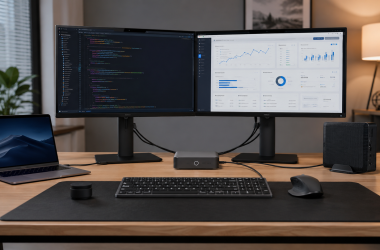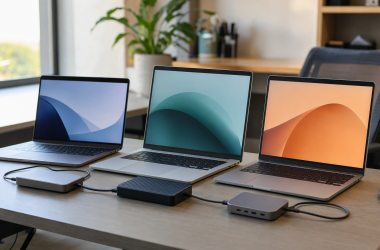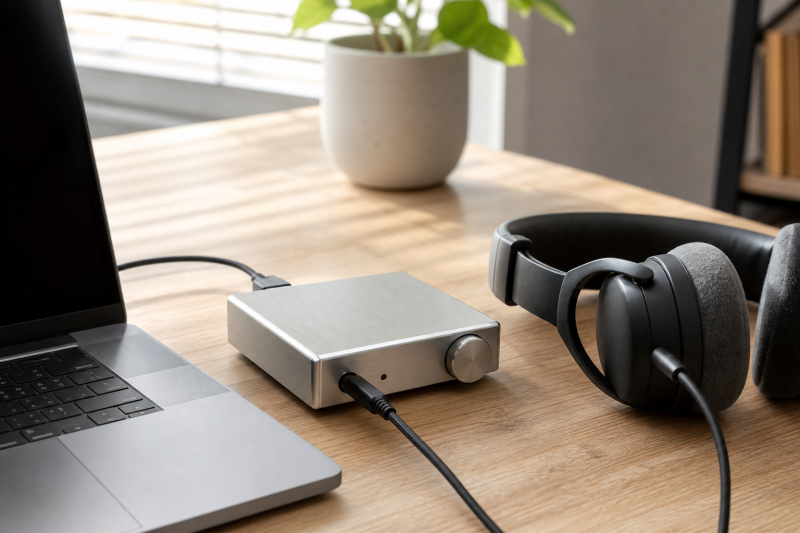
A desktop USB-C headphone amp makes sense when a laptop or desktop computer is the source and the wired-headphone connection and controls need to stay on the desk.
We would start with Fosi’s K7 for a desk setup that needs several listed inputs and separate headphone and RCA outputs. The SK02 is the more focused USB-or-optical desk option with a documented preamp role. Surfans’s X10 is for a compact, bus-powered setup that still needs physical controls. FiiO’s Tiny A is for a smaller 3.5 mm desk path with its stated charging pass-through, while BASN’s PA60 is for a compact two-output unit when its one-output-at-a-time limitation fits the setup.
Quick picks
- Fosi Audio K7: Best for a full desk DAC/headphone-amp layout with several product-listed inputs and RCA output.
- Fosi Audio SK02: Best for USB or optical desktop listening with 3.5 mm and 4.4 mm headphone outputs.
- Surfans X10: Best for a compact desk listening path with display, buttons, gain, and filter controls.
- FiiO SNOWSKY Tiny A: Best for one 3.5 mm headphone connection and a stated Type-C charging pass-through arrangement.
- BASN PA60: Best for compact 3.5 mm or 4.4 mm listening when one active headphone output at a time is enough.
| Image | Product | Details | Check Price |
|---|---|---|---|
 | Fosi Audio K7 | Desktop connections: USB-C, optical, coaxial, Bluetooth, and microphone inputs Headphone outputs: 3.5 mm single-ended and 4.4 mm balanced Extra outputs: RCA for a documented desktop audio-system role | Check Price on Amazon |
 | Fosi Audio SK02 | Inputs: USB and optical Headphone outputs: 3.5 mm single-ended and 4.4 mm balanced Desktop role: Fosi lists line output and preamp use with active speakers or an amplifier | Check Price on Amazon |
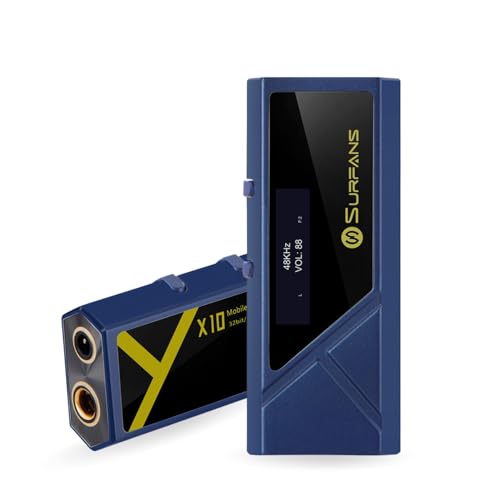 | Surfans X10 | Headphone outputs: 3.5 mm single-ended and 4.4 mm balanced Controls: Display, buttons, gain, and filter controls Power design: Surfans describes bus power without a battery or external supply | Check Price on Amazon |
 | FiiO SNOWSKY Tiny A | Headphone output: 3.5 mm Second port: Type-C with stated 2 A/20 V charging pass-through Host support: FiiO lists Windows, macOS, Android, iOS, Linux, and HarmonyOS | Check Price on Amazon |
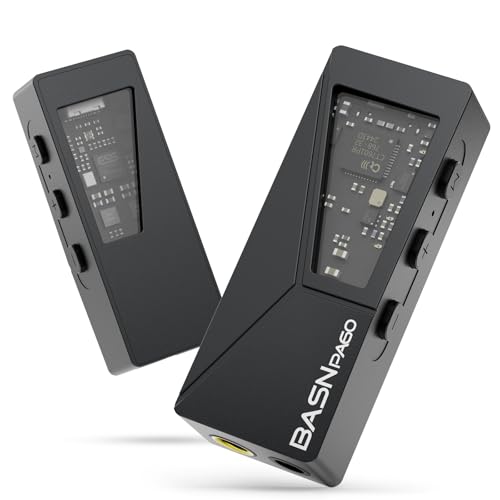 | BASN PA60 | Headphone outputs: 3.5 mm single-ended and 4.4 mm balanced Controls: Independent 60-step volume, filters, and gain modes Important limit: BASN says the two headphone jacks cannot be used simultaneously | Check Price on Amazon |
1. Fosi Audio K7
Fosi’s K7 is the lead pick for a desktop where the headphones are only one part of a fixed computer-audio chain. Fosi lists USB-C, optical, coaxial, Bluetooth aptX HD/LL, and 3.5 mm microphone inputs. It also lists 3.5 mm single-ended and 4.4 mm balanced headphone outputs, plus RCA outputs. That layout separates the computer input, headphone output, and an RCA path.
Fosi lists dual control knobs, shortcut buttons, a display, an angled chassis, and an included 12 V supply. Its stated up-to-2100 mW output figure describes a product rating, not a promise about volume with a particular headphone. Choose the K7 for the connection layout and desk controls you will actually use, not because a headline power figure makes every headphone match automatic.
Our Take
Pick the K7 when your desk needs a USB-C computer path plus a defined headphone and RCA-output plan. It is the broadest fixed-desk option here, but each listed input and output still needs to match the equipment already on the desk.
- Fosi lists USB-C, optical, coaxial, Bluetooth, and microphone inputs for a buyer who already knows the source devices in a fixed desk chain.
- Fosi specifies 3.5 mm single-ended and 4.4 mm balanced headphone outputs, so the choice can begin with the headphone termination already in use.
- The listed RCA outputs create a documented path toward powered speakers or another compatible desktop component rather than limiting the device to headphones alone.
- The K7’s many listed connections require a deliberate source-and-output plan. They do not make every port or headphone combination interchangeable.
- Fosi’s stated output figure does not establish loudness or a particular listening result with an individual headphone.
2. Fosi Audio SK02
Fosi’s SK02 is the cleaner desk pick when the actual source plan is USB or optical and the priority is a direct wired-headphone connection. Fosi lists USB and optical inputs, 3.5 mm single-ended and 4.4 mm balanced headphone outputs, plus a 3.5 mm line/optical output. That input plan is more limited than the K7’s, but it can be the better one when a laptop USB route or an optical source is all the desk needs.
The SK02 also has a multifunction control knob, high- and low-gain controls, and input-mode buttons. Fosi lists it as a headphone amplifier and as a preamp for active speakers or an amplifier. A line-output plan is a separate connection to verify, not a reason to assume the product powers passive speakers. Fosi lists PCM up to 32-bit/384 kHz and DSD256, but those decoding ceilings should follow the basic source and headphone checks rather than replace them.
Our Take
Choose the SK02 when USB or optical input, two listed headphone-output types, and a documented preamp role fit a tidy desktop listening setup. It is for the buyer who needs a specific desk route, not a general promise that a small DAC amp solves every speaker or headphone decision.
- Fosi lists USB and optical inputs for a desk that uses a computer source, an optical source, or one of those paths at a time.
- The stated 3.5 mm and 4.4 mm headphone outputs let a buyer match an existing wired-headphone plug without assuming an adapter is part of the package.
- Fosi documents preamp use with active speakers or an amplifier, which gives a buyer a defined reason to check line-output compatibility.
- The SK02’s USB-and-optical input set is narrower than the K7’s listed connection menu, so it is not the choice for every multi-source desk.
- A preamp role does not mean the SK02 directly drives passive speakers. Any speaker or amplifier path needs its own connection check.
3. Surfans X10
Surfans’s X10 belongs on this list for the desk that wants a compact USB-connected headphone route but does not want all adjustment to happen on the computer. Surfans lists a display, physical buttons, high- and low-gain settings, and three filter options. It also lists 3.5 mm single-ended and 4.4 mm balanced outputs. Those product controls make the X10 the useful middle ground between a simple fixed-cable adapter and a larger desktop DAC amp.
Surfans describes the X10 as bus powered, without a battery or an external power supply, and lists Windows, macOS, Android, and iOS compatibility. Bus power makes the host connection part of the power plan. Surfans states a 522 mW figure for the balanced output and says the X10 does not support Bluetooth. Treat the X10 as a wired, host-powered desktop route, not as a small version of every input-rich desk amp.
Our Take
Choose the X10 when a compact wired USB path with actual display, gain, and filter controls is more useful than multiple desk inputs or a separate power supply. It works best when the computer and the wired-headphone plug are already settled.
- Surfans lists a display, buttons, gain controls, and filter controls for buyers who want product-level adjustments at a desk.
- The listed 3.5 mm single-ended and 4.4 mm balanced outputs let the desktop route match an existing wired-headphone termination.
- Surfans describes the X10 as bus powered without a battery or external supply, which keeps the documented setup tied to the source computer.
- Surfans lists USB connectivity, not the K7’s wider range of desk-source inputs, so it is not the best fit for a multi-source connection plan.
- The stated balanced-output figure applies to that product path and does not establish how a particular headphone will perform.
4. FiiO SNOWSKY Tiny A
FiiO’s SNOWSKY Tiny A is the compact desk choice for a laptop that needs one 3.5 mm wired-headphone connection while its stated Type-C charging pass-through fits the plan. FiiO lists a 3.5 mm headphone port and a Type-C port, with stated 2 A/20 V fast-charging pass-through. That second port can make a cleaner laptop route, but it still leaves the charger, cable, and laptop power requirement as a compatibility check.
FiiO lists an ES9068AS DAC chip, PCM up to 384 kHz, DSD256, and UAC 1.0/2.0. It also lists Windows, macOS, Android, iOS, Linux, and HarmonyOS support. The Tiny A is specifically the 3.5 mm plus Type-C model. Do not import a 4.4 mm output from FiiO’s different Tiny B into this pick. The Tiny A is useful when its compact one-headphone-output and charging-port layout resolves the desk cable plan.
Our Take
Pick the Tiny A when one 3.5 mm headphone connection and a stated Type-C charging pass-through are more useful than a full desktop amplifier’s inputs or outputs. It is a compact laptop-desk route, not a substitute for the K7 or SK02.
- FiiO lists a 3.5 mm headphone port and a Type-C port for a compact audio-and-charging desk layout.
- The stated 2 A/20 V charging pass-through gives a buyer a product-specific reason to assess the charger and cable path before buying.
- FiiO lists Windows, macOS, Android, iOS, Linux, and HarmonyOS support for the stated host-compatibility boundary.
- The Tiny A has one listed 3.5 mm headphone output, so a 4.4 mm headphone plug requires a different documented product route.
- Its charging pass-through is product-specific. It does not guarantee that every laptop, charger, and USB-C cable combination will charge as expected.
5. BASN PA60
BASN’s PA60 is the compact choice for a desk where the source is USB-C and the buyer wants a 3.5 mm or 4.4 mm headphone option with on-device controls. BASN lists USB-C input, 3.5 mm single-ended and 4.4 mm balanced outputs, an independent 60-step volume control, eight selectable filters, high- and low-gain modes, and UAC 1.0/2.0 modes. The connection choice is its practical advantage. Use the output that matches the headphone cable already on the desk.
BASN also lists PCM up to 32-bit/768 kHz and DSD512. Those figures are stated format ceilings, not a guarantee about the computer’s output mode or a listening outcome. BASN says the 3.5 mm and 4.4 mm jacks cannot be used simultaneously. That limitation makes the PA60 a single-listener desktop route, not a way to run two pairs of wired headphones at once. Keep it in the plan only when a small USB-C unit is genuinely the right desk form factor.
Our Take
Choose the PA60 when the desk needs one compact USB-C-to-wired-headphone route with 3.5 mm or 4.4 mm output choices and physical volume control. It is a clear fit for one active headphone connection, not a dual-headphone or multi-input hub.
- BASN lists both 3.5 mm single-ended and 4.4 mm balanced outputs for selecting the documented connection that matches a wired headphone cable.
- The independent 60-step volume control, selectable filters, and gain modes provide listed on-device controls for a compact desk route.
- BASN lists UAC 1.0 and 2.0 modes, which gives a buyer a documented compatibility setting to verify for the intended source device.
- BASN says its 3.5 mm and 4.4 mm jacks cannot be used simultaneously, so the PA60 is not a two-headphone desktop solution.
- The PA60 is a compact portable DAC amp, which means it lacks the K7 and SK02’s documented multi-input or line-output desktop roles.
How to choose a USB-C headphone amp for a desktop setup
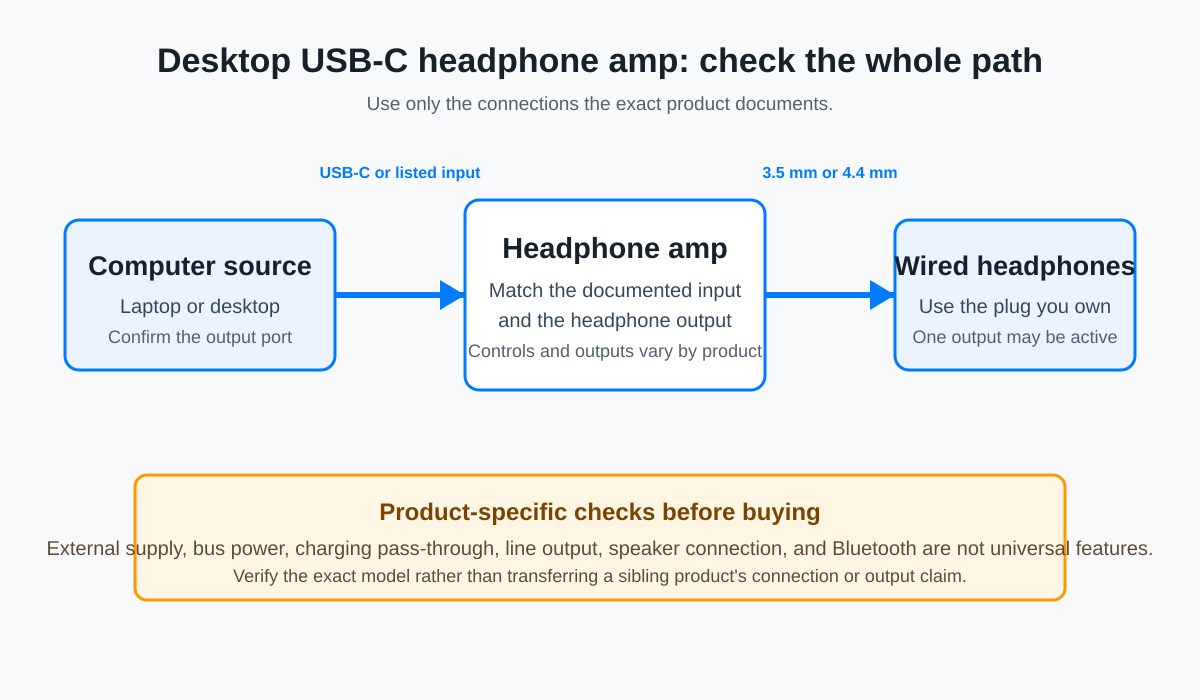
Map the source, amp, and headphone connection first
A desktop audio path needs three confirmed links: the source computer or other source, the product input, and the wired-headphone output. The K7 lists several source inputs, while the SK02 lists USB and optical. The X10 and PA60 use USB connectivity, and the Tiny A is built around its USB-C layout. These physical routes differ, so a product with the most ports is not automatically the useful one.
Before ordering, check these labels:
- Source connection: Identify the exact computer or source output and match it to an input the chosen product documents.
- Headphone termination: Match the cable already on the headphones to the listed 3.5 mm or 4.4 mm output. A connection name is not a reason to assume an adapter or second output.
- Power and placement: Determine whether the product uses an included supply, bus power, or a charging pass-through arrangement, then check the complete cable and power path.
Choose a full desk unit only when its extra connections solve a problem
The K7 and SK02 have product-listed desktop roles beyond a compact USB-C dongle. The K7’s listed RCA output can be useful in a setup with compatible powered speakers or an amplifier. Fosi lists the SK02 as a preamp for active speakers or an amplifier. Those roles are good reasons to select a fixed desk unit only if that downstream path exists. Neither description means a headphone amp will directly power passive speakers.
Use compact USB-C DAC amps for compact desk jobs
The X10, Tiny A, and PA60 can make sense when the desk is built around one computer and one listener. Surfans describes the X10 as bus powered with no battery or external supply. The Tiny A has stated charging pass-through, which shifts the decision to the charger and cable path. BASN says the PA60’s two headphone jacks cannot be used simultaneously. These conditions are not minor details. They determine whether the compact product actually suits the desk.
Keep recording and playback purchases separate
A USB-C headphone amp is for playback to wired headphones. If the job needs a microphone, instrument input, DAW recording, or recording-monitoring controls, choose an audio interface instead. Start with the broader Thunderbolt audio interface guide, then see our podcasting USB-C audio-interface guide or guitar-recording USB-C audio-interface guide. For a carry-focused laptop listening route, see our portable USB-C DAC guide.
Frequently asked questions
Does USB-C guarantee that a headphone amp will work with my computer?
No. USB-C is a connector. Check the exact computer or source, the product’s listed input and host support where supplied, the needed cable, and the wired-headphone connection. A documented product connection is the starting point, not proof that every USB-C port provides the same result.
Do I need a 4.4 mm output for a desktop headphone setup?
No. Choose the output that matches the headphone cable you plan to use. A 3.5 mm headphone plug needs a product that lists a 3.5 mm output. A 4.4 mm plug needs a product that explicitly lists a 4.4 mm output. Do not buy a product around a second output that the current headphones cannot use.
Can a headphone amp also connect to speakers?
Only when the exact product documents a suitable output and the downstream equipment matches it. Fosi lists RCA output on the K7 and lists the SK02 for preamp use with active speakers or an amplifier. Those roles do not mean either product directly powers passive speakers.
Is a compact USB-C DAC amp enough for a desktop?
It can be, when the desk needs one USB-connected source and one compatible wired-headphone route. Surfans, FiiO, and BASN each list a different compact layout and condition. If the desk needs several source inputs, a line-output plan, or a different power arrangement, a larger documented desktop unit may be the better fit.