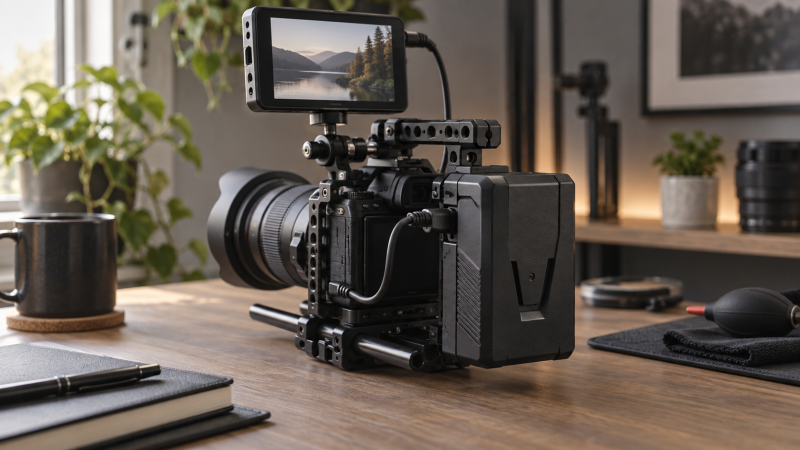
A compact V-mount battery can power a mirrorless camera and selected accessories from one removable pack. The right choice depends less on the biggest watt-hour number than on the camera input voltage, connector, cable and total load. A V-mount plate does not make every D-Tap, USB-C and DC output interchangeable.
These five compact V-mount batteries cover simple multiport power, established professional battery systems and app or on-pack status controls. We compared documented connections and buyer roles, not measured runtime. Before buying, sketch the complete camera, monitor and light wiring plan and confirm the battery’s output matches each device.
Choose the power path and cable for each device first, then choose a battery whose ports and continuous output can support the whole rig.Compact V-Mount Batteries Compared
| Image | Product | Details | Check Price |
|---|---|---|---|
 | SmallRig VB99 Pro | Listed capacity: 99Wh USB-C: Up to 100W PD listed Other outputs: USB-A, DC, BP, D-Tap Best fit: Compact mixed-output rig | Check Price on Amazon |
 | Anton/Bauer Titon Micro 90 V-Mount | Listed capacity: 94Wh official / 98Wh Amazon title USB-C: Not established Other outputs: P-Tap, USB Best fit: Existing Titon ecosystem | Check Price on Amazon |
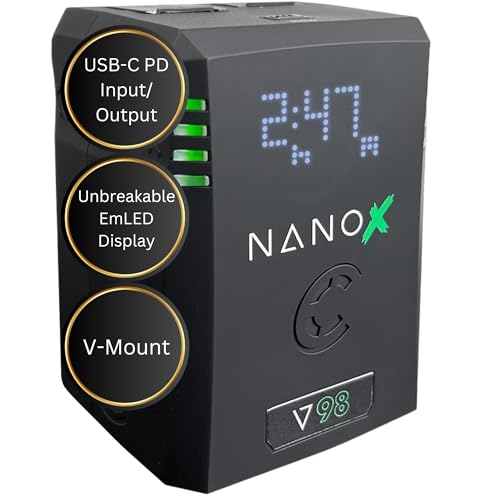 | Core SWX NANO X V98 | Listed capacity: 98Wh USB-C: PD input/output listed Other outputs: Check exact V98 port layout Best fit: Professional status visibility | Check Price on Amazon |
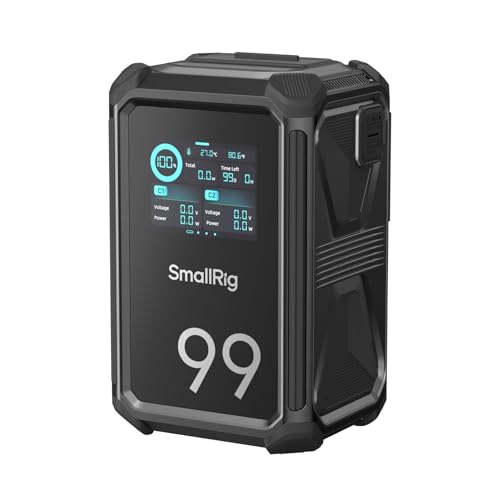 | SmallRig X99 | Listed capacity: 99Wh USB-C: Two ports listed Other outputs: Two D-Tap, app controls Best fit: App-managed multi-device rig | Check Price on Amazon |
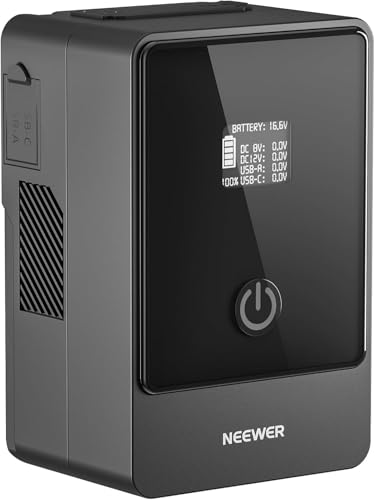 | NEEWER PS099F | Listed capacity: 99Wh USB-C: Bidirectional 100W PD listed Other outputs: USB-A, 8V/12V DC, BP, D-Tap Best fit: Mixed-voltage accessory rig | Check Price on Amazon |
1. SmallRig VB99 Pro — Best Compact Multi-Output Pack
The VB99 Pro listing identifies a 99Wh mini V-mount pack with USB-C PD, USB-A, DC 8V and 12V, BP and D-Tap connections. That mix suits a mirrorless cage with a separately powered monitor or small accessory. The listed body measures about 4.2 by 2.9 by 2.2 inches and weighs about 23.3 ounces. The dimensions and weight are for the pack alone, not the complete plate and cable arrangement.
Two USB-C connections are listed, but port count alone does not establish how much power every output can deliver at once. Check the current manual for simultaneous-output limits, then add camera and accessory draw. Confirm a camera’s USB-C charging or power-delivery behavior before assuming the port can run it continuously while recording. If the camera needs a regulated dummy-battery cable, choose that cable by camera model and rated voltage.
SmallRig’s backplate mounting options may help with cage placement. Test clearance for the camera’s screen, battery door and compact fill light before fastening the plate. A small pack behind a light camera can still move the center of gravity enough to affect handheld balance or a mirrorless gimbal.
Our Take Choose VB99 Pro when you know which USB-C, DC and D-Tap connections your setup requires. It is a flexible starting point, not a substitute for checking cable polarity, voltage and shared-output limits.
- 99Wh compact form listed.
- USB-C, USB-A, DC and D-Tap connection options.
- Mounting details in SmallRig documentation.
- Multiple ports still need a verified simultaneous-load plan.
- Plate and cable choices add cost and bulk.
2. Anton/Bauer Titon Micro 90 V-Mount — Best Existing Titon Fleet
Anton/Bauer’s official Titon Micro 90 V-mount page describes a compact professional pack with a P-Tap output, USB port and five-step fuel gauge. The manufacturer specifies 94Wh and 14.4V. The exact Amazon offer title instead says 98Wh. We cannot resolve that difference from the saved evidence, so check the label and current technical sheet for the exact unit offered before planning runtime or transport.
Its strongest reason to buy is an existing Anton/Bauer workflow, meaning known V-mount plates, charging equipment and service expectations. A first-time mirrorless user should not assume that the battery includes a plate, an appropriate camera cable or a USB-C PD output. The official page names a USB port, but does not establish USB-C PD behavior for this exact unit. Match a charger and mount by model rather than treating every V-mount accessory as universal.
The five-step indicator can provide a quick visual check, but it is coarser than a measured promise of remaining runtime. If your shoot also uses a camera teleprompter, include its screen power separately. Mounting all the gear on one plate may be awkward even when electrical output is sufficient.
The manufacturer’s 94Wh figure conflicts with the Amazon title’s 98Wh. Verify the delivered battery label and revision before relying on either number.Our Take Buy Titon Micro 90 V-mount when it fits an existing Anton/Bauer charging and plate system. For a new rig built around USB-C, its exact port behavior and conflicting capacity listing make it a less straightforward first purchase.
- Official V-mount, P-Tap and fuel-gauge documentation.
- Compact route for an existing professional battery fleet.
- 94Wh official versus 98Wh marketplace title requires verification.
- USB-C PD is not established for this exact offer.
- Separate compatible plate and charger may be needed.
3. Core SWX NANO X V98 — Best On-Pack Status
The NANO X series page describes a 98Wh V-mount variant with an on-pack status display, wraparound fuel-gauge LEDs and USB-C PD input/output. Its status features are useful when several packs rotate through a shoot and an operator must identify the charged one quickly. Core SWX also describes VoltBridge iD diagnostics that are readable on a phone, plus asset tagging. The diagnostics and tagging are manufacturer feature claims, not a test of app reliability.
The V98 is a choice for a fleet of packs, not a reason to buy every accessory from one maker. Confirm that the exact V98 variant in the Amazon offer has the connection layout you plan to use. Core’s series page also covers other capacities and a Gold-Mount variant. Do not transfer a feature from a different capacity or mount to this one without checking the model sheet. Likewise, check charger support for this V-mount revision.
On a small cage, screen visibility is as important as the display specification. Place the plate so the operator can see status without pulling the camera apart or covering an on-camera monitor. If the body is going on a motorized camera slider, verify the carriage’s load and moving cable clearance first.
Match the exact V98 V-mount revision, not only the NANO X series name, to its charger, plate and output diagram.Our Take Choose NANO X V98 if clear on-pack status and a Core SWX fleet workflow are more important to you than the simplest USB-C setup. Confirm the exact variant’s port map before wiring a camera.
- 98Wh V-mount option documented in the NANO X series.
- Display and wraparound status LEDs described.
- USB-C PD input/output listed.
- Series page spans multiple capacities and mount types.
- Phone diagnostics add an optional workflow dependency.
4. SmallRig X99 — Best App-Managed Outputs
The X99 listing describes a 99Wh V-mount battery with two USB-C and two D-Tap outputs. It also advertises a companion app for checking several batteries, switching supported ports and locating a pack. The X99 is a distinct choice from the simpler VB99 Pro when remote status or output control is part of the shooting workflow. App control is an added convenience, not a replacement for a physical power switch or a written wiring plan.
SmallRig also advertises a rugged case and drop resistance; those are manufacturer claims, not independently verified results. A battery surviving a stated drop does not mean a camera, cable or plate will survive it. The listing gives a weight around 31 ounces, so balance and secure mounting are especially important for a small mirrorless body. Check the full camera build against a tripod kit before choosing a head, or use a plate position that keeps the pack close to the support center.
When two accessories require D-Tap, verify the maximum combined current and each cable’s connector orientation. An app can report status yet cannot correct a dummy battery with the wrong voltage. If you do not need remote switching or multiple D-Tap loads, VB99 Pro may be the simpler SmallRig fit.
Our Take Choose X99 when you have multiple powered accessories and will use its status and port controls. Skip the extra complexity if a single camera cable and monitor are your whole load.
- Two USB-C and two D-Tap outputs listed.
- Remote status and port controls advertised.
- 99Wh capacity stated in exact listing.
- Heavier listed weight than some compact alternatives.
- App behavior and ruggedness rely on manufacturer claims.
5. NEEWER PS099F — Best Simple 100W USB-C Alternative
The exact PS099F offer lists a 99Wh V-mount pack with bidirectional USB-C PD up to 100W. Its named outputs also include USB-A, DC 8V and 12V, BP and D-Tap. The pack is a simple way to assemble a camera setup built around USB-C with a separately powered accessory, provided each device supports the selected connection and the battery’s shared output capacity.
The listing mentions a fast full recharge with a separately supplied suitable charger. Treat that as a seller claim under its test conditions, not a guaranteed time in your charging bag. Check the charger and cable watt ratings before expecting 100W PD. A USB-C power meter can help identify what a compatible source and cable negotiate, but it cannot validate the internal safety of a battery or an incorrect camera adapter.
Choose PS099F over a pack with more app features if the wiring plan is already straightforward. The listed D-Tap cable compatibility does not prove that a specific camera dummy-battery cable comes in the box. Put the plate, charger and required regulated cables on the order list, then compare the complete rig cost and mass with VB99 Pro.
Our Take Pick PS099F for a planned mirrorless rig built around USB-C that also needs a few conventional accessory outputs. Verify its included parts and total load rather than assuming every advertised port can run at peak simultaneously.
- 99Wh and bidirectional USB-C PD100 listed.
- USB-A, DC and D-Tap outputs listed.
- Charger and camera-specific cables need separate confirmation.
- Listed recharge time is not independently measured.
- Shared output ceiling needs checking for multi-device rigs.
Buying Guide
1. Map every device to a supported output
Start with the camera’s power-input specification. A USB-C socket may charge only when the camera is off, or it may support continuous external power under defined conditions. A D-Tap cable can also feed a regulated camera dummy battery, but the adapter must match the camera model, polarity and voltage. Never plug a battery’s unregulated output directly into an input merely because the connectors can be made to fit.
Then list the monitor, transmitter and lights separately. Record each device’s connector, accepted voltage and peak watts. A wireless microphone receiver may have a different charging arrangement from the camera, while a larger interview light is usually better on a separate stand. Compare the summed load with the exact battery’s simultaneous-output limits, not only a single USB-C port’s headline rating.
2. Estimate runtime without promising it
Watt-hours divided by total watts is only a rough upper-bound starting point. Conversion losses, camera operating mode, temperature and the battery’s cutoff behavior reduce useful time. A 99Wh label does not guarantee a fixed number of recording hours. Build margin into the schedule and test your own camera, lens, monitor and accessories together before a paid shoot.
Resolve capacity-label conflicts before relying on them. Anton/Bauer’s official Titon Micro 90 specification says 94Wh, while the exact marketplace title says 98Wh. Check the delivered label and manual for its revision. If you are preparing air travel, consult the current airline and regulator rules for that route and carry arrangement rather than assuming a battery is approved merely because a listing says 99Wh.
3. Balance the physical rig and charging kit
Count the V-mount plate, bracket and cables as part of the battery choice. A heavy rear pack can improve or worsen camera balance depending on the lens and support. Check access to the camera screen, controls and battery door. Run a short movement rehearsal on a mirrorless gimbal or camera slider before declaring a rig workable.
Confirm the charger by exact pack and input. USB-C PD input is convenient only with a suitable supply and rated cable. Traditional V-mount chargers must support the battery’s mount, chemistry and charging specification. Pack an independent spare for a long job. Rotating a second battery is usually safer than relying on an optimistic claim about recharge time between takes.
FAQ
Can a V-mount battery power my mirrorless camera directly?
Only if the camera supports the particular power path you plan to use. Check its manual for USB-C continuous power or choose a correctly regulated, model-specific dummy-battery adapter. A V-mount plate alone is just a mount and electrical interface for compatible equipment.
Test the assembled camera at its highest normal recording settings with the monitor and other accessories connected. Watch for a camera that slowly drains its internal battery despite external USB-C, or shuts down when another device starts drawing power. Fix the wiring before a location shoot.
Is a 99Wh pack enough for a camera and monitor?
It may be, but the answer depends on the camera and monitor’s actual watts and how long you need them running. Divide the stated watt-hours by the combined draw for a rough starting estimate, then leave generous margin for conversion losses and operating changes.
A monitor’s brightness, wireless accessories and camera recording settings can all alter draw. Test your exact setup with a full battery and record the practical interval. Carry a spare if missing a take would be worse than carrying the extra pack weight.
Are USB-C, DC and D-Tap ports interchangeable?
No. USB-C PD negotiates a supported profile, while fixed-voltage DC and D-Tap paths have their own ratings and connector rules. Match voltage, polarity, cable rating and device input. A connector that physically mates can still be the wrong electrical path.
Read the exact battery and device documentation rather than copying a cable from another rig. If more than one output runs at once, verify the shared limit. Do a short supervised test before routing cables into a cage or behind a mounted monitor.
Bottom Line
SmallRig VB99 Pro is the adaptable mixed-output starting point. Core SWX NANO X V98 fits a professional fleet where visible status is important, while NEEWER PS099F suits a simpler wiring plan built around USB-C. Anton/Bauer Titon Micro 90 makes sense inside its existing ecosystem, after resolving the capacity-label difference. SmallRig X99 is for users who will use its additional app and port controls.