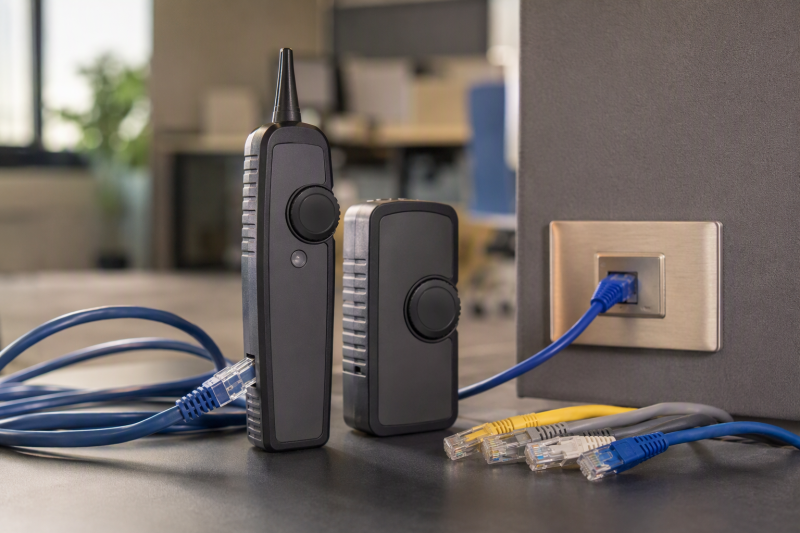
An Ethernet toner helps identify which unlabeled cable or wall jack reaches a particular rack, closet, or desk. A transmitter places a recognizable signal on the wire, and a handheld probe detects that signal among bundles or behind nonconductive surfaces. Many kits add continuity, wire mapping, fault location, port blinking, telephone-line checks, or PoE information, but those functions are not equal across products.
These eight kits span inexpensive analog tracers, detachable RJ45 mapping tools, professional tone-and-probe sets, and a multifunction tester with cable-length and PoE modes. The right choice depends on whether the run is connected to active network gear, whether its far end is accessible, how noisy or crowded the environment is, and whether testing or measurement is needed after the cable is found.
Do not connect a toner to an energized circuit unless the exact mode and voltage are explicitly supported. “Voltage detection” is not permission to inject a tone onto mains wiring, and several kits are limited to low-voltage or non-active conductors.- Best overall for office Ethernet: ZHOUCE NF-8209S combines three tracing modes, wire mapping, fault checks, cable-length functions, PoE information, port blinking, and an included 9V battery.
- Best professional analog kit: TEMPO 701K-G adds a high-power generator, amplified probe, bright proximity LED, distinct warble tones, work light, adapters, and a carrying case.
- Best straightforward low-voltage kit: Klein Tools VDV500-705 covers open-ended wires under 60V, includes RJ45 and alligator connections, and adds pin-to-pin mapping.
Ethernet Cable Toner Kit Comparison
| Image | Product | Details | Check Price |
|---|---|---|---|
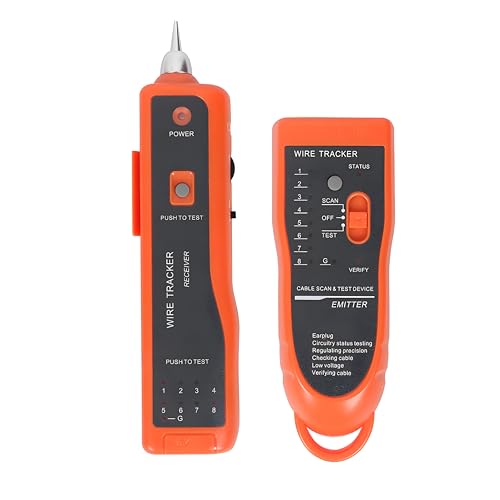 | Goeco Ethernet Network Toner Kit | Connections: RJ45, RJ11, alligator adapter Tracing aids: Headphone, volume, work light Testing: Breakpoint and polarity claims Batteries: Not included Safety: Voltage wording unclear; verify manual | Check Price on Amazon |
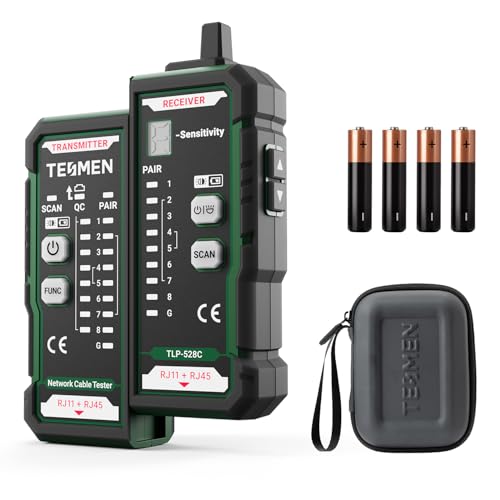 | TESMEN TLP-528C Network Cable Tester | Connections: RJ45 and RJ11 Functions: Trace, sequence, continuity, QC crimp Remote: Detachable Batteries: 4 AAA included Case: Storage box included | Check Price on Amazon |
 | TEMPO 701K-G Wire Tracer Kit | Generator: 77HP-G Probe: 200EP-G amplified Indication: Warble tone and proximity LED Connections: Modular, RJ11/45, alligator, socket adapter Case: Nylon case included | Check Price on Amazon |
 | Moocci RJ45 RJ11 Cable Tracer | Connections: RJ45, RJ11, BNC via adapter Functions: Trace, 18-light sequence, continuity, phone PoE claim: Sequence below 60V Tracing aids: Earphone and flashlight Batteries: Not included | Check Price on Amazon |
 | TEMPO 601K-G Wire Tracer Kit | Connections: RJ45, RJ11, RJ12, modular, alligator Functions: Trace, continuity, shorts, phone polarity Probe: Adjustable gain Indication: Tone and LED Case: Not stated | Check Price on Amazon |
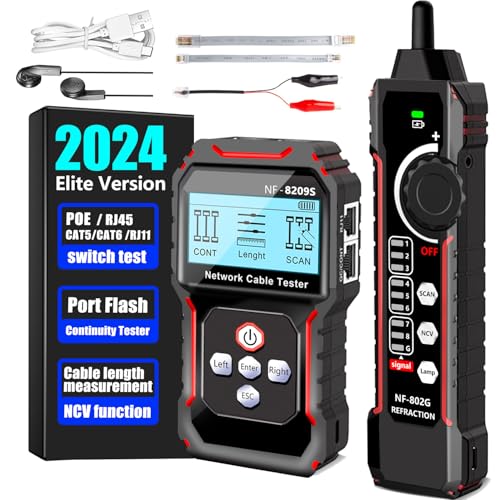 | ZHOUCE NF-8209S Network Cable Tester | Tracing modes: Normal, interference-resistant, PoE Functions: Map, faults, length, port blink, PoE Distance: 200 m mapping; 300 m remote/length stated Display: Large LCD Battery: 9V included | Check Price on Amazon |
 | Eujgoov 200EP Cable Tracing Kit | Functions: Trace, shorts, telephone states Tone: 2 signatures Indication: Audible and LED proximity Housing: ABS Package details: Verify before purchase | Check Price on Amazon |
 | Klein Tools VDV500-705 Wire Tracer Kit | Scope: Open-ended non-active wires below 60V Connections: RJ45 test cable and alligator clips Functions: Trace and pin-to-pin map Tracing aids: Work light, volume, headphone jack Active network: Not stated | Check Price on Amazon |
1. Goeco Ethernet Network Toner — Best Budget Kit for Noisy Rooms
Goeco traces RJ45 and RJ11 lines, plus electrical or speaker wire when connected through its alligator-clip adapter. The listing says it can locate breaks without damaging the cable cover and can trace cable attached to an operating switch, router, or PC terminal. The active-network claim is useful, but you should use it only in the documented mode and connection method.
The probe offers adjustable volume, a headphone connection for noisy areas, and an illuminating lamp for dark racks or ceiling spaces. Comparing the strength of its audible tone helps narrow a cable within a bundle. A light-touch switch and automatic shutoff are meant to conserve battery power, with low-voltage indicators flashing below a 6V battery level.
A compact toolkit and network wire stripper are included, but batteries are not. The source mentions positive and negative battery measurements from 10V to 110V without enough detail to treat the unit as a general electrical tester. Use the toner for supported low-voltage communications work and keep it away from unknown high-energy circuits.
[accentbox]Goeco is appealing when headphone monitoring, adjustable volume, and a work light matter more than advanced mapping or length measurement. Plan to supply batteries.[/accentbox]- Headphone and adjustable volume
- Work light and auto shutoff
- RJ45, RJ11, and clip connections
- Batteries not included
- Voltage-measurement description is unclear
2. TESMEN TLP-528C — Best Compact Mapping and Tracing Combo
The TLP-528C combines Ethernet and telephone tracing with line-sequence and continuity tests. Its probe is described as interference-resistant and uses a nonmetallic sensitive tip to locate Cat 5 or Cat 6 cable in bundles, under carpets, behind decorative walls, and above ceilings. It fits an office where the job extends beyond finding one port to checking how the cable is terminated.
LED sequence indicators show wiring order and reveal incorrect connections. A QC crystal-head crimp inspection adds a quick check of modular-plug quality. The controller and remote separate, so the two ends of a long installed cable can be checked from different locations. That detachable arrangement is especially useful between a patch panel and a distant wall jack.
The kit includes a storage box, manual, and four AAA batteries, so it is ready for basic use. The source does not state active-switch tracing, PoE testing, maximum distance, headset support, or a voltage limit. Do not infer those functions from the general tester category.
[accentbox]Choose TESMEN when the core job is trace, map, and inspect RJ45 or RJ11 terminations without the deeper complexity of the NF-8209S.[/accentbox]- Tracing, continuity, and wire sequence
- Detachable remote
- Batteries and storage box included
- No distance specification
- No PoE or live-network mode stated
3. TEMPO 701K-G — Best Professional Analog Kit
The TEMPO 701K-G is a professional analog tone generator and amplified probe for voice, data, and video wiring. It identifies wires in bundles, checks circuit breaks, monitors voltage, and traces through nonconductive surfaces such as wood and drywall. It is designed around a high-power 77HP-G generator and 200EP-G probe amplifier rather than an all-in-one LCD tester.
An LED proximity indicator becomes brighter as the probe approaches the correct pair, adding visual confirmation to the audible warble tone. A work light helps inside racks and behind furniture. Distinct signals are intended to remain recognizable in noisy environments, where a weak generic beep can be difficult to separate from background sound.
The package includes a modular plug, alligator leads, RJ11/45 connection, socket adapter, and nylon carrying case. The source does not provide mapping, PoE classification, cable length, or an explicit safe-voltage limit. Its strength is confident tracing and a professional accessory set, not multifunction certification.
[accentbox]Select the 701K-G for strong audible tracing plus a visual proximity indicator when cable identification is the primary job.[/accentbox]- Bright proximity indication
- Distinct high-power warble tones
- Adapters and carrying case included
- No wire-map feature stated
- Safe-voltage range not stated
4. Moocci RJ45/RJ11 Cable Tracer — Best Active-Line Budget Feature Set
Moocci’s SCAN mode traces RJ45, RJ11, BNC, and other metal wires through an adapter. The listing says it can trace lines connected to weak-current devices such as Ethernet switches, routers, and PCs. It also warns not to use the tool on a strong live circuit, a boundary that should govern any unfamiliar office wiring.
TEST mode uses 18 sequence indicators to identify opens, shorts, missing wires, and reversed connections. It checks continuity, telephone clear/ring/busy state, TIP and RING, and DC polarity. The product also claims line-sequence calibration for PoE below 60V and a digital signal for shielded-wire detection, with a “G” indicator assigned to the shield.
An earphone, adjustable volume, and LED flashlight support work in noisy or dark spaces. Batteries are not included, and the source does not state the required battery type. New stock was marked scarce when checked. The one-year warranty is useful, but the buyer should verify current instructions before connecting any powered line.
[accentbox]Moocci offers a broad budget toolset, but observe the explicit no strong live circuit warning and keep PoE use within the stated below-60V mode.[/accentbox]- SCAN and TEST modes
- Earphone and flashlight
- Shield and below-60V PoE claims
- Batteries not included
- Must not be used on strong live circuits
5. TEMPO 601K-G — Best Classic Voice and Data Tracer
The 601K-G is TEMPO’s more traditional tracing kit for voice, data, video, Internet, coax, RJ45, RJ11, and RJ12 wiring. Its clear warble tone is designed to identify a wire within a multi-pair cable, trace through walls, and help locate circuit breaks. A tone generator and probe are the center of the workflow.
The generator supports continuity and short-circuit checks, while LED indications cover continuity, voltage, polarity, and telephone ringing. Telephone-line polarity is a named feature. Adjustable gain lets the technician reduce overwhelming signals near the source or increase sensitivity when the target is faint in a crowded bundle.
Modular plugs and alligator test leads are included. Compared with the 701K-G, the source does not list a carrying case, work light, proximity-brightness LED, or socket adapter. It is a good fit for conventional communications troubleshooting where adjustable analog response is more important than an LCD or cable-length estimate.
[accentbox]Choose the 601K-G for classic warble-tone tracing, adjustable gain, continuity, and telephone diagnostics without the 701K-G accessory package.[/accentbox]- Adjustable probe gain
- Continuity and short checks
- Telephone polarity and ring indication
- No cable-length function stated
- No work light or case stated
6. ZHOUCE NF-8209S — Best Overall Multifunction Pick
The NF-8209S is the broadest tool here. It offers normal, interference-resistant, and PoE tracing modes, plus analog and digital signals. Wire mapping covers pins 1 through 8 and shield, while the listing claims detection of opens, shorts, miswires, split pairs, and cable breaks. Both host and remote support mapping work at a stated 200 meters.
Cable-length measurement and remote identification are described up to 1,000 feet or 300 meters, although the source also says greater distance improves accuracy without giving a tolerance. Port blinking helps locate the corresponding switch or router port. The QC crimp test claims support through Cat 8, but a crimp test is not the same as certifying installed-cable bandwidth to a category standard.
PoE functions identify powered pins, voltage, and stated PSE type under the listed af standard. The tool also detects AC voltage from 50V to 1000V; detection should not be confused with permission to tone or touch energized conductors. A large LCD, drop-resistant case, LED illumination, RJ45 remote, and included 9V battery complete the kit.
[accentbox]The NF-8209S is the best fit when one kit must handle tracing, mapping, length, faults, port blinking, and PoE inspection. Treat its category and voltage functions as screening tools, not formal certification or electrical-safety clearance.[/accentbox]- Three tracing modes
- Length, mapping, PoE, and port blink
- Battery and protective case included
- Length accuracy tolerance not stated
- QC test is not cable certification
7. Eujgoov 200EP Kit — Best Basic Audible and Visual Probe
The Eujgoov kit is a basic tone-and-probe option for telephone, data, Internet, voice, security, and communications wiring. It lists two tone signatures plus audible and visual indication. The LED proximity light provides another clue as the probe approaches the target wire, which can help when multiple cables produce similar audio levels.
The ABS probe housing is described as tough, strong, and wear resistant. Listed functions include line tracing, short-circuit testing, and telephone clear, busy, and ringing recognition. The source does not state connector types, included leads, batteries, safe voltage, cable categories, wire mapping, or package contents beyond the product description.
The missing details make the Eujgoov a fit only for buyers willing to confirm the current kit before purchase. Do not assume that “200EP” gives it the same generator, accessories, or specifications as another brand’s probe. Its strongest documented feature is the simple combination of two tones and LED proximity indication.
[accentbox]Choose Eujgoov only after verifying connectors, leads, power, voltage limits, and included components. The supplied listing is too sparse for a blind office deployment.[/accentbox]- Two tone signatures
- Audible and LED proximity indication
- ABS probe housing
- Connector and accessory details omitted
- Safe-voltage range not stated
8. Klein Tools VDV500-705 — Best Straightforward Low-Voltage Kit
Klein’s kit is an analog tone generator and probe for open-ended, non-active low-voltage wires under 60V. It covers Ethernet, Internet, telephone, speaker, coax, video, and data cabling. The explicit non-active boundary is clearer than listings that mix live-device claims with general voltage language.
Alligator clips connect to unterminated conductors, while an included RJ45-to-RJ45 test cable supports modular connections. Used together, the toner and probe can perform a pin-to-pin wire map. Klein advises separating wires when possible and using proper grounding to improve tone detection and accuracy.
The probe includes a work light, adjustable volume, and headphone jack for dark or noisy areas. The source does not list batteries, a case, cable-length measurement, PoE classification, or active-switch tracing. Klein’s kit is therefore a deliberate low-voltage tracing and mapping tool rather than an all-purpose digital network analyzer.
[accentbox]Klein is the clearest straightforward choice when the work stays on open-ended, non-active wiring below 60V and clear limits matter.[/accentbox]- Explicit under-60V non-active scope
- RJ45 cable and alligator clips
- Work light, volume, and headphone jack
- No active-switch mode stated
- No PoE or length function
Buying Guide: Choosing an Ethernet Toner Kit
Separate tracing from wire testing
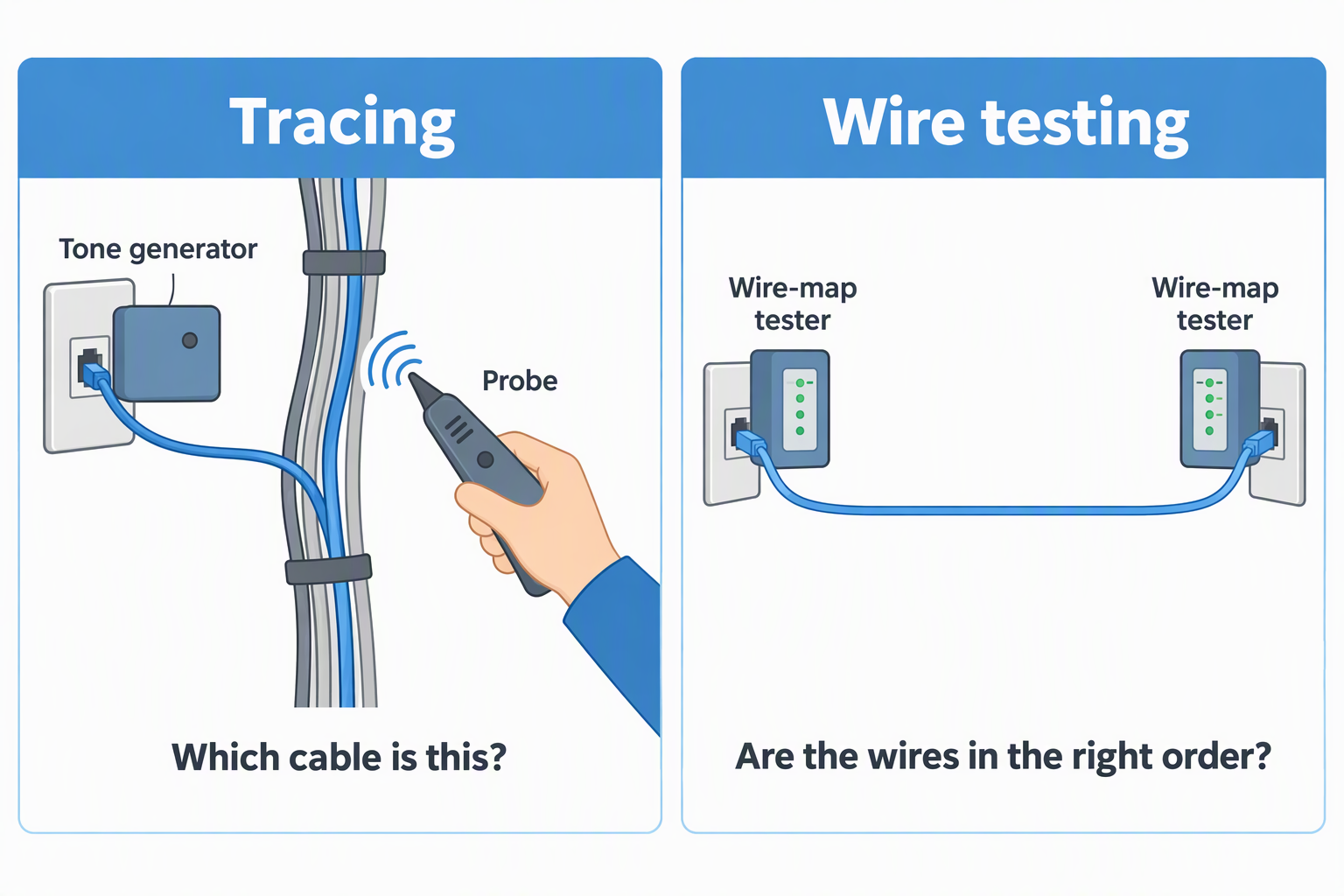
A toner answers “which cable is this?” by injecting and detecting a signal. A continuity or wire-map tester answers “are these known endpoints wired correctly?” by checking conductor order and faults. Tools such as TESMEN, Moocci, NF-8209S, and Klein combine both functions, while the TEMPO models emphasize tone-and-probe tracing.
Decide whether the job ends after identifying the run. New terminations also benefit from checks for opens, shorts, reversals, miswires, and split pairs. Even then, a map or continuity test does not certify that a cable meets its claimed Cat 6 or Cat 8 transmission performance.
Determine whether the cable is active
Some listings claim tracing on cables connected to switches, routers, or PCs, including Goeco and Moocci. Klein explicitly limits its analog tracing to open-ended, non-active wires under 60V. Do not assume that every probe can safely or effectively tone an active Ethernet or PoE link.
Identify the circuit and disconnect equipment when practical. Follow the selected mode’s manual and voltage limit. A tool that can detect voltage is not necessarily designed to inject tone while energized. Unknown building wiring should be treated as unsafe until qualified personnel establish otherwise.
Choose analog, digital, or multiple tracing modes
Analog warble tones are simple and familiar, with adjustable gain or volume helping separate nearby pairs. TEMPO uses distinctive audible signals, while 701K-G and Eujgoov add visual proximity feedback. Headphones on Goeco, Moocci, and Klein improve tracing in a loud office or equipment room.
The NF-8209S provides normal, interference-resistant, and PoE modes, plus analog and digital signals. Multiple modes can help around energized network equipment and dense bundles, but only when the correct mode is selected. More functions increase the need to understand the controls before touching production cabling.
Match connectors and wire types
RJ45 covers common Ethernet, while RJ11 and RJ12 address telephone-style connections. Alligator clips attach to unterminated pairs, speaker wire, or other supported conductors. Moocci also names BNC through an adapter, while TEMPO covers voice, data, and video wiring.
List the exact endpoints before buying. A kit with RJ45, modular plugs, and alligator leads handles more office scenarios than an Ethernet-only remote. Coax and shield tracing may require adapters or modes that are not included merely because the product description mentions those cable types.
Prioritize probe feedback for the work environment
In a quiet, sparse closet, an audible beep may be enough. In a live office or crowded rack, adjustable sensitivity, volume, headphones, and a visual proximity LED make identification more confident. The 701K-G uses an indicator that gets brighter near the target, while Goeco and Moocci support earphones.
Probe shape and tip sensitivity also affect results between tightly packed patch-panel cables. Start at lower gain near the generator so signal bleed does not make the entire bundle sound active, then increase sensitivity as needed. Separate candidate wires when possible and confirm the result at both ends.
Evaluate length and port-blink features carefully
The NF-8209S is the only option here with stated cable-length measurement and switch-port blinking. Its mapping function is listed to 200 meters, while remote identification and length work are described up to 300 meters. No measurement tolerance is provided, so use the distance as an estimate rather than installation certification.
Port blinking can locate a switch port without probing every cable, provided the attached network equipment and link state support the method. Port blinking complements toner tracing rather than replacing it. Document the resulting wall jack, cable label, patch-panel port, and switch port once identified.
Treat PoE and voltage features as safety boundaries
Moocci limits its direct PoE sequence claim to below 60V, and Klein specifies non-active wires below 60V. NF-8209S reports PoE pins and voltage and detects AC voltage, but detection does not authorize contact or tone injection. Goeco’s 10V to 110V battery wording is not a clear live-circuit rating.
Never use a communications toner as a substitute for a properly rated electrical test instrument. Disconnect unknown circuits where possible, respect category and voltage ratings, and stop when wiring could be mains-powered. Electrical tracing outside the tool’s documented scope belongs with qualified personnel.
Frequently Asked Questions
Can a toner identify a cable connected to a live switch?
Some kits can. Goeco and Moocci explicitly claim active-network tracing, while Klein specifies open-ended non-active wiring. Capability depends on the tool and mode, so there is no universal answer.
Follow the exact manual and protect connected equipment. If active tracing is not stated, disconnect the cable before applying tone rather than assuming compatibility.
Is a cable toner the same as a cable tester?
No. A toner identifies or follows an unknown run. A tester checks a known cable for conductor sequence, continuity, opens, shorts, and other faults. Many kits combine both functions.
Neither basic tracing nor wire mapping proves high-frequency category performance. Formal certification requires different measurement capability.
Can I trace cable through a wall?
Several listings claim tracing behind nonconductive surfaces such as drywall, wood, carpet, and ceilings. Detection strength depends on distance, wall material, adjacent wiring, probe sensitivity, grounding, and interference.
Metal, dense construction, and signal bleed can reduce precision. Trace from accessible points and confirm with labels or endpoint tests before opening any surface.
Does a toner locate an exact cable break?
Some products claim breakpoint or fault location, but the method and accuracy are not fully specified in every listing. A disappearing tone may narrow a region without giving a precise distance.
The NF-8209S adds length and fault functions, while other kits focus on continuity or tracing. Treat fault-location claims as diagnostic aids and confirm before replacing an installed run.
Should I use headphones when tracing?
Headphones can make a weak tone easier to compare in noisy environments and are supported by Goeco, Moocci, and Klein. They also reduce disturbance in an occupied office.
Keep volume at a safe level and use visual indicators where available. Lower gain near crowded bundles can reduce false identification from signal bleed.
Related Studio Wiring Guides
- Ethernet patch panels for creator studio wiring
- Audio cable testers for studio patch cables
- Managed 2.5GbE switches for editing networks
- SFP+ network cards for small 10GbE studios
- SFP+ direct attach cables for studio links
- Fiber media converters for desk extensions
- Wi-Fi 7 PCIe cards for workstations
- Rack shelves for non-rack studio gear
Bottom Line
The ZHOUCE NF-8209S is the strongest all-in-one network-maintenance choice. The TEMPO 701K-G is the focused professional tracer for strong analog indication, while the Klein VDV500-705 offers the clearest straightforward scope for open-ended low-voltage wiring.