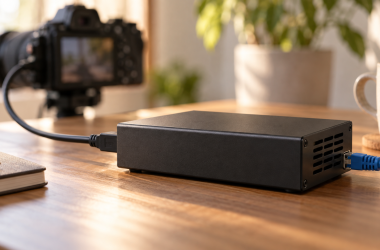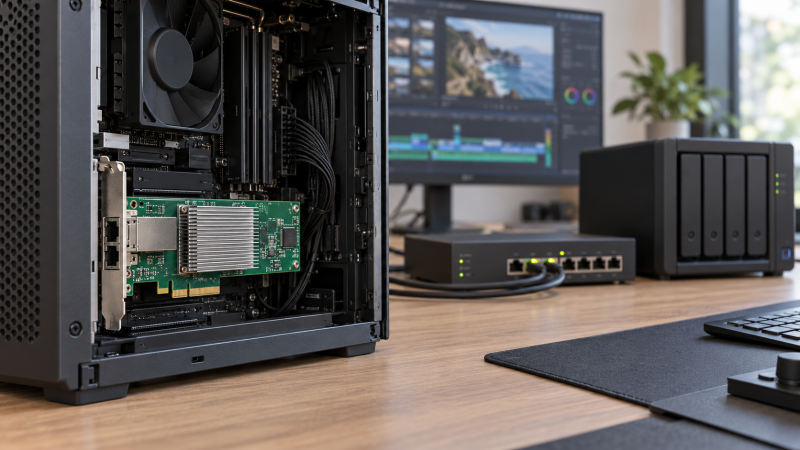
An SFP+ network card is the workstation-side link in a 10GbE studio that uses fiber, DAC, or AOC cabling. It can give an editing desktop a direct 10GbE path to shared storage or a multi-gig switch without the heat and cable-distance tradeoffs of an onboard copper 10GBASE-T port. The card is only one part of the connection. The transceiver or cable type, PCIe lane availability, driver support, bracket height, and airflow also decide how well it works.
These seven cards split into compact PCIe 4.0 x1 Realtek models and established Intel 82599-based PCIe 2.0 x4 or x8 designs. Some have one SFP+ port and others have two. The right pick depends on whether the workstation needs one storage path, two independent links, virtualization features, broad operating-system support, or the smallest possible slot footprint.
SFP+ is a cage, not an ordinary RJ45 socket. Most cards here require a compatible DAC, AOC, or SFP+ transceiver and fiber cable, usually purchased separately. Never assume that a bare Ethernet patch cable plugs directly into the card.- Best overall single-port card: BZIZU Intel 82599EN combines one open SFP+ cage, PCIe x4 fit, both brackets, broad platform support, and stated 10G/2.5G/1G/100M link rates.
- Best compact-slot option: BZIZU RTL8127ATF can reach 10GbE through a PCIe 4.0 x1-or-higher slot and supports Windows plus Linux kernels up to 6.12.
- Best dual-port card: LinksTek X520-DA2 provides two 10GbE SFP+ ports, a PCIe 2.0 x8 host interface, both brackets, and Intel virtualization features.
SFP+ Network Card Comparison
| Image | Product | Details | Check Price |
|---|---|---|---|
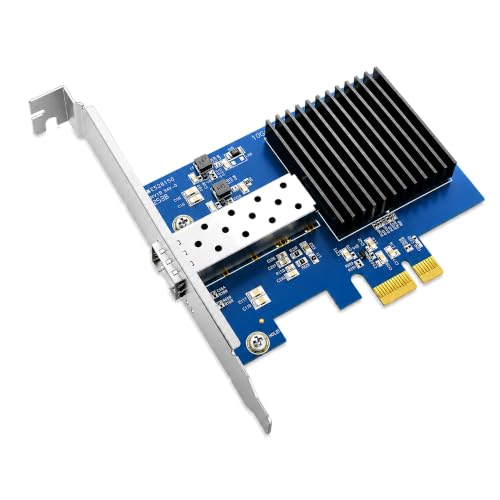 | BZIZU RTL8127ATF 10GbE SFP+ PCIe Card | Ports: 1 SFP+ Controller: Realtek RTL8127ATF Host interface: PCIe 4.0 x1 or higher Link rates: 10GbE stated OS: Windows 10 64-bit, 11; Linux to 6.12 | Check Price on Amazon |
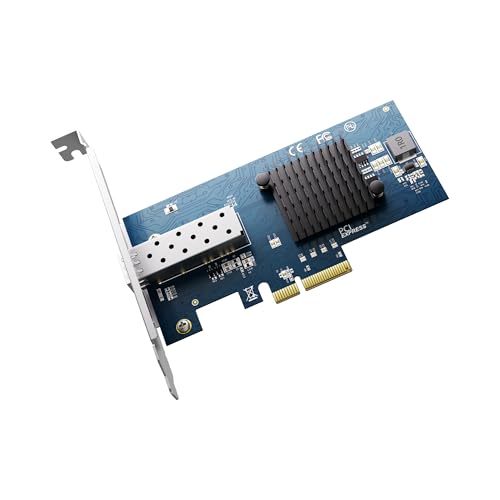 | BZIZU Intel 82599EN SFP+ Network Card | Ports: 1 SFP+ Controller: Intel 82599EN Host interface: PCIe x4 Link rates: 10G / 2.5G / 1G / 100M stated Brackets: Full-height and low-profile | Check Price on Amazon |
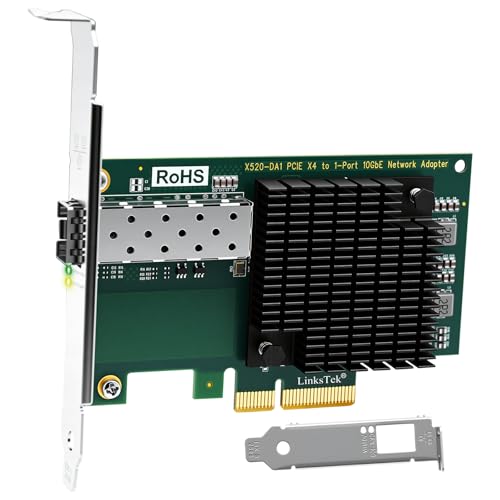 | LinksTek X520-DA1 SFP+ Adapter | Ports: 1 SFP+ Controller: Intel 82599 Host interface: PCIe 2.0 x4 Link rates: 10GbE and 1GbE Brackets: Full-height and low-profile | Check Price on Amazon |
 | LinksTek X520-DA2 Dual-Port SFP+ Adapter | Ports: 2 SFP+ Controller: Intel 82599ES Host interface: PCIe 2.0 x8 Link rates: 10GbE and 1GbE Brackets: Full-height and low-profile | Check Price on Amazon |
 | VIMIN X520-DA2 Dual-Port SFP+ Card | Ports: 2 SFP+ Controller: Intel 82599 Host interface: PCIe x8 or x16 Link rates: 10GbE or 1GbE; no 2.5G/5G Brackets: Standard and slim | Check Price on Amazon |
 | YuanLey RTL8127AT 10GbE SFP Network Card | Ports: 1 SFP Controller: Realtek RTL8127AT Host interface: PCIe 4.0 x1 Link rates: 10G and 1G OS: Windows 11; Linux to 6.12 | Check Price on Amazon |
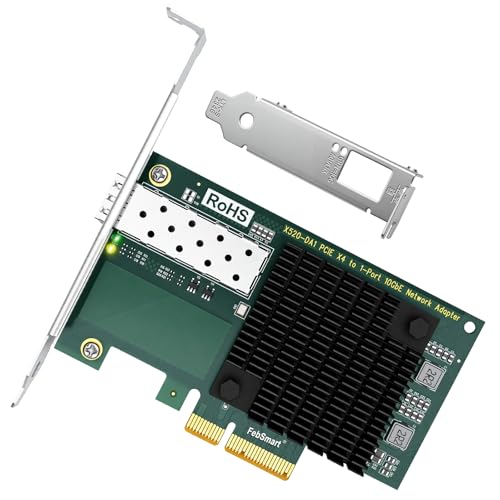 | FebSmart X520-DA1 SFP+ Network Adapter | Ports: 1 SFP+ Controller: Intel 82599ES Host interface: PCIe 2.0 x4 Link rates: 10GbE and 1GbE Brackets: Full-height and low-profile | Check Price on Amazon |
1. BZIZU RTL8127ATF PCIe 4.0 x1 Card — Best Compact-Slot Pick
When a GPU, capture card, or storage controller already fills the wider slots, the BZIZU RTL8127ATF fits in a single x1 slot instead. It is one of two x1 cards in this group, along with the YuanLey. It uses a PCIe 4.0 x1-or-higher connection to provide one 10GbE SFP+ port. The listing requires PCIe 4.0 or newer and the latest Realtek driver to reach the stated 10Gbps rate, so an older x1 slot should not be assumed sufficient.
You can use compatible 10GBASE-SR and 10GBASE-LR transceivers in its open cage for multimode or single-mode fiber. Neither the module nor fiber cable is included. BZIZU specifies support for full-duplex operation, IEEE 802.3ae, jumbo frames up to 16K, 802.1Q VLAN tagging, flow control, PXE boot, and Wake-on-LAN. Together they suit a workstation that needs a plain link to storage or to the core network.
The listing names Windows 10 64-bit, Windows 11, and Linux kernels through 6.12. Activity and 10G speed LEDs help you check the link. The package holds one TXA406 card, and the listing does not state which brackets come with it, so small-form-factor builders should verify whether a low-profile bracket is included.
[accentbox]Choose this Realtek card when a PCIe 4.0 x1 slot is the key constraint. Confirm bracket height and buy the correct SFP+ media separately.[/accentbox]- Uses a PCIe 4.0 x1-or-higher slot
- 16K jumbo-frame support
- Windows and Linux compatibility
- Transceiver and cable not included
- Low-profile bracket not stated
2. BZIZU Intel 82599EN Single-Port Card — Best Overall Single-Port Pick
A typical edit workstation needs one port to reach a 10GbE switch or NAS, and this single-port BZIZU covers that. The manufacturer rates the card for four PCIe lanes using Intel 82599EN silicon in an X520-DA1-compatible single-port design, so it fits x4, x8, or x16 slots. Full-height and low-profile brackets are both included, which settles bracket fit in a way the BZIZU Realtek listing does not.
The listing describes the SFP+ cage as free of vendor lock and compatible with third-party DAC, AOC, 10GBASE-SR, and 10GBASE-LR media. The listing also states that the link can step down to 2.5G, 1G, and 100M when the peer supports a slower rate. That multi-rate claim distinguishes it from the VIMIN card, which explicitly does not support 2.5G or 5G.
Platform coverage includes Proxmox, TrueNAS, Unraid, ESXi, QNAP, Synology, Ubuntu, Debian, and CentOS, with the Intel Ethernet Adapter Complete Driver Pack required on Windows. The manufacturer specifies that the card takes jumbo frames up to 9KB and does checksum offload in hardware. The passive heatsink runs warm, so even a quiet workstation needs deliberate airflow across the card.
[accentbox]Pick this card if you want a single-port card with open media choice, both brackets, x4 fit, and broad server or desktop support.[/accentbox]- Third-party DAC and optic support stated
- Both bracket sizes included
- Broad OS and appliance coverage
- Windows driver installation required
- Passive heatsink needs case airflow
3. LinksTek X520-DA1 — Best Documented Single-Port Intel Pick
LinksTek’s X520-DA1 pairs one SFP+ port with an Intel 82599 controller and a PCIe 2.0 x4 host interface rated at 20Gbps bandwidth. It fits x4, x8, and x16 slots. A full-height bracket is installed and a low-profile bracket is included, so it suits standard towers and compact workstation cases without an extra bracket purchase.
The port supports 10GbE and 1GbE with compatible optical transceivers, DACs, or AOCs. It is intended for LAN and SAN use with iSCSI, FCoE, and NFS. Intel virtualization features include on-chip QoS, Flexible Port Partitioning, VMDq, SR-IOV, Receive Side Coalescing, and Ethernet Flow Director. Those features make it a clearly documented single-port choice for virtualization or storage-heavy hosts.
Windows Server 2012R2 through 2022 is listed as plug and play. Windows 7 through 11 needs a driver, while Linux support uses IXGBE across named RHEL, SLES, Ubuntu, Debian, and FreeBSD releases. The detailed version list helps, but a newer or different release should still be checked before installation. SFP+ media is required and is not described as included.
[accentbox]Pick the LinksTek X520-DA1 when documented OS coverage and Intel virtualization features count for more than using the newest or narrowest PCIe interface.[/accentbox]- Detailed Windows, Linux, and FreeBSD support
- SR-IOV, VMDq, and storage protocols
- Both brackets included
- No 2.5GbE or 5GbE rate stated
- Requires separate SFP+ media
4. LinksTek X520-DA2 Dual-Port Card — Best Dual-Port Pick
The dual-port LinksTek X520-DA2 is intended for workstations or servers that need two independent 10GbE SFP+ connections. Uses include separate storage and production networks, redundant paths, or supported aggregated links. It connects through PCIe 2.0 x8 with a listed 40Gbps host-interface bandwidth and therefore requires an x8 or x16 physical slot.
Both ports support 10GbE and 1GbE optical, DAC, or AOC connections. The Intel 82599ES controller provides LAN and SAN functions, iSCSI and NFS support, SR-IOV, VMDq, Flexible Port Partitioning, on-chip QoS, Receive Side Coalescing, and Ethernet Flow Director. Dual ports do not automatically create 20Gbps for one transfer. Topology, configuration, peer support, and workload decide how the ports are used.
The OS list matches the single-port LinksTek. It names Windows Server releases, Windows desktop versions that need a driver, IXGBE-based Linux distributions, and FreeBSD. Full-height and low-profile brackets are included. Before you choose it, verify that the GPU does not block the needed x8 or x16 slot and that case airflow reaches the larger dual-port card.
[accentbox]Choose the X520-DA2 only when the network plan gives a defined job to both SFP+ ports. A single-port x4 card leaves more expansion resources free.[/accentbox]- Two 10GbE SFP+ ports
- Strong virtualization feature list
- Both bracket sizes included
- Requires an x8 or x16 slot
- Two links need deliberate configuration
5. VIMIN X520-DA2 Dual-Port Card — Best Explicit Fixed-Rate Warning
VIMIN’s Intel 82599-based X520-DA2 gives you two SFP+ ports at up to 10Gbps per port and fits PCIe x8 or x16 slots. It includes standard and slim brackets and a heatsink intended to keep the card stable during heavy transfers. The listing covers Windows 7 through 11, Windows Server, Linux, and VMware without naming detailed version ranges.
The most useful fact about this card is a limit. It does not support 2.5Gbps or 5Gbps. When connected to a 2.5G or 5G network device, the listing says it will operate at 1Gbps. The card therefore suits an intentionally 10GbE or 1GbE SFP+ environment, but it is a poor bridge into a mixed-rate multi-gig switch design.
The card has no RJ45 network port and cannot accept a copper patch cable directly. It requires appropriate SFP+ media. The listing’s warning helps prevent a common category mistake, but the listing does not name particular supported transceivers or DAC brands. Confirm media compatibility, drivers, and slot availability for your system before ordering.
[accentbox]VIMIN is a 10GbE-or-1GbE card, not a native 2.5GbE or 5GbE adapter. Use it only where both ends support the intended SFP+ rate.[/accentbox]- Two 10GbE SFP+ ports
- Standard and slim brackets
- Wide OS families listed
- No 2.5GbE or 5GbE support
- Supported media list not detailed
6. YuanLey RTL8127AT Card — Best Realtek Alternative with Both Brackets
YuanLey uses a Realtek RTL8127AT controller and a PCIe 4.0 x1 interface, with stated backward compatibility when installed in PCIe 3.0 x4, x8, or x16 slots. The single port auto-negotiates at 10G or 1G, and the card includes Wake-on-LAN and hardware checksum offload. Standard and low-profile brackets are both included, which the BZIZU Realtek listing does not state.
OS support is listed for Windows 11 and Linux kernels up to 6.12. The YuanLey list is narrower than the other BZIZU Realtek card’s, which also lists Windows 10 64-bit. Buyers keeping an older Windows workstation should not infer support from the shared controller family. The listing states lifetime technical support, but it describes no SFP+ module or cable package.
One claim in the listing needs confirmation. It says the SFP card supports existing Cat5e through Cat7 Ethernet cabling up to 100 meters. An SFP cage does not accept those cables by itself, so the statement may depend on a compatible copper transceiver that is not identified. Treat direct copper compatibility and distance as unverified until the seller specifies the required module.
[accentbox]This card offers PCIe 4.0 x1 fit and both brackets, but do not rely on the copper-cable claim without identifying a compatible SFP+ transceiver.[/accentbox]- PCIe 4.0 x1 interface
- Both bracket sizes included
- 10G and 1G auto-negotiation
- Copper-cabling claim lacks module details
- Windows 10 support not stated
7. FebSmart X520-DA1 — Best Single-Port Storage Feature Set
FebSmart specifies that the X520-DA1 uses the Intel 82599ES controller with a PCIe 2.0 x4 interface and 20Gbps host bandwidth. It has one SFP+ port for 10GbE and 1GbE connections through compatible transceivers, DACs, or AOCs. Full-height and low-profile brackets are included for standard and compact PCs.
The feature list is particularly storage-oriented: LAN and SAN support, Storage over Ethernet, FCoE, IEEE 1588, Data Direct I/O, PXE, intelligent offloads, on-chip QoS, Flexible Port Partitioning, VMDq, and SR-IOV. Those capabilities suit a studio server or virtualization host, and a desktop that only needs a fast path to shared storage.
Windows desktop releases require driver installation, while named Windows Server versions are described as driver-free. Linux uses IXGBE across specified RHEL, SLES, Ubuntu, and Debian versions. FreeBSD and all VMware ESXi editions are also listed. The detailed matrix helps, but the card still needs compatible SFP+ media and adequate cooling inside the workstation.
[accentbox]FebSmart suits single-port buyers who prioritize storage protocols, virtualization support, and a detailed operating-system list.[/accentbox]- Rich storage and virtualization features
- Both brackets included
- Detailed OS coverage
- Desktop Windows needs a driver
- Separate transceiver or cable required
Buying Guide: Choosing an SFP+ Card for a Small Studio
Start with the switch port and physical media
An SFP+ card must match the medium on the other end. A short in-rack or desk-to-switch connection may use a compatible direct-attach copper cable, while longer or electrically isolated runs may use an AOC or optical transceivers with fiber. SR commonly means multimode fiber and LR single-mode, as in the BZIZU Realtek listing.
Compatibility is not guaranteed by connector shape alone. Check both the NIC and switch requirements for DAC coding, optical type, wavelength, fiber type, connector, and supported distance. The BZIZU Intel card explicitly claims an open SFP+ cage, while several other cards state no vendor-compatibility list. Buy the link as a matched system rather than three unrelated parts.
Reserve the correct PCIe slot and lane generation
The Realtek cards use a narrow PCIe 4.0 x1 interface for one 10GbE port. The narrow interface can leave wider slots free, but the BZIZU listing specifically requires PCIe 4.0 or newer for full rate. YuanLey states fallback placement in PCIe 3.0 x4, x8, or x16 slots, which uses more physical slot space despite the narrow card edge.
Intel single-port X520-DA1 designs use PCIe 2.0 x4, while dual-port X520-DA2 cards use PCIe 2.0 x8. Check physical length, electrical lane allocation, and motherboard sharing rules. Installing a card can reduce GPU or M.2 lanes on some systems even when the connector physically accepts it.
Decide whether one or two SFP+ ports are necessary
One port is sufficient for the common workstation-to-switch or workstation-to-NAS path. A second port can serve a separate storage network, redundant link, direct-attached device, or supported aggregation. The dual-port LinksTek and VIMIN models require x8 or x16 slots, which is a cost in an editing tower.
Two ports do not automatically make one copy twice as fast. Link aggregation and multipath behavior depend on the operating system, switch, protocol, peer, and traffic pattern. Choose a dual-port card only when you have a defined topology. Otherwise, a single-port x4 or x1 card reduces power, heat, and slot pressure.
Check supported link rates in mixed-speed networks
SFP+ cards often center on 10GbE and 1GbE. The VIMIN explicitly says it does not support 2.5GbE or 5GbE and falls to 1GbE with those devices. LinksTek and FebSmart list 10GbE and 1GbE. Within this group, only the BZIZU Intel card claims steps down through 2.5G, 1G, and 100M.
The switch port and installed module or cable must support the same rate. Do not assume a 10GbE SFP+ link runs at every intermediate Ethernet speed. For a mixed 2.5GbE studio, confirm the entire link or route workstations through a switch designed to bridge the needed 2.5GbE edge and 10GbE uplink speeds.
Match the driver to the exact operating system
Intel 82599 cards have wide stated coverage, but desktop Windows often needs a driver. LinksTek and FebSmart list IXGBE for Linux and name supported distribution releases. BZIZU’s Intel card also lists Proxmox, TrueNAS, Unraid, ESXi, QNAP, and Synology, while Windows needs the Intel driver package.
Realtek support differs by product. BZIZU lists Windows 10 64-bit, Windows 11, and Linux through kernel 6.12, while YuanLey lists Windows 11 and the same kernel ceiling. Download the driver before removing the old network connection, and verify support for newer kernels or OS builds instead of assuming the printed range covers newer releases.
Plan airflow in a quiet workstation
10GbE controllers and optics can generate heat during sustained transfers. The BZIZU Intel listing says its passive heatsink runs warm and needs active case airflow or a small fan. VIMIN includes a heatsink for temperature control. Even without an explicit warning, a card placed under a large GPU can sit in an area with little airflow.
Do not remove airflow entirely to make the case quieter. A slow, well-positioned case fan can be quieter and safer than leaving a passive 10GbE card to run hot. Keep the heatsink unobstructed, monitor link stability during long transfers, and avoid resting cables against fan blades or hot components.
Confirm bracket height and installation contents
A low-profile workstation needs the corresponding bracket. BZIZU Intel, both LinksTek models, VIMIN, YuanLey, and FebSmart list both bracket sizes as included. The BZIZU Realtek listing does not specify a low-profile bracket, so compact-case owners should confirm the package first.
Also verify what is not included. The BZIZU Realtek explicitly excludes the SFP+ module and fiber, and the other cards generally describe media requirements rather than a bundled connection. Budget for the correct DAC, AOC, or paired optics and fiber alongside the NIC.
Frequently Asked Questions
Is an SFP+ card the same as a 10GbE RJ45 card?
No. An SFP+ card provides a cage for compatible modules or fixed SFP+ cables. An RJ45 10GBASE-T card has a built-in copper Ethernet socket. The physical connector, media, power behavior, and supported distance are different.
An SFP+ cage can sometimes use a compatible copper transceiver, but a copper transceiver does not turn every SFP+ card into a native multi-rate RJ45 adapter. Verify the module, heat, distance, and supported link rates before using copper.
Should a small studio use DAC or fiber?
A compatible DAC is often convenient for short links within a desk or rack because the cable and its ends come as one part. Fiber with SR or LR optics can support longer runs and electrical isolation, but requires matched transceivers and the correct fiber type.
The best choice depends on distance, routing, switch support, and replaceability. Confirm both endpoints before buying. Neither medium makes a 1GbE storage device transfer at 10GbE.
Can a dual-port card provide 20Gbps to one workstation?
Not automatically. Each port can form a separate 10GbE link, but combining them depends on link aggregation, multipath support, switch configuration, protocol, and traffic flow. A single transfer may remain limited to one link.
Dual ports are valuable for separate networks, redundancy, or workloads designed to use multiple paths. They also require more PCIe lanes and cooling than a typical single-port card.
Do these cards include an SFP+ transceiver?
Not according to their listings, which describe required media but state no bundled transceiver for these picks. The BZIZU RTL8127ATF explicitly says the module and fiber cable are not included.
Assume the connection media is a separate purchase unless the listing clearly says otherwise. Match the card, switch, optical standard or DAC, distance, and fiber connector as one system.
Are Intel 82599 cards too old for a current studio?
Not necessarily. The Intel 82599-based options use PCIe 2.0 but list broad OS, storage, and virtualization support. Their x4 or x8 host interfaces provide the stated bandwidth for one or two 10GbE ports, respectively.
The practical questions are driver support for your operating system, slot availability, heat, and required link rates. A newer PCIe 4.0 x1 Realtek card saves lanes, while an Intel card may fit a virtualization or server environment better.
Related Studio Network Guides
- Managed 2.5GbE switches for small editing networks
- Wi-Fi 7 PCIe cards for desktop workstations
- Ethernet adapters for laptops
- Thunderbolt docks for workstation desks
- USB-C hubs for desktop connectivity
- Desktop rack stands for small audio interfaces
- Rack shelves for non-rack studio gear
- DisplayPort cables for editing monitors
Bottom Line
The BZIZU Intel 82599EN is the best all-round single-port choice for broad platform support and flexible media. The BZIZU RTL8127ATF is the space-saving modern option when a PCIe 4.0 x1 slot is the constraint, while the LinksTek X520-DA2 is the stronger dual-port choice for a planned two-link topology.