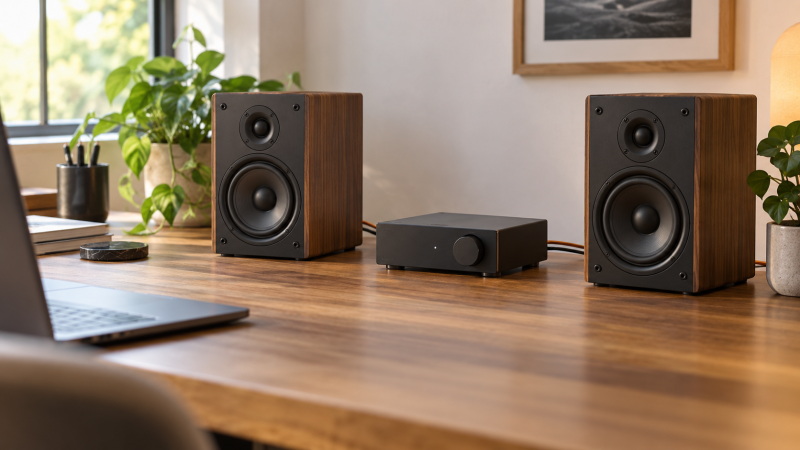
Passive bookshelf speakers do not connect directly to a laptop or interface on their own. The setup needs a separate amplifier or receiver, speaker wire, and a way to place the pair sensibly around the desk. In return, you can choose the amplifier path separately from the speakers.
This guide compares six Amazon US passive speaker pairs with active New offers. Each product here needs amplification. Start by checking the amplifier’s speaker connections and supported load, then choose a pair that physically fits the desk or nearby shelf without forcing an awkward listening position.
A passive desktop setup works only when the amplifier, speaker terminals, wire, and placement are considered together.Passive Bookshelf Speakers Compared


1. RIOWOIS DS6500M — Small Wall-Mountable Pair
RIOWOIS lists the DS6500M as a passive pair with a 2.75-inch woofer, a 2-inch tweeter, and a 6-ohm impedance. The listing gives compact dimensions of 4.3 inches long and 6.6 inches high, so it is relevant when a pair must live on a shallow shelf or beside a small desktop display rather than on full-size stands.
Wall-mount accessories are listed in the package, together with hooks and a rear mounting arrangement. Wall mounting can solve a cramped desktop, but a wall-mounted pair still needs left-right symmetry and wire routing back to the amplifier. Do not plan to connect them directly to a computer or turntable without an amplifier.
Our Take Buy the DS6500M if compact dimensions and included wall-mount hardware are your priorities. It is a small passive pair, so confirm the amplifier can support its stated 6-ohm load before treating mounting convenience as the full solution.
- Lists compact dimensions and a two-way driver layout.
- Wall-mount accessories are listed in the box.
- Needs a separate amplifier and speaker wire.
- Wall placement still needs symmetrical positioning.
2. Edifier P12 — 4-Inch Passive Pair
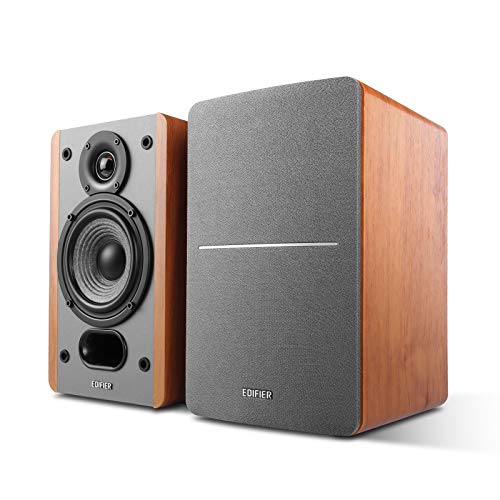
Edifier lists the P12 as a passive two-way pair with a 4-inch bass driver, a 19mm silk-dome tweeter, a bass reflex port, and 6-ohm impedance. The listing explicitly says an amplifier or receiver is required and that speaker wire is included. That explicit requirement is useful for a first passive setup because it removes any ambiguity about what powers the pair.
Built-in wall-mount brackets are also listed. A 4-inch driver may be a better physical fit than larger bookshelf speakers on a medium desk, but the cabinet still needs room around it. Measure the usable surface and decide whether the pair will sit on the desk, on stands, or on the wall before buying wire lengths.
Our Take Buy the P12 if you want a standard passive 4-inch pair with the amplifier requirement stated plainly. It suits a desk setup that can accommodate slightly larger cabinets and an external amp.
- Listing clearly states that an amplifier or receiver is required.
- 4-inch driver and built-in wall bracket are listed.
- External amplification adds another desktop component.
- 6-ohm load needs checking against the amp.
3. Pyle PCB3BK — Small Cube Footprint
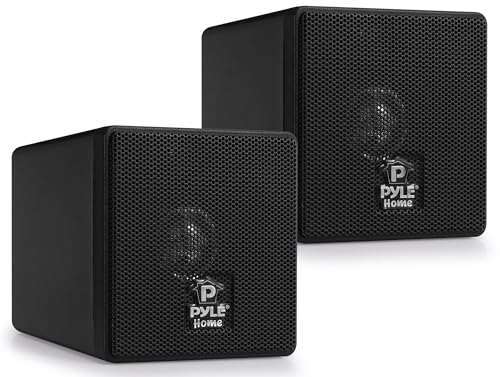
Pyle lists the PCB3BK as a passive pair built around a 3-inch paper-cone driver, with 8-ohm impedance and compact dimensions of 3.6 by 3.6 by 4.6 inches. Those dimensions suit a narrow gap beside a display or a very short shelf.
The listing also gives an 80Hz to 18kHz frequency-response figure and says the speakers are sold in pairs. Treat that listed range as product information, not a prediction of what you will hear at a specific desk. The important setup question is whether your amplifier has an appropriate speaker output and whether the tiny cabinets can be placed at a useful distance apart.
Our Take Buy the Pyle pair if the cube footprint is your priority and the amp supports an 8-ohm speaker load. The very small cabinets fit tight spots, but they do not remove the need for a proper stereo layout.
- Lists a very compact cube enclosure.
- 8-ohm impedance is stated.
- 3-inch single driver is a simple configuration.
- Still requires an amplifier and wire.
4. Micca COVO-S — Very Compact 2-Way Pair
Micca lists the COVO-S as a compact two-way passive pair with a 3-inch wool-fiber woofer and a 0.75-inch PEI tweeter. At 5.1 inches tall and 4.2 inches wide, it is a small speaker designed for people who cannot give up much desk or shelf area. The listing also states that it needs an amplifier or home-theater receiver.
Speaker wire is not included, according to the listing, and the pair cannot connect directly to a turntable, smartphone, or computer. Plan around both limits. The COVO-S suits a buyer who is already willing to run a separate amp.
Our Take Buy the COVO-S if its listed compact size suits your desk. It works best when you already have a compact amplifier plan and can add the necessary wire rather than expecting a direct laptop connection.
- Lists a 3-inch woofer and separate 0.75-inch tweeter.
- Compact height and width are stated.
- Listing says speaker wire is not included.
- Cannot connect directly to a laptop or phone.
5. Saiyin OS6310 — Adjustable Wall Mounting
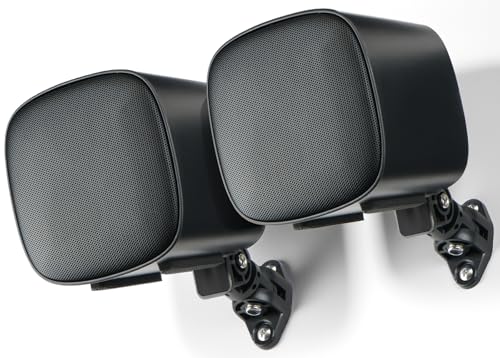
Saiyin lists the OS6310 as a passive pair with a 3-inch full-range driver, dual bass-reflex ports, and a 4.2 by 4.2 by 4.3-inch cabinet. The product page also repeatedly states that an amplifier is required and that it has no Bluetooth. Those limits are helpful because they keep the system decision clear. Source devices feed the amp, then the amp drives the speakers.
The included bracket is listed as adjustable through 170 degrees horizontally and vertically. That flexibility can help clear a crowded desk, although a broad adjustment range does not set the correct listening angle automatically. Place both sides consistently and make sure the wire route remains safe and manageable.
Our Take Buy the Saiyin if the listed adjustable mount is why you want the pair. It suits a small desk where speakers need to move off the work surface, provided you already have the amplifier and wire required for passive operation.
- Lists a compact cabinet and adjustable wall bracket.
- Passive requirement is stated plainly.
- No Bluetooth is listed.
- Bracket adjustment does not replace setup care.
6. RIOWOIS DS6810M — Flexible Speaker Terminals
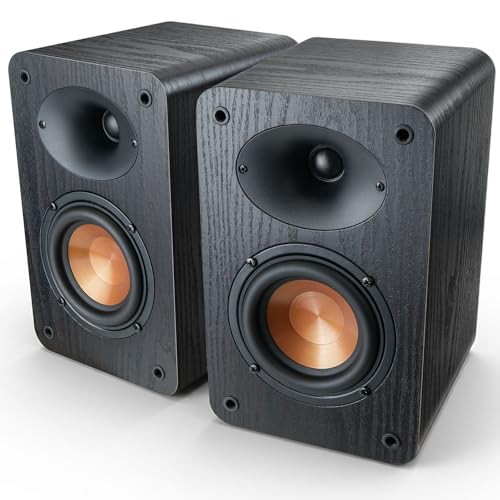
RIOWOIS lists the DS6810M as a passive pair that needs an amplifier or receiver, with a silk-dome horn tweeter, rear bass-reflex port, and gold-plated terminals. The key connection detail is the listed support for banana plugs, U-type terminals, and bare wire. Those options can make it easier to match the termination you already use with a compact amplifier.
The listing says speaker wire, receiver, and amplifier are sold separately. The rear port means you should consider what will sit behind the speaker before choosing its final position. A desk pushed against a wall is not the same arrangement as an open shelf, so leave room to experiment with a repeatable placement.
Our Take Buy the DS6810M if terminal flexibility is a priority for an existing amplifier and speaker-wire setup. It is still a passive system with separate components to plan, but the listed connection options make it the most flexible wiring choice here.
- Lists banana, U-type, and bare-wire terminal support.
- Rear bass-reflex port and separate tweeter are listed.
- Amplifier and wire are sold separately.
- Rear port needs space behind the cabinet.
Buying Guide
Build the amplifier path before choosing speaker cosmetics
Passive speakers need an amplifier or receiver between the source and the pair. The speaker listings in this guide state that requirement directly or describe the speakers as passive. A laptop, phone, turntable, or interface needs the amplifier or receiver before it can drive the speaker terminals.
Check the amplifier’s supported speaker load and connector type. Several products here list 6-ohm or 8-ohm impedance, while the DS6810M lists several terminal styles. Read the exact amplifier manual and its speaker-output markings before buying a pair. A connector that physically accepts wire does not confirm an appropriate pairing.
Choose placement that gives each speaker a job
Make room for a left-right stereo arrangement. Small cabinets can be useful because they fit around a display, but they still need separation and a reasonably consistent angle toward the listening position. Splitting a pair between the desk and a far shelf makes a consistent stereo position harder to find than placing two speakers together.
Wall hardware can free the desktop without removing the setup task. The RIOWOIS DS6500M, Edifier P12, and Saiyin OS6310 list wall-mount hardware or brackets. Check the mounting surface, cable route, and practical listening height first. The bracket is only one part of getting a stable and repeatable position.
Plan the wire run as part of the desktop layout
Speaker wire is a component of the system you need to plan. The Micca listing says wire is not included, while the Edifier P12 listing says it is included. Confirm the required length before you mount or hide anything. A short, tidy run is easier to inspect than a path that is stretched across a walkway or trapped behind furniture.
Terminal style affects convenience, not the need for an amplifier. Banana plugs, U-type terminals, and bare wire can each be useful depending on the amplifier. Choose the termination that the speaker and amp both support, then verify that the connection is secure before listening. Do not force a connector because it appears to fit.
Frequently Asked Questions
Can I plug passive bookshelf speakers directly into a laptop?
No. Passive speakers require an amplifier or receiver to drive them. The Micca COVO-S listing specifically says it cannot be connected directly to a computer, smartphone, or turntable, and the other products here are also sold as passive speakers.
For a laptop desk, the signal usually goes from the laptop or audio interface to an appropriate amplifier, then from the amplifier to the speakers with speaker wire. Confirm the inputs and outputs on the actual amplifier before buying the rest of the system.
Is a smaller passive speaker always better for a desk?
No. A smaller cabinet is easier to place, but it still needs a usable stereo position. The Pyle PCB3BK and Micca COVO-S have compact listed dimensions, which can help on a narrow desk, but they still need space from one another and a path back to the amplifier.
Choose the smallest pair that lets you position both speakers properly. A larger pair on a nearby shelf or stand can be the cleaner result when the desk surface is already too crowded for symmetrical placement.
Do wall-mounted passive speakers avoid the need for stands?
They can avoid desk stands, but wall mounting creates its own placement and wire-routing work. The listed brackets on some products can move speakers off the desk, which is useful when space is limited. Check the mounting surface and listening height before treating that as a universal answer.
Wall mounting does not remove the amplifier, speaker-wire, or left-right placement requirements. Keep those decisions together so the final system remains practical to use and adjust.
Bottom Line
For a conventional 4-inch passive setup, Edifier P12 is a sensible starting point because its amplifier requirement and wall bracket are listed. For a very compact two-way pair, Micca COVO-S is the one to look at. For flexible amplifier-side wiring, RIOWOIS DS6810M gives the listed terminal options.