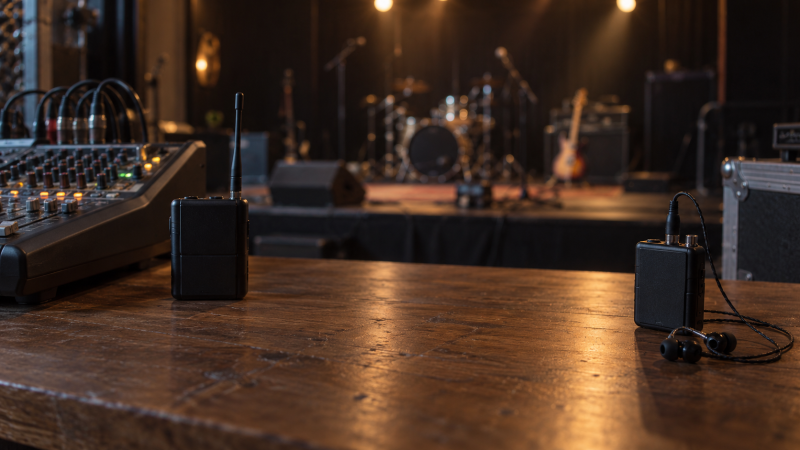
A wireless in-ear monitor system removes the headphone cable between a performer and the mixer. It does not create a personal mix. The mixer still needs to feed the transmitter, and the performer needs a wired earphone at the receiver. For a small stage, check mono or stereo operation, receiver count, transmitter input and power.
These six active New systems include a transmitter and receiver in each exact listing. They span compact 2.4 GHz pairs, a kit with two receivers and a charging case, a 5.8 GHz stereo option and a UHF half-rack mono setup. Claimed range and delay come from sellers or makers, not a measurement at your venue. The local radio environment, obstacles and other systems can change the result.
Trace the whole path: mixer monitor output → transmitter → wireless receiver → wired IEMs. Check the mix format, connector and power plan before comparing range claims.Wireless IEM Systems Compared
| Image | Product | Details | Check Price |
|---|---|---|---|
 | LEKATO MS-02 | Best fit: Compact shared mix Band: 2.4 GHz Receivers included: One Power: Rechargeable Earphones: Not included | Check Price on Amazon |
 | JOYO JW-07 | Best fit: One-to-one practice Band: 2.4 GHz Receivers included: One Multi-receiver: Not supported Listed range: 40–60 ft open space | Check Price on Amazon |
 | Xvive U4 | Best fit: Compact mixer feed Band: 2.4 GHz Receivers included: One Listed battery: Up to 5 hours Earphones: Not in exact set | Check Price on Amazon |
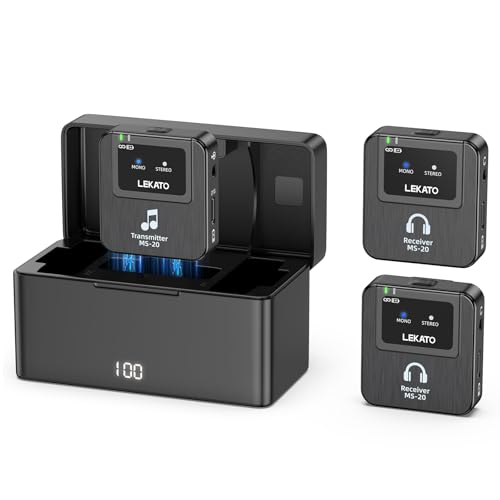 | LEKATO MS-20 | Best fit: Two people, shared mix Band: 2.4 GHz Receivers included: Two Power: Charging case Earphones: Not included | Check Price on Amazon |
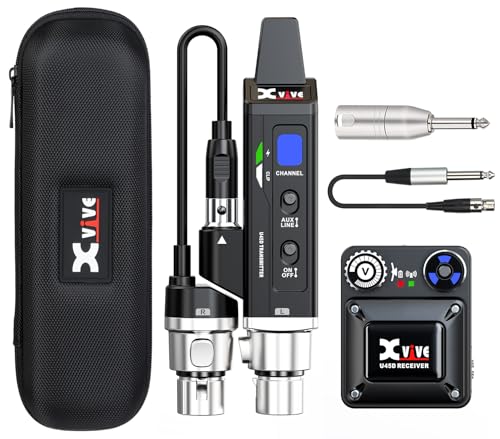 | Xvive U45D | Best fit: Stereo and side control Band: 5.8 GHz Modes: Stereo, left, right, mix Receivers included: One Scan: Smart channel scan | Check Price on Amazon |
 | Phenyx Pro PTM-11 | Best fit: Fixed mono station Band: UHF, check exact variant Format: Half-rack TX, AA bodypack Output: Mono, loop output Earphone: Included in 1B set | Check Price on Amazon |
1. LEKATO MS-02 — Best Compact Shared Feed
LEKATO’s MS-02 uses a 2.4 GHz transmitter and clip-on receiver and offers mono/stereo switching. The seller says one transmitter can feed multiple paired receivers, with a stated setup of up to four pairs of devices. Sharing a feed is useful when two performers need the same mix rather than separate personalized feeds. Both units are rechargeable. The listing gives about 6 to 8 hours after a full charge and an open-area range of 100 feet.
The box does not include earbuds, so budget for wired IEMs and check their plug against the receiver before the show. The seller’s latency figure of less than 4.5 ms is specified for mono mode, not every stereo setup. A shared transmitter gives everyone the same source mix. Receiver volume can vary, but one performer cannot change a vocal/instrument balance independently without another mixer send. Pair all receivers during soundcheck, not between songs.
One transmitter can serve a shared mix, but the performers still need their own receivers and earphones.Our Take Buy the MS-02 if your small group can share a monitor mix and values a compact rechargeable kit. It is not a substitute for separate mixes when each performer needs different levels.
- Seller documents one-to-many pairing.
- Mono/stereo mode switch listed.
- Rechargeable transmitter and receiver.
- No earbuds included.
- All paired receivers share one source mix.
2. JOYO JW-07 — Best One-to-One Practice Setup
The JOYO JW-07 is another compact 2.4 GHz transmitter/receiver pair, but its listing specifically says one transmitter does not support multiple receivers. The one-to-one design makes it better suited to a solo performer, guitarist practicing with a personal feed or a stage position where each musician has a dedicated system. JOYO states 48 kHz/16-bit audio, less than 5 ms latency and more than 8 hours of battery life after charging.
The seller’s range is 40 to 60 feet in open space, shorter than several other stated ranges here. Treat the range as a planning limit rather than an observed guarantee. People, stands and crowded radio channels can still reduce it. The listing describes frequency hopping and channel banks, but it does not justify assuming many units will coexist automatically. If two people must hear one shared mix, use a system that expressly documents one-to-many receivers instead of trying to pair a second JW-07 pack.
Our Take Buy the JW-07 if you want a simple personal monitoring link where one receiver is enough. Its explicit one-to-one limit helps avoid buying the wrong kit for a group.
- Clear one-to-one setup boundary.
- Seller lists more than 8 hours of battery life.
- Cannot add several receivers to one transmitter.
- Shorter stated open-space range than some alternatives.
3. Xvive U4 — Best Compact Mixer Feed
Xvive’s U4 set has one transmitter and one beltpack receiver. The transmitter connects to a mixer or audio-interface output, with a 6.3 mm-to-XLR adapter in this exact set. Xvive documents 2.4 GHz operation, 24-bit/48 kHz audio, less than 5 ms latency, up to 90 feet of stated range and roughly five hours of battery life. The U4 suits a performer who wants to plug a monitor send into a compact transmitter without finding rack space.
Confirm the mixer send’s connector and level before connecting. A balanced XLR jack and an unbalanced instrument or headphone output are not the same source, even if an adapter can mate the plugs. The receiver’s earphone output needs a wired IEM; the exact Amazon set lists transmitter, receiver, adapter and bag, not earphones. Xvive sells compatible extra receivers, but add them only when the same mix for multiple performers is acceptable and the maker’s pairing instructions fit your setup.
Our Take Buy the U4 if you want a compact link from a mixer send to one performer’s IEMs that the maker documents. Its five-hour listed battery figure deserves attention for long events.
- Maker documents transmitter, receiver and adapter path.
- Compact, no rackmount transmitter needed.
- Additional compatible receivers are offered.
- Five-hour listed battery life needs show planning.
- Earphones are not in this exact set.
4. LEKATO MS-20 — Best Two-Receiver Kit
The MS-20 listing is a one-transmitter, two-receiver package with a charging case. LEKATO says the case can recharge the included units twice and advertises 30 hours of total use with the case, which is not 30 continuous hours for one charge on each receiver. The system uses 2.4 GHz, can switch between mono and stereo, and the seller states up to 150 feet in open space. The kit is a practical package when two people need one common cue mix and want the units organized between rehearsals.
The seller also mentions USB-C OTG audio input from compatible devices, but confirm the source and charging path for the exact phone or laptop before relying on that route at a live show. Earphones are not included. Extra compatible receivers may share the transmitter’s mix, but the two supplied receivers are the concrete reason to choose this listing over the MS-02. Rehearse with both packs simultaneously and check that the case has enough charge for every planned set.
The 30-hour headline includes charging-case top-ups, not one uninterrupted session.Our Take Buy the MS-20 if two performers need the same wireless feed and a case to manage charging. It offers less value if each musician needs a distinct mix.
- Two receivers in the exact package.
- Charging case stores and tops up units.
- Mono/stereo switching listed.
- No earbuds included.
- Case-inclusive battery claim is not per-charge runtime.
5. Xvive U45D — Best Stereo Mix Control
The U45D uses 5.8 GHz wireless and gives the receiver stereo, left, right and mix modes according to Xvive and the exact listing. Its kit includes a transmitter, receiver, charging cable, adapters and case. Xvive describes channel scanning and less than 5 ms latency. For a small-stage performer who needs to separate a vocal cue from instruments or choose a side of a stereo feed, these named receiver modes are more useful than a vague promise of “stereo sound.”
Stereo begins at the source. The mixer must supply suitable left/right monitor feeds and the transmitter must receive them correctly. A mono mixer send will not become a stereo mix when a receiver is switched to stereo. The 5.8 GHz band differs from the 2.4 GHz systems above, but no band is automatically interference-free at every venue. Scan and test the channel during soundcheck with the other wireless gear operating. Verify the exact U45D variant and input adapters before connecting.
Our Take Buy the U45D if you have a stereo monitor feed and want selectable listening modes at the receiver, and you accept the extra setup. It is unnecessary for a single mono cue mix.
- Stereo, left, right and mix listening modes.
- Channel scan and 5.8 GHz path documented.
- Needs appropriate stereo mixer routing to matter.
- Venue RF scan still required.
6. Phenyx Pro PTM-11 — Best Fixed Mono Station
The PTM-11 takes a different physical approach. It pairs a UHF half-rack transmitter with a bodypack receiver, antenna and rack kit. Phenyx Pro says the PTM-11-1B package includes one receiver and an earphone. The transmitter provides a mono monitor mix, a PAD input control and a loop output to pass the source onward. The rack transmitter makes sense for a fixed small-stage or worship setup where the wireless transmitter can stay near the mixer rather than hanging from its output socket.
Phenyx lists selectable frequency variants and an open-area range up to 164 feet. Check the exact regional frequency version and venue RF plan before ordering or operating. A UHF system is not universally plug-and-play in every place. The receiver uses two AA batteries, while the transmitter requires its power adapter. A spare battery pair and a soundcheck with other transmitters switched on are more important than trusting the maximum range figure. The mono output is a feature for a simple single mix, not a stereo route.
The rack transmitter, AA bodypack and mono mix make PTM-11 a fixed-station choice, not a rechargeable clip-on pair.Our Take Buy the PTM-11 if the mixer and transmitter stay in place and a focused mono feed is enough. Verify the frequency variant and power logistics before the show.
- Fixed half-rack transmitter and bodypack format.
- Loop output and PAD control documented.
- One earphone in PTM-11-1B set.
- Mono-only monitor feed.
- Frequency variant and AA batteries need planning.
Buying Guide
Start with the mix you can actually send
A wireless IEM transmitter only passes along the monitor feed supplied by a mixer, interface or other source. If the console has one mono aux output, a stereo-capable system cannot manufacture independent left/right placement. If two performers need different vocal levels, give them separate sends and likely separate transmitter channels or systems. A one-to-many setup is appropriate only when the same mix works for everyone.
Check the source connector and signal level. A mixer’s balanced line output, an unbalanced aux output and a headphone output can differ. Xvive’s U4 and U45D include or document particular adapters, while Phenyx’s rack transmitter has its own inputs and controls. Do not buy a plug adapter as a substitute for understanding the signal. For a compatible monitoring earpiece, see our wired in-ear monitor guide.
Plan for RF, line of sight and power
The listed 2.4, 5.8 GHz and UHF bands describe different radio paths, not a universal ranking of reliability. Nearby Wi-Fi, other wireless audio, bodies, walls and stage metal can change usable range. The claimed 40 to 164 foot figures are usually open-area numbers, not promises across a crowded room. Soundcheck at the furthest place a performer will stand, with the other systems and lights operating.
Check whether the transmitter and receiver are rechargeable or use AA cells. U4’s listed five-hour battery life may be enough for a set but not an entire day without charging. The MS-20’s claim of 30 hours with the case requires returning units to the case. PTM-11 uses mains power at the transmitter and AA cells in the bodypack. Record the recharge or replacement plan alongside the set list, and keep a safe wired fallback where possible.
Decide between a shared feed and separate control
LEKATO’s one-to-many systems and compatible extra Xvive receivers can let several performers hear one source mix. A shared mix can simplify a rehearsal, but it cannot give the singer more voice and the drummer more click independently. JOYO’s JW-07 is explicitly one-to-one according to its listing. Multiple wireless systems may coexist, but channel spacing and interference must be checked with the exact gear and venue.
If you need a stereo image or selectable left/right listening, the U45D has the clearest mode options here. If spoken cues and a basic band blend suffice, a mono PTM-11 feed may be easier to operate. Keep ear safety in the plan. Start receivers low, check a limiter or mixer output settings, and avoid sudden level jumps. The USB-C audio-interface guide for podcasting covers an adjacent desk signal path, not a substitute for an IEM transmitter.
Frequently Asked Questions
Do these systems include the actual in-ear earphones?
Not all of them. Wireless link and listening earpiece are separate items unless the exact package says otherwise. The LEKATO MS-02 and MS-20 listings explicitly exclude earbuds, and the Xvive U4 exact set lists the transmitter, receiver, adapter and bag. Phenyx Pro’s PTM-11-1B package lists one earphone.
Match the earphone plug to the receiver output and choose tips that seal comfortably. Do not assume a product photo shows every included accessory.
Can one transmitter serve the whole band?
Only when the system supports compatible multiple receivers and the band can share one mix. LEKATO lists one-to-many operation for MS-02 and MS-20. Xvive offers compatible extra U4 receivers. JOYO says the JW-07 transmitter does not pair with multiple receivers. A receiver’s volume knob changes loudness, not the balance of instruments within a shared feed.
If each performer needs a different cue balance, plan multiple mixer sends and corresponding wireless channels or systems. A theoretical receiver count is not proof that every musician will get a usable personal mix.
Is the longest advertised range the safest choice?
No. Open-space range is conditional and varies with venue layout and radio traffic. A short but clear path at the actual stage is more useful than a larger number from another product’s open-field claim. Delay, dropouts and interference also depend on the rest of the signal chain.
Set up the stage as it will be during the performance, turn on the other wireless devices and walk to the intended positions during soundcheck. Use a channel scan or frequency plan where the system supports one, and have a wired fallback for a critical performer. Do not decide solely by the farthest listed distance.
Bottom Line
For a compact mixer feed, Xvive U4 is a clear starting point. LEKATO MS-02 serves a shared rechargeable feed, while MS-20 supplies two receivers and a charging case. JOYO JW-07 suits one performer with no plan for several receivers. Xvive U45D gives stereo listening modes, and Phenyx Pro PTM-11 is a fixed mono UHF station.