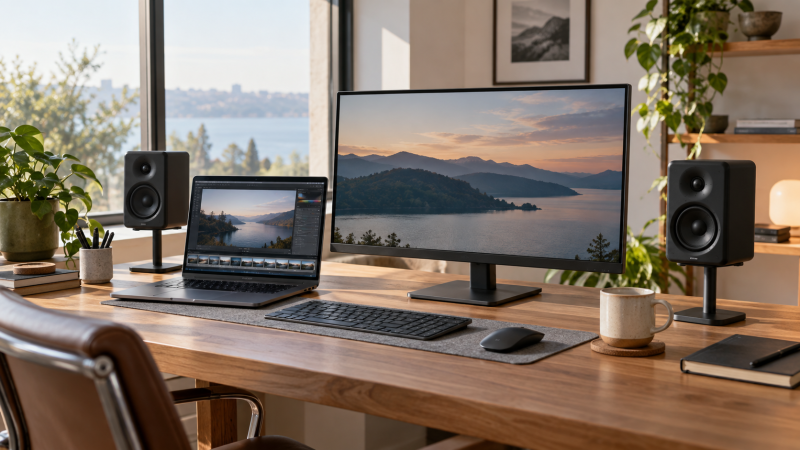
Small desktop speakers often sit below ear height, especially when a tall display fills the center of a workstation. A stand can raise them or angle them upward without switching to stands that sit on the floor. The useful question is where each tweeter points from your actual chair, not whether the product promises better sound. Measure your speakers and desk before choosing a fixed tilt or a tall riser.
The six active New pairs here include a clamp-on model, fixed-height risers, and angled metal platforms. They differ in rise, top-plate size, desk support and stated load. Three listings disagree with themselves about height, depth or load. No independent listening or vibration test for these exact stands is included, so we compare physical fit and safe placement instead.
Measure your seated ear height relative to each speaker’s tweeter. Then measure the cabinet’s foot pattern, weight and available desk or clamp-edge space. A stand that raises a speaker too high, tilts it past your head or leaves a foot unsupported is the wrong fit.Desktop Speaker Stands Compared
| Image | Product | Details | Check Price |
|---|---|---|---|
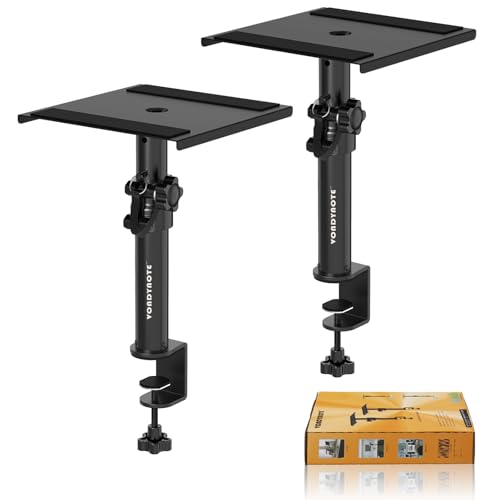 | Vondynote Clamp Pair | Support: Desk clamp Rise: 9–14 in Top: 9 × 9 in Seller load: 50 lb each | Check Price on Amazon |
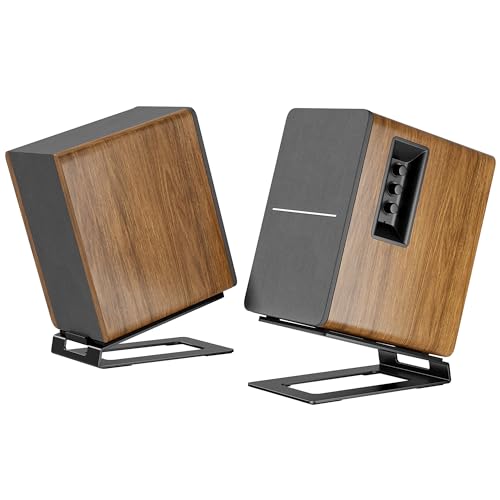 | PEGZONE 16-Degree Tilt Pair | Support: Freestanding Tilt: 16° fixed Base: 7.1 × 4.8 in Seller load: 22 lb each | Check Price on Amazon |
 | suptek SDM003MB | Support: Freestanding Rise: 6.1 in Top: 7.9 × 6.5 in Seller load: 44 lb each | Check Price on Amazon |
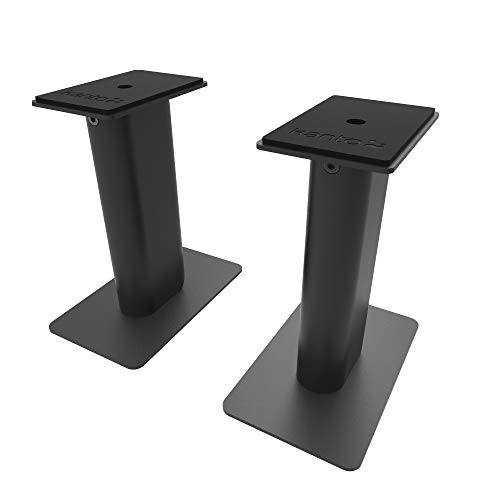 | Kanto SP9 | Support: Freestanding Rise: 8.3 in title; 9 in feature Top: Two plate sizes Adjustment: 15° rotation | Check Price on Amazon |
 | PUTORSEN Cantilever Pair | Support: Freestanding C-shape Tilt: 6° fixed Depth: 5.5–7.5 in feature Seller load: 12 lb each | Check Price on Amazon |
 | VAYDEER Metal Pair | Support: Freestanding C-shape Tilt: 5° fixed Base: 7.09 × 5.51 in Seller load: Conflicting listing figures | Check Price on Amazon |
1. Vondynote Clamp Pair — Best for a Clear Desktop
Vondynote’s pair clamps to the desk instead of using broad tabletop bases. The seller lists four speaker-height settings: 9, 10.6, 12.3 and 14 inches. Each stand has a 9-by-9-inch metal top plate and a stated 50-pound capacity. With those figures, it is a candidate when a compact editing desk is already crowded, but the speaker still needs to fit and remain centered on the plate.
The clamp is listed for desk edges up to 2.6 inches thick and has EVA padding against scratches. Measure the actual edge, including any apron, cable tray or rounded lip. A nominally thin tabletop may still block the clamp’s jaws. Keep the clamp away from a weak extension or damaged laminate. Tighten and test both stands before placing powered speakers on them. The listing’s vibration language is not an independent acoustic test.
Our Take Choose this clamp pair when a strong, accessible desk edge can support it and you need the tabletop clear. The clamp’s fit to your desk edge counts for more than the listed speaker weight alone.
- Four stated height settings.
- 9-inch-square speaker platform.
- Clamp saves tabletop area.
- Needs a suitable 2.6-inch-or-thinner desk edge.
- Desk construction controls safety.
2. PEGZONE 16-Degree Tilt Pair — Best Fixed Upward Angle
PEGZONE lists a pair of metal desktop stands with a 7.1-by-4.8-inch base and a fixed 16-degree upward tilt. The seller gives a 22-pound load limit and says the stands can be freestanding or secured to compatible speaker mounting holes. A fixed angle can be helpful if a speaker sits well below ear level, but it cannot be adjusted for a taller chair or a lower monitor.
Measure where a line projected from the tweeter would meet your seated position. If the stand points above your head, a flat riser is a better fit. The base dimensions describe the footprint on the desk, not necessarily the surface that supports the speaker. Confirm the cabinet’s feet and, if you plan to screw it down, the mounting-hole pattern and hardware compatibility. Seller claims of richer sound are not proof of a result in your room.
Our Take Pick this pair only if its fixed 16-degree angle solves a measured height gap. With no adjustment available, fit counts for more than broad compatibility copy.
- Fixed 16-degree upward tilt is explicit.
- Freestanding or screw-secured setup described.
- 22-pound seller load figure.
- No angle adjustment for a different chair.
- Usable speaker surface needs confirmation.
3. suptek SDM003MB — Best Simple Six-Inch Rise
The suptek SDM003MB pair raises speakers by a listed 6.1 inches. Its top plates measure 7.9 by 6.5 inches, and the seller states 44 pounds per stand. That fixed rise is easy to plan around. Measure the tweeter’s present height and add roughly six inches before buying. It may be enough for a low bookshelf speaker but too much for a speaker already near ear level.
Each platform has an anti-slip mat. Check that the speaker’s feet or flat cabinet base sit entirely on the supported surface, not only on the mat’s edge. A higher load rating does not correct a top plate that is too narrow. The listing claims improved staging and vibration performance, but neither is independently measured for this desk. Assembly is described as simple, but level both stands and retighten them after positioning the speakers.
Our Take Choose suptek when an approximately six-inch rise and its 7.9-by-6.5-inch platform match your cabinet. Its simple fixed height is a virtue only if it puts the tweeter where you need it.
- 6.1-inch rise is easy to evaluate.
- Top-plate dimensions are stated.
- 44-pound seller limit per stand.
- Rise is fixed.
- Top plate may not fit wide cabinets.
4. Kanto SP9 — Best Rotating Top Plate
Kanto includes two top-plate sizes with the SP9 pair and says each plate can rotate up to 15 degrees left or right. The rotation is toward the chair and is not a promise of adjustable upward tilt. The stands are sold for small to medium bookshelf speakers and compact studio monitors. A hollow support column allows cable routing. Check whether your connector can pass through it before assembly.
The listing disagrees on height. The title calls the pair 8.3 inches tall, while a feature says 9 inches. The difference affects the fit if the tweeter is already close to ear level. Check the exact measurement and which plate you plan to install. The seller describes steel construction and closed-cell foam padding, but neither material alone proves an audible change in a specific setup. The included screw fits only a compatible speaker mounting hole.
Our Take Choose SP9 for its plate options and side-to-side aiming if the height works for your chair. Resolve the seller’s 8.3-versus-9-inch discrepancy before treating it as a precision riser.
- Two included plate sizes.
- 15-degree left/right rotation.
- Hollow column for cables.
- Title and feature disagree on height.
- Rotation does not set vertical tilt.
5. PUTORSEN Cantilever Pair — Best Space Below the Speaker
PUTORSEN’s pair uses a C-shaped cantilever that leaves about 5.9 inches of room beneath the speaker. The seller lists a 6-degree upward tilt and a 12-pound limit per stand. The clearance can suit a small desk where an interface or other short item needs to fit below the cabinet. Confirm that the base itself does not block the item’s controls or ports and that the combined setup remains stable.
The listing includes an extendable ledge stopper, but its depth claims differ. The title says up to 7.71 inches, while a feature gives an adjustable range of 5.5 to 7.5 inches. Measure the cabinet’s actual base depth and confirm the stop position with the seller rather than assuming either maximum. EVA contact pads are listed. Sound and vibration claims are not comparative test data. The fixed tilt also needs to point the tweeter toward your chair.
Our Take Pick PUTORSEN for useful clearance beneath a light speaker. Because of its 12-pound load ceiling and conflicting depth range, measure the exact cabinet first.
- C-shaped space beneath each speaker.
- 6-degree tilt stated.
- Adjustable ledge stopper described.
- 12-pound seller limit per stand.
- Listing conflicts on maximum cabinet depth.
6. VAYDEER Metal Pair — Best Compact Five-Degree Tilt
VAYDEER lists a 5-degree upward tilt and a C-shaped metal body with a 7.09-by-5.51-inch base. The open space beneath may help clear a small device or cable bundle on the desk. Five degrees is a gentler fixed angle than the 16-degree metal pair above, but which one works depends on the vertical gap from tweeter to ear and the listening distance.
Its load claims conflict. The title says the pair supports up to 40 pounds, while a feature says 15 pounds per stand. Those figures are not interchangeable. Do not place a heavier cabinet on either stand until the seller confirms the limit for this exact variant. The listing also names silicone anti-slip mats. They may improve grip, but no evidence here shows how much vibration reaches a particular desk.
Our Take Consider VAYDEER if a compact base and gentle tilt suit your setup. Treat its advertised capacity as unresolved, not as permission for a heavy bookshelf speaker.
- Compact listed desk footprint.
- Gentle 5-degree fixed tilt.
- Open C-shaped space below.
- Seller load statements conflict.
- Fixed tilt cannot be fine-tuned.
Buying Guide: Raise the Tweeter Safely
Calculate rise and tilt from your chair
Start with the tweeter’s current height and your ear height in the chair you use for work. A fixed riser adds height. An angled stand changes the direction the speaker points. The two adjustments are different. If the tweeter already sits near ear level, a six- or nine-inch stand can overshoot. If the speaker is low, a 16-degree tilt may point it toward you or past you depending on listening distance. Measure before buying, then reassess with both speakers at matching positions.
For a stereo setup, keep left and right distance and height as symmetrical as the room allows. A rotating Kanto plate can aim a cabinet sideways, but it does not adjust vertical tilt. The floor-stand guide covers moving speakers off the desk altogether. Choose a stand that sits on or clamps to the desk only when the desk surface or clamp edge can safely carry both monitors.
Match cabinet feet, weight and desk construction
Measure the actual foot pattern beneath each speaker, not just its driver diameter. Even suptek’s listed 7.9-by-6.5-inch top plate can leave a wide cabinet’s feet unsupported. Check whether an angled platform has a front stop and whether a mounting screw matches your speaker. If a listing’s load limit is inconsistent, as with VAYDEER, get an answer for the exact offer or choose a product with clear headroom. A printed capacity does not make a weak desk edge or narrow plate safe.
For clamp-on stands, inspect desktop thickness and edge access. Vondynote’s listing specifies a 2.6-inch jaw range, but an underside apron or a rounded lip may prevent a secure bite. Freestanding stands avoid that problem but occupy tabletop area. Put them where a cable cannot pull a speaker forward, a monitor arm cannot strike it, and a child or pet cannot tip it. Check that the desk itself is stable before adding tall, heavy speakers.
Treat sound and vibration promises as unmeasured
Steel, foam and silicone appear throughout these listings. They describe materials or contact surfaces, not a directly comparable vibration-reduction result for your desk. A stand may change what you hear because it changes speaker height, angle or distance from a wall. Test one placement at a time at the same listening level. If the desktop rattles, remove loose objects and check speaker feet before assuming a different mat will cure it.
The bass-trap guide concerns room-corner treatment, not raising speakers. Neither a desktop stand nor a corner foam block guarantees an accurate mix in a small room. If the choice is between a flat riser and an angled stand, prioritize safe fit and tweeter direction. Buy the simple one that solves the placement problem.
Frequently Asked Questions
Is a fixed upward tilt always better than a flat riser?
No. Tilt is useful only when it points the tweeter toward your seated ears. A speaker already at ear height may need no upward angle. A 16-degree fixed tilt can overshoot from a close listening distance, while five or six degrees may be too little if the speaker is far below you.
Measure your setup and check the angle from the normal chair position. If you change desk or chair height often, a fixed-angle stand may be less flexible than a level riser with adjustable speaker placement. Keep left and right settings matched so one speaker does not aim above the other.
Do I need a clamp stand to save desk space?
Not necessarily. A clamp pair moves most of the support off the tabletop, but it requires a strong, accessible edge. A C-shaped freestanding stand leaves some space below the speaker while using a small base on the desk. The difference is where the load goes, not a universal sound-quality ranking.
Check your desk edge, speaker weight and the area behind the display. If a clamp cannot grip securely, choose a freestanding stand with a suitable top and footprint. Do not rely on adhesive pads or an overloaded clamp to hold a powered monitor.
Source boundary: Product identities, measurements and included hardware come from six exact Amazon US listings checked for active New offers. Height, depth and load conflicts are identified where the same listing disagrees with itself. No independent acoustic or structural tests were performed. The featured image is illustrative, not a listed product. Verify cabinet fit and seller terms before purchase.