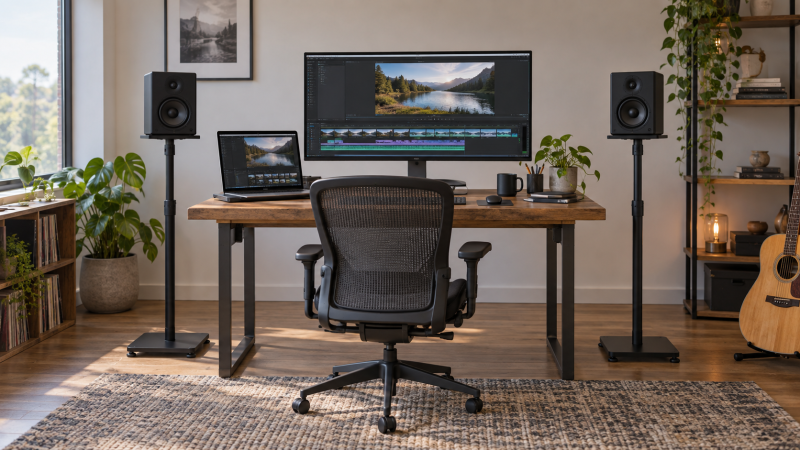
An editing desk can run out of room before the speakers are in the right places. Floor stands free the desktop, but they introduce a different problem. Each speaker needs a stable platform at the right seated ear height. A stand tall enough for a TV may be too tall beside a low workstation. Measure from the floor to your ears in the chair you actually use before shopping.
These six active New pairs are floor-supported, not desk clamps or tabletop risers. Their height ranges start between 24 and 33.3 inches, their top plates vary, and their seller-stated load limits run from 11 to 88 pounds per stand. Fit and safety are easier to assess from those numbers than from a generic promise of “better sound.” None of these exact stands was independently load- or vibration-tested for this article.
Measure your seated ear height, speaker cabinet base, cabinet weight and available floor space on both sides of the desk. Choose a stand that can put the tweeter near ear level while keeping every foot safely supported on the top plate.Studio Monitor Floor Stands Compared
| Image | Product | Details | Check Price |
|---|---|---|---|
 | PERLESMITH PSSS2 | Height: 33.3–45.1 in Top fit: 4.5–9 in width Seller load: 11 lb each Best fit: Small, light monitors | Check Price on Amazon |
 | Vondynote Studio Pair | Height: 33–51 in Top plate: 9 × 9 in Seller load: 88 lb each Best fit: Cable-hidden desk setup | Check Price on Amazon |
 | AxcessAbles Studio Pair | Height: 26–42 in title; 26–46 in feature Top plate: 9 × 9 in Seller load: 80 lb each Best fit: Lower seated position | Check Price on Amazon |
 | Rockville RVSM1 | Height: 33–45 in Top plate: 9.05 × 9.45 in Seller load: 80 lb each Best fit: Tripod-base monitor support | Check Price on Amazon |
 | MOUNTUP Universal Pair | Height: 28.3–37.4 in Top plate: 9.8 × 9.8 in Seller load: 22 lb each Best fit: Shorter floor stand | Check Price on Amazon |
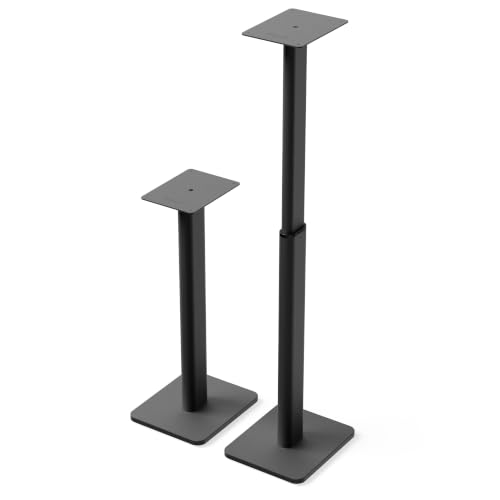 | Kanto SPH | Height: 24–42 in Top plate: 5.9 × 7.9 in Seller load: 30 lb each Best fit: Low seated desk height | Check Price on Amazon |
1. PERLESMITH PSSS2 — Best for Light Compact Speakers
PERLESMITH sells the PSSS2 as a pair with a 33.3- to 45.1-inch height range. The top adjusts to speakers 4.5 to 9 inches wide, and the seller gives an 11-pound limit per stand. The height, width and load limits suit a small, light monitor beside a desk, not an 80-pound cabinet just because the stand is called universal. The listing also excludes round or irregular speaker shapes.
Its hollow pole has a listed cable opening, and hook-and-loop straps are offered if a connector will not pass through. Check your power plug and audio connector before relying on hidden routing. The steel stand includes nonslip foot pads. A wide floor base still needs space away from a chair’s wheels, a door swing and children or pets. Extend both sides to the same height and confirm the speaker does not rock.
Our Take Choose PSSS2 only when a compact cabinet fits the width adjustment and sits comfortably below the seller’s 11-pound capacity. The adjustable top counts for more than its broad “universal” label.
- Top width adjusts from 4.5 to 9 inches.
- Height range covers many raised desks.
- Internal opening or external straps for cables.
- 11-pound limit excludes heavier monitors.
- Not listed for round or irregular cabinets.
2. Vondynote Studio Pair — Best Cable-Hidden Heavy-Monitor Setup
Vondynote’s pair uses a 9-by-9-inch top plate with an EVA nonslip layer. The listed height runs from 33 to 51 inches, held by knobs and pins. The seller states an 88-pound load per stand, far above what a small nearfield speaker usually needs, but that figure is not a reason to ignore platform fit or floor stability. Measure the cabinet base and position its weight centrally.
An internal cable opening is listed at 1.38 by 0.98 inches. Confirm that the actual plug or connector fits through before assembly. Otherwise a cable can run neatly outside. The metal base occupies about 13.5 by 13.5 inches. Rubber feet are supplied for hard flooring and metal feet for softer surfaces. Plan the floor footprint on both sides of the workstation before promising yourself a clutter-free desk.
Our Take Pick this pair when a nine-inch top, internal cable route and higher listed capacity are what you need. Its 33-inch minimum may still be too high for a low chair.
- 88-pound seller limit per stand.
- Internal cable opening specified.
- Hard-floor and soft-floor feet supplied.
- 33-inch minimum can be too tall.
- 13.5-inch floor base needs clear space.
3. AxcessAbles Studio Pair — Best Broad Tripod Footprint
AxcessAbles lists a 9-by-9-inch top tray and an 18-by-18-inch triangular floor base for this steel pair. The seller claims an 80-pound capacity per stand and includes nonskid pads and optional carpet spikes. Those details make it a plausible choice when the speaker has a broad cabinet and you can give each tripod base room beside the desk. A chair wheel crossing the base remains a trip hazard.
The exact offer conflicts on height. The title says 26 to 42 inches, while a feature bullet says 26 to 46 inches. Its lower end could serve a seated editor, but do not rely on the upper four inches until the current seller listing confirms them. The listing’s recommendation of separate isolation pads is a suggestion, not proof that a bare stand is acoustically poor. Seat each speaker securely on the platform before adding another layer.
Our Take Choose this for the broad base and stated load limit when there is floor space. Verify the disputed maximum height and your cabinet fit instead of treating either listing line as settled.
- 9-inch-square top tray.
- 80-pound seller capacity.
- Carpet spikes and nonskid pads included.
- Title and feature disagree on maximum height.
- Large floor base needs a clear walkway.
4. Rockville RVSM1 — Best Mid-Height Tripod Stand
The RVSM1 pair lists 33 to 45 inches of adjustable height and a 9.05-by-9.45-inch top platform with an EVA foam layer. Rockville states an 80-pound capacity per stand. Its tripod floor base is listed at 17.7 by 17.7 inches and includes rubber contact pads. That base deserves the same attention as the speaker plate. Clear the space beside the editor’s chair and avoid blocking an accessible route through the room.
Height adjustment uses a clutch and safety pin. Set both stands at the same measured level, tighten them according to the instructions and test stability before powering the monitors. The seller calls the foam platform vibration-reducing, but this article has no directly comparable desk or floor vibration measurement. A floor stand can change the speaker’s position even when the foam itself makes no proven audible difference.
Our Take Shortlist Rockville when a 33-inch minimum and tripod footprint suit the workstation. The locking hardware and tray measurements are decision details, and the acoustic benefit remains unmeasured here.
- Top dimensions and height range stated.
- Safety pin backs up the height lock.
- 80-pound seller capacity.
- 17.7-inch tripod base occupies floor area.
- 33-inch minimum can overshoot seated ear height.
5. MOUNTUP Universal Pair — Best Short Stand with Wide Top
MOUNTUP’s pair spans 28.3 to 37.4 inches and uses a 9.8-by-9.8-inch square top. The seller gives a 22-pound capacity per stand. That short height range can be useful when a seated editor’s ears are below where a taller minimum stand would put the tweeters. The top is wider than many nine-inch trays, but still compare the actual cabinet feet with the usable surface.
Each base is listed at 11.8 inches across, and the stand has a hollow cable route with a 0.87-by-1.8-inch opening. Check plug dimensions before assembly. Rubber feet and metal points for carpet are included in the listing. A glass floor base may look tidy but still needs a level, protected position away from rolling chairs. If your speakers exceed 22 pounds each, choose a stronger stand rather than using this pair at its limit.
Our Take Choose MOUNTUP if its lower range suits your chair and the speaker stays under the stated capacity. Its wide top is useful, but the shorter maximum may rule out a tall desk.
- 9.8-inch-square top.
- 28.3-inch minimum suits some seated setups.
- Internal cable route specified.
- 22-pound seller load ceiling.
- 37.4-inch maximum limits taller placement.
6. Kanto SPH — Best Low Height Range
Kanto’s SPH pair begins at 24 inches and extends to 42 inches, the lowest listed minimum in this comparison. The steel stands have a 5.9-by-7.9-inch top plate and a seller-stated 30-pound limit per stand. That combination fits a low seated ear height, but the smaller platform may not fit a broad studio monitor even if the weight is acceptable. Measure the speaker’s feet, not just the cabinet’s outside shell.
The listing describes a dual-screw height lock, internal cable route, rubber feet and carpet spikes. Those features help adapt a pair to different floors and keep cables away from chair wheels. Check the current package and the seller’s warranty terms before purchase. Its language about reduced resonance remains a seller claim without a side-by-side measurement in this room. Keep both speaker heights and left-right distances matched after setup.
Our Take Pick Kanto when a 24-inch starting height is necessary and your speaker’s base fits the smaller plate. Capacity alone cannot make an overhanging cabinet stable.
- Low 24-inch starting position.
- 30-pound seller limit per stand.
- Rubber feet and carpet spikes listed.
- 5.9-by-7.9-inch plate may be too small.
- Acoustic claims are not independently tested here.
Buying Guide: Build a Stable Listening Position
Start with seated ear height and speaker placement
Measure height from the floor to your ears while you sit in the editing chair at your normal posture. Then measure where the tweeter sits within its cabinet. The stand’s tray does not need to rise all the way to your ears. Compare that required tray height with each stand’s range. A 33-inch minimum may be fine beside a tall desk and too high beside a low one. If your chair, desk or display can move, use the setup you actually edit in most often.
Keep the left and right speakers at matching height and similar distance from the listening position. A floor stand can move a monitor away from the desk surface, but it cannot fix an uneven stereo setup by itself. Our balanced TRS cable guide covers connecting powered monitors to an interface, a separate decision. Start with the speakers and their intended placement, then buy stands that fit them.
Check platform fit, weight and the floor base
A speaker labeled five-inch may have a cabinet much wider than the driver. Measure the actual foot pattern and base depth against the stand’s usable top plate. Kanto’s smaller plate and the wider MOUNTUP or Vondynote tops suit different cabinets. Keep a heavy monitor centered and do not assume a nonslip pad makes an unsupported overhang safe. Treat seller capacity as a ceiling, not a target. Leave margin for a powered cabinet and its cables.
The floor footprint needs attention in a working room. A tripod can extend into the chair path even when its platform looks compact. Hard floors may call for rubber feet and carpets may call for spikes, but use only hardware suitable for the floor and the stand’s instructions. Route power and audio cables so they do not tug on the speaker or catch under a wheel. Put the stands where a pet or child cannot easily knock them over.
Separate placement from isolation claims
Some stands include foam or rubber on the tray. That material may help grip and protect a speaker cabinet, but “vibration-reducing” is not a measured audio result for the exact desk and floor here. The larger change may simply be the speaker’s new height and position. Test at a consistent volume and seated location before attributing a clearer mix to the platform material.
If speaker placement leaves uneven bass in a small room, bass traps address room-corner treatment, a different decision. A floor stand is a way to free desk space and position a monitor. It is not a room treatment or a guarantee of better frequency response.
Frequently Asked Questions
Will a floor stand make my monitors sound better?
It may let you put the tweeters at a more useful height and left-right position, which can change what you hear at the chair. The change is a placement benefit, not proof that one stand’s steel, foam or base improves the speaker’s inherent performance. None of the six exact offers has a comparable listening-room test in this article.
Measure the setup before and after at the same listening level. If a speaker still sits too close to a wall or the pair is asymmetric, adjust placement first. A stand cannot correct a faulty speaker, an unsuitable room or a mistaken audio-output setting.
Can a stand with an 80-pound rating hold any monitor below 80 pounds?
No. Weight is only one fit check. The top plate must support the cabinet’s actual feet and keep its center of mass stable. The base also needs level floor contact and enough space that people, pets or chairs will not strike it. A narrow, tall cabinet may be less stable than a compact one of the same weight.
Read the current seller instructions for maximum load and assembly. Use the supplied locking pins or screws and check them after setup. If a cabinet overhangs or rocks, choose a wider platform rather than relying on the printed weight figure alone.
Source boundary: Product identities, dimensions, included hardware and stated capacities come from six exact Amazon US listings checked for active New offers. They are seller claims, not independent structural or acoustic tests. The featured image is illustrative and does not depict any listed stand. Verify current cabinet fit and floor safety before buying.