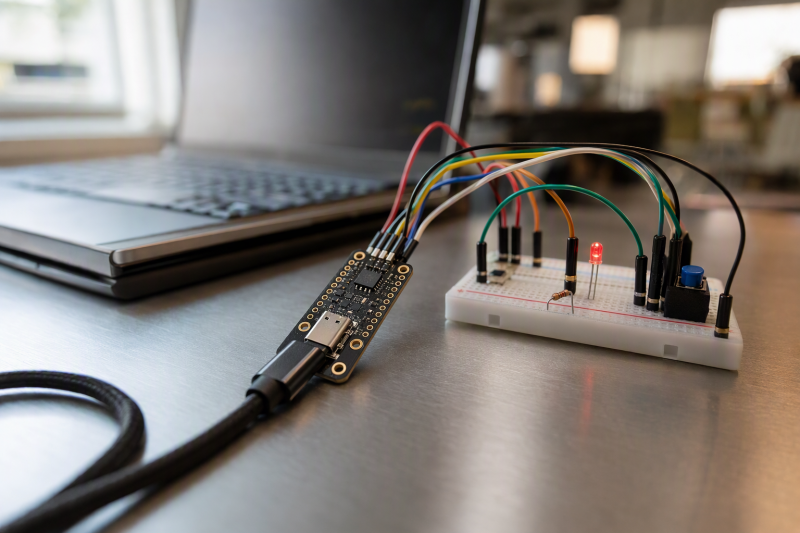
A USB-C breakout board turns a dense connector into pads or header holes that can be reached with ordinary bench wiring, which makes it useful for low-voltage power experiments, USB 2.0 data, cable checks, enclosure feed-throughs, and connector retrofits. It does not automatically provide USB Power Delivery negotiation, SuperSpeed data, current protection, voltage regulation, or a complete USB-C device design.
The eight packs below include six-signal basic boards, 16-pin female sockets, 24-pin male and female parts, and panel-mount breakouts. The main decision is which pins need to be accessible. VBUS, ground, CC1, CC2, D+, and D- are enough for many USB 2.0 and standard-power prototypes. USB 3.x work needs the high-speed differential lanes and layout control that six-pad boards do not expose.
LONELY BINARY is the best general breadboard pick because its documentation lists dual 5.1 kOhm CC pull-down resistors, a power LED, six named signals, 2.54 mm spacing, USB 2.0 support, and straight plus right-angle headers. Amabro is the better enclosure option with panel hardware and manufacturer-rated 480 Mbps USB 2.0 support. MTDELE is the only set here specifying both 24-pin male and female connector formats, but it asks more from the soldering setup.
USB-C Breakout Board Comparison
| Image | Product | Details | Check Price |
|---|---|---|---|
 | DIANN Six-Signal Breakout | Best fit: Basic USB-C power or USB 2.0 retrofit Exposed signals: VBUS; GND; CC1; CC2; D+; D- Pitch: 0.1 inch Current claim: 1.5 A nominal; 3 A peak stated Quantity: 5 boards | Check Price on Amazon |
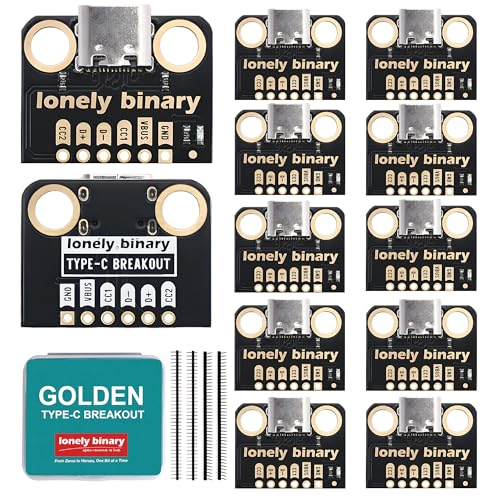 | LONELY BINARY Gold Breakout | Best fit: Breadboard-ready standard 5 V sink prototype CC resistors: Dual 5.1 kOhm pull-downs Data: USB 2.0 D+ and D-; no SuperSpeed Pitch: 2.54 mm / 0.1 inch Quantity: 12 boards plus header strips | Check Price on Amazon |
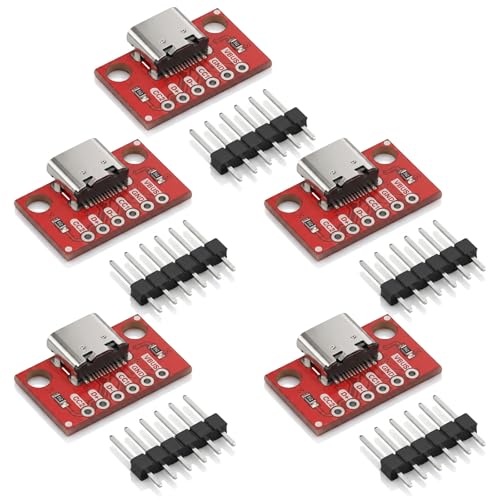 | Zelphvt Six-Signal Breakout | Best fit: Through-hole connector retrofit Exposed signals: VBUS; GND; CC1; CC2; D+; D- Pitch: 0.1 inch Connector: 16-pin female USB-C Quantity: 5 boards | Check Price on Amazon |
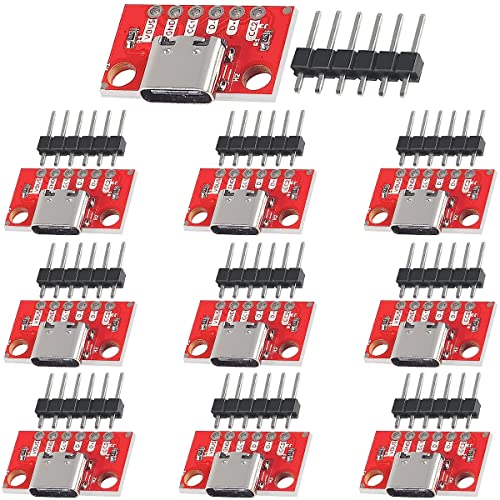 | DKARDU JK-US-641 | Best fit: Bulk basic boards with pin headers Exposed signals: VBUS; GND; CC1; CC2; D+; D- Pitch: 2.54 mm / 0.1 inch Current claim: 1.5 A nominal; 3 A max stated Quantity: 10 boards | Check Price on Amazon |
 | MTDELE 24-Pin Male and Female Set | Best fit: Connector-level male and female fixture work Connector format: 24-pin USB-C Mix: 5 male; 5 female Size: 8.4 x 2.6 mm stated Rating: 3 A; 20 V | Check Price on Amazon |
 | Cermant 20-Pack 16-Pin Test Boards | Best fit: High-quantity female-socket experiments Connector: 16-pin female USB-C Board type: PCB test socket Materials: Plastic; metal; PCB Quantity: 20 boards | Check Price on Amazon |
 | Cermant Six-Signal 10-Pack | Best fit: Basic breakouts needing positioning holes Exposed signals: VBUS; GND; CC1; CC2; D+; D- Pitch: 2.54 mm / 0.1 inch Mounting: Positioning holes Quantity: 10 boards | Check Price on Amazon |
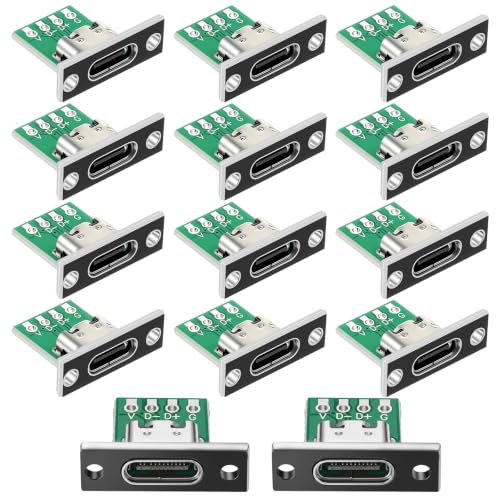 | Amabro Panel-Mount Breakout | Best fit: USB-C feed-through in a project enclosure Data: USB 2.0 up to 480 Mbps Board size: 20.1 x 6.7 x 1.5 mm Mounting: 2 mm screw hole Quantity: 14 boards | Check Price on Amazon |
Choose by electrical function before pack size. A board with 20 pieces is not useful if it omits the signal lane or CC configuration your prototype requires. Read the board markings, inspect continuity, and confirm orientation before connecting a host, charger, or valuable device.
Also match the board to the physical bench workflow. A 2.54 mm or 0.1-inch terminal pitch is convenient for headers, perfboard, and jumper wires, while a panel-mount assembly solves a different problem: placing a serviceable connector at an enclosure wall. Neither format substitutes for strain relief, current protection, or a verified wiring diagram.
1. DIANN Six-Signal Breakout — Best Five-Pack for Basic Retrofits
DIANN supplies five female boards exposing VBUS, GND, CC1, CC2, D+, and D- at 0.1-inch pitch. Bent pins make the six connections accessible without soldering directly to the connector’s tiny contacts. The format suits keyboard conversions, charging-port replacements, and other USB 2.0 or power projects using those signals.
The seller states 1.5 A nominal and up to 3 A depending on the upstream equipment. It also says resistance has been added, but gives no value or exact CC circuit. Do not assume the board presents the correct source or sink identity until the populated resistors and connections are inspected. SuperSpeed pairs are not exposed.
Our Take: DIANN is a practical five-pack for basic USB-C socket retrofits when the six named signals are sufficient. The unspecified resistor configuration is the main reason to inspect the board before applying power.
[su_box title=”PROS” style=”soft” box_color=”#2e7d32″] – Six named signals cover standard power, CC, and USB 2.0 data access. – A 0.1-inch pitch connects readily to common headers and perfboard. – Five boards provide enough stock for prototypes and replacement attempts. – Bent through-hole pins avoid direct work on tiny connector contacts. [/su_box] [su_box title=”CONS” style=”soft” box_color=”#c62828″] – Resistor values and CC role are not specified in the product details. – The six-signal layout omits USB 3.x SuperSpeed lanes. – The stated 3 A peak depends on the source and complete wiring design. [/su_box]2. LONELY BINARY Gold Breakout — Best Breadboard-Ready Sink Board
LONELY BINARY includes 12 female USB-C boards with dual 5.1 kOhm pull-down resistors on CC1 and CC2. Those resistors identify a sink and request standard 5 V from a USB-C source without an external CC network. The maker recommends currents up to 1.5 A and tells users to consult the applicable requirements for higher-current designs.
VBUS, ground, CC1, CC2, D+, and D- appear at 2.54 mm pitch. A power LED shows when VBUS is present. The ENIG-finished boards include two 40-pin straight and two 40-pin right-angle breakaway header strips. USB 2.0 data is supported when wired correctly. USB 3.x lanes are explicitly absent.
Our Take: LONELY BINARY is the most complete entry point for a breadboarded 5 V USB-C sink or USB 2.0 prototype. Its CC values, LED, finish, pitch, and included headers leave fewer unknowns than simpler packs do.
[su_box title=”PROS” style=”soft” box_color=”#2e7d32″] – Dual 5.1 kOhm CC pull-downs provide a clearly stated sink configuration. – A VBUS LED gives immediate confirmation that source power is present. – Twelve ENIG-finished boards suit classes, labs, and repeated prototypes. – Straight and right-angle breakaway headers support several board orientations. – USB 2.0 D+ and D- are exposed at breadboard-friendly 2.54 mm pitch. [/su_box] [su_box title=”CONS” style=”soft” box_color=”#c62828″] – The maker recommends only up to 1.5 A without further design review. – USB 3.x SuperSpeed pairs are not broken out. [/su_box]3. Zelphvt Six-Signal Breakout — Best Through-Hole Five-Pack
Zelphvt supplies five 16-pin female USB-C connector boards reduced to six accessible signals: VBUS, ground, CC1, CC2, D+, and D-. The 0.1-inch through-hole terminals accept wires or headers without requiring the user to touch the connector’s small surface-mount contacts.
The listing states 1.5 A nominal and 3 A peak depending on the upstream source. Intended uses include worn-port replacement, detachable-keyboard conversion, and custom electronics. No CC resistor values, board dimensions, header parts, data-rate statement, or mounting-hole details are supplied. Treat the reversible connector as a physical feature, not proof that both orientations are wired correctly in the final project.
Our Take: Zelphvt is the straightforward five-board through-hole choice for a six-signal prototype. It offers less configuration detail and fewer accessories than LONELY BINARY.
[su_box title=”PROS” style=”soft” box_color=”#2e7d32″] – Five boards expose power, CC, and USB 2.0 data signals directly. – Through-hole terminals simplify wire and header attachment. – A 0.1-inch pitch works with common prototype-board spacing. [/su_box] [su_box title=”CONS” style=”soft” box_color=”#c62828″] – CC resistor population and values are not stated. – Headers, mounting dimensions, and a data-rate limit are not specified. – USB 3.x high-speed pairs are not available on the six-signal output. [/su_box]4. DKARDU JK-US-641 — Best 10-Pack with Pin Headers
DKARDU packages ten female USB-C boards with 2.54 mm pin headers. The outputs are VBUS, GND, CC1, CC2, D+, and D-. The listing also maps conventional USB 2.0 wire colors: D+ green, D- white, ground black, and VBUS red, which can help during a keyboard or headset conversion.
The seller states 1.5 A nominal and up to 3 A depending on the source. Through-board terminals avoid hand-soldering the connector’s tiny pads. As with other six-signal boards, no SuperSpeed lanes are exposed. CC resistor values and exact board dimensions are not provided, so inspect the populated components and fit before final assembly.
Our Take: DKARDU is the useful quantity pack when you need ten basic boards and included 2.54 mm headers. It is better documented for wire identification than for CC configuration.
[su_box title=”PROS” style=”soft” box_color=”#2e7d32″] – Ten boards support repeat conversions, classroom work, or spare inventory. – Included 2.54 mm headers match breadboards and DuPont-style wiring. – Named signal and wire-color mapping simplifies USB 2.0 harness work. – Through-hole connections reduce the need to touch tiny connector pads. [/su_box] [su_box title=”CONS” style=”soft” box_color=”#c62828″] – CC resistor values and role are not stated. – The 3 A statement remains dependent on source and full project wiring. – Six outputs cannot carry USB 3.x SuperSpeed lanes. [/su_box]5. MTDELE 24-Pin Male and Female Set — Best Connector-Level Mixed Pack
MTDELE includes five 24-pin USB-C male and five 24-pin female connector boards. The parts are listed at 8.4 by 2.6 mm, 3 A, and 20 V. MTDELE is the only pack here that explicitly mixes plug and receptacle forms, which makes it relevant to inline adapters, extension prototypes, and connector-level test fixtures.
The record calls the parts USB 3.1 connectors but does not state which pins are available at usable pads, the supported data rate, board layout, solder pitch, CC circuitry, or impedance control. High-speed USB cannot be assumed from the connector name alone. These compact 24-pin parts are a poor choice for a beginner seeking six large breadboard holes.
Our Take: MTDELE is the specialized mixed male/female pack for experienced connector work. Buy it for form-factor access, not as proof of a ready-to-run USB 3.1 link.
[su_box title=”PROS” style=”soft” box_color=”#2e7d32″] – Five male and five female parts support both sides of an inline fixture. – A 24-pin format exposes more connector complexity than six-signal boards. – The listing provides 3 A and 20 V component ratings. [/su_box] [su_box title=”CONS” style=”soft” box_color=”#c62828″] – Available breakout pads, pitch, and board layout are not described. – No supported data rate or high-speed layout performance is stated. – The manufacturer’s tiny 8.4-by-2.6 mm parts demand finer soldering than header boards. [/su_box]6. Cermant 20-Pack 16-Pin Test Boards — Best Bulk Female-Socket Pack
Cermant provides 20 female USB-C test-socket boards built around 16-pin connectors. The large pack suits repeated connector replacement, production experiments, education, or a repair bench that expects some boards to be consumed during process development.
The connector uses plastic and metal on a green PCB, with through-board terminals described as easier to solder than tiny surface pads. Although the product name uses USB 3.1 language, the record gives no exposed-signal map, pitch, resistor values, data rate, current rating, voltage rating, or dimensions. Do not infer SuperSpeed functionality from the title.
Our Take: Choose this Cermant pack when you want quantity and a female test-socket format more than detailed electrical documentation. It requires the most pre-use inspection among the bulk options.
[su_box title=”PROS” style=”soft” box_color=”#2e7d32″] – Twenty boards offer the largest quantity in this comparison. – Female 16-pin connectors suit repeated socket-oriented prototypes. – Through-board terminals are easier to approach than bare connector contacts. [/su_box] [su_box title=”CONS” style=”soft” box_color=”#c62828″] – Exposed pins, pitch, dimensions, ratings, and resistor population are unspecified. – USB 3.1 wording is not backed by a stated data rate. – The pack includes no documented headers or mounting hardware. [/su_box]7. Cermant Six-Signal 10-Pack — Best Basic Boards with Mounting Holes
This Cermant set includes ten 16-pin female connector boards exposing VBUS, ground, CC1, CC2, D+, and D- at 2.54 mm pitch. The large holes accept headers, wires, or DuPont connections, while positioning holes provide a way to fix the PCB during assembly or inside a prototype.
The listing states 1.5 A nominal and up to 3 A depending on upstream equipment. Uses include adding USB-C power to a device, replacing a headset port, or converting a wired keyboard. CC resistor values, board dimensions, included headers, and USB data rate are not stated.
Our Take: Cermant’s six-signal pack is the best simple 10-pack when you need mounting holes. It gives clearer signal and mechanical access than Cermant’s 20-pack, but still leaves CC configuration for the builder to inspect.
[su_box title=”PROS” style=”soft” box_color=”#2e7d32″] – Ten boards balance bulk value with a documented six-signal output. – A 2.54 mm pitch accepts common headers and DuPont-style wiring. – Positioning holes help secure the board during soldering or enclosure work. – Large plated holes simplify connections compared with raw USB-C contacts. [/su_box] [su_box title=”CONS” style=”soft” box_color=”#c62828″] – CC resistor values and included header parts are not stated. – Board dimensions and mounting-hole measurements are missing. – Six signals limit the design to power and USB 2.0-class data paths. [/su_box]8. Amabro Panel-Mount Breakout — Best Enclosure Feed-Through Pack
Amabro supplies 14 female USB-C panel-mount boards with USB 2.0 data up to 480 Mbps. Six accessible pads cover 5 V, ground, D+, D-, CC1, and CC2 at 2.54 mm pitch. The explicit USB 2.0 rate is more useful than an unsupported USB 3.x label.
Each board measures 20.1 by 6.7 by 1.5 mm and includes a 2 mm screw hole for enclosure attachment. A metal panel and green plastic housing form the connector assembly. The listing gives no current limit, CC resistor values, included screws, or cable-orientation dimensions, so the panel opening and electrical role still need design work.
Our Take: Amabro is the best choice for bringing USB 2.0 and 5 V through a project enclosure. Its board and screw-hole dimensions make mechanical planning easier than most other packs.
[su_box title=”PROS” style=”soft” box_color=”#2e7d32″] – Fourteen panel-mount boards support multiple enclosures or production trials. – USB 2.0 data is explicitly rated up to 480 Mbps. – Board dimensions and a 2 mm screw hole support enclosure layout work. – Six pads at 2.54 mm pitch keep internal wiring accessible. [/su_box] [su_box title=”CONS” style=”soft” box_color=”#c62828″] – Current rating, CC resistor values, and screw contents are not stated. – The six-pad interface omits USB 3.x SuperSpeed signals. – A panel opening must be designed around the connector and cable clearance. [/su_box]Buying Guide: Choose a USB-C Breakout Board
Count the Signals Your Prototype Needs
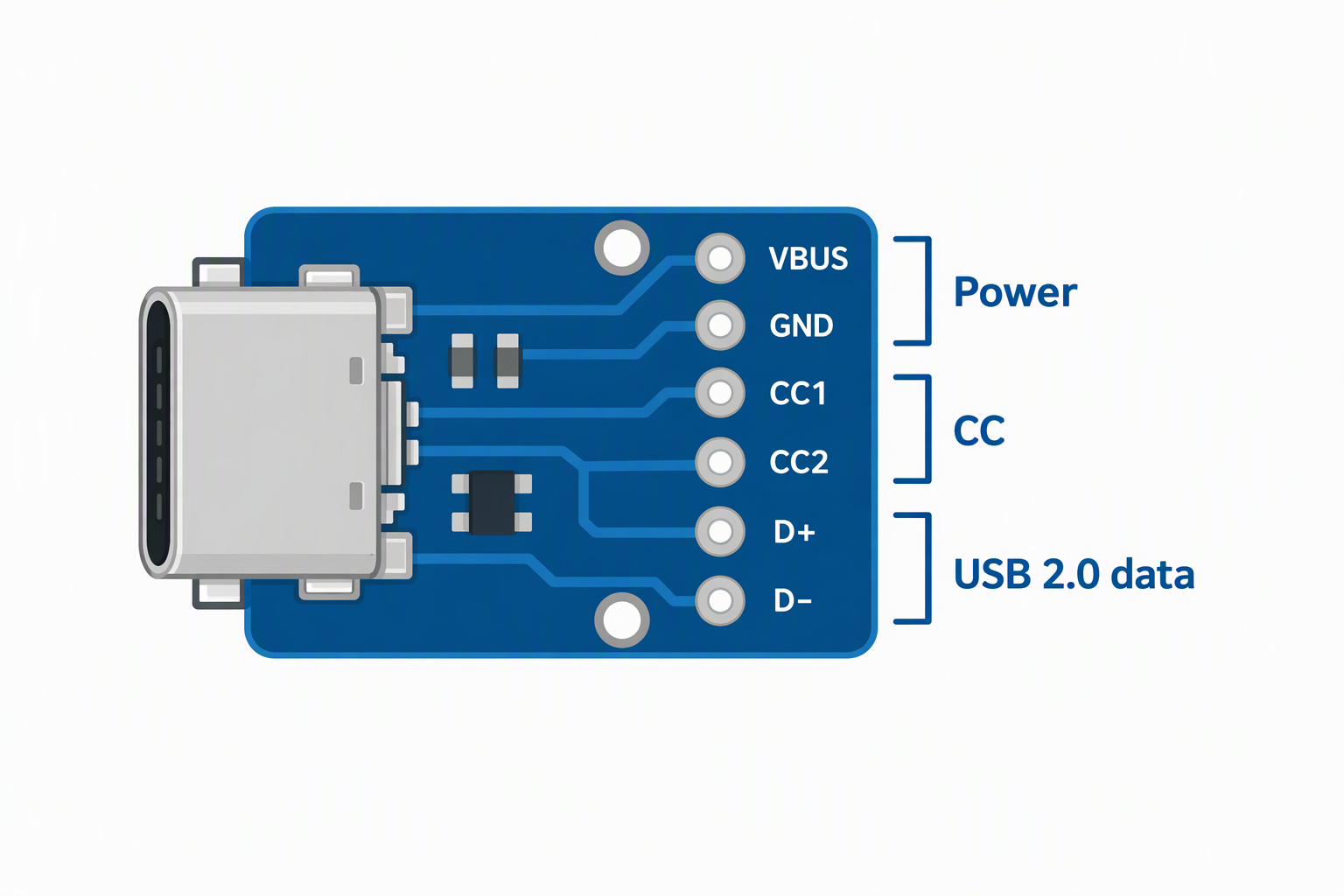
Six-signal boards cover power, CC, and USB 2.0 data. DIANN, LONELY BINARY, Zelphvt, DKARDU, Cermant 10-pack, and Amabro expose VBUS, ground, CC1, CC2, D+, and D-. LONELY BINARY and Amabro explicitly describe USB 2.0 operation.
USB 3.x requires more than a Type-C shell. MTDELE lists 24-pin male and female formats, but no rate or layout performance. Use a USB-C cable tester to inspect a cable, not to assume the breakout preserves high-speed signaling.
Understand the CC Resistor Role
CC1 and CC2 tell USB-C partners how the port should behave. LONELY BINARY clearly populates dual 5.1 kOhm pull-downs for a sink requesting standard 5 V. Other boards expose CC pads or mention resistance without documenting the exact network.
Do not apply power until the CC design is known. A breakout alone is not a PD trigger or controller. A USB-C electronic load can test a controlled power source, while the breakout still needs correct source-or-sink configuration and current handling.
Match Pitch and Soldering Difficulty
A 2.54 mm or 0.1-inch breakout is easiest for a prototype bench. DIANN, LONELY BINARY, Zelphvt, DKARDU, Cermant 10-pack, and Amabro state that spacing. DKARDU includes headers, and LONELY BINARY includes straight plus right-angle strips.
Compact 24-pin work needs finer tools and technique. MTDELE’s parts, which the manufacturer lists at 8.4-by-2.6 mm, are not equivalent to six large holes. A precision soldering tip and solder wick can help manage small joints and bridges without changing the electrical design.
Plan the Mechanical Installation
Breadboard tests and enclosure ports need different boards. LONELY BINARY prioritizes DIP headers, Cermant’s 10-pack adds positioning holes, and Amabro supplies a 2 mm screw hole and exact board dimensions.
Secure the board before soldering or repeated plugging. A PCB holder or helping hands keeps strain away from tiny pads. Add cable relief in the finished enclosure so connector force is not carried by wires alone.
Validate Power and Data Separately
Current claims depend on the full path. Several basic boards state 1.5 A nominal and 3 A depending on the source, while MTDELE documents 3 A and 20 V component ratings. Trace width, joints, headers, wiring, CC advertisement, and source policy all affect the safe result.
A power LED or continuity check does not prove data integrity. Use a digital logic analyzer for accessible USB 2.0-related signal work only when its voltage and rate limits fit. A desoldering pump removes solder during rework but cannot repair a flawed high-speed layout.
Frequently Asked Questions
Can a Six-Pin USB-C Breakout Carry USB 3.x Data?
No, the common six outputs expose only VBUS, ground, CC1, CC2, D+, and D-. D+ and D- carry USB 2.0 data. USB 3.x requires separate high-speed differential lanes that these boards do not provide.
A USB-C connector shape does not define the data rate. LONELY BINARY explicitly says its SuperSpeed pins are absent, and Amabro states USB 2.0 up to 480 Mbps. Choose a suitable high-speed board and layout for SuperSpeed work.
Do I Need CC Resistors for a Power Project?
Yes, USB-C sources use CC pins to detect and classify a connection. LONELY BINARY includes dual 5.1 kOhm pull-downs that identify a sink and request standard 5 V. An exposed CC pad by itself provides no defined behavior.
The correct network depends on the port role. Do not copy a sink pull-down into a source design without understanding the specification and power policy. Inspect any pre-populated board before connection.
Does a 3A Listing Mean the Board Always Supplies 3A?
No, the load draws current and the source advertises what is available. The board and wiring must safely carry the result. Several listings make their 3 A statement conditional on upstream equipment.
Current capability is a system property. CC configuration, source limits, trace width, headers, wires, solder joints, and protection all affect it. Begin with a current-limited source when developing a new circuit.
Which Board Is Easiest to Use on a Breadboard?
LONELY BINARY is the most complete breadboard package. It uses 2.54 mm spacing and includes both straight and right-angle breakaway headers. Its dual CC pull-downs and power LED reduce extra setup for a standard 5 V sink.
DKARDU is another header-based option. DIANN, Zelphvt, Cermant 10-pack, and Amabro also state 0.1-inch or 2.54 mm access, but included accessories differ.
Can I Use a Breakout Board as a PD Trigger?
Not by itself. A basic breakout exposes VBUS, ground, and CC pins but does not perform Power Delivery messaging for higher fixed voltages. LONELY BINARY’s 5.1 kOhm resistors request ordinary 5 V source behavior, not a negotiated 9, 15, or 20 V contract.
Use a purpose-built PD trigger for requested higher voltage. Keep the breakout for pin access, connector conversion, and USB 2.0 or 5 V experiments. Verify every board’s populated circuit before applying power.
Final Recommendation
LONELY BINARY is the best general prototype-bench choice because it documents dual 5.1 kOhm CC pull-downs, USB 2.0 support, 2.54 mm pitch, a VBUS LED, ENIG finish, and included straight and right-angle headers. Choose Amabro for an enclosure feed-through with stated dimensions and 480 Mbps support, or Cermant’s 10-pack when positioning holes and basic six-signal access matter.
Start with the required signals and port role, then choose pitch and mounting style. Inspect the actual CC network, verify continuity and orientation, and test power with current limiting before connecting a host or device. The USB-C shape is only the connector. The circuit around it determines what the prototype can safely do.