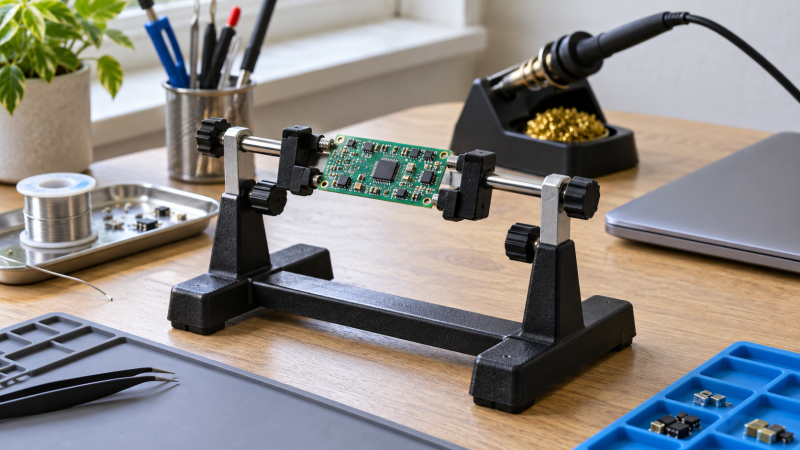
A circuit board holder has one main job, which is keeping the board where you put it while both hands handle the iron, solder, probe, or tweezers. The wrong fixture can be too tall for comfortable work, too light for cable tension, too narrow for the board, or unable to expose the second side without a complete reset.
The eight holders here take several approaches. The Noah NH-11E and ToneBar XB003G2 use rotating frame designs for access to both faces. The Stickvise holds a board flat at table level. WalkCleaner’s HX-02 is a lightweight PETG fixture for boards up to 4.33 inches wide, while SOSS GAMING’s SG-11E accepts boards up to 8 inches wide. Those differences affect the work more than an extra accessory that does not help the board stay aligned.
For a general small-electronics bench, the Noah NH-11E offers the clearest balance of metal-base stability, 360-degree rotation, and a stated 20 x 14 cm maximum board size. Buyers who prefer to keep the board low should consider the Stickvise instead. If the rest of the station needs organizing, the guides to magnetic parts trays and USB-C electric screwdrivers cover two neighboring bench decisions.
| Image | Product | Details | Check Price |
|---|---|---|---|
 | Noah NH-11E | Best fit: All-around small-board soldering Maximum holding size: 20 x 14 cm Rotation: 360 degrees Base: Metal; 4 anti-slip feet Warranty: 1 year stated | Check Price on Amazon |
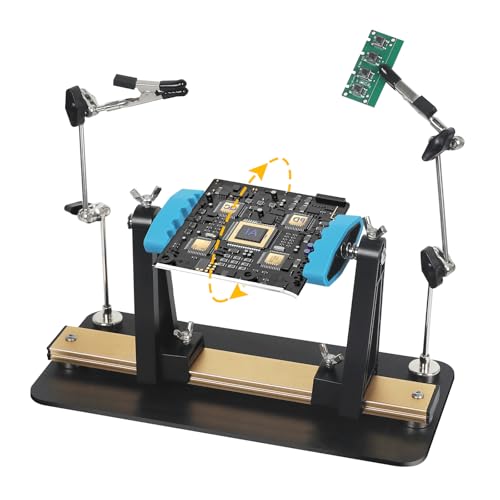 | EOOKU 10GE | Best fit: Magnetic-base station with extra clips Rotation: 360 degrees Extra holders: 2 alligator clips Material: Aluminum Base: 2 magnets and iron base stated | Check Price on Amazon |
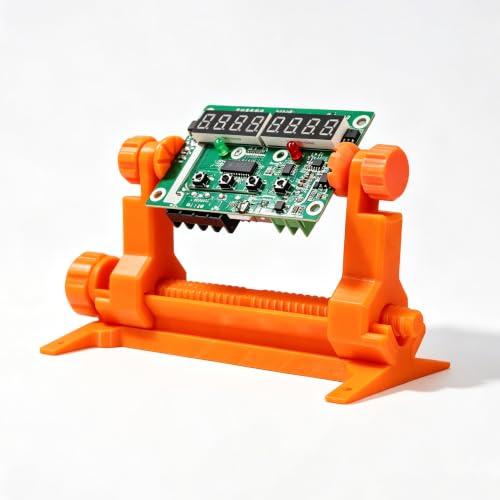 | WalkCleaner HX-02 | Best fit: Lightweight holder for narrow boards Maximum width: 4.33 inches PCB thickness: 0.03 to 0.1 inch Weight: 0.225 lb Material: FDM 3D-printed PETG | Check Price on Amazon |
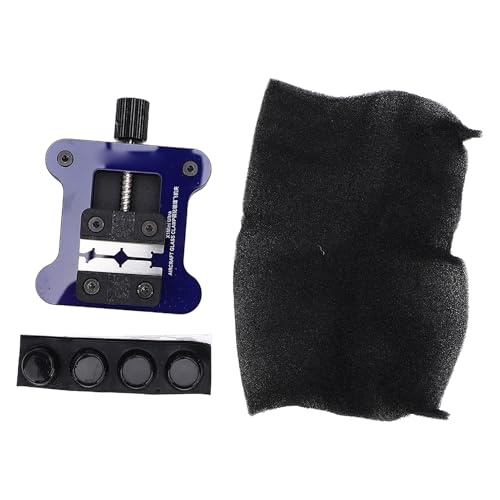 | Jeffergarden Adjustable PCB Holder | Best fit: Compact parts and delicate board edges Supported component size: Up to 6.6 cm stated Contact: Non-marring clamps Base: Metal; 4 anti-slip pads Adjustment: Sliding clamp and knob | Check Price on Amazon |
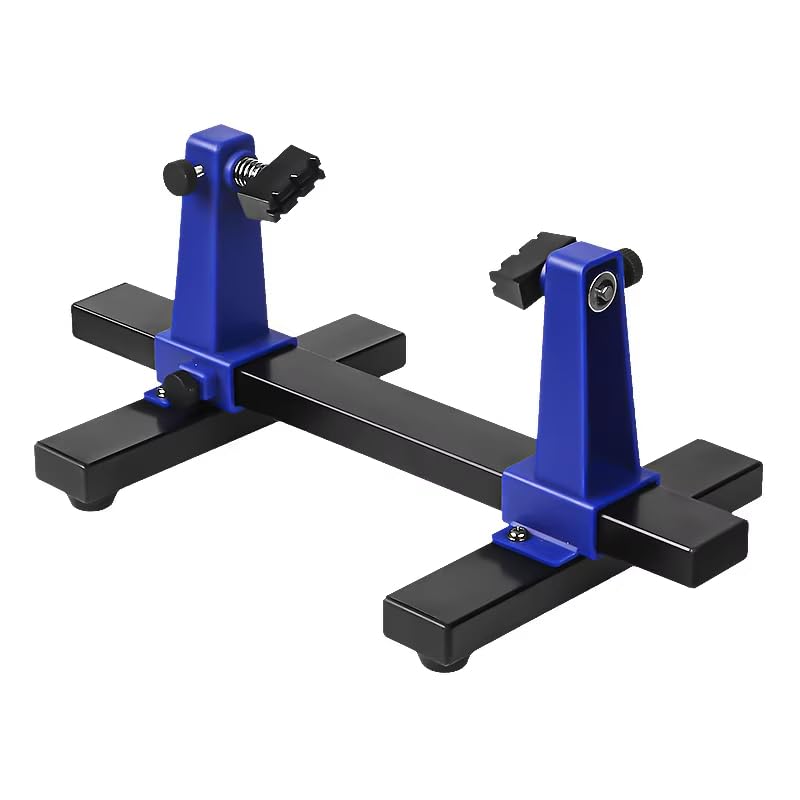 | ToneBar XB003G2 | Best fit: Broad width and thickness adjustment Width range: 0 to 200 mm Maximum PCB thickness: 3 mm Rotation: 360 degrees Base: Metal; 4 rubber feet | Check Price on Amazon |
 | Stickvise PCB Vise | Best fit: Low-profile table-level work Position: Holds PCB flat Included jaws: Standard nylon Custom support: 3D-printable jaw plates Optional upgrades: PTFE and aluminum jaws; PartLift | Check Price on Amazon |
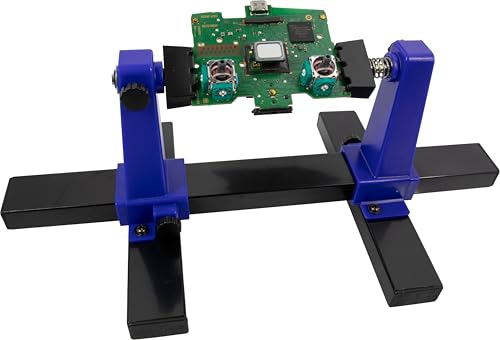 | SOSS GAMING SG-11E | Best fit: Boards up to 8 inches wide Maximum width: 8 inches Rotation: 360 degrees stated in title Base: Wide metal base Contact: Non-marring grip surfaces | Check Price on Amazon |
 | QYQRQF-SC-1 Set | Best fit: Rotating frame with iron rests Maximum opening: 20 cm Thickness settings: 4 Rotation: 360 degrees Included rests: 2 iron racks | Check Price on Amazon |
How we ranked these PCB holders
Every selected product has a New offer and a stated role in holding circuit boards for soldering, desoldering, rework, repair, inspection, testing, or assembly. The ranking favors disclosed board capacity, access to both sides, base construction, anti-slip details, non-marring contact, and a design suited to a small electronics bench.
We did not run hands-on holding-force or thermal tests. Dimensions, materials, capacities, and rotation claims come from the product listings. Where a listing omits a figure, we leave it unstated instead of estimating from a photograph or borrowing a number from a similar-looking fixture.
1. Noah NH-11E — Best Overall for Small Electronics Boards
Our take: The Noah NH-11E is the pick for a general small-electronics bench, because it covers the main bench requirements without an unusual setup. Noah lists a maximum holding size of 20 x 14 cm, a 360-degree rotating holder, a metal base, and four anti-slip bumper feet. That combination suits small and medium boards that need to remain stable while the work moves between their component and solder sides.
The rotation mechanism is the key reason to choose it over a flat vise. Noah says the holder can turn fully around so the user can reach both board faces without removing the PCB. Full rotation helps during through-hole assembly or rework where placement happens on one face and soldering on the other, although the listing does not give a maximum board thickness.
The metal base and four bumpers are intended to keep the fixture positioned on the work surface. Noah also lists a one-year after-sales and quality-assurance period. Buyers still need to compare the 20 x 14 cm capacity with the actual board, including protruding connectors that may interfere with the clamps.
Pros
- The stated 20 x 14 cm maximum supports many small electronics boards.
- Full 360-degree rotation exposes either PCB face without removing the board.
- A metal base and four anti-slip feet address movement on the bench.
- Noah lists a one-year after-sales and quality-assurance period.
Cons
- The listing states no maximum PCB thickness, overall footprint, or weight.
2. EOOKU 10GE — Best Magnetic-Base Holder with Extra Clips
Our take: Choose EOOKU’s 10GE when the board needs a fixture and the job also benefits from two movable clips for light wires or small parts. It combines an adjustable PCB rail with two metal alligator clips and a magnetic-base arrangement. The dual-joint clips are described as adjustable, while the main holder rotates through 360 degrees.
EOOKU lists an aluminum construction, smooth sliding clamps, two magnets in the base, and an iron base intended to resist tipping on metal surfaces. The listing contains placeholder text instead of base dimensions, so there is no reliable width-by-depth figure to compare. Judge it on its magnetic mounting and accessory layout, not an assumed footprint.
The listing describes a universal fit across different PCB sizes but does not publish a maximum board width or thickness. The missing limit makes this holder better for buyers who can confirm fit from the seller before ordering, or who work mainly with modest hobby boards. Its extra clips add positioning options, but they do not replace the main PCB clamps.
Pros
- Two dual-joint alligator clips add separate positioning points beside the PCB.
- The main holder rotates 360 degrees for access to both board faces.
- Two base magnets are intended to secure the aluminum station to metal surfaces.
Cons
- The listing states no maximum PCB width or thickness and contains no usable base dimensions.
- Magnetic-base stability depends on placing the fixture on a suitable metal surface.
3. WalkCleaner HX-02 — Best Lightweight Holder for Narrow Boards
Our take: The WalkCleaner HX-02 is the light, compact option for narrow boards. Its stated weight is 0.225 lb, its maximum board width is 4.33 inches, and its dual-screw rail accepts PCBs from 0.03 to 0.1 inch thick. Those disclosed limits make it easier to rule in or out than a universal-fit claim with no numbers.
WalkCleaner uses FDM 3D-printed PETG and describes the material as heat resistant. The two independent clamp heads rotate through a full circle so either side can be presented for inspection, soldering, desoldering, repair, or assembly. Because the listing provides no temperature rating, the material claim should not be treated as permission to rest a hot iron on the fixture.
The low weight helps with storage and transport but does not establish the same steadiness on the bench as a heavy metal base. This model makes the most sense for small DIY boards that stay within its width and thickness ranges, particularly where the holder is packed away after use. A cable or stiff wire pulling against the board may require more deliberate bench placement.
Pros
- A 0.225 lb listed weight makes the fixture easy to store or transport.
- The 4.33-inch maximum width clearly defines its narrow-board role.
- Dual-screw adjustment covers PCB thicknesses from 0.03 to 0.1 inch.
- Independent rotating clamp heads expose either board side.
Cons
- The 4.33-inch width limit excludes larger controller and computer boards.
- PETG is described as heat resistant without a stated temperature rating.
4. Jeffergarden Adjustable PCB Holder — Best for Compact Components
Our take: Jeffergarden’s holder suits small repair parts and delicate board edges. Its listing says the sliding clamp and knob arrangement supports components up to 6.6 cm, while non-marring clamp surfaces are intended to hold delicate board edges without scratching contact points. The small component range and gentle contact surfaces make it a focused choice for phone, controller, chip, and compact-board work.
The wide metal base is supplied with four anti-slip pads. Jeffergarden says the fixture is intended to reduce movement and board bending while leaving both hands free. The movement and bending claims are design claims rather than quantified force figures, but the metal construction and included pads give buyers concrete features to compare with a lightweight plastic frame.
The 6.6 cm figure is described for supported components rather than as a clearly labeled maximum board width. Buyers should not assume it translates into a 6.6 cm clamp opening without confirmation. The listing also does not state 360-degree rotation, so it is better treated as an adjustable compact fixture than as a flip-over frame. The listing does not publish its weight either.
Pros
- Non-marring clamp contacts are intended to protect delicate PCB edges.
- A wide metal base and four anti-slip pads support fixed bench placement.
- Phone, controller, chip, CPU, and hard-drive repair are named uses.
Cons
- The stated 6.6 cm component figure is not clearly defined as board width.
- The listing describes no 360-degree rotation, so two-sided access is unconfirmed.
5. ToneBar XB003G2 — Best for a Wide Adjustment Range
Our take: The ToneBar XB003G2 suits buyers who work with boards of many sizes, because it states both a width range and a thickness limit. Its slidable frame adjusts from 0 to 200 mm wide, and four thickness settings support boards up to 3 mm thick. That capacity covers small phone boards, Arduino boards, graphics cards, and other daily electronics panels named by the listing.
ToneBar specifies that the spring-loaded clamps rotate through 360 degrees, allowing a board to be flipped for soldering, desoldering, or chip replacement without repeated removal. ToneBar pairs metal in the base with ABS arms and four rubber feet. The listing says the feet prevent sliding and help avoid scratches on the circuit surface, although it does not provide the base weight.
The short-body design is described as lightweight and portable, so this model aims to combine a broad clamp range with easier storage. The 3 mm thickness limit is the figure to check carefully, because connector placement, shields, and edge geometry can affect whether a nominally thin board seats properly even when the bare PCB meets the limit.
Pros
- Width adjustment from 0 to 200 mm covers a broad range of board sizes.
- Four settings accept PCB thicknesses up to a stated 3 mm.
- Spring-loaded clamps provide 360-degree rotation for two-sided work.
- A metal base and four rubber feet address bench stability.
Cons
- Boards thicker than 3 mm fall outside the stated clamp range.
- No base weight is given for comparing resistance to cable pull.
6. Stickvise PCB Vise — Best Low-Profile Flat Holder
Our take: Stickvise is the choice for technicians who prefer to rest their arms near the work surface. It holds a PCB flat at table level for soldering, rework, probing, and testing, unlike the elevated rotating frames, and it suits anyone who does not need the board suspended above a metal base.
The standard version uses nylon jaws. Stickvise also points to optional anodized-aluminum Pro Jaws, high-temperature PTFE jaws, and a PartLift accessory for supporting through-hole parts with the board inverted. Those upgrades are not presented as included with the standard gray model, so buyers should plan around the standard nylon-jaw vise unless the listing states otherwise at purchase.
The fixture is described as hackable, with custom jaw plates available through 3D printing and tested modifications on the Stickvise website. That adaptability helps with repeat bench work on odd board outlines. It does not offer the instant 360-degree flip of Noah or ToneBar, so access to the reverse side requires a different handling routine.
Pros
- The low-profile design holds the PCB flat at table level for stable arm positioning.
- Standard nylon jaws provide the included board-contact arrangement.
- Custom jaw plates can be 3D printed for specialized applications.
Cons
- The standard vise does not provide a listed 360-degree flip mechanism.
- PTFE jaws, aluminum jaws, and PartLift support are optional accessories.
- The listing does not state a maximum board width or thickness.
7. SOSS GAMING SG-11E — Best for Boards Up to 8 Inches Wide
Our take: SOSS GAMING’s SG-11E is the pick for buyers who need a clearly stated opening for wider boards. Its sliding clamps accept boards up to 8 inches wide, covering small controller PCBs as well as larger electronics within that limit. The product title also identifies 360-degree rotation, which supports access to both sides during soldering and diagnostics.
The holder uses rigid metal construction with a wide, balanced base. SOSS GAMING says the design is intended to prevent tipping or shifting, while non-marring grip surfaces hold board edges without crushing components or damaging the PCB. No product weight or board-thickness limit is stated, so width alone does not guarantee fit.
This model especially suits game-controller repair, which the listing names directly. It also suits broader DIY and professional bench work when the board falls within the 8-inch opening. Buyers working on thick edge connectors or irregular cutouts should verify jaw clearance rather than relying only on the maximum width.
Pros
- The sliding clamp system accepts boards up to a stated 8 inches wide.
- A 360-degree rotation claim supports access to both board faces.
- Rigid metal construction and a wide base are intended to resist shifting.
- Non-marring grip surfaces address contact with delicate PCB edges.
Cons
- The listing states no board-thickness range, product weight, or bench footprint.
8. QYQRQF-SC-1 Set — Best with Built-In Iron Rests
Our take: The QYQRQF-SC-1 set is for buyers who want the holder and the soldering iron to have their own places on a small bench. It adds two iron racks to a rotating PCB frame. The manufacturer specifies an adjustable opening reaching up to 20 cm, and the design includes four thickness positions to support different board sizes, which makes it a practical all-in-one frame.
The metal frame uses four anti-slip rubber foot pads, while ABS side supports slide to adjust width. QYQRQF says the handles rotate 360 degrees, with a knob that loosens for angle adjustment and tightens at the chosen position. The listing names household appliances, phones, computers, and electronic toys among the repair uses.
The four thickness positions are not accompanied by exact millimeter values, so buyers cannot compare them directly with ToneBar’s stated 3 mm maximum. The two iron racks also need clear space around the frame. Choose this model for its 20 cm opening, rotating access, and integrated rests rather than for the smallest possible footprint.
Pros
- A maximum 20 cm opening supports a useful range of small electronics boards.
- Four thickness positions give the clamps several board-fit options.
- Two included iron racks organize tools beside the PCB fixture.
Cons
- The listing omits exact thickness values for the four clamp positions and overall dimensions.
- The integrated iron racks require more clear bench area around the frame.
Buying Guide: Choosing a PCB Holder for Small-Board Soldering
Measure width, thickness, and edge clearance
Start with the board’s clamping edges, not its overall outline alone. ToneBar accepts widths from 0 to 200 mm and boards up to 3 mm thick, WalkCleaner lists 4.33 inches wide and 0.03 to 0.1 inch thick, Noah states 20 x 14 cm, and SOSS GAMING states an 8-inch maximum width. These published limits provide a better starting point than a generic universal-fit label.
Connectors and components near the edge can reduce usable clamp space. A board may fall within the width limit yet have a port, switch, or shield exactly where the jaw needs to sit. Non-marring contacts on Jeffergarden and SOSS GAMING address surface contact, but they do not remove the need for a clear gripping area. Measure the bare edge that the clamp will actually reach.
Choose flat support or 360-degree rotation
A rotating frame is convenient when work alternates between component and solder sides. Noah, EOOKU, ToneBar, SOSS GAMING, and QYQRQF all state 360-degree movement in their titles or feature lists, while WalkCleaner uses two independently rotating clamp heads. This arrangement can reduce repeated unclamping during through-hole assembly and two-sided inspection.
A low-profile flat vise favors table-level control. Stickvise keeps the PCB flat for soldering, probing, rework, and testing, and it offers optional accessories for other configurations. That position can be more comfortable for long inspection sessions, but it does not offer the same flip-over motion. The right choice depends on whether board height or reverse-side access interrupts the task more often.
Compare base stability with portability
Metal bases and anti-slip feet support a permanent bench station. Noah has a metal base with four bumper feet, Jeffergarden supplies a metal base with four pads, ToneBar combines a metal base with four rubber feet, and QYQRQF uses a metal frame with four rubber pads. SOSS GAMING also describes a wide, balanced metal base, although its weight is not stated.
Low mass and magnetic mounting solve different problems. WalkCleaner weighs 0.225 lb and prioritizes easy storage, while EOOKU uses two magnets to secure its base to a suitable metal surface. A light fixture is easier to pack away, but stiff leads may move it more. A magnetic base can improve placement on steel yet offers no such benefit on a nonferrous or wooden bench.
Treat heat-related descriptions as boundaries, not guarantees
A PCB holder supports the board and is not an iron rest unless one is included. QYQRQF includes two iron racks, while the other listings do not establish their clamps or bases as safe landing places for a hot tip. WalkCleaner describes PETG as heat resistant but gives no temperature rating. Keep the iron in a purpose-built rest rather than inferring contact safety from a general material description.
Optional jaw materials can address specialized workflows. Stickvise identifies separate high-temperature PTFE jaws and anodized-aluminum Pro Jaws, but its standard gray model comes with nylon jaws. Treat those upgrades as separate purchases. When arranging a broader repair station, keep power and data leads orderly as well. Our guides to USB4 cables and compact Thunderbolt 5 docks can help keep cables from pulling on the holder.
Buy the fixture for the board, not the accessory count
Extra clips and tool racks are useful only after the main clamps fit. EOOKU provides two alligator clips, and QYQRQF includes two iron racks. These accessories can make a compact station more orderly, but neither compensates for a board outside the holder’s width, thickness, or edge-clearance range.
A simple holder can be the better long-term bench tool. Noah supplies a defined 20 x 14 cm capacity and rotation, ToneBar publishes both width and thickness limits, and Stickvise offers a flat, modifiable jaw system. If completed boards feed into storage or computer testing, keep the fixture separate from USB-C drive docks and four-bay DAS enclosures so those devices do not become accidental supports.
Frequently Asked Questions
Do I need a 360-degree PCB holder?
Rotation is most useful when the job repeatedly moves between both board faces. Through-hole assembly, inspection, and rework can involve placing a component on one side and reaching its joints on the other. Noah and ToneBar provide rotating frames with published size limits, while QYQRQF pairs rotation with two iron racks.
A flat holder can be preferable when most work happens from one side or when table-level support improves control. Stickvise is specifically designed to keep the board flat for soldering, rework, probing, and testing. Rotation is therefore a workflow choice, not a universal requirement.
Can these holders clamp laptop or desktop computer boards?
Some small computer boards may fit, but the holder’s stated range decides. Noah lists 20 x 14 cm, ToneBar reaches 200 mm wide, SOSS GAMING reaches 8 inches, and QYQRQF reaches 20 cm. Jeffergarden also names motherboards, chips, CPUs, and hard drives among its use cases, though its 6.6 cm component figure is not clearly a board-width limit.
Large desktop motherboards exceed the intended small-board category for several picks. Measure width, thickness, and a clear jaw area before ordering. For related storage work after repair, an M.2 SATA enclosure handles a different job and should not be used to brace the fixture.
Will the clamp damage a circuit board edge?
The clamp should contact a clear, structurally suitable edge rather than components or exposed contacts. Jeffergarden and SOSS GAMING specifically describe non-marring grip surfaces, and ToneBar says its structure holds a PCB without scratching the circuit surface. Those statements do not guarantee safe contact at every point on every board.
Use only enough clamping action to secure the PCB according to the holder’s mechanism, and check both faces before rotating. Irregular cutouts, edge connectors, and parts mounted close to the perimeter can interfere even when the board meets the nominal size limit. Reposition rather than forcing a jaw around an obstruction.
Is a heavy base always better?
A heavier or wider base can resist movement, but the listings rarely publish weight. Noah, Jeffergarden, ToneBar, SOSS GAMING, and QYQRQF describe metal-base arrangements, while EOOKU adds magnetic attachment. WalkCleaner is the exception with a stated 0.225 lb total weight.
Bench material, cable tension, board size, and hand pressure also affect how a fixture behaves. EOOKU’s magnets need a suitable metal surface, and anti-slip feet need a clean, stable bench. Keep loose hardware in a separate tray rather than loading the holder’s base with screws or brackets.
Which holder is best for a very small workspace?
WalkCleaner is the clearest portable choice because it weighs 0.225 lb and is described as compact. Its 4.33-inch board-width limit also keeps the intended projects narrow. Stickvise is another useful option when a low-profile, table-level arrangement is more important than a rotating frame.
Published overall footprints are missing for most of these products, so maximum board capacity should not be mistaken for base size. Leave room for the iron stand, solder, lighting, and extraction equipment. If the same desk also connects repaired systems, a Thunderbolt 5 workstation dock belongs outside the hot-work area.
Final recommendation
The Noah NH-11E is the best all-around starting point because it combines a stated 20 x 14 cm capacity, 360-degree rotation, a metal base, and four anti-slip feet. ToneBar is the stronger fit when board thickness must be checked against a published 3 mm maximum, and SOSS GAMING is the straightforward choice for widths up to 8 inches.
Choose Stickvise for low-profile table-level work, WalkCleaner for light storage and narrow boards, EOOKU for a magnetic base plus two accessory clips, Jeffergarden for non-marring compact-part handling, or QYQRQF for integrated iron rests. The best fixture is the one whose clamps fit the actual board without obstructing the work area.