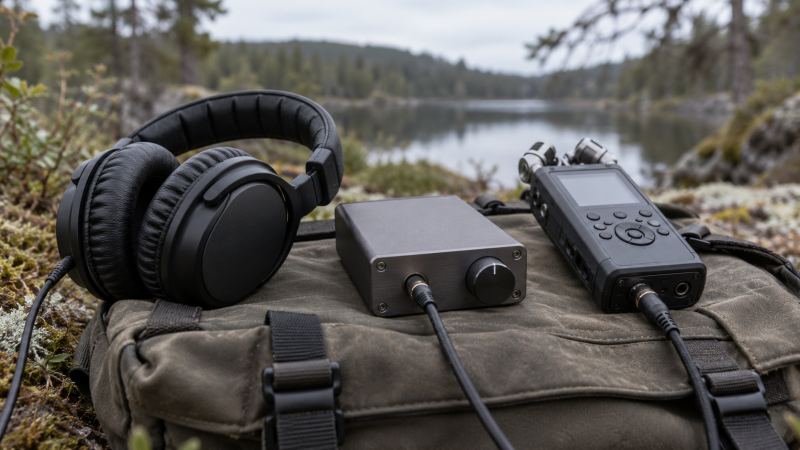
A portable headphone amplifier can make a wired monitoring setup easier to hear when a field recorder, camera, or small mixer has limited level control. It is not an automatic upgrade for every recorder. The source connector, headphone impedance range, gain control, and battery plan all need to match the equipment you carry.
This guide compares six Amazon US portable headphone amplifiers with active New offers. Most use 3.5mm input and output, while one Donner model lists XLR and TRS source inputs. Choose the connection type first, then compare listed battery life and impedance guidance.
A portable amp is useful only when its input, output, gain, and battery plan fit the recorder and headphones you carry.Portable Headphone Amplifiers Compared
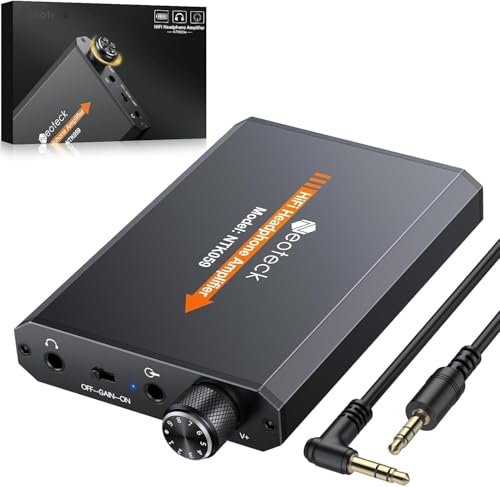

1. Neoteck 16-300 Ohm Amp — Long Stated Battery Life
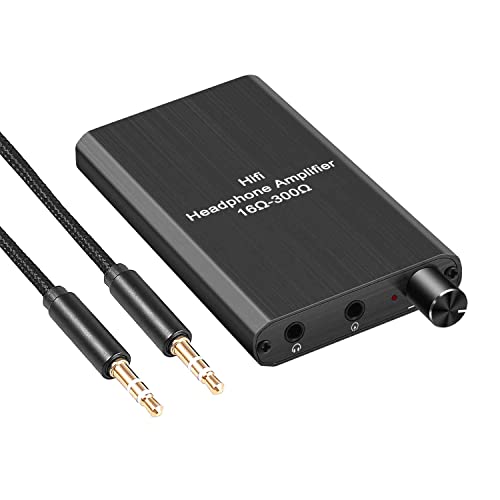
Neoteck lists this portable amp for 16 to 300-ohm headphones, with a two-stage gain switch, 3.5mm connection, and a 1500mAh battery. The listing says the battery can run for more than 12 hours and includes a Type-C cable. The battery and cable suit a monitoring chain that is entirely 3.5mm and a buyer whose main concern is carrying one small rechargeable device.
The listing also claims signal-to-noise and distortion figures. The signal-to-noise and distortion figures are seller-provided specifications, not independent measurements. The decision is simpler. Check that your recorder has a compatible analog output, your headphones sit in the stated range, and the cable layout will not put extra strain on a camera or recorder jack.
Our Take Buy the Neoteck if you want a conventional 3.5mm portable amp with a long listed runtime. It suits a simple field kit, but it does not add XLR, TRS, or digital source compatibility.
- Lists 16 to 300-ohm headphone support.
- 1500mAh battery and Type-C cable are listed.
- Uses a 3.5mm-only analog path.
- Listing performance figures are not independent tests.
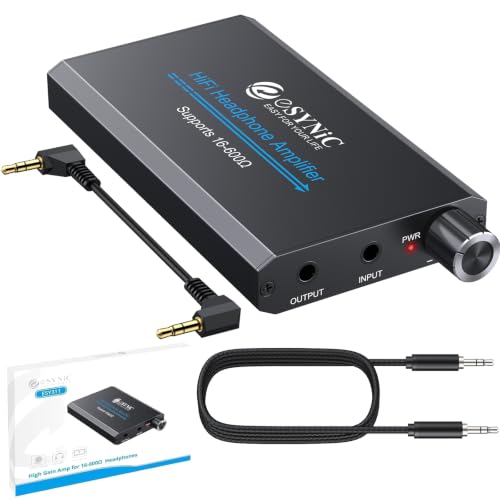
2. eSynic ESY311 — Higher Listed Impedance Range
eSynic lists the ESY311 with a 16 to 600-ohm headphone range, low and high gain settings, and a 3.5mm analog interface. The listing describes the low setting for 16 to 32-ohm earphones and the high setting for 50 to 600-ohm monitoring headphones. The range is the key difference when the same kit may use both sensitive in-ear monitors and higher-impedance headphones.
The product page says it provides 12 or more hours of playback and includes two 3.5mm cables. Gain settings are not a substitute for setting safe monitoring levels. Start at low volume, confirm the source and headphones are connected correctly, and increase only as needed for the environment.
Our Take Buy the eSynic if its listed 16 to 600-ohm range and separate gain guidance match the headphones you carry. It is still a compact 3.5mm amp, so it needs the right analog source cable.
- Lists a 16 to 600-ohm range.
- Low and high gain settings are described.
- Uses only the listed 3.5mm analog interface.
- Gain needs careful level setting in the field.
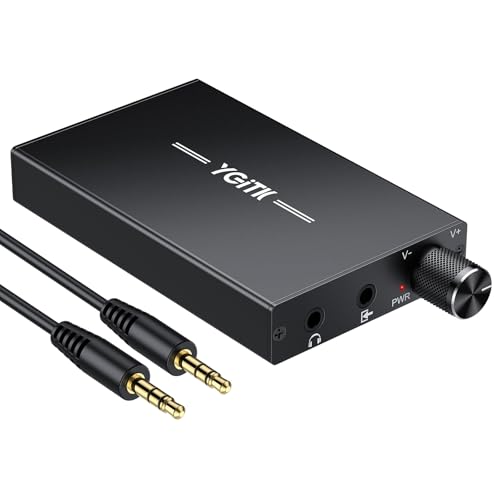
3. YGiTK Gamma4A — USB-C Charging
YGiTK lists the Gamma4A for 16 to 300-ohm headphones, with a two-stage gain switch, a volume knob, 3.5mm input and output, and a 1500mAh battery. The listing says the battery provides up to 10 hours and charges through USB-C. USB-C charging can be convenient when the rest of the travel kit already uses USB-C cables.
The listing includes noise and distortion claims, but they do not demonstrate how the unit behaves with a particular recorder or camera. Keep the connection question separate from charging convenience. Make sure the source has a usable analog output and that you can pack a short, secure cable between the recorder and amp.
Our Take Buy the YGiTK if you want USB-C charging and your field kit already uses a 3.5mm monitoring path. It has the common gain and volume controls, but it is not a replacement for a recorder with the wrong output connector.
- USB-C charging and a 1500mAh battery are listed.
- Lists two-stage gain and a volume knob.
- Listed runtime is up to 10 hours.
- Analog input and output are both 3.5mm.
4. RuiPuo A010 — Long Listed Runtime
RuiPuo lists the A010 with 3.5mm stereo input and output, a high and low gain switch, volume control, a 1000mAh battery, and Micro USB charging. The listing says up to 15 hours of battery use and identifies a 16 to 150-ohm headphone range. The A010 is a candidate for a 3.5mm field setup using headphones inside that stated range.
Micro USB is the tradeoff if the rest of your equipment has moved to USB-C. Carry the right charging cable and do not assume the listed runtime will apply to every gain setting, headphone, or temperature. For recording, battery planning means knowing which devices need charging before you leave.
Our Take Buy the RuiPuo if its listed 15-hour runtime and 16 to 150-ohm range fit the exact headphones in your bag. It is a simple analog amp with an older charging connector.
- Lists up to 15 hours from a 1000mAh battery.
- Gain and volume controls are listed.
- Uses Micro USB charging.
- Listed headphone range tops out at 150 ohms.
5. Donner EM1 — XLR or TRS Source Input
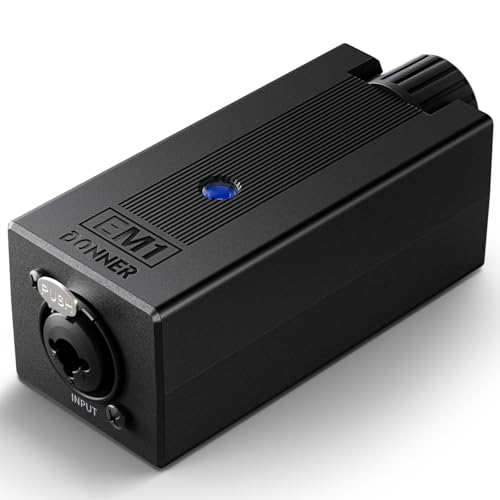
Donner lists the EM1 as a rechargeable analog monitor amplifier with XLR and TRS inputs, a 3.5mm output, a stereo or mono source switch, and a belt clip. This input layout differs from the 3.5mm-only products in this guide. It is the relevant option when a recorder, mixer, or camera rig supplies a compatible XLR or TRS monitoring feed.
The listing says it does not support a microphone and gives up to 12 hours from its Li-ion battery. The source must be a suitable line or monitoring output, not a microphone connection. Confirm the cable wiring and source level before buying, because an XLR connector alone does not identify the type of signal present.
Our Take Buy the Donner EM1 if XLR or TRS source input is essential to your field setup. It takes a different connection path from the common 3.5mm portable amps, so cable and signal checks come first.
- Lists locking XLR and TRS source inputs.
- Stereo or mono source switch and belt clip are listed.
- Listing says it does not support a microphone.
- Output remains a 3.5mm headphone connection.
6. LVY A010 — Basic 3.5mm Gain Control
LVY lists a compact portable amp with 3.5mm AUX input and output, a two-stage gain switch, and a 16 to 300-ohm load range. The listing says it runs more than five hours and names compatibility with phones, computers, and other 3.5mm audio devices. It is the basic candidate when a small analog amp and simple gain control are all the field kit needs.
Because the listed runtime is shorter, plan the battery use deliberately. If the recorder, headphones, and amp all run for different lengths of time, the shortest one can decide when monitoring stops. Pack power and check the unit before a long session rather than relying on an old charge.
Our Take Buy the LVY if you want an uncomplicated 3.5mm amp with a listed 16 to 300-ohm range. Its shorter stated runtime suits shorter sessions or a kit with a clear charging plan.
- Lists 16 to 300-ohm support and two-stage gain.
- Uses standard 3.5mm input and output.
- Listing states more than five hours of use only.
- No XLR, TRS, or digital input is listed.
Buying Guide
Match the source output before choosing an amp
Most portable units here use 3.5mm analog input and output. Neoteck, eSynic, YGiTK, RuiPuo, and LVY fit that pattern. Check the recorder or camera’s monitoring output before buying a cable. A headphone jack, line output, and microphone input can look similar while serving different roles.
The Donner EM1 follows a different connection route. It lists XLR and TRS inputs, a 3.5mm headphone output, and a stereo or mono switch. The XLR and TRS inputs can be useful when the source supports them, but an XLR plug does not prove that the connected output is appropriate. Verify the source manual and cable wiring.
Use gain as a level-setting tool, not a promise of better monitoring
A gain switch helps accommodate different headphone loads. The eSynic listing separates its low and high gain guidance, while several other amps list a two-stage switch. Begin at a low listening level after every connection change. High gain cannot correct a poor source signal or a mismatched cable.
Headphone impedance is one compatibility input. The eSynic lists 16 to 600 ohms, while RuiPuo lists 16 to 150 ohms. Match the exact headphones to the range stated by the amplifier and do not assume every headphone will perform the same way from a portable battery device.
Build a battery plan for the whole field kit
Listed runtime varies from more than five hours to more than 12 hours. Battery capacity, gain position, load, and conditions can all affect runtime. Charge the recorder, amp, phone, and spare power source before the job, then pack the cable each device uses.
Check which charging connector your devices use. Neoteck and YGiTK list Type-C charging, RuiPuo lists Micro USB, and Donner lists rechargeable battery operation with LED indicators. Minimizing cables can be convenient, but the correct amp is still the one that connects to the monitoring source properly.
Frequently Asked Questions
Can I connect a portable headphone amplifier to a camera or field recorder?
Sometimes, if the source has a compatible monitoring or line output and the cable is wired for that output. Most amps here use a 3.5mm analog path, while the Donner EM1 lists XLR and TRS inputs. Read both manuals before connecting anything.
Do not use a microphone input as though it were a headphone or line output. Connector shape is not enough to identify signal type. Confirm the recorder’s output level and the amp’s intended input before monitoring a live recording.
Do I need high gain for field recording headphones?
Not necessarily. Start with low volume and the lower gain setting when available. Gain helps match the source and headphone load. It does not make every headphone louder by default. A sensitive pair can become too loud quickly.
Use the manufacturer’s stated impedance guidance as a starting point, then set levels conservatively. Safe monitoring and a clean cable connection come before trying to use the highest gain position.
Is battery life the main reason to choose one portable amp?
Battery life counts, but connection compatibility comes first. An amp that lasts a long time is not useful if it cannot accept the recorder’s output or drive the headphones within its stated range. Check input, output, and cable requirements first.
Once the signal path is clear, compare the listed runtime and charging connector with the rest of your field kit. A short session may suit a simpler unit, while longer work benefits from a more deliberate charging plan.
Bottom Line
For a basic 3.5mm portable setup, Neoteck 16-300 Ohm Amp is the starting comparison. For higher stated impedance coverage, eSynic ESY311 is the fit. When the field source uses XLR or TRS, Donner EM1 is the distinct option.