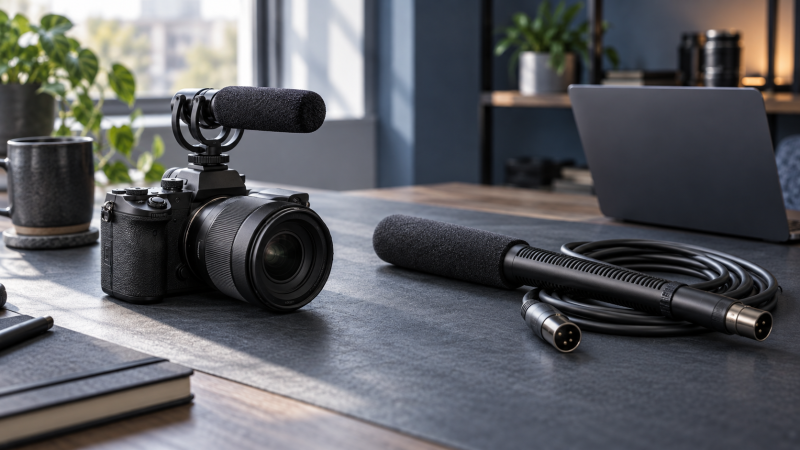
Camera audio improves when the microphone points toward the person speaking and sits close enough to capture a strong voice signal. A compact on-camera shotgun mic is convenient for moving shots, while a longer XLR model suits a boom, recorder or camera with a suitable XLR input. The two setups are not interchangeable. The connector and power source decide what you can actually use.
These six picks cover battery-free camera mics, a digital USB-C option and two XLR models. First check whether your camera has a 3.5mm external-mic input, an XLR adapter or neither. A mic cannot improve a recording if its signal never reaches the camera.
If your camera lacks a microphone jack, do not buy a 3.5mm camera mic on the assumption that a headphone jack or USB charging port will accept it. Check the camera manual’s audio-input section before choosing a connector.Shotgun Microphones Compared
| Image | Product | Details | Check Price |
|---|---|---|---|
 | RØDE VideoMicro II | Path: Camera mic input Power: Check camera path Mount: Compact shoe Best fit: Light on-camera rig | Check Price on Amazon |
 | Movo X1-Mini | Path: TRS / TRRS / USB-C Power: Battery-free Mount: Shoe or boom Best fit: Hybrid camera/USB-C | Check Price on Amazon |
 | Sennheiser MKE 600 Bundle | Path: XLR / listed adapter Power: Phantom or battery Mount: Shock mount Best fit: XLR reach + low cut | Check Price on Amazon |
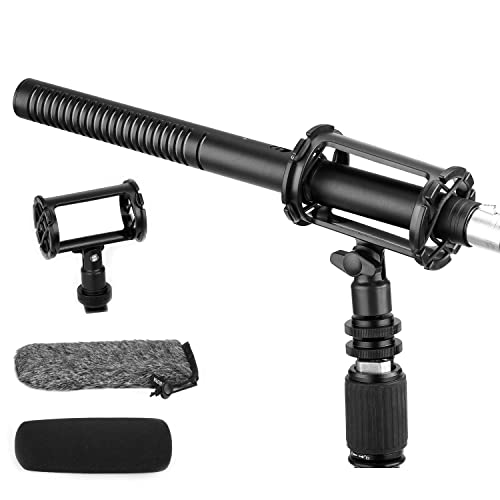 | BOYA BY-BM6060 | Path: XLR Power: 24–48 V / AA Mount: Shock/cold shoe Best fit: AA-backed XLR | Check Price on Amazon |
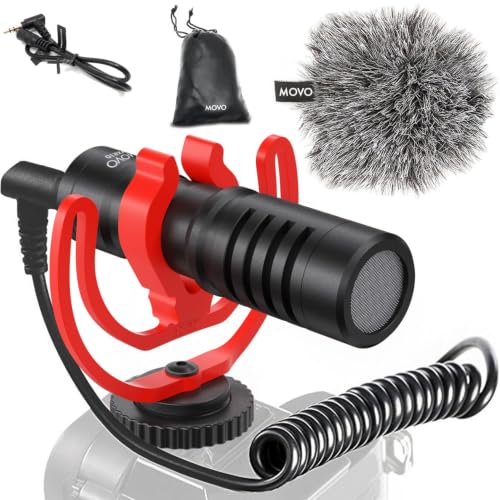 | Movo VXR10 | Path: 3.5mm TRS / TRRS Power: Plug-in Mount: Shock mount Best fit: Simple analog kit | Check Price on Amazon |
 | COMICA CVM-V30 LITE | Path: 3.5mm mode switch Power: Plug-in Mount: Cold shoe Best fit: Camera/phone switch | Check Price on Amazon |
1. RØDE VideoMicro II — Best Compact Camera Mount
The VideoMicro II is an 80 mm, 39 g compact directional microphone according to its specifications. The size and weight count for a creator carrying a small mirrorless body, because a short mic is less likely to crowd the lens or become the largest item in a travel bag. RØDE’s returned features include a Helix isolation mount intended to reduce handling knocks, plus a shoe mount and cable-management arrangement. The size specified by RØDE is a more concrete reason to choose it than a vague promise of professional sound.
This pick belongs on a camera rig with the correct external audio connection and cable. The returned bullet set describes directional pickup, but it does not establish that every phone, camera or USB port accepts the mic. Verify the actual connector path and record a test clip with the camera’s input level set sensibly. A mic mounted several feet from a speaker still records more room than the same mic placed nearer on a boom.
Our Take Choose the VideoMicro II when a light, short on-camera microphone and integrated isolation mount are the priority. Check the camera input and cable before treating its small size as a complete audio solution.
- 80 mm, 39 g body listed.
- Helix isolation mount and shoe mount.
- Compact fit for a mobile camera rig.
- Listing bullets do not prove compatibility with every camera.
- On-camera distance can still leave a voice too far away.
2. Movo X1-Mini — Best Analog and USB-C Flexibility
The X1-Mini’s most useful distinction is its listed bundle of 3.5mm TRS for cameras, 3.5mm TRRS for phones, and digital USB-C for compatible computers and phones. The bundle gives one microphone several recording routes that are not electrically identical. The seller describes a battery-free aluminum body, an integrated shock mount and a supercardioid pattern. It includes foam and furry windscreens, a hard case and a Rycote shock mount, according to the returned feature bullets.
Choose the cable for the device you are actually recording into. A 3.5mm camera socket normally expects the camera lead, while a phone may need the TRRS lead or the USB-C digital cable. The listing’s 24-bit digital-mode claim is about the USB-C path, not a measured guarantee of cleaner camera audio. Its camera-shoe mount can be convenient while moving. A boom position may get it nearer an interview subject when the scene permits.
Our Take X1-Mini makes sense for a creator who switches between a camera with a mic jack and a compatible USB-C device. Its varied included cables are the purchase reason. Confirm the correct input mode on each device.
- Camera TRS, phone TRRS and USB-C digital leads listed.
- Battery-free microphone.
- Foam and furry windscreens included.
- Several leads make cable selection important.
- 24-bit claim does not establish real-world noise performance.
- USB-C compatibility remains device-dependent.
3. Sennheiser MKE 600 Bundle — Best XLR or AA-Powered Reach
This exact Amazon offer is a bundle centered on the MKE 600, not a bare microphone. Its returned listing names the microphone, Sennheiser shock mount and foam windshield, plus a third-party universal shoe/boom shock mount, an XLR cable and cleaning cloth. It also mentions an XLR-to-3.5mm lead in the manufacturer-included contents. Check the current offer’s included items rather than assuming a different MKE 600 listing ships the same cables.
The functional reasons to consider it are the mic’s switchable low-cut filter, high-directivity design and stated phantom or battery power. Battery operation can help when a camera lacks phantom power, but the camera must still receive the audio through a suitable input and cable. An XLR plug is not a generic USB connector. If you are recording the mic separately, a compatible field recorder is another route. Sync sound and picture afterward.
Our Take The MKE 600 bundle is for a creator prepared to manage an XLR recording chain or the specifically supported battery-powered camera route. Verify both the current bundle contents and the camera’s actual audio input.
- Phantom or battery powering stated.
- Switchable low-cut filter.
- Shock mounts and cabling listed in this offer.
- More pieces and setup checks than a small plug-in camera mic.
- Bundle contents can differ from a bare-mic offer.
- Needs a verified camera or recorder input path.
4. BOYA BY-BM6060 — Best AA Backup for XLR Interviews
BOYA’s BY-BM6060 is a 3-pin XLR shotgun condenser microphone whose returned listing specifies 24–48 V phantom power or one AA battery. That dual power option is useful for interviews when one recording device supplies phantom power and another does not. The seller calls the pickup pattern supercardioid and includes a suspension shock mount, furry windshield, foam windshield and a cold-shoe mount with a quarter-inch thread. The mount and windshields are listed package components, not proof that every camera needs or supports all of them.
Power and signal are separate questions. An AA cell may power the microphone, but it does not turn the XLR output into a 3.5mm or USB input. The recording device still needs the proper audio connection. For camera use, check the input type, mounting clearance and whether the mic remains outside the image. For an interview, moving a mic closer to the voice usually counts for more than choosing a long microphone while leaving it on a distant camera.
Our Take BY-BM6060 is a practical XLR alternative when AA operation alongside phantom power solves a location problem. Do not mistake its battery option for universal camera connectivity.
- 24–48 V phantom or one AA battery stated.
- Furry and foam windscreens listed.
- Suspension mount and cold-shoe option.
- XLR output needs a compatible recording chain.
- AA power does not solve connector mismatch.
5. Movo VXR10 — Best Simple Camera-and-Phone Kit
Movo’s VXR10 is a compact directional mic with a 3.5mm input requirement and plug-in power, according to its own returned feature bullet. The listing names separate camera and smartphone cables, a furry windscreen, carrying case and shock mounts. The plain analog connection makes it a smaller, simpler kit than the USB-C-capable X1-Mini, provided the camera actually has an external mic socket. An aluminum housing is listed, but durability claims are not a substitute for checking the mount’s fit.
Check the compatibility caveats before buying. Movo says newer USB-C or Lightning phones need a suitable 3.5mm adapter and explicitly warns that some cameras, including Canon Rebel T6/T7, do not support external microphones. The correct TRS or TRRS cable must match the recorder. The seller suggests placing the mic roughly 1–5 feet from the subject. Treat the distance as its setup guidance, not a fixed rule for every room. A short test clip will expose a wrong cable more quickly than a longer spec comparison.
Our Take VXR10 works as a basic analog camera-and-phone kit when you have verified a 3.5mm mic input and the right included cable. Skip it for a camera without external audio input.
- Separate camera and smartphone cables listed.
- Furry windscreen and carrying case included.
- Compact directional microphone.
- Needs plug-in power and a real 3.5mm microphone input.
- Modern phones may need a compatible adapter.
- Some entry-level cameras have no mic input.
6. COMICA CVM-V30 LITE — Best Camera-Phone Switch
The black CVM-V30 LITE listing describes a physical Camera/Phone switch on the microphone body. The switch can be simpler than swapping between separate TRS and TRRS leads when alternating compatible devices, but both devices still need a 3.5mm mic jack. The mic is listed as supercardioid, battery-free and powered by the camera or phone’s plug-in power. The shock mount uses a cold-shoe foot with a quarter-inch thread at the bottom.
COMICA explicitly cautions that a DSLR without an external microphone input cannot use it. The returned bullets name several Canon Rebel and Nikon entry-level bodies as examples. It also advises enabling the external mic in the device menu and recording a test clip. The caution is sound, because a mechanical switch cannot make a headphone-only port become an input. The seller’s claims about off-axis rejection are not an independently measured guarantee against traffic, wind or a noisy room.
Our Take Pick CVM-V30 LITE when one camera and one phone both have compatible 3.5mm mic inputs and a body switch simplifies your kit. Verify the exact devices first.
- Camera/Phone mode switch on the body.
- Battery-free plug-in power.
- Cold-shoe mount with quarter-inch thread.
- Both device types still need a 3.5mm mic input.
- Entry-level cameras without a mic jack are excluded.
- External mic setting may need enabling.
Buying Guide: Build the Audio Path Before Picking a Mic
Start with the camera’s real microphone input
Look up the camera’s external microphone input, not just a nearby 3.5mm socket. A headphone output sends sound out, so it cannot record a microphone by itself. If a 3.5mm mic input exists, check whether the camera expects plug-in power and which cable wiring it needs. If it has XLR through a handle or adapter, verify whether that path supplies phantom power before choosing an XLR condenser microphone.
The VideoMicro II, VXR10 and CVM-V30 LITE are compact camera-centered choices, but broad compatibility language does not override your camera’s input specification. The X1-Mini adds a digital USB-C route for compatible devices. None of these four works around a camera with no external audio support.
Choose power and recording device together
An XLR microphone may need 24–48 V phantom power, an internal battery or another specified supply. The MKE 600 bundle lists phantom or battery operation, while the BY-BM6060 lists phantom or one AA. Their XLR outputs still require a suitable camera, adapter, interface or field recorder. Powering the capsule does not change the plug on the signal cable.
If you record XLR audio separately from video, budget time for syncing audio in the edit and monitoring for clipping during the take. A field recorder for XLR microphones may solve the input and power problem, but it adds files and post-production steps. For quick moving footage, a camera-mountable 3.5mm mic can be the more manageable option when the camera supports it.
Positioning beats a distant directional label
The phrase directional pickup does not mean a shotgun mic can isolate a quiet voice from across a large room. Directionality can attenuate some off-axis sound, but a nearby hard wall or loud background source can still enter the recording. If the shot permits, place the mic closer to the speaker with a boom or keep the camera within a sensible speaking distance. On-camera mounting is fastest, not always closest.
An isolation mount helps with handling vibration, and a furry windscreen can help outdoors, but neither fixes a faulty input cable or an overly distant mic. Test with the camera operating as it will during the shoot, because autofocus, operator movement and air conditioning may all change what you hear. A camera field monitor helps you frame the shot. Headphones or a monitored recorder help you judge the sound.
Check what the exact offer includes
A model may appear as a bare microphone or a bundle. This MKE 600 offer is a bundle with extra mounts and cables. Do not assume a different offer includes them. Likewise, check that an X1-Mini purchase includes its listed leads.
Before buying, compare the offer’s contents, connector type, mounting hardware and wind protection with your camera bag. Then record a one-minute spoken clip and listen to it on headphones before a paid shoot. That small rehearsal checks the complete path, which a product specification sheet cannot do for your camera.
Frequently Asked Questions
Can I use a shotgun microphone with a camera that has no mic jack?
A camera with no mic jack has no 3.5mm microphone input to use. A headphone port or charging socket should not be assumed to accept analog microphone audio. Check the camera manual for a supported USB-audio mode or a manufacturer-approved XLR handle before buying a mic for direct camera recording.
If the camera cannot accept external sound, record to a separate supported device and sync audio to video afterward. Recording separately requires a recorder, a compatible mic path and extra editing work, but it avoids buying a camera cable that has nowhere to connect.
Do XLR shotgun microphones always need phantom power?
No. The two XLR offers here each state an alternative battery-power option: the MKE 600 listing says phantom or battery, and the BY-BM6060 listing says 24–48 V phantom or one AA. Confirm the exact microphone’s power setup and whether the offer includes any needed battery or adapter before shooting.
Even with battery power, XLR signal still needs a compatible input path. A powered mic cannot be plugged directly into a typical camera headphone jack. An XLR-capable camera, approved handle, suitable interface or recorder is the route to check.
Is a furry windscreen enough for outdoor dialogue?
A furry windshield can reduce air movement across a capsule, but it does not guarantee usable dialogue in every wind condition. The VXR10, X1-Mini and BY-BM6060 listings include furry protection in their package descriptions. The VideoMicro II bullets returned here do not establish that exact included accessory.
For an outdoor shot, listen through the full camera or recorder chain with the windscreen installed, at the intended mic position. If speech is still buried, move to shelter, place the mic closer or change the shot. Do not rely on a package photo or broad noise-rejection claim as a substitute for that test.
Source boundary: Product identities, package contents and stated features come from the six linked Amazon US listings. We did not record with these microphones or measure pickup, wind rejection or sound quality. Confirm the current offer, compatibility and accessories before purchase.