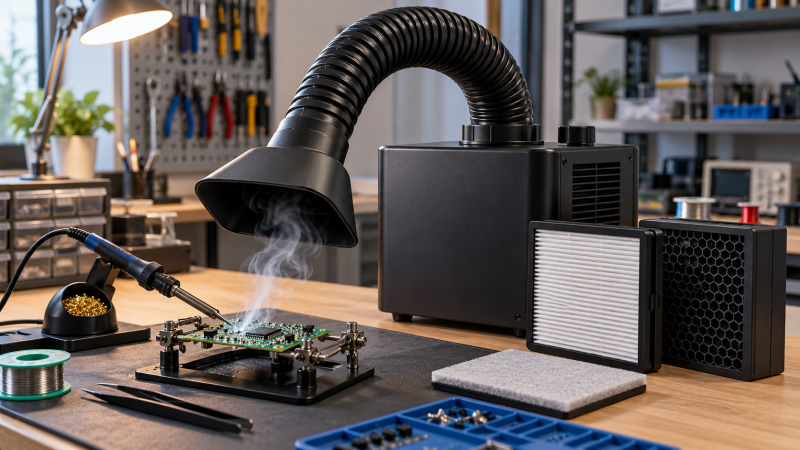
Soldering beside a small fan can move smoke from your eyes, but it does not give the workbench a defined filter path or close capture. A multi-stage extractor combines a pre-filter with particulate media and, in many models, activated carbon for odors. Choose by hood placement, stated airflow, and maintenance between repair jobs.
Choose the capture position and filter stack first, then compare stated airflow, hose reach, noise control, replacement routine, and the actual work your bench performs.Best Multi-Stage Solder Fume Extractors Compared
| Image | Product | Details | Check Price |
|---|---|---|---|
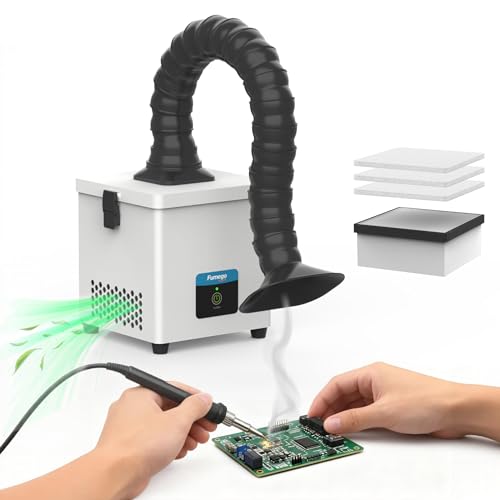 | FUMEGO DX50 | Best fit: Light-duty repair bench Filter: Pre-filter, HEPA, carbon Airflow: 180m3/h; 3 speeds | Check Price on Amazon |
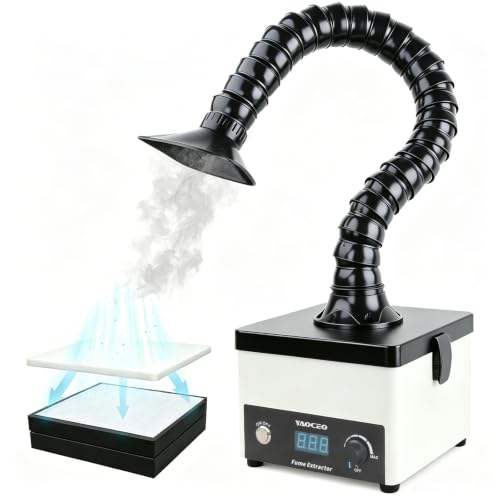 | 7500 RPM Metal Extractor | Best fit: Washable pre-filter setup Filter: 3 washable pre-filters, HEPA Airflow: 7500 RPM; stepless | Check Price on Amazon |
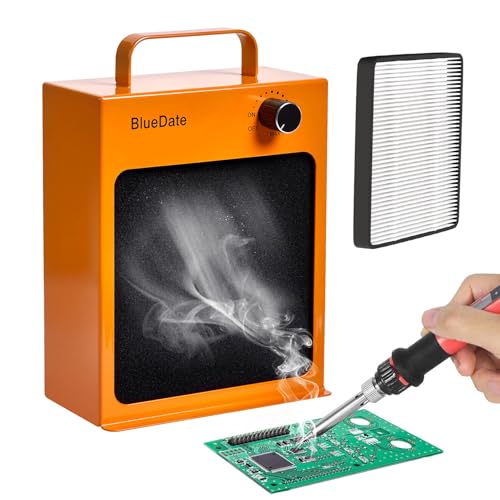 | BlueDate HEPA Extractor | Best fit: Simple dual-filter desktop unit Filter: H13 HEPA, carbon cotton Airflow: Stepless control | Check Price on Amazon |
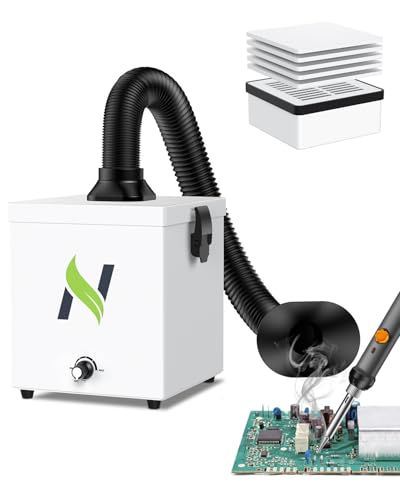 | NT-M1 | Best fit: Small bench with long hose Filter: Pre-filter, H13 HEPA, carbon Airflow: 168m3/h; 25.6in hose | Check Price on Amazon |
 | FumeClear FC-2001S | Best fit: Three-stage portable extractor Filter: Pre-filter, H12 HEPA, carbon Airflow: 128-168m3/h | Check Price on Amazon |
 | KQZ B1 | Best fit: Compact H13 workstation unit Filter: 9mm pre-filter, H13 HEPA, carbon Airflow: 168m3/h; 66mm hose | Check Price on Amazon |
 | 2-in-1 Smart Reminder Extractor | Best fit: Tracked filter replacement Filter: H13 HEPA, carbon Airflow: Stepless; 400h reminder | Check Price on Amazon |
1. FUMEGO DX50 — Best for a Light-Duty Repair Bench
A desktop repair bench that needs adjustable capture and a clear limit on use is the job FUMEGO DX50 is built for. The listing gives it a 180m3/h airflow figure from a 7,500 RPM motor, plus three selectable airflow levels. Its consumables include five pre-filters and an integrated filter that combines HEPA with activated carbon.
The 20-inch flexible gooseneck can be moved around a board, connector, or small hand tool, so the main body doesn’t have to sit beside the iron. The listing identifies the DX50 as intended for light-duty desktop soldering and PCB repair, not high-volume laser engraving. For a workstation that also needs a stable camera view, see our USB webcam guide.
Decision point: A 180m3/h stated airflow, three speeds, a 20-inch hose, and a pre-filter, HEPA, and carbon stack suit light-duty bench soldering. Our TakeBuy FUMEGO DX50 when the task is electronics repair or other light-duty soldering and the 20-inch hood can sit near the smoke source. Respect the listing’s laser-engraving limit instead of treating this desktop model as a production extraction system.
- A stated 180m3/h airflow gives the buyer a concrete reference for desktop smoke-capture planning.
- Five pre-filters protect the combined HEPA and activated-carbon filter from larger soldering debris.
- Three airflow levels let a buyer choose a lower or higher stated suction setting.
- The 20-inch gooseneck and 360-degree adjustment help place the hood close to a small joint.
- Its 110-to-220V input supports benches that need a stated wide-voltage power range.
- The listing limits the DX50 to light-duty soldering and PCB repair, excluding high-volume laser engraving.
- An integrated HEPA and carbon filter means the buyer must replace the combined main filter assembly.
2. 7500 RPM Metal Extractor — Best for Washable Pre-Filters
This metal-bodied extractor suits a bench where washable outer filters are more useful than an odor-focused carbon stage. The listing pairs a 7,500 RPM motor with one HEPA filter and three reusable pre-filters. The stepless dial gives continuous control rather than three fixed speed choices, and the listing calls out soldering, jewelry work, and pyrography.
Its listed 20-inch gooseneck and side-exhaust body keep the intake aimed at a small work area without putting a broad fan in the operator’s sightline. The listing excludes laser engraving and odor removal from wood, leather, acrylic, or similar materials. For wall-mounted equipment storage near the bench, see our vertical wall-mount server rack guide.
Buy this model when reusable pre-filters and a stepless control dial fit your upkeep routine. Choose a carbon-stage alternative if odor handling is part of the job, instead of assuming every HEPA-only stack provides it.
- Three washable pre-filters can reduce how often the main HEPA filter needs replacement after routine soldering.
- The 7,500 RPM motor gives a named motor-speed figure for comparing this compact extractor category.
- A stepless speed dial permits more adjustment points than a three-level airflow control.
- The 20-inch 360-degree gooseneck helps keep the hood near detailed board and jewelry work.
- A side exhaust and compact metal body suit a crowded bench with limited horizontal space.
- The stated filter stack does not include activated carbon for the odor-removal applications the listing excludes.
- It is not recommended for laser engraving or wood, leather, and acrylic odor-removal work.
3. BlueDate HEPA Extractor — Best Simple Dual-Filter Desktop Unit
BlueDate suits someone who wants a portable desktop unit with a specified particulate and odor filter pair. Its listing describes an H13 HEPA plus activated-carbon-cotton double filter, stepless speed regulation, and an included extra filter set. The listing positions it for soldering stations, hand engraving, and jewelry soldering rather than a large fixed booth.
Airflow does not separate BlueDate from the other models, because the listing does not state a cubic-meter-per-hour figure. Its compact format and the ability to move it around a changing desk are the reasons to pick it. For a work surface that holds small bench parts, see our magnetic silicone work-mat guide.
Decision point: H13 HEPA plus activated-carbon cotton, stepless adjustment, and a second supplied filter set fit a simple movable desktop filter plan. Our TakeBuy BlueDate when a compact dual-filter unit and included spare filters are more valuable than a published airflow figure. Place the intake close to the work and plan replacements before the two filter sets are exhausted.
- An H13 HEPA and activated-carbon-cotton double filter gives this small unit two stated filtration functions.
- Stepless speed regulation lets the operator adjust air volume to the amount of visible smoke.
- The package includes two filter sets, reducing the first replacement purchase for a new workbench.
- Its compact portable format can move between a soldering station, engraving area, and jewelry bench.
- The listing names soldering, hand engraving, and jewelry soldering as intended desktop work contexts.
- No stated airflow figure makes a direct suction comparison with 168m3/h and 180m3/h models impossible.
- The double filter is simpler than the three-stage pre-filter, HEPA, and carbon arrangements in other choices.
4. NT-M1 — Best for a Small Bench With a Long Hose
NT-M1 fits a small desk that still needs the intake to reach across a soldering fixture. The manufacturer lists a 5.1 by 5.1 by 6.3-inch, three-pound body and a flexible hose extending to 25.6 inches. The listing states 168m3/h of airflow and a filter sequence of a 10mm high-density pre-filter, H13 HEPA, and carbon powder.
The stepless knob lets an operator tune the fan to a small connector repair or a smokier through-hole joint. Its stated applications include soldering, PCB repair, and everyday DIY work, which makes it a better fit for a portable repair station than a large enclosed manufacturing cell. For a second display that can hold a schematic beside the bench, see our portable monitor guide.
Buy NT-M1 when the bench is tight but the hood needs more reach than a fixed short intake. The compact body does not eliminate the need to leave room for the hose arc and a safe power route.
- A 5.1 by 5.1 by 6.3-inch body fits a stated compact footprint on constrained repair desks.
- The 25.6-inch flexible hose can place the capture head close to a board without moving the base.
- A stated 168m3/h airflow provides a published comparison figure for a three-pound desktop extractor.
- The 10mm pre-filter, H13 HEPA, and carbon powder provide three named filtration layers.
- A stepless rotary control lets the operator lower fan speed when quiet detailed work needs less suction.
- The small three-pound body still needs room for a fully bent 25.6-inch hose and power cable.
- The listing frames this unit for hobby, repair, and everyday work rather than high-volume production extraction.
5. FumeClear FC-2001S — Best Three-Stage Portable Extractor
FumeClear FC-2001S suits a buyer who wants the filter stages named one by one. Its filter system is a pre-filter, H12 HEPA filter, and high-iodine activated carbon, and the listed airflow range is 128 to 168m3/h. The manufacturer identifies compact workspaces and precision soldering as its intended setting.
Its extendable hose makes the portable form useful at a bench where the work changes position. Put the nozzle directly at the source, as the listing instructs, instead of relying on the room to carry smoke toward a distant intake. For a power source for a mobile repair bench, see our LiFePO4 power-station guide.
Decision point: A pre-filter, H12 HEPA, high-iodine carbon stack, 128-to-168m3/h airflow, and an extendable hose fit portable precision soldering work. Our TakeBuy FumeClear FC-2001S when a named three-stage filter stack and a portable hose are the priority. Position its intake at the solder source, then set the airflow level that fits the volume of smoke at that station.
- A pre-filter, H12 HEPA filter, and high-iodine carbon layer form a clearly named three-stage stack.
- The 128-to-168m3/h stated airflow range gives the operator a published suction range for comparison.
- An extendable hose gives the portable base a stated way to put the nozzle near precision work.
- The compact-workspace design fits soldering benches where a larger floor-standing extraction system will not fit.
- Its 110-to-220V universal-voltage description supports buyers who need a stated broad input range.
- The H12 HEPA designation is lower than the H13 labels used by several other compact extractor listings.
- The 128m3/h lower end of its stated airflow range is below the fixed 168m3/h figures on NT-M1 and KQZ B1.
6. KQZ B1 — Best Compact H13 Workstation Unit
KQZ B1 suits an electronics bench that needs a compact metal extractor and wants the pre-filter thickness stated. Its system uses a 9mm pre-filter, an H13 HEPA and coal-based activated-carbon cartridge, and a stated airflow of 168m3/h. The package also includes five pre-filters, one efficiency filter, a tube, and a hood.
The listing describes a 66mm 360-degree adjustable gooseneck hose but gives no reach measurement, so confirm placement before buying. It also lists a 110-to-220V input for benches that may move between locations. For close-up inspection during repair, see our USB microscope guide.
Buy KQZ B1 when the extractor can stay close to the work and the included spare pre-filters make the maintenance plan easier. Choose a longer-hose model when the base must sit farther from the solder station.
- A 9mm pre-filter gives the main H13 HEPA and carbon cartridge a stated first barrier against debris.
- The stated 168m3/h airflow matches the published suction figure of the compact NT-M1 alternative.
- Five included pre-filters provide replacement material before the buyer needs to source new outer filters.
- The 360-degree adjustable gooseneck supports direct hood aiming when the compact base stays near the work.
- A metal body and 110-to-220V input suit a stated portable workstation use case.
- The listing does not state hose reach, so confirm placement before buying.
- Its one-touch suction description offers less stated adjustment detail than the stepless controls on several alternatives.
7. 2-in-1 Smart Reminder Extractor — Best for Tracked Filter Replacement
Filter maintenance gets forgotten on a shared bench, and the 2-in-1 smart reminder extractor adds a prompt for it. The listing specifies an H13 HEPA and activated-carbon composite filter with a 400-hour replacement reminder using a buzzer and flashing screen. It also lists 0-to-100 stepless speed adjustment with a digital display and a flexible gooseneck.
The reminder prompts a filter check, but it does not replace inspection or consideration of work conditions. This model is described for soldering, DIY, 3D printing, nail work, and jewelry making, so it is broader than a specialized enclosed industrial unit. For an organized bench power layout, see our GaN travel-adapter guide.
Decision point: An H13 HEPA and carbon composite filter, 0-to-100 speed control, digital display, and 400-hour reminder suit a shared bench with accountable maintenance. Our TakeBuy this model when a visible replacement reminder will keep a shared bench from ignoring its filter routine. Use the 400-hour alert as a prompt to inspect and replace the filter, not as proof that every work condition uses it equally.
- A 400-hour buzzer and flashing-screen reminder gives shared workbenches a stated filter-maintenance prompt.
- The H13 HEPA and activated-carbon composite filter combines named particulate and odor-focused filtration layers.
- A 0-to-100 stepless adjustment and digital display give the operator a visible speed-control interface.
- An adjustable gooseneck can point the suction nozzle directly at soldering smoke or other desktop work.
- The listed uses include soldering, 3D printing, nail work, DIY, and jewelry-making benches.
- The 400-hour counter is a reminder, not a material-specific measurement of filter loading or remaining capacity.
- The listing provides no cubic-meter-per-hour airflow figure for direct comparison with the 168m3/h and 180m3/h models.
Buying Guide: Choosing a Multi-Stage Solder Fume Extractor for a Professional Workbench
Put the hood near the source before comparing airflow
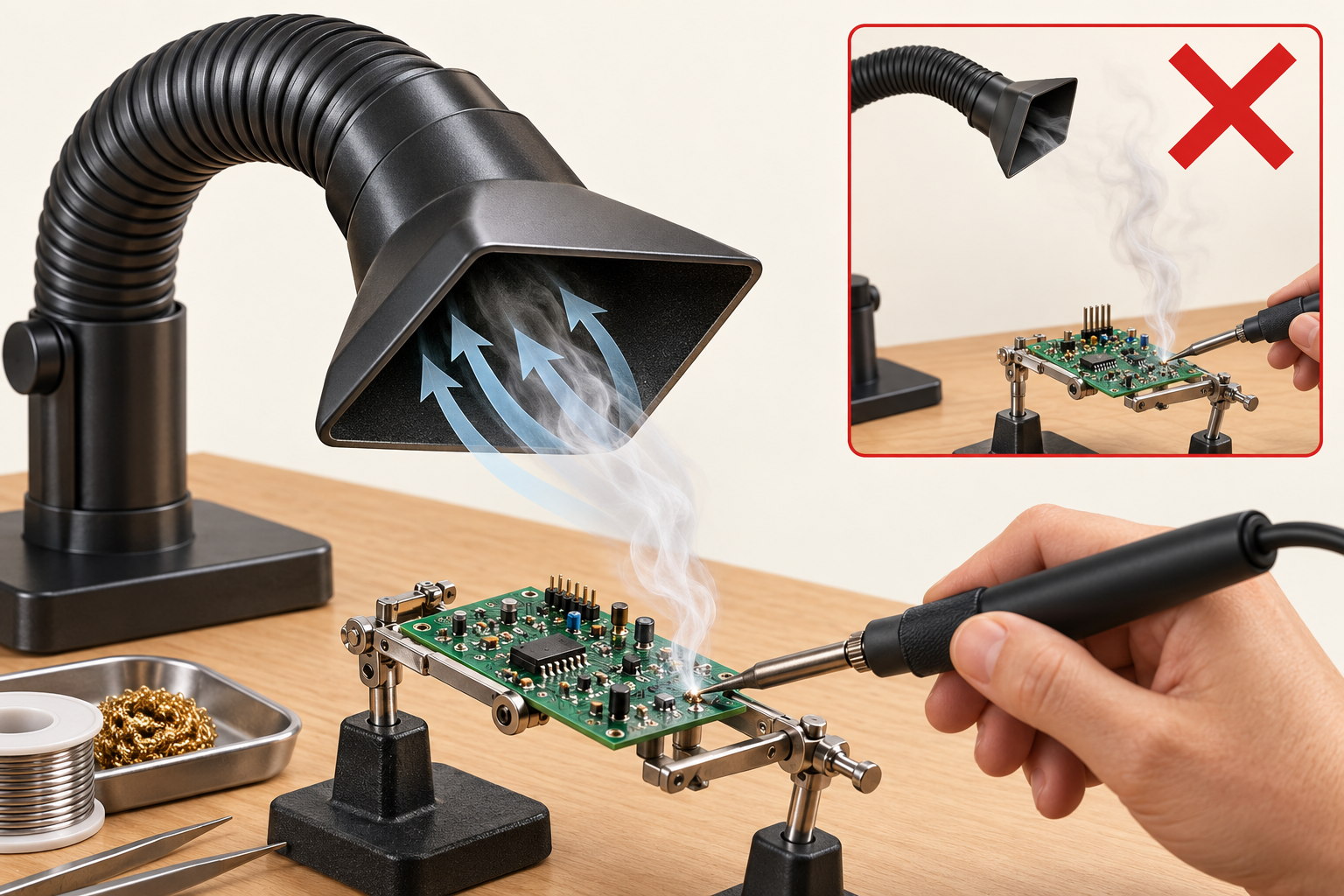
The hood position is the first decision because the extractor only captures smoke that enters its intake. FUMEGO DX50 and the metal extractor each list a 20-inch gooseneck, while the NT-M1 listing gives a 25.6-inch hose. Choose the reach that lets the nozzle sit close to the solder joint without blocking the iron, board, or hands.
Do not place the hood so far away that the visible smoke crosses the operator’s face before it reaches the inlet. Close source capture is more useful than a large airflow number with poor placement. Move the hood for a few representative joints, then see whether its bend and base position work with the actual fixture.
Read every filter layer and its maintenance role
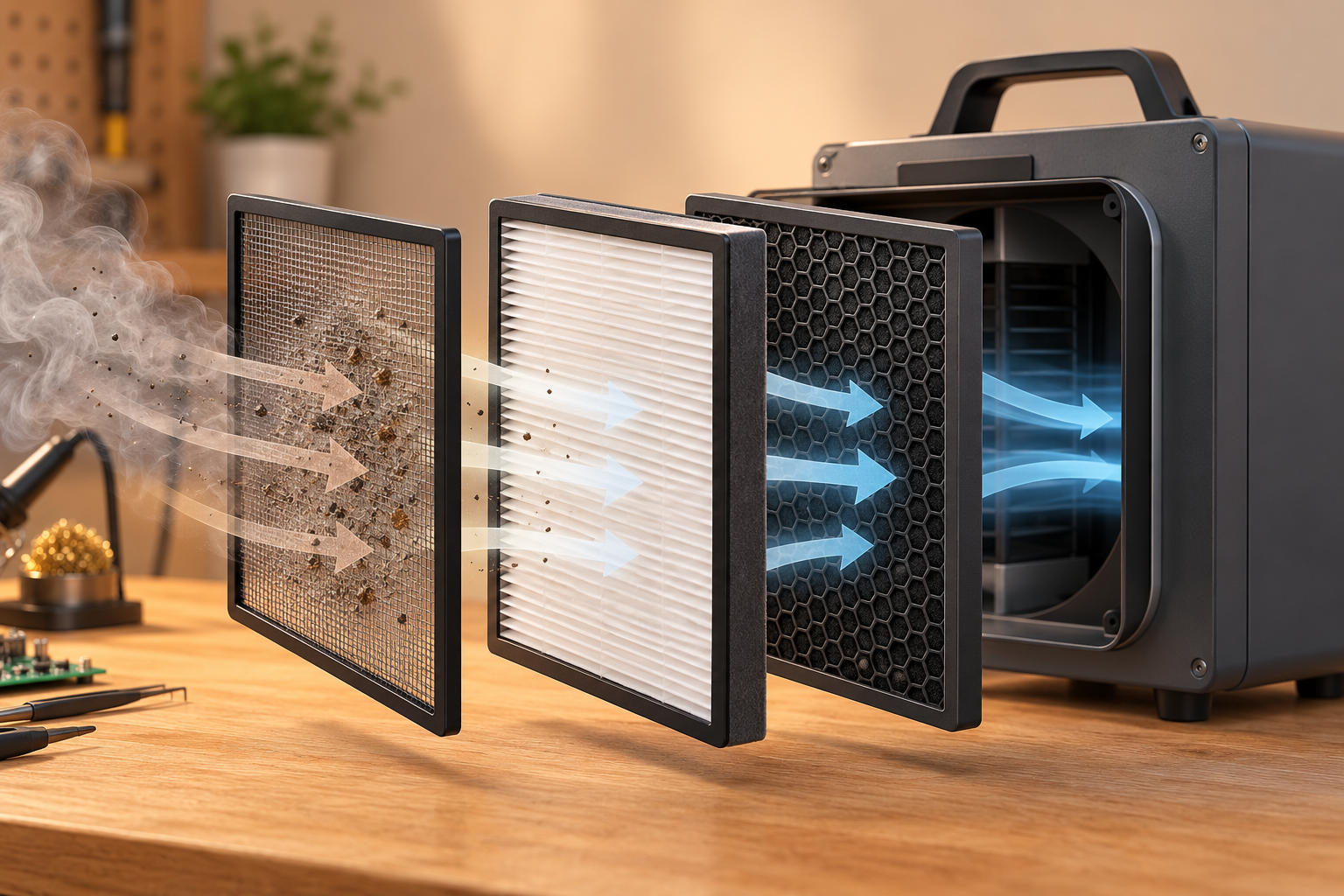
A multi-stage filter description can include a washable pre-filter, a disposable pre-filter, HEPA media, activated carbon, or a composite cartridge. FumeClear FC-2001S names a pre-filter, H12 HEPA, and high-iodine carbon sequence, while KQZ B1 lists a 9mm pre-filter plus H13 HEPA and carbon.
The first layer catches larger debris before it reaches the finer media, so it affects the replacement routine as much as the air path. Filter availability and replacement work belong in the buying decision. A cartridge that combines HEPA and carbon may be convenient, but it can also mean both functions are replaced together.
Match stated airflow and speed controls to the task
Airflow figures are useful comparisons only when each listing supplies one. DX50 states 180m3/h, while the NT-M1 and KQZ B1 listings state 168m3/h. BlueDate and the smart reminder extractor instead give stepless adjustment but no published cubic-meter-per-hour figure, so they cannot be ranked by airflow alone.
Use speed control to match the immediate smoke level and the bench’s noise tolerance. A stepless dial or digital scale is useful when fine work does not need maximum fan output. Fixed levels can still work when the job repeats, but check that the lowest setting captures smoke at the planned hood position.
Separate repair work from excluded high-volume jobs
Desktop extractors are not all built for the same source material or volume. FUMEGO DX50 identifies light-duty soldering and PCB repair and excludes high-volume laser engraving. The metal extractor also says it is not recommended for laser engraving or odor-removal jobs involving wood, leather, or acrylic.
Read those limitations as product boundaries, not as optional warnings. The source material and job volume decide whether a compact bench extractor is appropriate. A repair bench can be a good fit for a small unit even when a production or engraving workflow needs a different extraction approach.
Build a visible filter-change routine for shared benches
Filters work only when the operator recognizes when to inspect or replace them. The smart reminder extractor has a manufacturer-rated 400-hour alert, while KQZ B1 includes five pre-filters and BlueDate includes a second filter set. Those features can simplify the initial routine, but they do not remove the need to keep compatible replacements available.
Assign an owner for filters and record the model number or spare part information where the bench team can find it. A visible replacement log prevents the extractor from becoming a forgotten appliance. When the reminder appears or the pre-filter is visibly loaded, inspect the entire stack rather than only resetting a counter. For a companion maintenance task, see our soldering-tip cleaner guide.
Frequently Asked Questions
Is a HEPA filter the same as a multi-stage extractor?
Not necessarily. A HEPA filter names a particulate filter layer, while a multi-stage system adds one or more other layers such as a pre-filter and activated carbon. The number and type of layers differ from one model to another.
Check the listing for the complete path. A washable pre-filter can protect the main filter, and carbon can be included as a separate layer or part of a composite cartridge. The exact arrangement controls both upkeep and replacement purchases.
Should I choose a longer hose or higher stated airflow?
Choose the hose that lets you put the capture hood close to the actual source, then compare stated airflow among models with similar placement. A strong fan cannot collect smoke effectively if the nozzle is far away or aimed in the wrong direction.
On a small bench, a longer hose can make the body easier to place away from the iron stand and fixture. On a stable dedicated station, a short adjustable gooseneck may be enough and can keep the setup simpler.
Are these extractors suitable for laser engraving?
Not unless the listing names it. Two of the compact extractor listings specifically exclude laser engraving or high-volume engraving, so their soldering focus should not be extended to another source material.
Laser, wood, leather, acrylic, resin, and metal work can create different amounts and kinds of smoke or odor. Read the intended-use language for the chosen extractor and use a system designed for the actual material and workload.
How often should I replace the filters?
Follow the product’s supplied instructions, inspect the filter condition, and keep replacements available. A reminder, such as the smart model’s 400-hour alert, can prompt an inspection but does not measure every workload or filter condition.
The pre-filter may need attention before the finer filter stages because it catches larger debris. Build checks into the bench routine so a loaded outer filter does not reduce the available suction before a repair job starts.
Can I use one extractor for several benches?
One portable unit can move between benches if the hood can be placed close to the active work and the equipment is allowed to cool or be relocated safely. Moving one unit can suit occasional repairs with one operator.
For concurrent soldering, each active location needs its own source capture plan. Sharing one unit across distant benches leaves at least one operator without the close hood placement that makes a desktop extractor useful.
Bottom Line
Choose FUMEGO DX50 for a stated 180m3/h, three-speed light-duty soldering and PCB-repair setup with a pre-filter, HEPA, and carbon path. Choose FumeClear FC-2001S for an explicit pre-filter, H12 HEPA, and carbon sequence with 128-to-168m3/h stated airflow. Choose the 2-in-1 Smart Reminder Extractor when H13 HEPA plus carbon and a 400-hour reminder suit a shared bench.