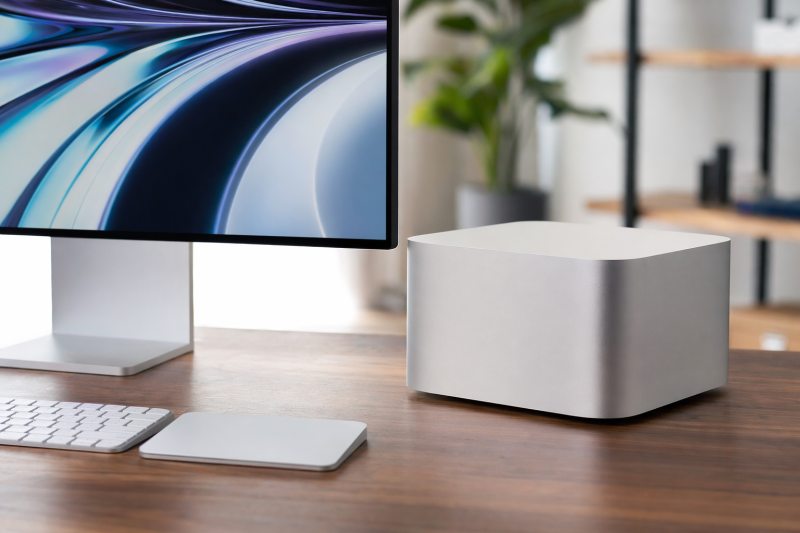
The Apple Studio Display is the best monitor for Mac mini if you want the cleanest all-in-one setup: 27-inch 5K sharpness, an integrated camera, strong speakers and microphones, and a single Thunderbolt connection designed around the Mac. The ASUS ProArt PA27JCV is the stronger value when 5K text clarity matters more than an Apple camera and audio system. For a lower-cost desktop, the Dell S2725QS pairs 27-inch 4K resolution and 120Hz motion with the Mac mini’s built-in HDMI port.
Both the M4 and M4 Pro Mac mini drive up to three external displays, though their maximum resolution and refresh combinations differ. A 5K or 6K panel gives macOS Retina-class pixel density at the right size. A 4K model costs less and can run faster, and a 40-inch 5K2K screen replaces two narrower work areas. The picks below cover those choices and treat monitor charging as beside the point for a desktop Mac.
This post includes affiliate links, for which we may earn a commission at no extra cost to you should you make a purchase using our links. As an Amazon Associate, we can earn from qualifying purchases. Learn more.Recent Updates
July 2026: We built this guide around the currently sold M4 and M4 Pro Mac mini and Apple’s display-support matrix published in March 2026. All nine exact monitor listings passed Amazon Creators API search and item checks. Where a current model now fills an older monitor’s role, we swapped it in.
Quick Picks for Mac mini
- Best overall: Apple Studio Display, for 27-inch 5K clarity plus a camera, microphones, and speakers in one Mac-focused package.
- Best-value 27-inch 5K: ASUS ProArt PA27JCV, for 218 PPI text, an ergonomic stand, and broad manufacturer-rated color coverage.
- Best 32-inch Retina-class monitor: ASUS ProArt PA32QCV, for 6K resolution, Thunderbolt 4, and a larger 218 PPI workspace.
- Best ultrawide for M4 Pro: LG UltraFine evo 40U990A-W, for 5120 x 2160, 120Hz, and Thunderbolt 5.
- Best monitor with a built-in dock: Dell UltraSharp U3225QE, for 4K at 120Hz plus KVM, 2.5Gb Ethernet, and a large USB hub.
- Best budget pick: Dell S2725QS, for a straightforward 27-inch 4K and 120Hz HDMI setup.
- Best for gaming and HDR video: ASUS ROG Swift OLED PG32UCDMR, for 4K QD-OLED at up to 240Hz.
- Best Mac-focused 32-inch 4K: BenQ MA320U, for Mac control integration, speakers, and a USB hub.
- Best 5K monitor with smart features: Samsung ViewFinity S9, for a detachable 4K camera, speakers, AirPlay, and smart apps.
Mac mini Monitor Comparison
| Image | Product | Details | Check Price |
|---|---|---|---|
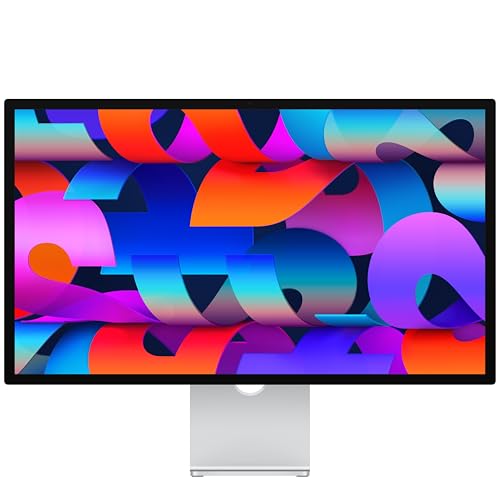 | Apple Studio Display | Size and resolution: 27-inch 5K, 5120 x 2880 at 60Hz Connection: Thunderbolt 5 Mac mini value: 218 PPI, camera, speakers, microphones Stand: Tilt-adjustable stand Best for: Best overall Mac mini setup | Check Price on Amazon |
 | ASUS ProArt PA27JCV | Size and resolution: 27-inch 5K, 5120 x 2880 at 60Hz Connection: USB-C with DisplayPort Alt Mode Mac mini value: 218 PPI, KVM, ergonomic stand Stand: Height, tilt, swivel, pivot Best for: Best-value 27-inch 5K | Check Price on Amazon |
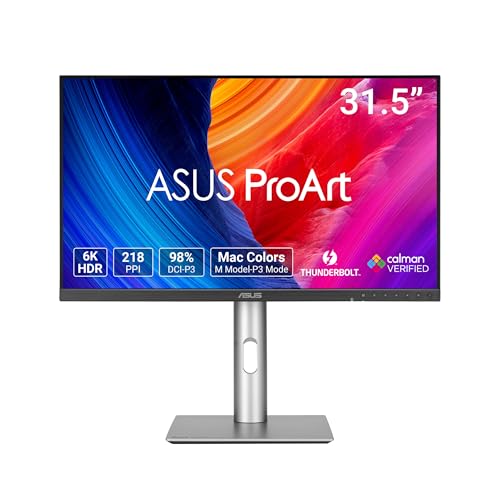 | ASUS ProArt PA32QCV | Size and resolution: 31.5-inch 6K, 6016 x 3384 at 60Hz Connection: Thunderbolt 4 Mac mini value: 218 PPI, KVM, USB hub Stand: Height, tilt, swivel, pivot Best for: Best 32-inch Retina-class choice | Check Price on Amazon |
 | LG UltraFine evo 40U990A-W | Size and resolution: 40-inch 5K2K, 5120 x 2160 at 120Hz Connection: Thunderbolt 5 Mac mini value: Wide workspace, USB hub, speakers Stand: Height, tilt, swivel Best for: Best ultrawide for M4 Pro | Check Price on Amazon |
 | Dell UltraSharp U3225QE | Size and resolution: 31.5-inch 4K, 3840 x 2160 at 120Hz Connection: Thunderbolt 4 Mac mini value: KVM, 2.5GbE, broad USB hub Stand: Height, tilt, swivel, pivot Best for: Best monitor with a built-in dock | Check Price on Amazon |
 | Dell 27 Plus 4K S2725QS | Size and resolution: 27-inch 4K, 3840 x 2160 at 120Hz Connection: HDMI 2.1 or DisplayPort 1.4 Mac mini value: 4K, 120Hz, built-in speakers Stand: Height, tilt, swivel, pivot Best for: Best budget Mac mini monitor | Check Price on Amazon |
 | ASUS ROG Swift OLED PG32UCDMR | Size and resolution: 31.5-inch 4K QD-OLED at 240Hz Connection: DisplayPort 2.1a, HDMI 2.1, USB-C Mac mini value: KVM, USB hub, OLED gaming features Stand: Height, tilt, swivel Best for: Best for gaming and HDR video | Check Price on Amazon |
 | BenQ MA320U | Size and resolution: 31.5-inch 4K, 3840 x 2160 at 60Hz Connection: USB-C with DisplayPort Alt Mode Mac mini value: Mac controls, USB hub, speakers Stand: Height, tilt, swivel, pivot Best for: Best Mac-focused 32-inch 4K | Check Price on Amazon |
 | Samsung ViewFinity S9 S27C900 | Size and resolution: 27-inch 5K, 5120 x 2880 at 60Hz Connection: Thunderbolt 4 Mac mini value: 4K camera, speakers, smart apps Stand: Height, tilt, pivot Best for: Best 5K monitor with smart features | Check Price on Amazon |
Mac mini Display Compatibility at a Glance
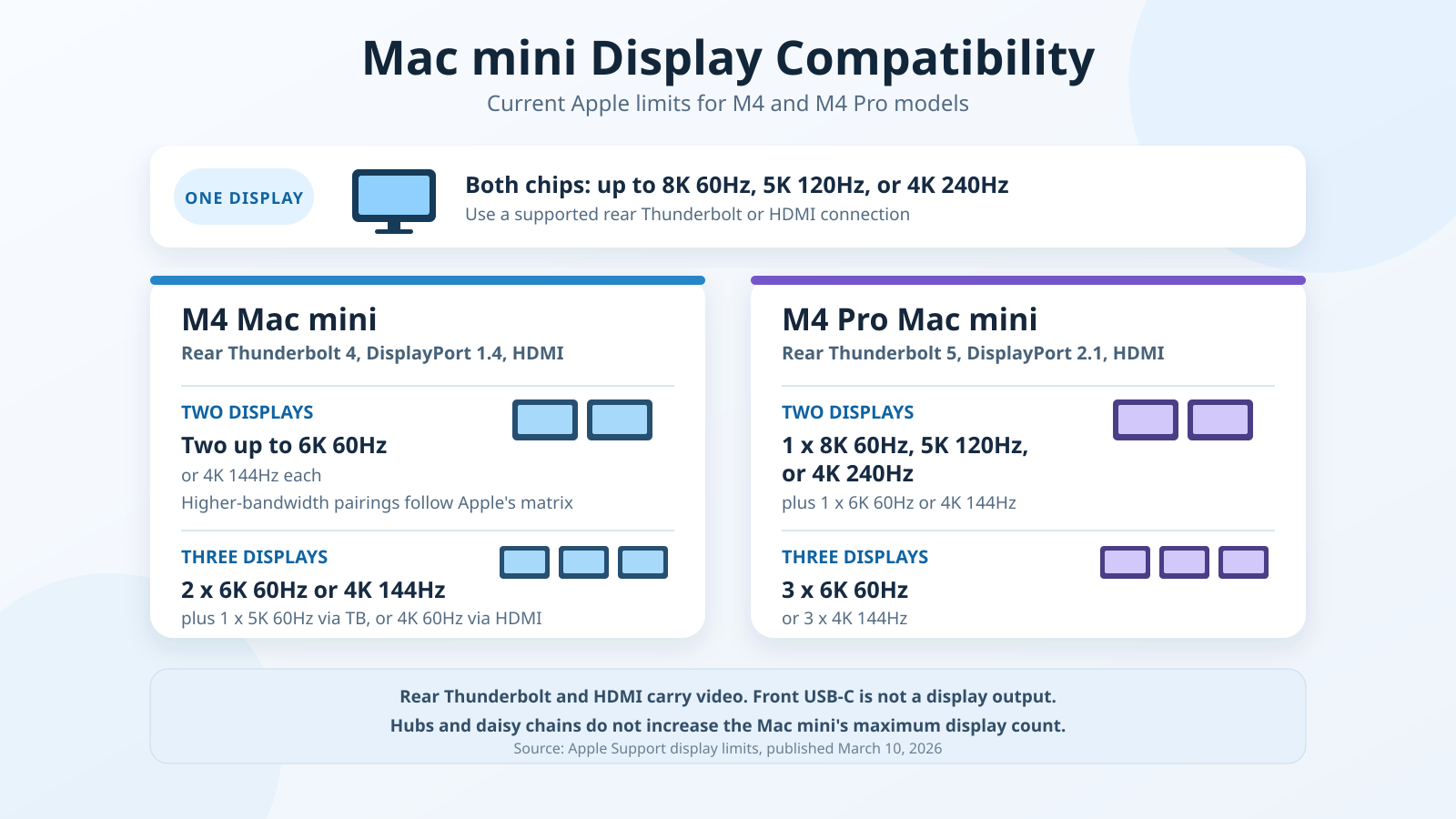
Apple currently sells the Mac mini with either M4 or M4 Pro. Both support up to three external displays, but M4 Pro gives each rear USB-C display port Thunderbolt 5 and native DisplayPort 2.1, while M4 uses Thunderbolt 4 and native DisplayPort 1.4. Both also have rear HDMI, the simple connection for a monitor such as the Dell S2725QS, while a Thunderbolt or USB-C display belongs on a rear Thunderbolt port.
For one display, Apple says either chip can drive up to 8K at 60Hz, 5K at 120Hz, or 4K at 240Hz through Thunderbolt or HDMI. With three displays, M4 can run two at up to 6K 60Hz or 4K 144Hz, plus a third at up to 5K 60Hz through Thunderbolt or 4K 60Hz through HDMI. M4 Pro can run three displays at up to 6K 60Hz or 4K 144Hz each. Apple’s current Mac mini display-support page lists the full two-display permutations as well.
Those figures are ceilings, not promises for every monitor and cable. The monitor input, the cable, macOS, firmware, and active display combination must all support the requested mode. A dock or daisy chain can reroute cabling, but Apple says it does not raise the Mac mini’s maximum total display count. Our guide to supporting more external monitors on M-series Macs explains why software-driven display adapters are a separate approach with their own tradeoffs.
Table of Contents
- Apple Studio Display, best overall
- ASUS ProArt PA27JCV, best-value 27-inch 5K
- ASUS ProArt PA32QCV, best 32-inch Retina-class choice
- LG UltraFine evo 40U990A-W, best ultrawide for M4 Pro
- Dell UltraSharp U3225QE, best monitor with a built-in dock
- Dell S2725QS, best budget Mac mini monitor
- ASUS ROG Swift OLED PG32UCDMR, best for gaming
- BenQ MA320U, best Mac-focused 32-inch 4K
- Samsung ViewFinity S9, best 5K monitor with smart features
1. Apple Studio Display — Best Overall Monitor for Mac mini
The current Apple Studio Display is the most coherent single-monitor partner for Mac mini. Apple specifies a 27-inch 5120 x 2880 panel at 218 pixels per inch, the density that lets macOS draw a spacious, familiar interface while keeping text and icons sharp. It runs at 60Hz, and Apple rates it for 600 nits, P3 color, and True Tone. This is not the fastest display here; it puts clarity ahead of gaming refresh.
The exact Amazon listing is the standard-glass model on a tilt-adjustable stand. Apple also sells nano-texture glass, height-adjustable stands, and VESA configurations, but those are separate purchases. This one does not adjust for height: a 27-inch screen should meet your eye line rather than force you to hunch. A monitor riser is the simple fix if the supplied tilt stand sits too low.
The display also carries the media hardware the Mac mini lacks. Apple’s specifications list a 12MP Center Stage camera with Desk View, a six-speaker system, and a three-microphone array. Its connection panel holds two Thunderbolt 5 ports and two USB-C ports: one Thunderbolt port feeds the Mac, and the downstream Thunderbolt and USB-C ports serve compatible peripherals. Apple lists up to 96W power delivery, but the Mac mini runs on its own AC supply, so that output only matters if you later share the screen with a laptop.
The strongest reason to buy it is integration, not any single number. Camera, speakers, microphones, USB expansion, and 5K density all arrive in one enclosure on one upstream cable. The gaps are just as plain: no high-refresh mode, no HDMI input for a game console, no KVM, and no height adjustment on this configuration.
Apple promotes display daisy chaining on the current model, but that does not raise the three-display cap on either M4 or M4 Pro Mac mini. For more options at this density, see our guide to the best 5K monitors.
Our Take
Choose the Studio Display when the monitor should also supply the camera and audio the Mac mini lacks. The 218 PPI 5K panel is the display advantage; the Apple integration is what makes it our overall pick. If height adjustment is essential, buy a different stand configuration from the start.
- 27-inch 5K panel at an Apple-specified 218 PPI
- Integrated 12MP camera, microphones, and six-speaker system
- Thunderbolt 5 and USB-C peripheral connections
- Mac-focused setup with one upstream cable
- 60Hz refresh rate
- This exact configuration has tilt but no height adjustment
- No HDMI input or two-computer KVM
2. ASUS ProArt PA27JCV — Best-Value 27-Inch 5K Monitor
The ASUS ProArt PA27JCV is the 27-inch 5K choice for buyers who want fine text without paying for Apple’s camera and audio. ASUS lists the same core 5120 x 2880 resolution and 218 PPI density as the Studio Display, so macOS can keep controls at a comfortable size while the extra pixels sharpen text, icons, and image edges. It is the clearest value route into the classic 27-inch Retina-class format.
ASUS positions the PA27JCV for color work: it specifies 99% DCI-P3, 95% Adobe RGB, and 100% sRGB coverage, ships Calman Verified, and claims a factory color error below Delta E 2. Those are manufacturer figures, not independent measurements. Color-critical work still needs calibration and profiling rather than treating a factory report as permanent accuracy.
Connectivity is USB-C rather than Thunderbolt. The USB-C input accepts DisplayPort Alt Mode, carries USB data, and supplies up to 96W to a compatible laptop, though the Mac mini takes only video and USB data over that cable, not power. ASUS also lists HDMI 2.1, DisplayPort 1.4, a USB hub, a KVM, and two small speakers. The KVM is the difference that counts if a keyboard and mouse need to switch between the Mac mini and a work laptop.
The stand is far more accommodating than the tilt-only Studio Display: ASUS gives it height, tilt, swivel, and pivot, plus a 100 x 100mm VESA pattern. Its LuxPixel coating is meant to cut reflections while keeping detail. The trade is a 60Hz ceiling and no integrated camera or higher-end speaker array, so you may still want a webcam and external speakers.
Pick the PA27JCV for the pixels, stand, and KVM, not for laptop charging. The Mac mini’s desktop design makes the 96W figure incidental. For a 27-inch USB-C screen without a 5K requirement, our best USB-C monitors guide covers a broader field.
Our Take
The PA27JCV is our best-value 5K pick because it keeps the 218 PPI advantage and adds full stand adjustment and a KVM. It asks you to bring your own camera and better speakers, a fair trade for a Mac mini desk that already has them.
- 27-inch 5K resolution at an ASUS-listed 218 PPI
- Full ergonomic stand and VESA support
- USB-C hub and KVM for two-computer desks
- Broad manufacturer-rated color coverage
- USB-C connection is not Thunderbolt
- Limited to 60Hz
- No integrated webcam and only basic speakers
3. ASUS ProArt PA32QCV — Best 32-Inch Retina-Class Monitor
The ASUS ProArt PA32QCV scales the high-density Mac desktop up to 31.5 inches. ASUS specifies a 6016 x 3384 IPS panel at 218 PPI, so the density matches the 27-inch 5K class while the larger screen gives windows more room. It is the pick for big spreadsheets, dense editing interfaces, and several documents at once that need 32-inch scale without dropping to ordinary 4K density.
Apple supports one 6K 60Hz monitor on either M4 or M4 Pro Mac mini, and the PA32QCV’s native refresh is 60Hz. It connects over Thunderbolt 4, and ASUS lists two Thunderbolt ports, up to 96W Power Delivery, a USB hub, HDMI 2.1, and DisplayPort 1.4 with Display Stream Compression. The Mac mini ignores the charging output, but Thunderbolt and the hub still cut down on peripheral cables, and Auto KVM lets two connected computers share the attached USB devices.
ASUS rates the panel for 98% DCI-P3 and 100% sRGB, includes an M Model-P3 preset, and lists both Calman verification and a factory color error below Delta E 2. It also carries DisplayHDR 600 certification. Those figures make it a credible large creative-work monitor, but HDR certification does not turn an IPS panel into an OLED or a fine-zone Mini LED display. Expect a bright professional desktop and broad gamut rather than deep cinematic black.
The stand adjusts for height, tilt, swivel, and pivot, though pivoting a 31.5-inch panel needs real vertical clearance, so measure the desk and any shelf above it. A 6K signal also deserves a direct, capable cable: use the included or manufacturer-qualified Thunderbolt route before adding a dock, and check Apple’s current matrix before pairing it with two more high-resolution screens.
The PA32QCV trades refresh rate and desk space for density and physical room. The Dell U3225QE below is the stronger 120Hz office hub at 32 inches, but its 4K panel is far less dense. Our best Thunderbolt monitors guide compares more screens that pair a display with a high-speed hub.
Our Take
Choose the PA32QCV when 32-inch size and Retina-class density are both nonnegotiable. It is a specialist productivity and creative display: 6K at 60Hz, full stand adjustment, Thunderbolt 4, a KVM, and a useful hub, without the camera and audio package of Apple’s 27-inch model.
- 31.5-inch 6K panel at an ASUS-listed 218 PPI
- Thunderbolt 4 hub and Auto KVM
- Fully adjustable stand
- Manufacturer-rated wide color coverage and DisplayHDR 600
- 60Hz ceiling
- Large panel needs adequate desk depth
- No integrated camera
4. LG UltraFine evo 40U990A-W — Best Ultrawide for M4 Pro
The LG UltraFine evo 40U990A-W suits a Mac mini owner who wants one continuous work area instead of two separate monitors. LG specifies a 40-inch curved Nano IPS Black panel with 5120 x 2160 resolution and refresh up to 120Hz. Its 21:9 shape holds a large primary app beside reference material with no center bezel, and the extra vertical pixels make it better for documents and editing than a 3440 x 1440 ultrawide.
Thunderbolt 5 makes the 40U990A-W a natural match for the M4 Pro Mac mini. LG also includes DisplayPort 2.1, HDMI 2.1, USB-C and USB-A hub connections, and up to 96W charging for a compatible laptop. The M4 Mac mini can still drive the display through a suitable connection, but M4 Pro’s Thunderbolt 5 and native DisplayPort 2.1 line up more directly with the monitor’s newest interfaces. The Mac mini itself runs on AC power.
LG lists up to 120Hz, VESA DisplayHDR 600, 99% DCI-P3 coverage, and a 2000:1 contrast ratio, all manufacturer ratings. Apple supports one display up to 5K 120Hz on both current Mac mini chips, but that does not guarantee every 5120 x 2160 mode through every cable or multi-monitor arrangement. Connect directly, confirm the refresh in macOS, and only then add other displays or hubs.
The screen trades Retina-class density for width. Those 5120 pixels span 40 inches rather than 27, so text is not as fine as on a 27-inch 5K or 32-inch 6K panel. In return you get physical space, smoother motion, and fewer window boundaries. The height, tilt, and swivel stand helps center the broad panel, but there is no pivot, and the desk needs enough depth to keep the edges comfortable.
Our Take
Pick the 40U990A-W when one wide, high-refresh workspace beats Retina-class density. It is strongest beside M4 Pro, where Thunderbolt 5 and DisplayPort 2.1 are available at both ends. Buyers who mostly read small text should favor the PA27JCV or PA32QCV.
- 40-inch 5120 x 2160 ultrawide workspace
- Up to 120Hz refresh
- Thunderbolt 5, DisplayPort 2.1, HDMI 2.1, and USB hub
- Height, tilt, and swivel adjustment
- Lower pixel density than 27-inch 5K or 32-inch 6K
- Requires a wide, deep desk
- 120Hz depends on the complete connection and display arrangement
5. Dell UltraSharp U3225QE — Best Monitor With a Built-In Dock
The Dell UltraSharp U3225QE is the strongest desk-infrastructure choice here. Dell pairs a 31.5-inch 3840 x 2160 IPS Black panel at up to 120Hz with Thunderbolt 4, a KVM, 2.5Gb Ethernet, downstream display connections, and a wide set of USB ports. The Mac mini has no use for a charging monitor, but it can use almost everything else in this hub.
Connect the Mac mini through the rear Thunderbolt port and the display carries video while handing its Ethernet and USB devices to macOS. Dell specifies a separate upstream path for a second computer, so the KVM can share a keyboard, mouse, storage, and other peripherals between a personal Mac mini and a work laptop without cable swaps. The listed 140W EPR output goes to that compatible laptop, not the Mac mini.
Dell rates the monitor for 4K at 120Hz and a 3000:1 contrast ratio, and that 120Hz refresh makes scrolling and pointer motion look more fluid than a 60Hz productivity display. At roughly 140 PPI, though, 32-inch 4K lacks the density of 32-inch 6K. macOS scaling can give comfortable controls and a useful workspace, but fine text will not match the PA32QCV’s 218 PPI structure.
The stand adjusts for height, tilt, swivel, and pivot, and Dell includes a Thunderbolt 4 cable. There is no webcam or speaker system, so the model assumes separate media hardware. That suits buyers who already own a good camera and speakers, or who want each part to be replaceable.
Buy the U3225QE for its hub and KVM, not its power-delivery headline. If you do not need wired networking, shared USB devices, or downstream display connections, the Dell S2725QS gives the Mac mini a simpler 4K 120Hz screen. Our guide to monitors with built-in docking stations explains when this integration is worth choosing over a separate dock.
Our Take
Choose the U3225QE for a two-computer desk where the monitor must also organize Ethernet, USB devices, and display expansion. Its 32-inch 4K 120Hz panel is good, but the KVM and hub are the reasons it ranks above less expensive 4K options.
- 32-inch 4K panel at up to 120Hz
- Thunderbolt 4 hub, KVM, and 2.5Gb Ethernet
- Broad USB and downstream display connectivity
- Fully adjustable stand
- Lower density than 32-inch 6K
- No integrated camera or speakers
- High charging output adds no value to Mac mini itself
6. Dell S2725QS — Best Budget Monitor for Mac mini
The Dell S2725QS is a reminder that the Mac mini does not need Thunderbolt in a monitor. Dell specifies a 27-inch 3840 x 2160 IPS panel at up to 120Hz, with two HDMI 2.1 inputs and DisplayPort 1.4. An HDMI cable runs straight into the Mac mini’s native rear port and leaves all three Thunderbolt ports free for storage, networking, or other peripherals.
At 27 inches, 4K works out to about 163 PPI. That is less dense than 27-inch 5K, but far finer than 27-inch QHD. macOS offers scaled resolution choices to balance interface size against workspace, and Apple cautions that scaled modes can affect performance, so start at the default and compare the choices in your normal applications.
Dell adds two 5W speakers and a stand that adjusts for height, tilt, swivel, and pivot, which are easy extras to miss in the value tier, and rates the panel for 99% sRGB and 1500:1 contrast. There is no USB hub, Ethernet, webcam, KVM, USB-C, or Thunderbolt, so peripherals connect to the Mac mini or to a separate hub.
The missing USB-C charging is no defect in this pairing: the Mac mini takes power from the wall and does not accept monitor Power Delivery. A simpler connection set lets the S2725QS concentrate on resolution, refresh, speakers, and adjustment. It also handles a console over the second HDMI input, though your audio and input-switching preferences may still make dedicated speakers the better choice.
Our Take
The S2725QS is the best budget-minded Mac mini monitor here because it avoids charging and docking features the desktop does not need. It gives you 27-inch 4K detail, up to 120Hz, speakers, and a proper stand over a direct HDMI connection. Add a separate hub only if your peripherals demand one.
- 27-inch 4K panel with up to 120Hz refresh
- Direct HDMI connection preserves Thunderbolt ports
- Built-in speakers
- Height, tilt, swivel, and pivot adjustment
- No USB-C or Thunderbolt input
- No USB hub, Ethernet, or KVM
- Not as sharp as a 27-inch 5K panel
7. ASUS ROG Swift OLED PG32UCDMR — Best for Gaming and HDR Video
The ASUS ROG Swift OLED PG32UCDMR is the specialist choice for a Mac mini that also handles games and HDR video. ASUS specifies a 31.5-inch 3840 x 2160 QD-OLED panel at up to 240Hz, a manufacturer-rated 0.03ms response time, and 99% DCI-P3 coverage. OLED’s per-pixel light control puts deep black beside bright detail in a way an ordinary edge-lit IPS monitor cannot.
Its inputs suit high-bandwidth sources unusually well. ASUS lists DisplayPort 2.1a UHBR20, two HDMI 2.1 connections, and USB-C with DisplayPort Alt Mode. M4 Pro can use a rear Thunderbolt 5 port’s native DisplayPort 2.1 output with a suitable cable, while HDMI 2.1 gives either current Mac mini a direct route. Apple supports one 4K 240Hz display on both M4 and M4 Pro, but the cable, input, monitor mode, macOS, and any other active screens still decide what appears in settings.
The display also provides a USB hub and KVM. Its 90W USB-C charging is useful to a shared laptop, not to the Mac mini. ASUS includes height, tilt, and swivel adjustment but no pivot, which is sensible for a large OLED gaming panel.
OLED carries a real desktop tradeoff. Menu bars, dock icons, editing controls, and application chrome can sit static for hours, which raises image-retention and burn-in risk. ASUS lists OLED Care features, a Neo Proximity sensor, and three-year warranty coverage that includes burn-in under its terms. Those measures cut the risk but do not rule out permanent image retention, so anyone who spends all day in static spreadsheets should favor an IPS display.
Our Take
Choose the PG32UCDMR when gaming motion and HDR contrast matter enough to accept OLED care and static-content risk. It reaches the Mac mini’s highest single-display 4K refresh class, and its KVM and multiple inputs leave room for a console or gaming PC. Our best OLED monitors guide covers the panel technology in more depth.
- 4K QD-OLED panel at up to 240Hz
- DisplayPort 2.1a, HDMI 2.1, and USB-C inputs
- USB hub and KVM
- Three-year ASUS warranty includes burn-in coverage under its terms
- Static desktop content creates burn-in risk
- Lower text density than 32-inch 6K
- No integrated camera or Ethernet
8. BenQ MA320U — Best Mac-Focused 32-Inch 4K Monitor
The BenQ MA320U is a 32-inch 4K alternative for buyers who want Mac-oriented controls without moving to 6K. BenQ specifies a 31.5-inch 3840 x 2160 IPS panel at 60Hz, 97% P3 coverage, and a matte surface. It markets the color tuning for Mac devices and uses Display Pilot 2 software to fold monitor brightness and volume control into macOS.
Treat that as a manufacturer convenience, not a promise that the panel matches every Apple display perfectly. The MA320U’s roughly 140 PPI density sits well below the 218 PPI of a 32-inch 6K screen. It gives windows generous physical scale, and macOS scaling keeps controls comfortable, but text edges will not look as fine as they do on the PA32QCV.
BenQ lists USB-C DisplayPort Alt Mode with up to 90W Power Delivery, a second USB-C connection at up to 15W, two USB-A ports, and two HDMI 2.0 inputs. The hub carries USB data for the Mac mini, which does not accept USB-C Power Delivery. Two 3W speakers cover system sounds and basic calls, the stand handles height, tilt, swivel, and pivot, and a 100 x 100mm VESA pattern supports an arm.
BenQ rates typical brightness at 550 nits and lists DisplayHDR 600 support. As with the ProArt HDR rating, that describes supported capability, not OLED-like black. The 60Hz limit also makes it less fluid than the Dell 4K models. The case for the MA320U is the mix of 32-inch size, Mac control integration, a useful USB hub, and ergonomic hardware.
Our Take
Pick the MA320U when you want a large Mac-oriented desktop and prefer software integration over high refresh. It is easier to set up than a bare budget screen, but the Dell U3225QE is the better hub and the ASUS PA32QCV is the sharper 32-inch option.
- Large 32-inch 4K workspace
- BenQ Display Pilot 2 integration for Mac controls
- USB-C and USB-A hub plus two HDMI inputs
- Full ergonomic stand and VESA support
- 60Hz refresh rate
- Far lower density than 32-inch 6K
- Mac mini cannot use the 90W charging output
9. Samsung ViewFinity S9 — Best 5K Monitor With Smart Features
The Samsung ViewFinity S9 combines 27-inch 5K density with features that keep working when the Mac mini is asleep. Samsung specifies a 5120 x 2880 IPS panel at 218 PPI and 60Hz, with a matte surface and 600-nit typical brightness, and rates it for 99% DCI-P3 and a factory color error below Delta E 2. Those are Samsung figures, not independent measurements.
Thunderbolt 4 is the primary computer connection and carries video and USB data from a rear Mac mini port. Samsung lists up to 90W charging for compatible laptops, plus Mini DisplayPort and USB-C connectivity. The screen adds speakers and a detachable 4K SlimFit camera, filling two gaps the Mac mini leaves open, and the stand adjusts for height and tilt and pivots for portrait use.
The smart platform is the reason to choose it over another 5K screen. Samsung includes AirPlay, streaming apps, and its Gaming Hub, so the display can serve media without routing everything through macOS. Some owners want that independence; others would rather skip another software platform and account layer. The ViewFinity S9 is also a 2023 design, though Samsung’s product page remains live and the Amazon listing still carried an offer on our July 2026 check.
Against the Studio Display, Samsung offers a detachable camera, smart apps, and more stand movement, while Apple brings a newer Thunderbolt 5 connection, its own Center Stage camera behavior, and a six-speaker system. Against the PA27JCV, it adds Thunderbolt, a camera, and smart functions at the same 5K resolution class.
Our Take
Choose the ViewFinity S9 when 5K text, an included camera, and stand-alone streaming features all belong on the same desk. Skip it if you want the simplest possible monitor firmware or if the PA27JCV’s KVM and full ergonomic stand better fit your two-computer work.
- 27-inch 5K panel at a Samsung-listed 218 PPI
- Thunderbolt 4 and detachable 4K camera
- Built-in speakers, AirPlay, and smart apps
- Height adjustment and portrait rotation
- 60Hz refresh rate
- Smart platform adds software some buyers do not need
- Older design than the current Apple Studio Display
How to Choose the Best Monitor for Mac mini
Start with 5K or 6K for Retina-class density
Resolution and screen size work together. A 27-inch 5K display and a 31.5-inch 6K display both land near 218 PPI, based on their listed diagonal and native resolution. That density gives macOS enough pixels to draw a comfortable interface with fine text, which is the main reason the Studio Display, PA27JCV, and PA32QCV sit near the top of this list.
A 27-inch 4K screen is about 163 PPI, a 32-inch 4K screen about 140 PPI. Both can look sharp at a normal distance, but neither reproduces the pixel structure of the 5K and 6K options. macOS offers scaled resolution choices that trade interface size against workspace. Apple recommends starting at the default and warns that a scaled resolution can affect performance. Choose the monitor for its physical size first, then pick the scaling option that keeps text readable in your normal applications.
The 40-inch 5K2K LG takes a different route. Its 5120 horizontal pixels buy width rather than high density, which helps with several windows, a long editing timeline, or a broad spreadsheet, but it is not a 40-inch version of a 27-inch Retina display. Our best 4K monitors and 5K guide separate those density and workspace priorities further.
Match refresh rate to the job
Sixty hertz remains appropriate for writing, office work, photo editing, and most video timelines. A 120Hz display makes scrolling, pointer motion, and animations look smoother. A 240Hz model is primarily a gaming purchase, and it asks for a compatible input and cable as well as a Mac-supported mode.
Apple’s one-display ceiling is generous: up to 5K 120Hz or 4K 240Hz on either M4 or M4 Pro. Those limits change once two or three displays are active. If high refresh matters most, set up the main display’s direct connection first and verify the mode in macOS before adding a dock or other screens. Never assume a port label alone guarantees the panel’s maximum refresh.
Choose HDMI, USB-C, or Thunderbolt deliberately
HDMI is an excellent Mac mini connection when the monitor does not need to act as a hub. It uses the desktop’s dedicated rear output and preserves the Thunderbolt ports for fast storage, networking, or audio hardware. That is why the S2725QS makes sense despite lacking USB-C.
USB-C DisplayPort Alt Mode can combine video and USB data, as on the PA27JCV, MA320U, and PG32UCDMR, but it does not automatically bring Thunderbolt bandwidth. Thunderbolt monitors can expose a faster hub or a downstream Thunderbolt device path, though their real value depends on what you attach. Our USB4 vs. Thunderbolt 4 explainer covers the interface distinction.
M4 Pro’s Thunderbolt 5 ports and native DisplayPort 2.1 output make it the stronger host for the LG 40U990A-W and a direct DisplayPort 2.1 route to the ASUS OLED. M4’s Thunderbolt 4 ports remain fully capable for the 5K and 6K 60Hz productivity picks. Read our DisplayPort 2.1 explainer before buying an adapter solely because its version number sounds newer.
Do not pay for charging unless another computer needs it
The Mac mini has an internal power supply and runs on AC. It cannot be powered by a monitor’s USB-C Power Delivery output, so a 90W, 96W, or 140W charging figure says nothing about how well a monitor pairs with Mac mini.
Charging matters only when the same monitor also hosts a MacBook or work laptop. Then a high-output USB-C or Thunderbolt input can charge the laptop while a KVM shares the keyboard, mouse, and hub, so compare the laptop’s power needs against the monitor rating and cable support. Our best monitor for MacBook Pro guide treats charging as a primary requirement because the computer is portable.
Decide whether the monitor should replace a dock
A monitor hub can reduce boxes and cables, but only if it has the ports you need. The U3225QE is the strongest dock replacement here because Dell lists 2.5Gb Ethernet, a KVM, several USB connections, and downstream display paths. The PA32QCV and PA27JCV offer useful KVM and USB functions without wired networking. The S2725QS has no hub, which is fine if your Mac mini already connects directly to all peripherals.
List the devices before choosing: keyboard and mouse, camera, audio interface, card reader, external SSD, network cable, and any second computer. Check each port’s data role rather than counting USB-shaped sockets. A display output on a hub also counts against Apple’s total display limits.
Leave room for the stand, camera, and speakers
A large resolution is wasted if the screen sits too close or too low. A fully adjustable stand makes it easier to center the top third of the panel near eye level. The Studio Display listed here tilts but does not adjust for height, while the ProArt and Dell picks move more freely. VESA support lets a suitable arm reclaim desk depth, but the arm must handle the monitor’s weight and wide-panel balance.
The Mac mini has a built-in speaker for basic system sound but no camera or microphone array. The Studio Display and ViewFinity S9 fill those gaps most completely; the others may need a webcam, microphone, or speakers. Factor those costs and USB connections into the decision, not just the panel.
Frequently Asked Questions
What is the best monitor for Mac mini M4?
The Apple Studio Display is our best overall monitor for Mac mini M4 because its 27-inch 5K panel, camera, microphones, speakers, and Thunderbolt connection form a complete desktop. The ASUS PA27JCV is the better-value 5K option, and the Dell S2725QS is the straightforward 4K 120Hz choice. M4 supports up to three external displays, subject to Apple’s resolution and refresh combinations.
Does Mac mini support a 5K or 6K monitor?
Yes. Apple says M4 and M4 Pro Mac mini can each drive a single display up to 8K 60Hz, 5K 120Hz, or 4K 240Hz. A 6K 60Hz monitor is within the documented limits of both chips. Additional displays change the allowed combinations, so consult Apple’s matrix for a two-screen or three-screen setup.
Is 4K or 5K better for a 27-inch Mac monitor?
Five-kilopixel resolution fits better when text clarity and Retina-class density matter most. A 27-inch 5K screen is about 218 PPI, while 27-inch 4K is about 163 PPI. The 4K option stays sharp, often comes with higher refresh, and can be a better use of budget. macOS scaling controls how large the interface appears on either screen.
Can the front USB-C ports connect a monitor?
Apple does not list display output for the two front USB-C ports on the current Mac mini. It lists them as USB 3 connections up to 10Gbps. Connect monitors to the rear Thunderbolt ports or the rear HDMI port instead.
Does Mac mini need USB-C charging from a monitor?
No. Mac mini plugs into AC power and does not use a monitor’s Power Delivery output. Charging is useful only if the display is also shared with a compatible laptop. For Mac mini alone, prioritize display quality, hub data ports, Ethernet, KVM, camera, speakers, and stand adjustment.
Can I daisy-chain monitors from Mac mini?
Compatible Thunderbolt displays can support a chained physical connection, but Apple says a hub or daisy chain does not raise the host’s maximum display count. M4 and M4 Pro Mac mini support up to three external displays. Resolution and refresh limits still apply to the entire arrangement.
How We Chose These Monitors
We began with Apple’s current Mac mini specifications, model-identification page, scaling guidance, and March 2026 display-support matrix. That fixed which Mac mini generations are sold, which rear ports carry video, and the one-display, two-display, and three-display ceilings.
Each ranked monitor then needed a current official manufacturer page to support its identity and key specifications. We favored materially different buyer positions over nine near-identical 4K panels: 27-inch 5K, 32-inch 6K, ultrawide 5K2K, dock monitor, basic 4K, OLED gaming, Mac-focused 4K, and smart 5K. Manufacturer brightness, gamut, contrast, response, and certification figures are attributed as specifications rather than presented as independent measurements.
Finally, we searched the Amazon Creators catalog for every exact model and verified each listing with item lookup on July 15, 2026. All nine returned matching titles, active offers, and primary images. We did not inherit identifiers from older articles, guess unavailable variants, hardcode live prices, or claim personal testing.
Also Considered
The LG 40WP95C-W was left out because the newer 40U990A-W fills the same 5K2K ultrawide role with Thunderbolt 5 and 120Hz. The older ASUS PG32UCDM gave way to the exact PG32UCDMR listing with DisplayPort 2.1a. We skipped the glossy BenQ MA320UP because it overlaps the matte MA320U, and we chose Dell’s S2725QS over the USB-C S2725QC because monitor charging is not useful to Mac mini. The Apple Studio Display nano-texture, height-adjustable, and VESA versions remain separate configurations and should not stand in for the standard-glass tilt-stand model used here.