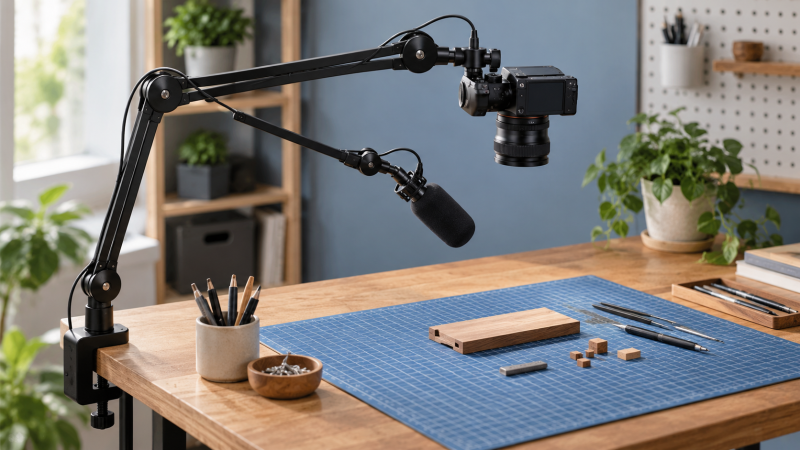
An overhead desk arm can place a camera, light, or microphone above a work surface without using a floor stand. The useful comparison points are the stated load in the orientation you will use, the number and range of joints, the clamp opening, and the thread or adapter supplied for the device.
These five articulated overhead desk arms are all stated to suit camera and microphone use. Their load figures use different orientations and wording, so a larger number on one listing is not automatically a direct capacity match for another. Plan the camera, lens, microphone mount, light, and cable weight as one supported arrangement.
Choose the arm by its stated horizontal-load figure, reach, and mounting thread before treating a camera clamp as a general studio rig.Overhead Desk Rigging Arms Compared
| Image | Product | Details | Check Price |
|---|---|---|---|
 | TARION Titanrig Lite Z | Best fit: Highest listed camera load Load: 17.6 lb Joints: 18.9-inch articulating arm; 360/180-degree adjustment Mount: Double C-clamp; 1/4 and 3/8-inch screws Extras: Tablet holder; microphone compatibility | Check Price on Amazon |
 | JEBUTU MS05 | Best fit: Tall three-section reach Reach: 14.76 to 41.14 inches Load: Nearly 6.6 lb listed Joints: Three sections; 180-degree sections Mount: C-clamp up to 1.96 inches Extras: 1/4-inch screw; microphone support | Check Price on Amazon |
 | DImotliyor 3-Section Arm | Best fit: Multi-thread attachment flexibility Load: 4.5 lb horizontal; 6 lb suspended Joints: Three rods; 180-degree adjustment Mount: C-clamp up to 2.4 inches Extras: 1/4, 3/8, and 5/8-inch screws | Check Price on Amazon |
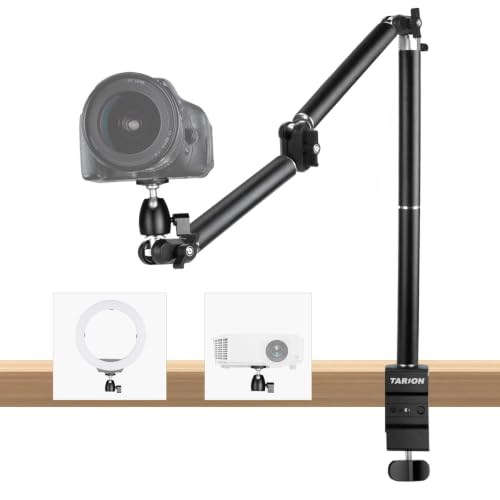 | TARION TKA01-L | Best fit: Gear-joint locking Load: 6.6 lb horizontal; 8.8 lb vertical Joints: Three locking gear joints Reach: 38 inches Extras: 1/4 and 3/8-inch threads for microphones | Check Price on Amazon |
 | DNSbabi 3-Section Arm | Best fit: Highest listed horizontal load Load: 16 lb horizontal; 22 lb maximum Joints: Three sections; 360-degree base and top Reach: 35.4 inches extended Extras: 1/4, 3/8, and 5/8-inch screws; microphone support | Check Price on Amazon |
1. TARION Titanrig Lite Z — Highest Listed Camera Load
TARION lists the Titanrig Lite Z as an overhead DSLR desk arm with a double C-clamp and a 17.6-pound load capacity. Its listing names an 18.9-inch articulating arm, 360-degree vertical and 180-degree horizontal adjustment, a 1/4-inch and 3/8-inch dual-thread connection, and an extra tablet holder. It also says the arm can accommodate a camera, ring light, webcam, tablet, cell phone, and microphone.
The double clamp sets a fit requirement for your desk. TARION gives a desk-thickness range of 0.6 to 2.95 inches and lists anti-slip pads. Check that range against the actual desk edge before using the arm for an overhead camera position. The 17.6-pound figure is a listed total load, not a reason to ignore the balance of a long lens or accessory arm.
TARION lists a 17.6-pound capacity, double C-clamp, 18.9-inch arm, and 1/4-inch plus 3/8-inch threads.Our Take Choose this when the listed 17.6-pound capacity and double-clamp desk range best fit a heavier camera arrangement.
- The listed 17.6-pound capacity is a total load, higher than the horizontal figures that DNSbabi, TARION TKA01-L, and DImotliyor list.
- Double C-clamps and a 0.6-to-2.95-inch desk range help define its mounting requirements.
- The 1/4-inch and 3/8-inch threads are listed for camera, light, tablet, and microphone setups.
- Its 18.9-inch articulated arm is shorter than the 35.4-inch and 38-inch listed alternatives.
- The 17.6-pound figure is a total load rating, so an extended camera still needs to be balanced.
2. JEBUTU MS05 — Tall Three-Section Reach
JEBUTU lists a detachable three-section overhead camera desk mount with a 14.76-to-41.14-inch height range. Each section can adjust 180 degrees, giving the arm a stated 360-degree overall adjustment. The product includes a 1/4-inch screw and a C-clamp that opens to 1.96 inches. Its feature information also describes microphone, camera, projector, and video-light use.
Its nearly 6.6-pound listed load makes this a different choice from the higher-capacity TARION Titanrig Lite Z and DNSbabi arms. The longer stated reach can help position a lighter camera or microphone over a broad desk, but the supported device should stay within the listing’s load and clamp conditions. Choose it for height and angle, and look at the higher-capacity arms first for a heavy lens package.
JEBUTU lists three detachable sections, 14.76-to-41.14-inch reach, 180-degree section movement, and a 1.96-inch clamp opening.Our Take Pick this for a stated tall, three-section overhead arm when the planned camera or microphone load stays modest.
- The 14.76-to-41.14-inch listed height range suits a wider top-down framing area.
- Three detachable sections and 180-degree movement give stated options for overhead positioning.
- Its nearly 6.6-pound listed capacity is lower than the 16-pound DNSbabi horizontal-load figure.
- The C-clamp opens to 1.96 inches, so thicker desk edges need a different mount.
- Only a 1/4-inch screw is listed, while the other four arms list two or three thread sizes.
3. DImotliyor 3-Section Arm — Multi-Thread Attachment Flexibility
DImotliyor lists a three-section detachable overhead arm with 1/4-inch, 3/8-inch, and 5/8-inch screws, a phone holder, and a 360-degree ball head. Each rod can adjust 180 degrees, while the base can rotate 360 degrees. The product states compatibility with DSLR cameras, webcams, projectors, phones, lights, and microphones.
The listing gives a 4.5-pound horizontal load and a six-pound maximum when suspended. Those orientation-specific numbers are the practical selection point. Its padded C-clamp opens to 2.4 inches, so it can suit a desk edge that exceeds JEBUTU’s stated clamp size. Choose it for thread flexibility only when the planned device and angle sit inside the stated load figures.
Our Take Choose this when several thread sizes are a bigger need than carrying the largest listed horizontal camera load.
- Three listed screw sizes make it easier to match a camera, microphone, or light adapter.
- Its 2.4-inch clamp opening exceeds JEBUTU’s stated 1.96-inch desk-edge limit.
- Three rods, 180-degree adjustment, and a 360-degree base give a flexible stated geometry.
- The listing differentiates 4.5-pound horizontal and six-pound suspended loads for position planning.
- The 4.5-pound horizontal rating is the lowest load figure on this page.
- The stated six-pound maximum does not replace checking the load in the actual extended orientation.
4. TARION TKA01-L — Gear-Joint Locking
TARION lists the TKA01-L with three locking gear joints that provide 180-degree tilt and 360-degree rotation. The listing names a 6.6-pound horizontal extension load, an 8.8-pound vertical load, 38-inch reach, 1/4-inch and 3/8-inch connection points, and a detachable ball head. It explicitly mentions extra threads for microphones, monitors, and video lights.
The TKA01-L suits a buyer who wants the listing’s geared-lock approach to angle control. Its separate vertical and horizontal figures make orientation part of the decision. A camera held straight above a workbench is not the same lever load as a camera projecting out from the desk pole, so use the 6.6-pound horizontal number when choosing an extended overhead position.
TARION lists three locking gear joints, 38-inch reach, a 6.6-pound horizontal limit, and microphone-capable 1/4-inch and 3/8-inch threads.Our Take Buy this for stated gear-joint locking and long reach when the camera’s horizontal load stays within 6.6 pounds.
- Three locking gear joints give a stated mechanical way to hold an overhead camera angle.
- The 38-inch reach is longer than TARION Titanrig Lite Z’s listed 18.9-inch articulated arm.
- Its listed horizontal extension capacity is 6.6 pounds, well below the DNSbabi horizontal figure.
- The 8.8-pound vertical and 6.6-pound horizontal capacities are different ratings, so an extended camera should use the lower one.
- The dual-slot clamp still needs a desk edge that suits its listed 2.36-inch opening.
5. DNSbabi 3-Section Arm — Highest Listed Horizontal Load
DNSbabi lists a three-section flexible articulating overhead arm with a 35.4-inch extended length and a 13.8-inch folded length. It has a 360-degree-adjustable base and top, 1/4-inch, 3/8-inch, and 5/8-inch screws, a phone holder, and stated support for cameras, webcams, lights, and microphones. Its clamp opens to 2.4 inches and has padding.
The listing states up to 16 pounds horizontally and 22 pounds maximum, which are its key comparison numbers. It also says the joints lock by gear. Use the 16-pound horizontal figure for an extended camera arrangement and keep cables from imposing their own pull on the arm. The 35.4-inch reach suits a wide workbench without requiring the 41.14-inch height range of JEBUTU.
DNSbabi lists a 16-pound horizontal load, 35.4-inch extended length, three sections, gear-locked joints, and three thread sizes.Our Take Choose this when the highest stated horizontal-load figure and multi-thread attachment options are the deciding needs.
- The 16-pound listed horizontal capacity is the highest horizontal-load figure in this guide.
- Its 35.4-inch extended length and 13.8-inch folded length support a broad desk with compact storage.
- Three thread sizes and stated microphone support help match different camera and audio mounting hardware.
- The 22-pound maximum is a different rating from the 16-pound horizontal figure, so an extended camera should use the lower one.
- A 2.4-inch clamp opening needs a compatible desk edge before the arm can be secured.
Buying Guide
1. Use the horizontal load figure for an extended camera
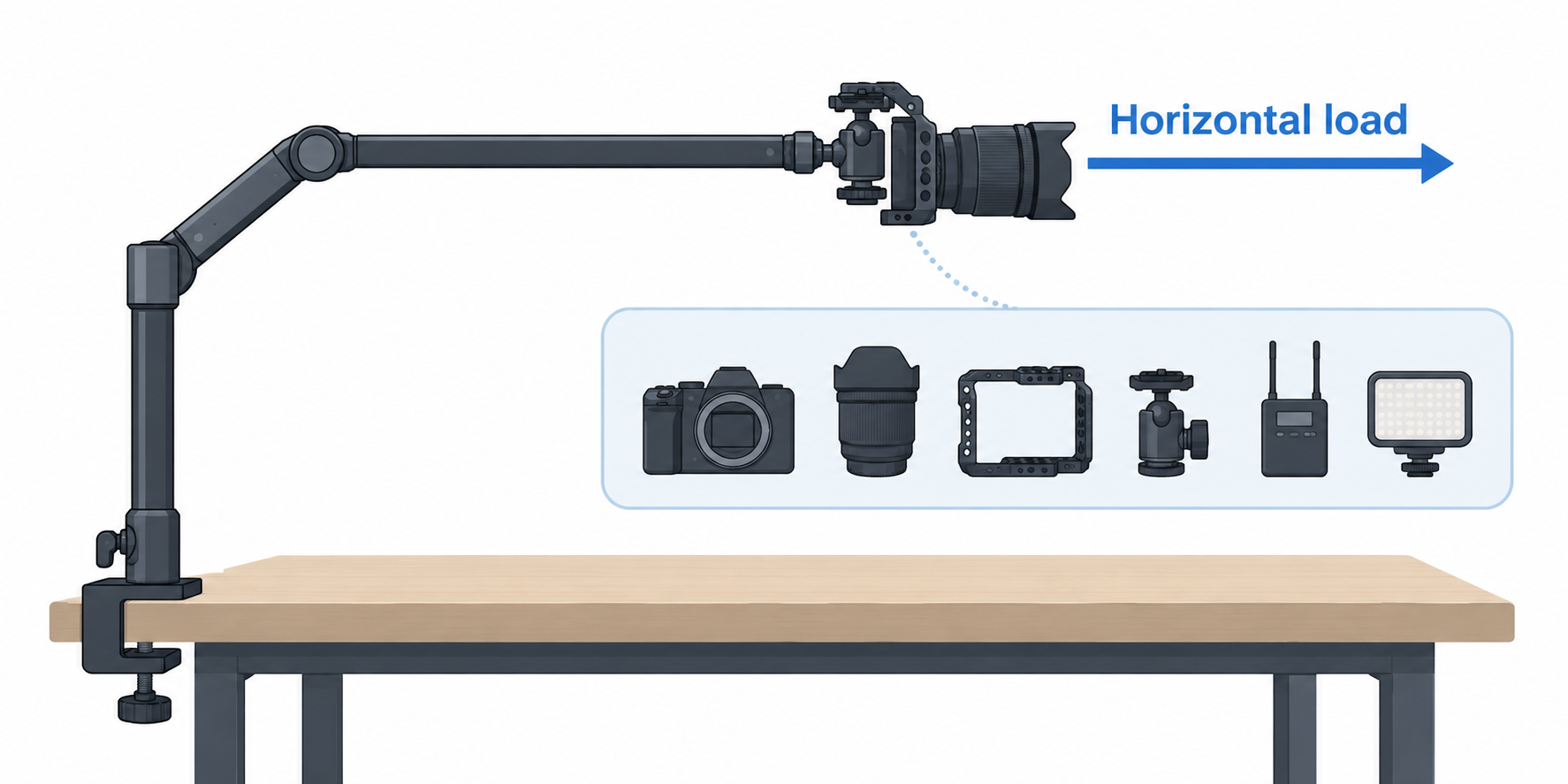
A camera over the center of a workbench creates a different load than one held upright. DNSbabi lists 16 pounds horizontally and 22 pounds maximum, while TARION TKA01-L lists 6.6 pounds horizontally and 8.8 pounds vertically. Those pairs show why the extended orientation is the relevant number for a top-down camera.
Do not size an arm from the camera body alone. Add the lens, cage, microphone receiver, ball head, and any light that share the arm. TARION Titanrig Lite Z lists 17.6 pounds as its total load capacity, while DImotliyor lists 4.5 pounds horizontally. Choose the lower applicable stated figure once the arrangement extends outward.
2. Match the reach to the work surface
Reach controls whether the lens can frame the center of the desk without an awkward clamp location. JEBUTU lists 14.76 to 41.14 inches of height, TARION TKA01-L lists 38 inches, and DNSbabi lists 35.4 inches extended. Measure the desk depth and the camera’s desired distance before choosing a tall pole or a long articulated arm.
A shorter arm can be more useful for a small task area. TARION Titanrig Lite Z lists an 18.9-inch articulated arm and a double C-clamp. A compact product-shooting desk may need its stability and attachment layout more than a 40-inch reach. Pair it with a tabletop tripod only when the camera placement requires a separate low angle.
3. Check thread and accessory compatibility
Thread size decides whether the planned attachment can fit directly. DImotliyor and DNSbabi list 1/4-inch, 3/8-inch, and 5/8-inch screws; TARION Titanrig Lite Z and TKA01-L list 1/4-inch and 3/8-inch connections. JEBUTU lists a 1/4-inch screw. Match the camera cage, microphone adapter, light, or ball head to the stated connection.
A listed phone holder is not a substitute for a camera attachment. TARION Titanrig Lite Z, DImotliyor, and DNSbabi include tablet or phone accessories, but a mirrorless camera should use its appropriate thread or plate. A camera cage and quick-release plate can change the attachment path and the effective load.
4. Measure the clampable desk edge
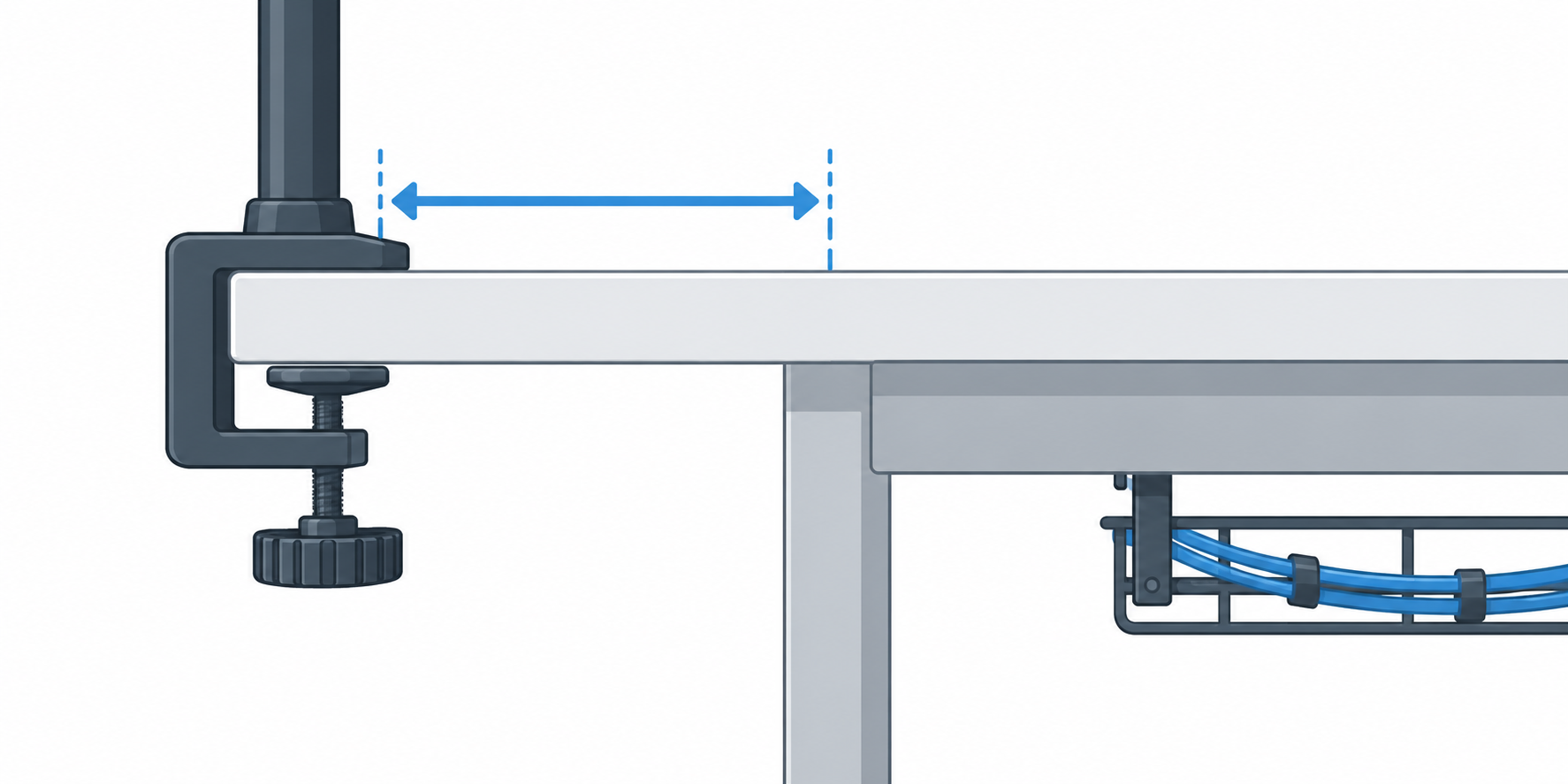
Clamp thickness is a hard fit limit. TARION Titanrig Lite Z lists 0.6 to 2.95 inches, while DImotliyor and DNSbabi list openings up to 2.4 inches. JEBUTU lists a 1.96-inch opening. Measure the actual clear edge, including any apron or cable tray, instead of measuring the desk top alone.
The clamp also needs clear space around it. TARION TKA01-L lists a dual-groove clamp opening to 2.36 inches, and JEBUTU lists a removable C-clamp with rubber padding. A desk cable tray or monitor arm may already occupy the edge where a rigging arm needs to attach.
5. Plan camera, microphone, and cable positions together
Every arm here is stated to support a microphone, but the attachment path differs. TARION TKA01-L lists extra 1/4-inch and 3/8-inch threads for microphones, while JEBUTU describes microphone use through its arm arrangement. Decide whether the microphone is on the same arm, a separate thread, or a microphone boom arm before choosing a product.
Cable pull can spoil an otherwise valid load calculation. Route a camera’s HDMI, USB, or power lead with enough slack for the listed 180-degree or 360-degree motion. A camera cable clamp can organize a cable path, but it should not become another unsupported load hanging from the overhead arm.
FAQ
Which arm lists the highest horizontal camera load?
DNSbabi lists the highest horizontal figure at 16 pounds. Its same listing gives a 22-pound maximum, three sections, 35.4-inch extended length, and gear-locked joints. Use the 16-pound number for an arrangement that projects out over the desk.
TARION Titanrig Lite Z lists a 17.6-pound total capacity, but it does not use the same horizontal-versus-maximum wording. Compare only the condition each listing actually states. The camera, lens, cage, light, ball head, and cables all belong in the final load plan.
Which arm has the greatest listed reach?
JEBUTU lists the largest range, up to 41.14 inches. Its three detachable sections can adjust from 14.76 to 41.14 inches and each section has 180-degree movement. It fits a buyer who needs a high overhead starting point for a lighter camera, mic, or light.
TARION TKA01-L lists 38 inches and DNSbabi lists 35.4 inches extended. A longer reach does not automatically mean a higher horizontal rating, so compare JEBUTU’s nearly 6.6-pound figure with the actual camera setup before prioritizing distance.
Can these arms hold a microphone as well as a camera?
All five arms are stated to support microphone use. TARION Titanrig Lite Z lists microphone compatibility, JEBUTU names microphone support, DImotliyor and DNSbabi list microphones among supported devices, and TARION TKA01-L lists dedicated extra threads for microphones.
The microphone still needs a compatible attachment. Verify whether it uses 1/4-inch, 3/8-inch, or 5/8-inch hardware, then factor its mount and cable into the arm’s stated load. A separate shock mount may create a different mounting requirement.
What desk thickness can these clamps fit?
TARION Titanrig Lite Z lists the largest stated clamp range, up to 2.95 inches. DImotliyor and DNSbabi list up to 2.4 inches, TARION TKA01-L lists 2.36 inches, and JEBUTU lists 1.96 inches. Those figures describe the clear material thickness the clamp can take.
Measure beneath the desktop, too. A reinforced lip, drawers, a cable basket, or another clamp can remove the usable edge. The clamp needs a flat, strong portion of the desk so its stated capacity applies to the installation rather than a compromised surface.
Do gear joints matter for overhead recording?
Gear joints are a stated angle-locking feature on TARION TKA01-L and DNSbabi. TARION calls out three locking gear joints with 180-degree tilt and 360-degree rotation. DNSbabi says its joints lock by gear for its three-section arm.
The feature is useful when the camera must return to the same top-down position, but it does not raise the listed capacity. Choose the arm by horizontal load and reach first, then use a geared-lock design when repeatable angle adjustment matches the recording workflow.
Can I use one arm for a camera and a light?
Only use the attachments and load the listing actually supports. TARION Titanrig Lite Z names top threads for fill lights, ring lights, cameras, and other equipment, while DImotliyor names video lights and cameras. The product details do not establish a safe combined load for a camera and a light in every orientation.
A small LED video light may be better on a separate mount when it would turn the camera arm into a long, unbalanced assembly. Keep the selected arm inside its stated horizontal figure and route every cable so it cannot tug during angle changes.
Bottom Line
Pick TARION Titanrig Lite Z for its double clamp and 17.6-pound listed capacity, JEBUTU for the 41.14-inch reach, DImotliyor for its three thread sizes, TARION TKA01-L for its three locking gear joints, and DNSbabi for its 16-pound stated horizontal capacity. The correct arm is the one whose stated clamp, connection, reach, and orientation-specific load match the exact camera or microphone position.