A softbox that looks right in a product photo can still be the wrong purchase for your COB light. The attachment must match the fixture’s native modifier mount, clear its yoke and controls, stay within the maker’s support guidance, and leave the light properly ventilated. Check those conditions before choosing a diameter or comparing light output.
“Bowens compatible” answers only the first mechanical question, and it does not prove every large modifier is safe or practical on every light.Name the mount on both sides
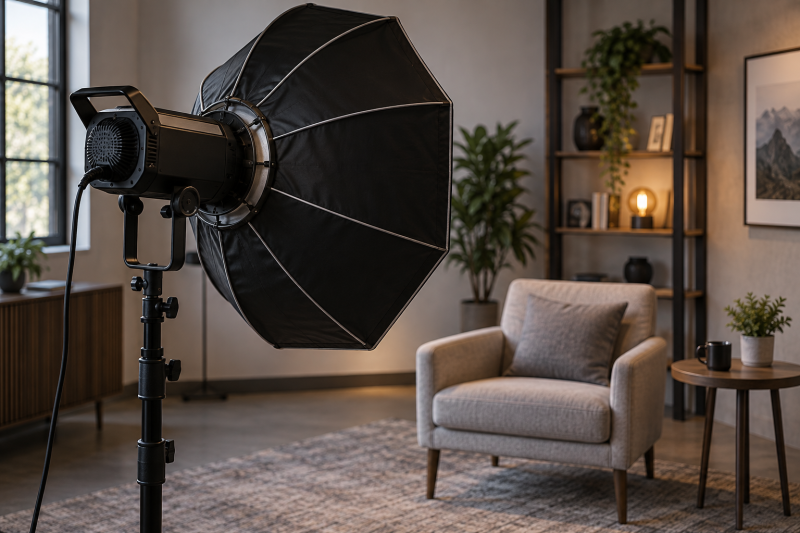
Start with the exact fixture model, not merely the brand. Read the manufacturer’s specification for the front mount and look at the softbox’s speed ring or mounting plate. The front mount and the ring or plate are the mating parts. A softbox sold with interchangeable rings needs the right ring installed. A softbox with a fixed ring needs a matching fixture mount or a manufacturer-supported adapter.
For example, amaran’s 100x S and 200x S product details identify a Bowens mount on both named lights. Godox’s SL60II Bi product page also identifies a Bowens mount. That common label is useful for a preliminary shortlist, but it does not say anything about the weight of a particular softbox, yoke clearance or whether an accessory is designed for the heat of a continuous light.
The ML60II Bi is an exception. Godox’s ML60II Bi page describes its native Godox-mount accessories and says a Bowens adapter opens access to Bowens accessories. Do not treat “Godox mount” as another spelling of “Bowens mount.” An adapter adds depth and more turning force on the mount, so verify the exact adapter, fixture and modifier combination rather than buying a generic ring by diameter.
Some similarly named softboxes use different mounts altogether. Aputure’s LS 60 Softbox FAQ says that model uses the LS 60 Mini Mount and is not directly compatible with Bowens fixtures. Matching the brand name or the word “softbox” is therefore not enough. Read the accessory’s exact model and mount listing.
Check the load and the yoke’s motion
A mount that clicks in place is only a mechanical connection. The softbox’s mass extends forward of the light, and a large modifier can put more turning force on the yoke than you would expect from its weight alone. Check the fixture and adapter manuals for supported modifiers or load guidance. If no limit is published for the combination you want, ask the maker rather than assuming that a working latch proves long-term support.
Put the proposed setup on paper: fixture, adapter if any, softbox, grid, stand and any boom arm. The stand and head must support the assembled load at the angle you plan to use, not merely the bare light. Putting a softbox on a boom also changes the balance, and you may need counterweight according to the stand maker’s instructions. Route cables so they don’t pull on the fixture or create a trip path.
Yoke clearance is an easy detail to miss. The rear of a deep softbox or an adapter can run into a yoke knob, handle, power connector or control panel as you tilt the lamp. Verify the fixture’s physical dimensions and the modifier’s depth, then check that it can reach the required interview angle without forcing the mount. A light that can aim only straight ahead with your chosen modifier may be the wrong combination even when the ring fits.
Keep the light and modifier within their intended use
COB fixtures use fans, vents and thermal controls. Keep the fixture’s ventilation openings clear and follow its manual for operating temperature and permitted modifiers. The softbox should attach at the designed front mount. Do not wrap diffusion around the lamp body or power supply to make an incompatible modifier stay in place.
Check whether the softbox maker describes continuous LED use and whether its inner and outer diffusion can be installed for your intended light. A fixture that accepts the ring does not prove that an improvised fabric setup is safe near the emitter. If the manufacturer specifies a protective cover, reflector removal sequence or mounting order, follow that sequence rather than forcing the softbox over an attached accessory.
Assembly is part of the decision in a small room. A quick-release softbox can save setup time, but it may be deeper or heavier than a simple folding model. A larger front surface can soften light at a given placement, yet it also needs more space beside the subject and more clearance from walls. Measure the available room and how far the light can sit from the interview chair before choosing the biggest diameter on a marketplace page.
Match the modifier to your interview setup
Decide where the light will stand and where the softbox front will face. For a shallow room, an oversized deep dome may crowd the camera or appear in a wide shot. For a desk interview, the lamp and stand must stay outside the frame, and the face must still be lit from the intended direction. Test those distances with a tape measure, not just a product photo.
Then decide whether you need a grid, skirt or removable diffusion. Those accessories alter spill and setup complexity, and they may not be included in the base softbox. Compare the exact package contents and how you would get a replacement accessory. A Bowens ring that fits the light does not guarantee a grid made for another diameter will fit the modifier.
Use our bi-color COB light guide for interview softboxes to shortlist lights by role. This page is about the connection you must validate after selecting a fixture and before buying a specific softbox. Use the manufacturer’s documents for the final pairing of your exact models.
A five-point pre-purchase check
Write down the fixture’s exact model and native mount. Record the softbox model and speed ring. If an adapter is required, record its exact model and the maker’s supported combination. Then check the assembled load and stand capacity, the yoke’s full intended tilt range, and the fixture’s ventilation and modifier instructions. If an answer is missing, pause that combination instead of guessing.
When the parts arrive, assemble them with the light powered off and cool, seat and lock the ring according to the manual, and tilt the fixture through the angles you plan to use. Confirm that no fabric touches vents, no knob is blocked, and the stand stays stable before powering on. Make those checks with your exact gear before a shoot.
Frequently asked questions
Does Bowens mount mean any Bowens softbox will work?
A Bowens mount is a likely attachment interface, and not a universal load or clearance guarantee. Check the softbox’s ring, fixture yoke, adapter if any, and the manufacturers’ supported modifier guidance. A very large or deep softbox can be impractical on a small head even if the ring locks.
Also check the softbox’s intended light type and ventilation requirements. Mechanical fit is only one part of safe use.
Can I put a Bowens softbox on a Godox-mount fixture?
Some fixtures accept a Bowens softbox through a specific adapter. Godox says its ML60II Bi can use a Bowens adapter, but you need to check the exact adapter and modifier combination. Do not assume a native Godox mount accepts a Bowens ring directly.
The adapter may move the softbox farther forward. Recheck yoke clearance and stand balance with the adapter included.
Is a larger softbox always better for a small interview room?
No. The light’s apparent size relative to the subject and its placement shape the result, but the room must also fit the modifier, stand and camera framing. A larger box that cannot be placed or aimed where you need it is not an upgrade.
Measure the space available beside and above the subject. Choose a diameter and depth you can mount, aim and store without forcing the fixture.
Bottom line
Buy the exact mount and mechanically sensible modifier, not just a softbox with a familiar label. Verify the fixture, adapter, speed ring, yoke, stand and ventilation as one setup before comparing sizes.