The Short Version
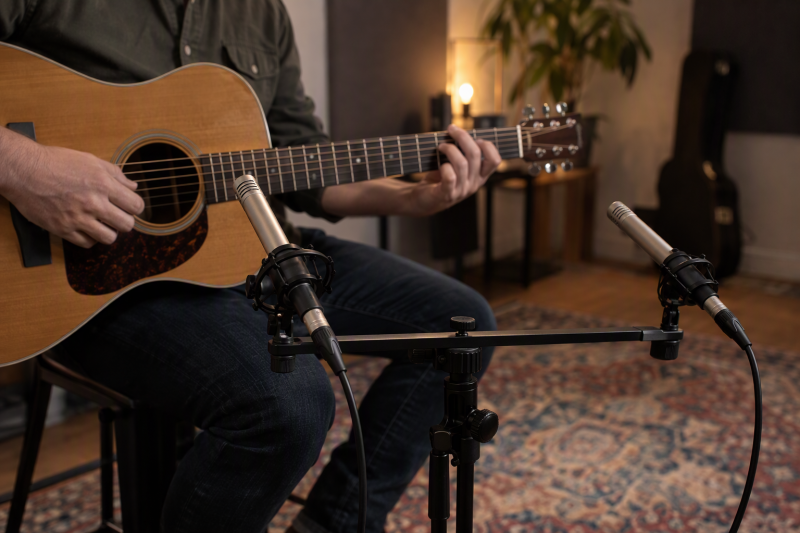
A matched stereo microphone pair gives an acoustic-recording setup two related condenser microphones for a deliberate stereo technique. The practical decisions are the pair claim, polar pattern, pad and filter controls, capsule orientation, supplied accessories, and the instruments or placement constraints the listing names.
Choose the sE Electronics sE7 Matched Pair for a cardioid pair with a selectable 20 dB pad. Choose the sE7 sideFire Pair when a 90-degree side-address capsule helps in tight overhead or close-miking positions. The RØDE NT5 Matched Pair is the simple classic cardioid choice with 1/2-inch gold-sputtered capsules.
Every product here is a matched pair or pair of small-diaphragm condensers that its listing supports. A pair alone does not select the recording technique. The room, source, stands, interface preamps, and placement still decide how the two microphone channels work together.
Quick Picks
- Best pad-equipped pair: sE Electronics sE7 Matched Pair for cardioid capsules and selectable 20 dB attenuation.
- Best tight-position design: sE7 sideFire Pair for 90-degree capsules, low-cut, and a listed 156 dB maximum SPL.
- Best simple cardioid pair: RØDE NT5 Matched Pair for its matched 1/2-inch cardioid capsules.
- Best Apollo workflow: Universal Audio SP-1 Pair for supplied UA Apollo SP-1 presets.
How We Picked
We chose products whose listings explicitly identify a pair or matched pair of condenser microphones. We compare them on listing-supported facts such as capsule style, cardioid pattern, pad, low-cut, maximum SPL, pair matching, and named source uses. We make no claim about a stereo image or tone that a listing does not establish.
Single vocal mics and a shotgun microphone are not covered here. A pair also needs two appropriate preamp channels, two XLR runs, and stable stands. A small audio interface may determine whether the recording rig has the required inputs.
Stereo Microphone Pairs Compared
| Image | Product | Details | Check Price |
|---|---|---|---|
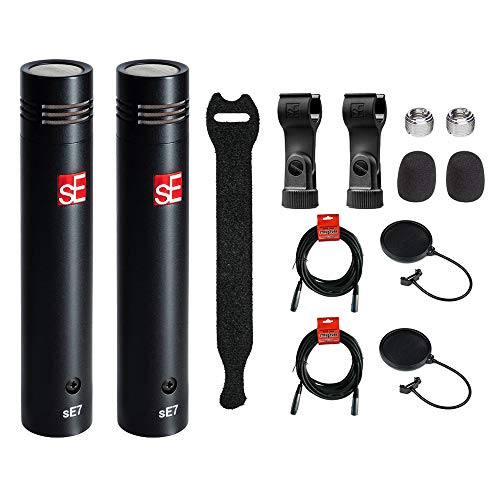 | sE Electronics sE7 Matched Pair | Best fit: Overheads and piano with pad Pair: Matched stereo pair Pattern: Cardioid Pad: Selectable 20 dB Circuit: Transformerless | Check Price on Amazon |
 | RØDE NT5 Matched Pair | Best fit: Classic cardioid acoustic pair Pair: Matched pair Capsule: 1/2-inch gold-sputtered Pattern: Cardioid Noise: Very low self-noise listed | Check Price on Amazon |
 | sE7 sideFire Pair | Best fit: Tight-placement stereo setups Pair: Pair Capsule: 90-degree side-address Pad: Switchable Max SPL: 156 dB listed Filter: Low-cut | Check Price on Amazon |
 | LEWITT LCT 040 MATCH | Best fit: Acoustic guitar and drum transients Pair: MATCH pair Capsule: Small-diaphragm condenser Strength: Transient response Sources: Drums and acoustic guitar | Check Price on Amazon |
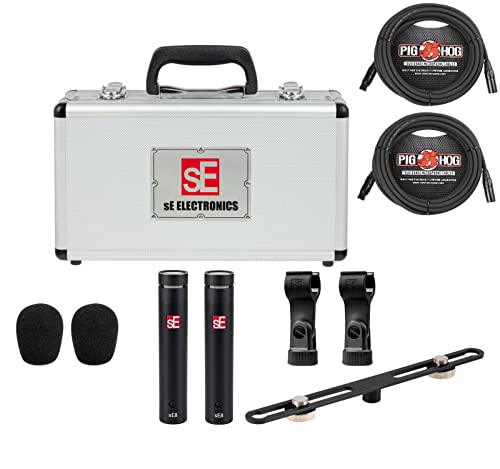 | sE Electronics sE8 Factory Matched Pair | Best fit: Pads and filters for detailed stereo work Pair: Factory matched pair Pads: Switchable Filters: Low-cut Connection: Gold-plated XLR | Check Price on Amazon |
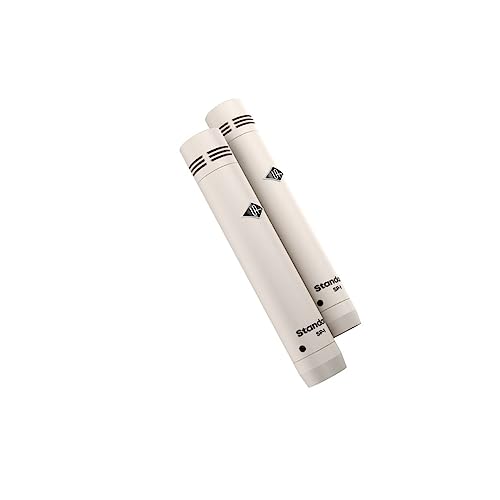 | Universal Audio SP-1 Pair | Best fit: UA Apollo preset users Pair: Matched condenser pair Sources: Strings and drums Included: Apollo SP-1 presets Format: Pencil microphones | Check Price on Amazon |
1. sE Electronics sE7 Matched Pair — Best for Overheads and Piano with a Pad
The sE7 listing identifies a matched stereo pair for overheads, pianos, and more, with a cardioid pattern, transformerless circuitry, and a selectable 20 dB pad. The bundle also includes two 20-foot XLR cables and two pop filters, so a buyer gets accessories as well as the two microphones.
Choose it when you want the listed pad and bundle contents as much as the cardioid pair. The extra accessories do not replace proper stands or interface channels, but they can reduce what a new stereo setup must add immediately.
Pros
- A matched stereo pair and cardioid pattern directly fit common two-microphone acoustic recording techniques.
- The selectable 20 dB pad is a listed control for louder source placement.
- The bundle names two 20-foot XLR cables and pop filters for a starting stereo rig.
Cons
- The bundle accessories add value only if their cable lengths and pop filters suit the intended setup.
- Its cardioid listing leaves stand spacing and stereo technique to the buyer.
2. RØDE NT5 Matched Pair — Best for Classic Cardioid Acoustic Recording
RØDE lists the NT5 as a matched pair of premium small-diaphragm condensers with 1/2-inch gold-sputtered cardioid capsules, very low self-noise, accurate cardioid response, and wide frequency response. It is the straightforward choice for a buyer who wants a traditional matched cardioid pair without a placement-specific side-address design.
Its value is simplicity and a clearly stated capsule format. Select it when the acoustic session needs a conventional pair and the interface, stands, and cables are already chosen separately.
Pros
- The matched 1/2-inch gold-sputtered cardioid capsules are a specific stereo-pair construction detail.
- The listing’s very low self-noise claim suits buyers prioritizing a quiet recording chain.
- Accurate cardioid response and wide frequency response are stated for general acoustic use.
Cons
- The listing does not name switchable pad or low-cut controls like the sE models.
- It uses a conventional cardioid format instead of a specialized tight-placement capsule orientation.
3. sE7 sideFire Pair — Best for Tight Stereo Mic Placement
The sE7 sideFire pair uses 90-degree side-address capsules, which the listing positions for tight spaces, unobtrusive close-miking, and creative overhead or underhead setups. It also lists a switchable pad, low-cut filter, 156 dB maximum SPL, and 140 dB dynamic range.
The sideFire is the pair to compare when physical placement is the main limitation. The rotated capsule is a listed distinction, but it does not remove the need to set two stands and confirm that the stereo geometry suits the instrument.
Pros
- The 90-degree capsule orientation directly targets tight and unobtrusive microphone placement.
- A switchable pad and low-cut filter provide two listed controls for source and room setup.
- The listed 156 dB maximum SPL is a specific high-level handling figure for loud sources.
Cons
- Side-address placement is more specialized than a conventional pencil pair for simple sessions.
- Buyers still need to establish two-microphone spacing and angle independently of the capsule design.
4. LEWITT LCT 040 MATCH — Best for Acoustic Guitar and Drum Transients
LEWITT lists the LCT 040 MATCH as a small-diaphragm condenser pair aimed at drum and acoustic-guitar recording, with an emphasis on transient response. It is the direct option for a buyer whose sessions center on those sources and who wants a pair with that named recording role.
The listing gives less control detail than the pad-and-filter sE options. Less detail can be welcome for a simple setup, but a buyer should confirm the rest of the signal chain and placement needs before treating fewer switches as an advantage.
Pros
- The listing explicitly names drums and acoustic guitar, two central stereo-pair recording sources.
- The stated transient response is a concrete reason to compare it for picked strings or percussion.
- The MATCH pair format places both microphones in the stereo-pair category the title defines.
Cons
- The listing does not identify switchable pad or low-cut controls like the sE7 sideFire.
- It states fewer placement or maximum-SPL figures for buyers comparing detailed controls.
5. sE Electronics sE8 Factory Matched Pair — Best for Pads and Filters
The sE8 listing identifies a factory matched pair with switchable pre-attenuation pads and low-cut filters. It also names an all-metal chassis and gold-plated XLR connector. It is a controls-focused pair for a buyer who wants those source and room adjustments stated by the listing.
Choose it when the pair itself needs selectable controls; the listing specifies that this bundle includes two Pig Hog XLR cables. The product still requires a stereo recording plan. Pads and filters are options to evaluate against the source, not automatic settings.
Pros
- A factory matched pair directly supports the stereo-pair requirement without a separate matching claim.
- Switchable pads and low-cut filters are two stated signal-control options for buyers.
- Metal chassis and gold-plated XLR are concrete listed construction and connection details.
Cons
- The listing does not state the 90-degree orientation found on the sideFire pair.
- The listed two Pig Hog XLR cables add a bundled component that buyers who already own cables may not need.
6. Universal Audio SP-1 Pair — Best for UA Apollo Preset Users
Universal Audio lists the SP-1 as a matched condenser pencil-microphone pair for stringed instruments, drums, and stereo recording. Its distinctive listing inclusion is UA Apollo SP-1 presets, so it is the workflow-specific choice for a buyer who already uses compatible Apollo software and hardware.
The presets are not a substitute for source placement or two input channels. Choose this pair when the buyer can use the named Apollo element and wants the listing’s smooth-top-end positioning for a general strings-and-drums pair.
Pros
- A matched condenser pair directly covers stereo recording for strings, drums, and related acoustic sources.
- Included UA Apollo SP-1 presets give Apollo users a specific listed workflow feature.
- Pencil-microphone format fits buyers seeking a compact small-diaphragm pair for stands or booms.
Cons
- Apollo presets have limited value for buyers without the compatible UA workflow.
- The listing does not state pad or low-cut controls available on the sE pairs.
Buying Guide: Choosing a Stereo Pair for Acoustic Recording
Confirm that the listing actually identifies a pair
The starting point is a true pair claim. RØDE calls the NT5 a matched pair, sE7 and sE8 use matched-pair language, LEWITT uses MATCH, and Universal Audio calls SP-1 a matched condenser pair. Checking for the claim prevents substituting a single condenser that happens to resemble the other microphone.
Pair matching does not remove placement decisions, but it tells you the two microphones belong together in the product’s stereo use case. Confirm the package contains the needed pair, then plan the interface inputs, XLR cables, stands, and placement for the actual session.
Start with capsule pattern and placement constraints
RØDE NT5 and sE7 list cardioid patterns, while sE7 sideFire uses a 90-degree side-address capsule. That physical orientation can make a major difference around drums, close guitar positions, or a piano where a standard end-address pencil shape conflicts with stands or nearby hardware.
Placement clearance comes before a theoretical stereo technique. A side-address capsule helps only when the setup has a tight-space problem. A conventional cardioid pair can be the clearer choice when the room and stands allow straightforward positioning.
Use pads and filters as source-specific controls
sE7 lists a selectable 20 dB pad. sE7 sideFire adds a pad and low-cut filter, and sE8 lists switchable pads and low-cut filters. The controls are useful for a buyer comparing loud drums, close sources, and a room with unwanted low-frequency content.
Do not treat a pad or low-cut filter as mandatory simply because it is included. The buyer should select a pair whose controls suit the sources and preamps already in use, then decide settings during the recording setup.
Check the interface and accessories before choosing the pair
The sE7 bundle lists two 20-foot XLR cables and two pop filters. Other pairs may need cables sourced separately. Every stereo pair needs two microphone inputs, so the interface or preamp rack must have enough compatible channels before a two-mic technique can begin.
The two-input requirement can rule out a pair that otherwise looks ideal. Count usable microphone inputs, check phantom-power capability where needed, and make sure both stands can reach the planned positions without stretching XLR cables through a walkway.
Match workflow extras to gear you already own
Universal Audio includes Apollo SP-1 presets with the SP-1 pair. The presets are a meaningful extra for an Apollo user, while an owner of another interface should value the microphones’ matched-pair and named-source claims more than software they cannot use.
Treat workflow extras as secondary to the pair and placement fit. A preset cannot create the two-channel routing, stand placement, or room setup the microphones need, but it can be a convenience once the compatible recording environment already exists.
Frequently Asked Questions
What is a matched stereo microphone pair?
It is a product sold as two related microphones for stereo use. The listings here use terms such as matched pair, factory matched pair, MATCH, or matched condenser pair. Buying a pair is different from buying two unrelated single microphones with similar names.
The pair claim is a purchase filter, not a full recording plan. A buyer still needs two input channels, two cables, two stands, and a placement method that works for the acoustic instrument or drum kit.
Do stereo pairs need two interface inputs?
Yes, a two-microphone stereo arrangement needs two microphone channels to record each microphone separately. The sE7 bundle includes two XLR cables, but cables do not provide the interface inputs or microphone preamps needed to capture both signals.
Check the available input count before purchasing. A compact interface may have only one usable microphone input, while a two-channel interface can accommodate a pair only if both channels are free for the session.
When is a 20 dB pad useful?
A pad is a source-level control that can be relevant when the microphone is placed close to a louder acoustic source. The sE7 listing includes a selectable 20 dB pad, while sideFire and sE8 list attenuation controls.
Use the listed pad as a comparison feature, not a promised fix for every gain problem. The source volume, distance, microphone preamp, and recording level all still determine whether attenuation is appropriate.
Why choose a side-address capsule pair?
sE7 sideFire rotates its capsule 90 degrees and names tight-space, overhead, and underhead placement as intended uses. The rotated capsule can simplify physical positioning around a drum kit, guitar, or other source where the body of a conventional pencil microphone points the wrong way.
The capsule orientation is a fit feature. It does not decide the stereo angle or spacing, and it is not automatically preferable in an open room where conventional cardioid pencils can be placed freely.
Are presets useful with a microphone pair?
They can be useful when the recording system supports them. Universal Audio includes UA Apollo SP-1 presets with the SP-1 pair, which is a stated workflow extra for a compatible Apollo setup.
The key condition is compatible gear. A buyer without Apollo hardware should prioritize the pair’s source fit, pattern, controls, and placement needs rather than treating the included presets as a universal advantage.
Bottom Line
Choose the sE Electronics sE7 Matched Pair for a cardioid pair, selectable 20 dB pad, and bundle accessories. Choose the sE7 sideFire Pair for its 90-degree capsule and filters. Choose the Universal Audio SP-1 Pair when Apollo presets fit the existing recording workflow.