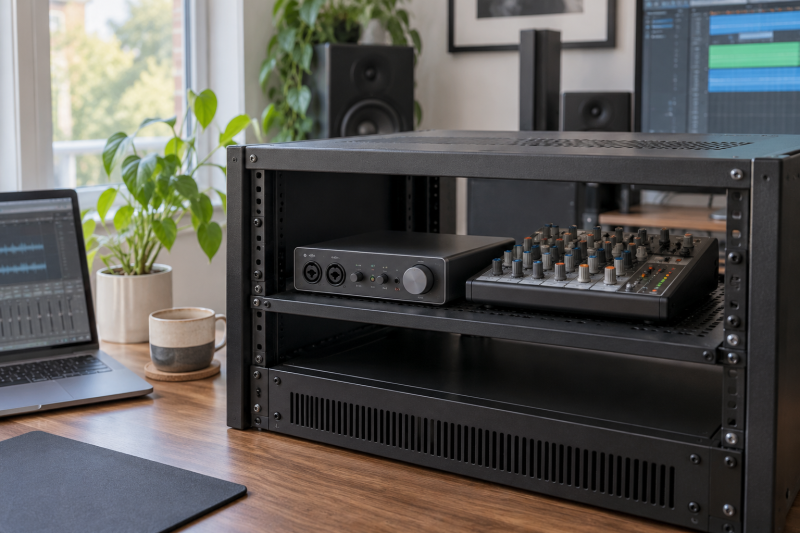
A rack shelf gives a non-rackmount audio interface, headphone amplifier, compact mixer, wireless receiver, network box, or effects unit a supported place inside a standard 19-inch rack. It avoids custom rack ears, but it does not make the device itself 1U. The shelf consumes its stated mounting height, and the gear above it needs additional vertical clearance.
The eight choices here include fixed cantilever shelves from about 10 to 18 inches deep, shelf two-packs, and one four-post sliding model. Manufacturer capacity claims range from 40 to 110 pounds where stated, but depth, mounting style, rack fit, airflow, cable clearance, and device retention decide the fit just as much. Measure the equipment and the rack from the front rails before ordering.
The AC Infinity 1U Shelf is the best overall compact choice because the manufacturer specifies 2.4 mm steel, a 60-pound rating, ventilation, and included hardware at a 10.5-inch depth. The StarTech 2U is better for deeper equipment, while the Otoolling sliding shelf serves four-post racks that need pull-out access.- Best compact shelf: AC Infinity 1U Shelf is rated to provide a 10.5-inch platform and 60-pound capacity using thick vented steel.
- Best deeper single shelf: StarTech 2U 16-Inch Shelf is rated to support 50 pounds on a deeper front-mounted platform.
- Best sliding four-post option: Otoolling 1U Sliding Shelf uses ball-bearing glides and explicitly excludes two-post racks.
Rack Shelf Comparison
| Image | Product | Details | Check Price |
|---|---|---|---|
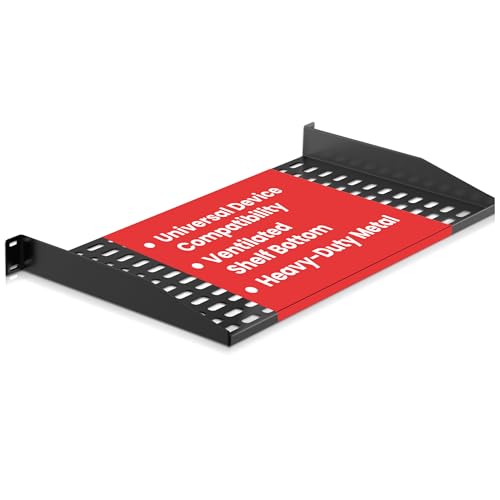 | Pyle PLRSTN14U 1U Vented Rack Shelf | Rack Height: 1U Dimensions: Amazon lists 10.25 × 2.0 × 19.5 in; platform depth is unlabeled Mounting: 19-inch cantilever Max Load: 110 lb Ventilation: Vented platform | Check Price on Amazon |
 | VEVOR 1U 10-Inch Rack Shelf Two-Pack | Rack Height: 1U per shelf Shelf Depth: 10 in Quantity: 2 shelves Max Load: 50 lb stated; per-shelf allocation unclear Material: 1.5 mm Q235 carbon steel | Check Price on Amazon |
 | Otoolling 1U Sliding Rack Shelf | Rack Height: 1U Shelf Depth: 15 in platform Mounting: 19-inch 4-post only Rail Depth: Title: 21.7-35.4 in; details: 15-29 in Max Load: Not stated | Check Price on Amazon |
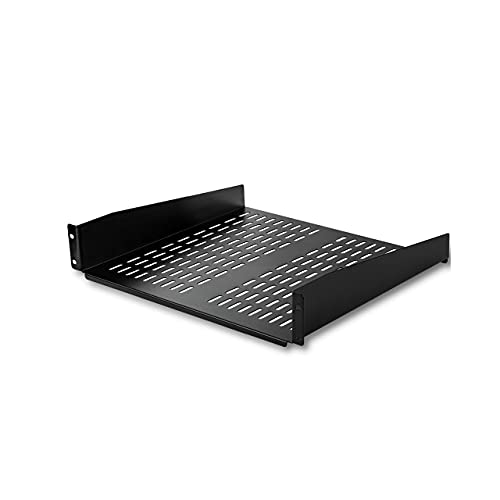 | StarTech CABSHELFV 2U 16-Inch Rack Shelf | Rack Height: 2U Shelf Depth: 16 in Mounting: 19-inch front cantilever Max Load: 50 lb / 23 kg Material: SPCC cold-rolled steel | Check Price on Amazon |
 | RIVECO RP3002 1U 12-Inch Shelf Two-Pack | Rack Height: 1U per shelf Shelf Depth: 12 in Quantity: 2 shelves Max Load: Not stated Retention: Reversible lip and cable-tie holes | Check Price on Amazon |
 | QiaoYoubang 1U 10-Inch Rack Shelf | Rack Height: 1U Shelf Depth: 10 in; 9.88 in usable Usable Width: 17.2 in Max Load: 40 lb Mounting Hardware: M6 screws and cage nuts included | Check Price on Amazon |
 | RIVECO RPMAIND 2U 18-Inch Shelf Two-Pack | Rack Height: 2U per shelf Shelf Depth: 18 in Quantity: 2 shelves Max Load: Not stated Material: 2.0 mm SPCC cold-rolled steel | Check Price on Amazon |
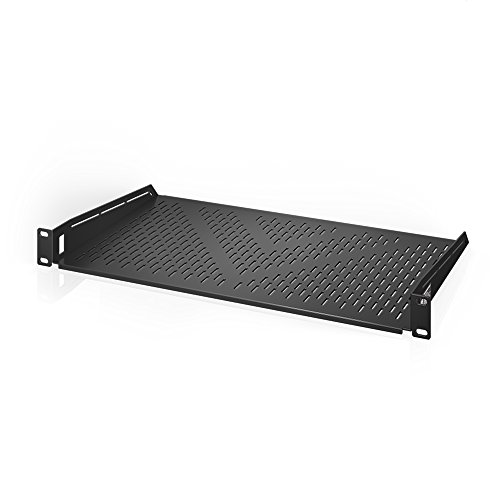 | AC Infinity AI-RTA3 1U Vented Rack Shelf | Rack Height: 1U Shelf Depth: 10.5 in in details; title says 10 in Mounting: Standard 19-inch rack Max Load: 60 lb Material: 2.4 mm SPCC cold-rolled steel | Check Price on Amazon |
1. Pyle PLRSTN14U — Best High-Capacity 1U Claim
The Pyle PLRSTN14U is the shelf to look at when load rating is the first question. It is a front-mounted 1U cantilever shelf for standard 19-inch racks. Its vented platform lets air pass beneath non-rack audio and computer equipment instead of trapping heat against a solid plate. The listing positions it for wall racks, cabinets, and conventional rack mounts in home or professional spaces.
A stated 110-pound capacity is the highest claim in this comparison. The supplied record does not establish steel thickness, mounting-hole type, included hardware, or whether that rating assumes a particular rack and installation. Those missing details make the large load figure difficult to apply to a specific audio device.
The Pyle suits a buyer who wants a large capacity margin, but device depth must be confirmed before purchase. A cantilever transfers weight through the front ears, so rack strength and fastener fit remain essential. It is best for a buyer who can obtain the current dimensional drawing and verify that the studio gear sits fully on the tray without blocking its own ventilation.
[accentbox color=”blue”]Best for a high-load 1U shelf requirement when current depth, hardware, and rack compatibility can be confirmed separately.[/accentbox]- Highest stated capacity in the group
- Vented 1U cantilever design
- Standard 19-inch compatibility listed
- Amazon lists 10.25 by 2.0 by 19.5 inches without identifying the platform depth
- The high load figure is hard to apply without those details
2. VEVOR 1U 10-Inch Two-Pack — Best Basic Shelf Pair
The VEVOR package contains two 1U shelves, each with a 10-inch depth for standard 19-inch four-post racks. A pair can separate an interface and network device, support two compact studio zones, or keep a spare available. The record frames these as cantilever trays even though it specifies four-post rack compatibility, so buyers should confirm the actual front-only mounting arrangement in the manufacturer’s installation guide.
VEVOR specifies 1.5 mm Q235 carbon steel and a perforated bottom for each shelf. The listed capacity is 50 pounds, but the wording does not explicitly clarify whether that number applies to each shelf or the pair. Treat it conservatively until confirmed. Screws and nuts are included, with a Phillips screwdriver required for assembly.
Ten inches works for many compact interfaces and small processors, but connectors may need additional space beyond the chassis. The VEVOR is the best straightforward two-pack when both shelves have a defined use. Measure the rack interior and equipment feet, and do not assume the entire device base is supported merely because the chassis is nominally less than 10 inches deep.
[accentbox color=”blue”]Best for two compact non-rack devices that each fit a 10-inch vented shelf in a compatible 19-inch rack.[/accentbox]- Two 1U shelves included
- 10-inch depth and 1.5 mm steel
- Perforated platforms with hardware
- Per-shelf capacity wording is not explicit
- Four-post wording conflicts with cantilever description
3. Otoolling 1U Sliding Shelf — Best Four-Post Pull-Out Access
Pull-out access is the reason to look at the Otoolling, the only sliding four-post shelf in this group. The manufacturer specifies a 15-inch storage platform that rides on two ball-bearing glides, so you can pull a small mixer, control unit, or other device forward for access. Ventilation openings support airflow, and the shelf and rail assembly are steel with a powder-coated finish.
Rack compatibility is narrower than for a cantilever. The bullets specify standard 19-inch four-post racks and explicitly exclude two-post racks, wall-mount cabinets, and racks without rear rails. All required screws and lock nuts are listed. The rail-depth information conflicts. The title lists 21.7 to 35.4 inches, while the details state 15 to 29 inches. Neither range should be treated as confirmed without checking the current drawing.
No weight capacity, usable width, extension length, or closed depth is stated. The sliding hardware also needs clear space and proper alignment at front and rear posts. A sliding shelf is the right category when pull-out access has a clear purpose, but the rack’s rail spacing must be measured and reconciled with the conflicting range before purchase.
[accentbox color=”blue”]Best for a four-post studio rack that needs a pull-out platform and can verify the shelf’s conflicting rail-depth specifications.[/accentbox]- Ball-bearing sliding shelf
- Manufacturer-listed 15-inch storage platform
- Explicit four-post fit and exclusions
- Mounting-depth ranges conflict
- No load rating is stated
4. StarTech 2U 16-Inch Shelf — Best Deep Single Cantilever
When a device is too deep for a compact tray, the StarTech CABSHELFV offers a 16-inch-deep platform for non-rackmount equipment in a standard 19-inch cabinet or equipment rack. That extra depth suits larger audio interfaces, small mixers, AV processors, or accessories that would overhang a 10- or 12-inch tray. Its front-mounted cantilever design does not require rear rails according to the supplied description.
The shelf occupies 2U at the front and supports a stated 50 pounds. SPCC commercial cold-rolled steel forms the structure, while a perforated plate allows air circulation. StarTech lists TAA compliance and lifetime backing with 24/5 technical assistance. The record does not state steel thickness, usable width, outside dimensions, or included mounting hardware.
A deeper cantilever increases force on the front rails, especially when a heavy device sits near the rear edge. Stay within both rack and shelf limits and confirm the equipment is permitted on front-only support. The StarTech is the best single deep shelf when 16 inches is genuinely needed and 2U of face space is available.
[accentbox color=”blue”]Best for deeper non-rack studio equipment that needs a 16-inch platform and can spare 2U at the rack face.[/accentbox]- 16-inch platform depth
- 50-pound stated capacity
- Vented SPCC cold-rolled steel
- Consumes 2U before device clearance
- Mounting hardware is not explicitly listed
5. RIVECO RP3002 12-Inch Two-Pack — Best Reversible-Lip Pair
RIVECO states the RP3002 package supplies two 1U shelves measuring 19 inches wide, 12 inches deep, and 1.7 inches high. Twelve inches of depth offers more device support than the compact 10-inch trays without reaching the bulk of a 16- or 18-inch shelf. Vents and predrilled cable-tie holes help with airflow and retention.
Detachable ears can be installed with the shelf lips facing up or down. Lips up create an edge intended to reduce the chance of a small device sliding off. Lips down can give a deeper chassis a clearer exit beyond the tray edge. The four corner joints are reinforced by welding. Mounting screws and cage nuts are included for both shelves.
The source does not state steel thickness, per-shelf load capacity, usable internal width, lip height, or compatibility with two-post versus four-post racks. The lip cannot replace proper fastening for gear that may move. The RP3002 is the best pair for studios that value a 12-inch middle depth and two mounting orientations.
[accentbox color=”blue”]Best for two medium-depth studio devices that benefit from 12-inch trays and reversible front-lip orientation.[/accentbox]- Two 12-inch 1U shelves
- Reversible lip-up or lip-down ears
- Vents, cable-tie holes, and hardware included
- No weight capacity is stated
- A lip cannot replace proper fastening for gear that may move
6. QiaoYoubang 1U 10-Inch Shelf — Best Dimensioned Budget Shelf
Fit planning is easier when a shelf states its usable size, and the QiaoYoubang provides both outside and usable dimensions. Its standard face is 1U high, 19 inches wide, and 10 inches deep, while the working platform is 17.2 inches wide by 9.88 inches deep. Those measurements make it easier to verify that a compact interface’s feet and chassis will sit within the tray.
Cold-rolled steel with a powder-coated finish carries a stated 40 pounds. The platform is ventilated, and the package includes assembly screws plus M6 screws and cage nuts. Holding brackets must be attached to the shelf before rack installation. The record does not state steel thickness, rack-post requirement, or lip dimensions.
The QiaoYoubang has the lowest stated capacity among the fixed shelves that publish a number, but 40 pounds is still above the weight of many small interfaces and processors. Its main advantage is dimensional clarity. It is the best budget-oriented compact shelf when a 9.88-inch usable depth supports the entire device base and rear cables have separate clearance.
[accentbox color=”blue”]Best for a compact device when exact 17.2-by-9.88-inch usable space is a higher priority than the highest capacity claim.[/accentbox]- Usable width and depth are stated
- 40-pound capacity
- Vented steel with M6 hardware included
- Less depth than 12- to 18-inch choices
- Steel thickness is not stated
7. RIVECO RPMAIND 2U 18-Inch Two-Pack — Best Extra-Deep Shelf Pair
RIVECO specifies that the RPMAIND contains two 2U shelves with 18-inch depth, the deepest fixed platforms in this comparison. They suit deep non-rack mixers, AV gear, large interfaces, or other equipment that would extend far beyond a compact tray. Standard 19-inch compatibility is stated for server, IT, router, AV, and audio racks.
According to the manufacturer, each shelf uses 2.0 mm SPCC cold-rolled steel and a vented surface. The package includes M6 screws and cage nuts for both trays. The source states that supported devices should be less than 19 inches wide, but it does not provide the usable platform width, weight capacity, lip size, or whether rear support is required.
An 18-inch cantilever places substantial force on the front rack rails when loaded, so the absence of a capacity figure is a concern. Verify the rack, mounting method, and equipment center of gravity before using the full depth. The RPMAIND is the best deep two-pack for devices that genuinely need the space, and it is not an automatic choice for compact gear.
[accentbox color=”blue”]Best for two deep non-rack devices when 18-inch platforms are necessary and safe front-rail loading can be confirmed.[/accentbox]- Two extra-deep 18-inch shelves
- 2.0 mm SPCC cold-rolled steel
- Vents and M6 mounting hardware
- No weight capacity is stated
- Consumes 2U per shelf before device clearance
8. AC Infinity 1U Shelf — Best Overall Compact Choice
The AC Infinity AI-RTA3 combines a compact platform with the thickest stated material among the fixed shelves. Its 2.4 mm SPCC cold-rolled steel supports a listed 60 pounds while consuming 1U at the mounting face. Vent openings preserve airflow across the tray without giving up the stated structural rating.
The title calls it a 10-inch shelf, while the product details state 10.5 inches deep. The detailed bullet is the more precise figure, but the difference should still be checked against the current drawing when a device fit is close. The shelf fits standard 19-inch racks and includes a 10-32 screw, washer, and cage-nut set.
No usable width, outside height, shelf weight, lip height, post requirement, or exact hardware quantity is supplied. Even so, the combination of 10.5-inch depth, 60-pound capacity, thick steel, ventilation, and included fasteners makes the AC Infinity the best compact all-around shelf. It suits small interfaces and processors whose feet remain fully on the platform.
[accentbox color=”blue”]Best for a compact non-rack audio device that fits a roughly 10.5-inch-deep shelf and benefits from a strong 60-pound rating.[/accentbox]- 2.4 mm SPCC cold-rolled steel
- 60-pound stated capacity
- Vented 1U format with hardware
- Title and details differ on 10 versus 10.5 inches
- Usable width and lip height are not stated
Buying Guide: Choosing a Rack Shelf for Studio Gear
Measure the device base, feet, and rear connectors
Measure the chassis width and depth, then locate its feet. The feet should rest on the usable shelf surface rather than straddling vents, lips, or unsupported edges. Usable platform depth counts for more than the product name, which is why the QiaoYoubang’s 9.88-inch working depth is helpful.
Add clearance for power, USB, XLR, TRS, MIDI, optical, and network connectors. Right-angle cables can reduce rear space when approved, but should not be forced against the rack wall. A ten-inch device may need more than a ten-inch rack bay after cable bends are included.
Calculate total rack-unit consumption
A 1U shelf consumes one unit at its face, but a device sitting on it can extend two, three, or more units upward. The open air above the shelf must remain clear. Shelf height and installed-system height are not the same number.
Measure the device from its feet to its top and convert that clearance to rack units, allowing ventilation space required by its manual. A 2U shelf plus a tall device may consume much more than 2U. Plan the full vertical envelope before assigning other rack gear.
Match cantilever or four-post support to the load
Most products here are front-mounted cantilever shelves. They suit shallow equipment when the rack rails, fasteners, and shelf rating support the load. A deeper shelf increases the force on the front mount. Keep heavy equipment close to the front rail when its feet and ventilation allow.
The Otoolling sliding shelf requires front and rear rails in a four-post rack. That arrangement supports the moving mechanism but demands correct rail spacing. Do not install a four-post sliding shelf in a two-post frame, and do not improvise missing rear support.
Read load claims with mounting conditions in mind
Published ratings range from 40 pounds on QiaoYoubang to 110 pounds on Pyle, with several products unstated. The device, shelf accessories, retention hardware, and anything placed above all contribute to the rack load. Use the lowest relevant limit across shelf, rack, and desk or floor support.
A large capacity claim does not prove that a deep device is balanced safely. Tighten correct fasteners and check the shelf for deflection after loading. Never exceed an unstated limit by assumption, especially on an extra-deep cantilever.
Preserve airflow around studio electronics
Every shelf here is described as vented, but a device’s own intake and exhaust locations determine whether those openings help. Keep bottom vents unobstructed and follow the manual’s side, top, and rear clearance. A perforated tray cannot cool a blocked device vent.
Place hotter equipment where rising air does not heat sensitive gear above it beyond allowed limits. Leave empty rack space or add approved ventilation panels when required. Temperature should be checked under an actual recording load, not only while equipment sits idle.
Secure small gear against sliding
A front lip, reversible edge, cable-tie hole, or hook-and-loop retention system can keep a lightweight interface from moving when cables are inserted. RIVECO RP3002 provides reversible lips and tie holes. Retention must not cover vents or press controls.
Avoid relying on connector cables to hold the device in place. If the rack moves, disconnect or support loose equipment first. Use removable fasteners appropriate to the chassis finish and warranty. The shelf supports weight, and a separate method controls lateral movement.
Verify rack holes and included hardware
Square-hole racks use cage nuts, while tapped rails accept a specific screw thread directly. These shelf packages list different hardware, including M6 and 10-32 sets. Threads are not interchangeable simply because the screw diameter looks close.
Match the fasteners to both the shelf ears and rack rails. Use all specified mounting points and washers, then recheck tightness after the first equipment move. Correct hardware is part of the capacity rating, not an optional accessory.
Related Studio Rack Guides
- Top desktop rack stands for small audio interfaces
- Top standalone microphone preamps for laptop recording
- Best XLR phantom power supplies for condenser microphones
- XLR-to-USB adapters for dynamic microphones
- XLR microphone cable snakes for podcast desks
- Best keyboard stands for home music production
- MIDI expression pedals for hands-free DAW control
- Best LED video light panels for small creator studios
Frequently Asked Questions
Does a 1U shelf use only 1U after equipment is installed?
No. The shelf face occupies 1U, while the device on top consumes additional vertical clearance. A tall interface may require several open units above the shelf. Count the shelf and device envelope together.
Leave any ventilation gap required by the equipment maker. Do not mount another unit where it contacts the device top. Rack planning should follow the tallest point of the installed gear.
Can a cantilever shelf fit a two-post rack?
Many front-mounted cantilever shelves can fit compatible two-post rails, subject to their instructions and load limits. The Otoolling sliding shelf explicitly cannot, because it needs rear rails in a four-post rack. Mounting style must match the rack structure.
Deep or heavy equipment may be unsuitable for front-only support even when the shelf holes align. Check both shelf and rack documentation. Physical attachment alone does not prove safe loading.
How deep should a shelf be for an audio interface?
Choose a usable platform deep enough to support the device feet and base without blocking ventilation. Then provide separate space for rear cables. Options here span roughly 10 to 18 inches. The shortest shelf that fully supports the equipment usually reduces cantilever force.
Do not choose by chassis depth alone if feet sit near the rear. Measure the actual underside. A modest overhang may be acceptable only when the shelf and device guidance permit it.
Are rack-shelf capacity ratings per shelf?
Single-shelf listings normally present one shelf rating, but two-pack wording can be less clear. VEVOR lists 50 pounds without explicitly stating how the number applies across the pair. Confirm per-shelf capacity before dividing a heavy load.
RIVECO’s two-packs provide no load figure in the supplied records. Use conservative equipment choices until a current rating is available. Never add two shelf ratings to support one device across separate trays.
How do I keep a small interface from sliding?
Use a shelf lip, appropriate hook-and-loop retention, or cable ties through designed holes, depending on the device and shelf. RIVECO RP3002 includes tie holes and a lip-up orientation. Keep every vent and control clear.
Route cables with slack and strain relief so they do not pull the device toward the rear. The interface’s rubber feet can add friction but may not be enough in a mobile rack. Test retention before moving or tilting the rack.
Bottom Line
The AC Infinity 1U Shelf offers the best compact mix of material thickness, capacity, ventilation, and hardware. Choose the StarTech 2U 16-Inch Shelf for a deeper single device, the RIVECO 18-Inch Two-Pack when two very deep platforms are truly needed, or the Otoolling Sliding Shelf for pull-out access in a measured four-post rack. Always count the device clearance above the shelf as part of the total rack-space requirement.