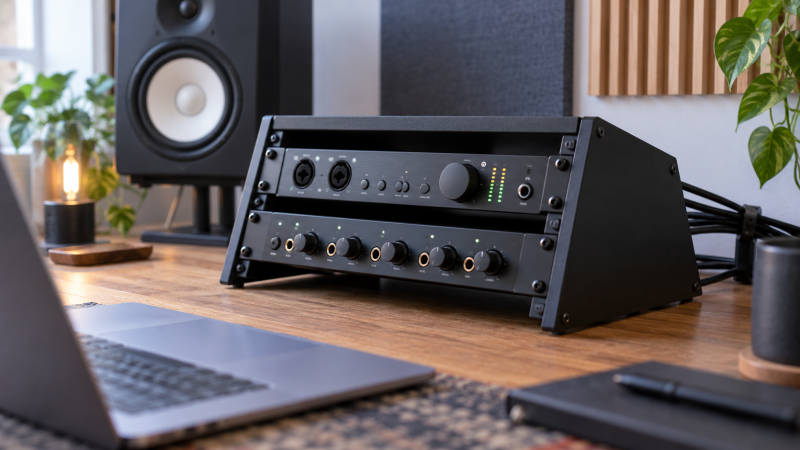
A desktop rack stand lifts rack-width audio equipment off the flat work surface, angles front panels toward you, and puts an interface, preamp, headphone amplifier, patchbay, or effects processor in one footprint. A small interface without 19-inch rack ears needs a compatible rack shelf or tray before it can mount in most of these stands, so rack-width is the first thing to check.
The eight picks range from 2U to 8U. Open two-post frames are easy to cable and easy to keep ventilated. Angled designs make controls easier to see. Enclosed 2U stands look more like desk furniture. Before you choose a size, count the rack units you need, confirm each device’s depth and mounting ears, and leave room for cable bends and airflow.
The RIVECO 6U is the best general desktop rack, with useful capacity, open access, a reinforced crossbeam, and included mounting hardware. Choose the JINGCHENGMEI 8U if you want an adjustable rail angle, or the Gator Elite 2U for the most finished compact housing for one or two shallow rack devices.- Best overall: RIVECO 6U Desktop Rack offers six rack spaces, open access, a reinforced beam, and included screws and cage nuts.
- Best adjustable-angle 8U rack: JINGCHENGMEI 8U tilts its posts from 9 to 24 degrees and carries a stated 50 pounds.
- Best finished 2U stand: Gator Elite 2U uses one-inch plywood and provides 12.75 inches from front rail to rear lip.
Desktop Rack Stand Comparison
| Image | Product | Details | Check Price |
|---|---|---|---|
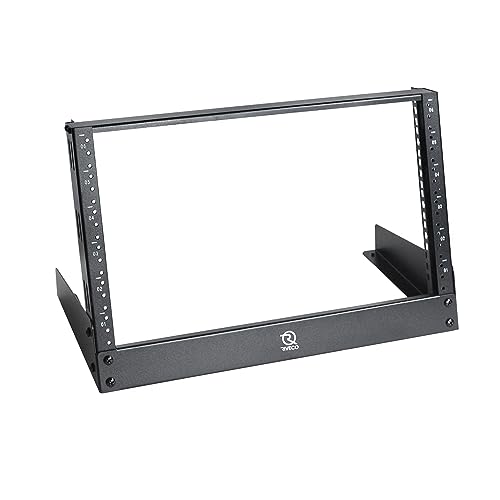 | RIVECO 6U Desktop Rack Stand | Rack Space: 6U Format: 19-inch, 2-post open frame Dimensions: Not stated Max Load: Not stated Mounting Hardware: Screws and cage nuts included | Check Price on Amazon |
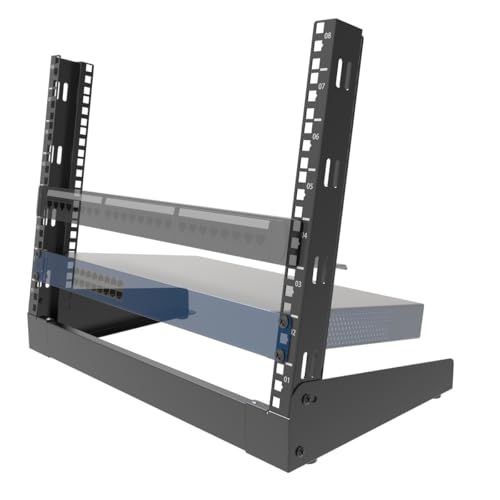 | JINGCHENGMEI 8U Adjustable Desktop Rack | Rack Space: 8U Format: 19-inch, 2-post square-hole frame Dimensions: 19.8 W x 11.6 D x 16.3 H in Max Load: 50 lb Rail Angle: 9-24 degrees | Check Price on Amazon |
 | Tecmojo 8U Two-Post Desktop Rack | Rack Space: 8U Format: 19-inch square-hole open frame Dimensions: Not stated Max Load: 143 lb / 65 kg Mounting Hardware: Cage nuts and screws included | Check Price on Amazon |
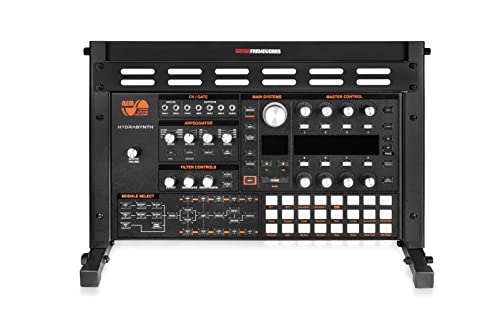 | Gator GFW-DESKTOPRK-06U Angled Rack | Rack Space: 6U Format: Angled collapsible metal frame Dimensions: Not stated Max Load: 75 lb / 34 kg Desk Contact: Non-slip rubber feet | Check Price on Amazon |
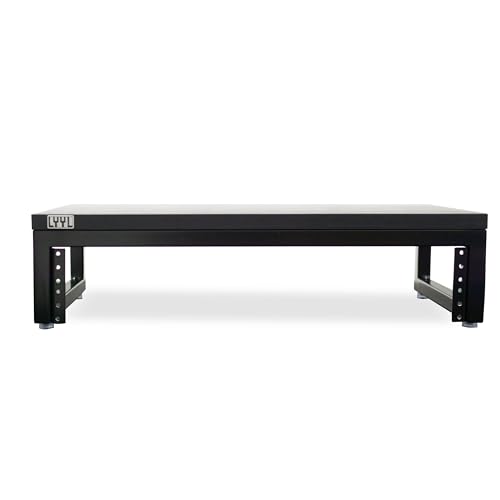 | LYYL 2U Desktop Audio Rack | Rack Space: 2U Format: Open steel rack with top platform Dimensions: Not stated Max Load: Not stated Desk Contact: 4 silicone leveling feet | Check Price on Amazon |
 | RIVECO LEAN04 4U Tabletop Rack | Rack Space: 4U Format: 19-inch, 2-post tapped-hole frame Material: 2.0 mm cold-rolled steel Max Load: Not stated Mounting Hardware: Screws included | Check Price on Amazon |
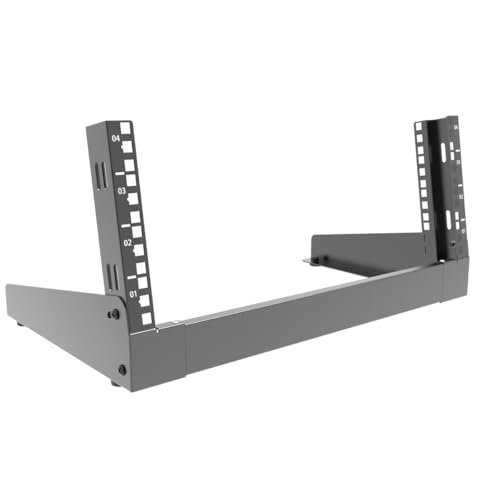 | JINGCHENGMEI 4U Desktop Rack | Rack Space: 4U Format: 19-inch, 2-post open frame Dimensions: 19.8 W x 11.6 D x 9.37 H in Max Load: 50 lb Mounting Hardware: 16 M6 screws included | Check Price on Amazon |
 | Gator Elite 2U Desktop Studio Rack | Rack Space: 2U Format: Finished plywood desktop housing Rack Depth: 12.75 in from front rail to rear lip Material: 1 in / 25 mm plywood Max Load: Not stated | Check Price on Amazon |
1. RIVECO 6U Desktop Rack — Best Overall Compact Studio Frame
On a compact production desk where gear gets adjusted often, the RIVECO’s open two-post structure exposes the rear for cable changes and lets heat escape without enclosed side panels. RIVECO states it provides 6U of 19-inch rack space, enough for a small interface plus several shallow processors, or for a patchbay and a preamp.
An extra horizontal beam connects the posts to resist twisting and forms a guarded upper edge. The manufacturer includes rack screws and cage nuts for mounting compatible gear. The source describes placement on a desktop or floor, but it does not state rail angle, load capacity, steel thickness, foot design, or maximum equipment depth.
Six rack units leave more room to grow than a 2U or 4U stand without reaching the height of the 8U choices, which makes the RIVECO the best overall pick for a small home studio. Heavy or deep equipment still needs appropriate support. A two-post desktop rack suits devices whose mounting guidance permits front-rail installation.
[accentbox color=”blue”]Best for a small studio assembling several shallow 19-inch audio devices in one accessible six-space desktop frame.[/accentbox]- Six standard 19-inch rack units
- Open access and added horizontal beam
- Rack screws and cage nuts included
- No maximum load stated
- Rail angle and feet are not described
2. JINGCHENGMEI 8U Desktop Rack — Best Adjustable-Angle Capacity
The JINGCHENGMEI 8U has the most flexible rail angle in this group. JINGCHENGMEI states the posts adjust from 9 to 24 degrees, between leaning front panels toward a seated user and standing them closer to upright. Eight units leave room for a larger interface, patchbay, preamps, and other shallow gear without splitting the setup across separate stands.
According to the manufacturer, the frame measures 19.8 inches wide, 11.6 inches deep, and 16.3 inches high including its non-slip feet. Cold-rolled steel with a powder-coated finish supports a stated 50-pound maximum. The square-hole posts use cage nuts, and the manufacturer includes 32 sets of M6 screws and nuts. The rack unfolds before the two posts are secured to the base.
Eight rack spaces can place upper controls relatively high on a desk, so measure sight lines around displays and monitor speakers. The 11.6-inch base depth is not the same as usable equipment depth, and the source does not state rear support. This rack is the best pick when front-panel angle and capacity are more important than keeping the rack visually low.
[accentbox color=”blue”]Best for a growing studio that needs eight rack units and wants to tune the front-panel angle for seated access.[/accentbox]- Eight rack units
- Rail angle adjusts from 9 to 24 degrees
- Dimensions, 50-pound load, and hardware are stated
- May sit too tall beneath low displays
- Usable equipment depth is not stated
3. Tecmojo 8U Desktop Rack — Best High-Capacity Open Frame
The Tecmojo is another 8U open two-post rack, but its stated 143-pound capacity is far higher than the JINGCHENGMEI rating. Cold-rolled steel forms the structure, and the square-hole rails are marked by rack unit for faster device alignment. The frame is described as compliant with EIA/ECA-310-E.
Cage nuts and screws are included for compatible 19-inch devices. The open design provides access from every side, which helps when connecting short patch cables, line outputs, word clock, MIDI, USB, and power across several audio units. The source does not state rail angle, steel thickness, frame weight, or foot material.
The load claim makes Tecmojo appealing for a dense set of processors, but desk strength and equipment mounting guidance still limit an actual installation. Weight high above the work surface should be considered even if the rack itself is rated for it. Choose the Tecmojo for the higher stated capacity when exact dimensions can be confirmed against the desk before ordering.
[accentbox color=”blue”]Best for a heavier eight-space collection of shallow rack equipment on a desk proven to support the combined load.[/accentbox]- Eight marked rack units
- 143-pound stated capacity
- Cage nuts and screws included
- Usable equipment depth is not stated
- Rail angle is not specified
4. Gator GFW-DESKTOPRK-06U — Best Collapsible Angled Rack
The Gator Frameworks stand provides 6U at a fixed angled orientation, so interface meters, preamp gain knobs, and effect controls are easier to see from a seated position. Top and bottom crossbars reinforce the metal frame, and non-slip rubber feet resist desk movement and protect the surface.
Gator Frameworks states a 75-pound maximum that sits between the JINGCHENGMEI and Tecmojo ratings. The frame folds flat for storage or transport, which helps a temporary production setup or mobile recording kit. The supplied record does not state the operating angle, folded thickness, hole type, included mounting hardware, or maximum supported device depth.
The Gator Frameworks stand is the best choice when an angled front panel and a frame that folds flat are more important than adjustable tilt. The six-unit capacity leaves room for expansion without towering over the desk like an 8U rack. Confirm whether mounting screws and nuts need to be bought separately, since they are not named in the package details.
[accentbox color=”blue”]Best for a portable or multipurpose studio that wants six angled rack spaces and flat-folding storage.[/accentbox]- Angled six-unit layout
- 75-pound stated capacity
- Folds flat with non-slip feet
- Operating angle and mounting hardware are not stated
- Mounting hardware is not listed
5. LYYL 2U Desktop Rack — Best Rack-and-Monitor Riser Hybrid
LYYL specifies a 2U rack opening below a flat top platform. Rack gear mounts underneath while a speaker or display sits above, so one desktop footprint serves two purposes. The stand can place a small interface or preamp within reach while lifting a monitor closer to eye level or a compact speaker closer to the desired height.
An open steel frame lets air move around mounted electronics. The manufacturer includes four silicone leveling feet that adjust slightly to stabilize the stand on an uneven work surface. The source does not state 19-inch compatibility explicitly in the bullets, overall width, depth, height, equipment clearance, top-platform dimensions, rack angle, load capacity, or how the rack device is fastened.
Those omissions make careful measurement essential. A display or speaker adds load above the rack gear and raises the combined center of gravity. Choose the LYYL only when the top platform has a defined job and its dimensions and ratings support both pieces of equipment.
[accentbox color=”blue”]Best for a compact desk that needs two rack spaces below a properly sized monitor or speaker platform.[/accentbox]- Two rack units plus a top platform
- Open steel frame for airflow
- Four silicone leveling feet
- No dimensions or load ratings are stated
- Rack fastener method is not stated
6. RIVECO LEAN04 4U Rack — Best Heavy-Gauge Compact Frame
RIVECO states the LEAN04 provides 4U of 19-inch space in an open two-post design. Four units are enough for a rackmount interface plus preamp or patchbay, and the top of the installation stays lower than on a six- or eight-space rack. Clear unit markings help with alignment during installation.
The manufacturer specifies a frame of 2.0 mm cold-rolled steel with a powder-coated finish and an added horizontal beam between the posts. The rails use tapped holes rather than the square holes and cage nuts found on several alternatives. Screws and rubber feet are included, but buyers should confirm the thread standard matches the supplied hardware and any replacement screws.
The source does not state rail angle, load capacity, support depth, or hole spacing beyond general 19-inch compatibility. The LEAN04 is the best compact open frame when material thickness is a priority. It works well for shallow equipment whose rack ears can carry the device from the front posts.
[accentbox color=”blue”]Best for a compact four-space setup that values stated 2.0 mm steel and simple tapped-hole mounting.[/accentbox]- Four standard rack units
- 2.0 mm cold-rolled steel
- Screws and rubber feet included
- No load capacity stated
- Tapped holes require the correct screw thread
7. JINGCHENGMEI 4U Rack — Best Dimensioned Compact Open Rack
JINGCHENGMEI lists the 4U at 19.8 inches wide, 11.6 inches deep, and 9.37 inches high including its rubber feet. Those dimensions make it easier to reserve actual desk space than with stands that state only the rack-unit count. It supports 19-inch sound, AV, server, and networking equipment in an open two-post structure.
Cold-rolled steel with a powder-coated finish supports a stated 50 pounds. The stand unfolds, then its posts attach to the frame with included screws. Sixteen M6 screws are provided for equipment mounting. Non-slip feet protect the desk, and the rack can fold flat again for carrying or storage.
The supplied record does not state rail angle, exact folded dimensions, or maximum equipment depth. The 11.6-inch base depth is useful for placement but should not be treated as the rackable chassis depth. This stand is the best compact choice for buyers who want both frame measurements and a published load capacity.
[accentbox color=”blue”]Best for a four-space desktop installation where exact outer dimensions and a 50-pound limit are important planning inputs.[/accentbox]- Full outer dimensions supplied
- 50-pound stated capacity
- Folds flat and includes 16 M6 screws
- Usable equipment depth is not stated
- Rail angle and folded dimensions are omitted
8. Gator Elite 2U Studio Rack — Best Finished Compact Housing
The Gator Elite uses one-inch-thick plywood and a black finished enclosure rather than an exposed steel frame. Its 2U opening suits one larger rackmount interface, two 1U devices, or a rack shelf carrying compatible non-rack equipment. The furniture-like sides can blend into a permanent control room more naturally than an open server-style rack.
Front-rail-to-rear-lip depth is stated at 12.75 inches, the clearest device-depth reference in this group. Non-slip feet stabilize the housing and protect the desk. The source lists preamps, interfaces, and effects processors as intended equipment, but does not state maximum load, ventilation openings, rack angle, mounting hardware, or usable depth after accounting for connectors.
Two rack units keep controls low and close, but leave almost no expansion room. Rear connectors and cable bends may extend beyond the 12.75-inch lip. The Gator Elite is the best finished compact stand for a settled one- or two-device setup, provided the chassis depth and rear cabling fit the available space.
[accentbox color=”blue”]Best for one or two rackmount audio devices in a permanent desktop setup that favors a finished plywood enclosure.[/accentbox]- Compact 2U layout
- One-inch plywood construction
- 12.75-inch front-rail-to-rear-lip depth
- No load rating stated
- Only two units of expansion space
Buying Guide: Choosing a Desktop Audio Rack
Confirm that the interface is rackmountable
A standard rack device is about 19 inches wide across its mounting ears and has front holes aligned with rack rails. Many “small audio interfaces” are desktop boxes without ears. A non-rackmount interface needs a suitable rack shelf or manufacturer kit, and that shelf consumes rack space and adds depth and weight.
Do not rest loose equipment across the rails or suspend it by cables. Check whether rack ears are included with the interface or sold separately. If you use a shelf, secure the device against sliding and keep the ventilation open. The stand, shelf, and interface must work as one supported assembly.
Count rack units with room for growth and airflow
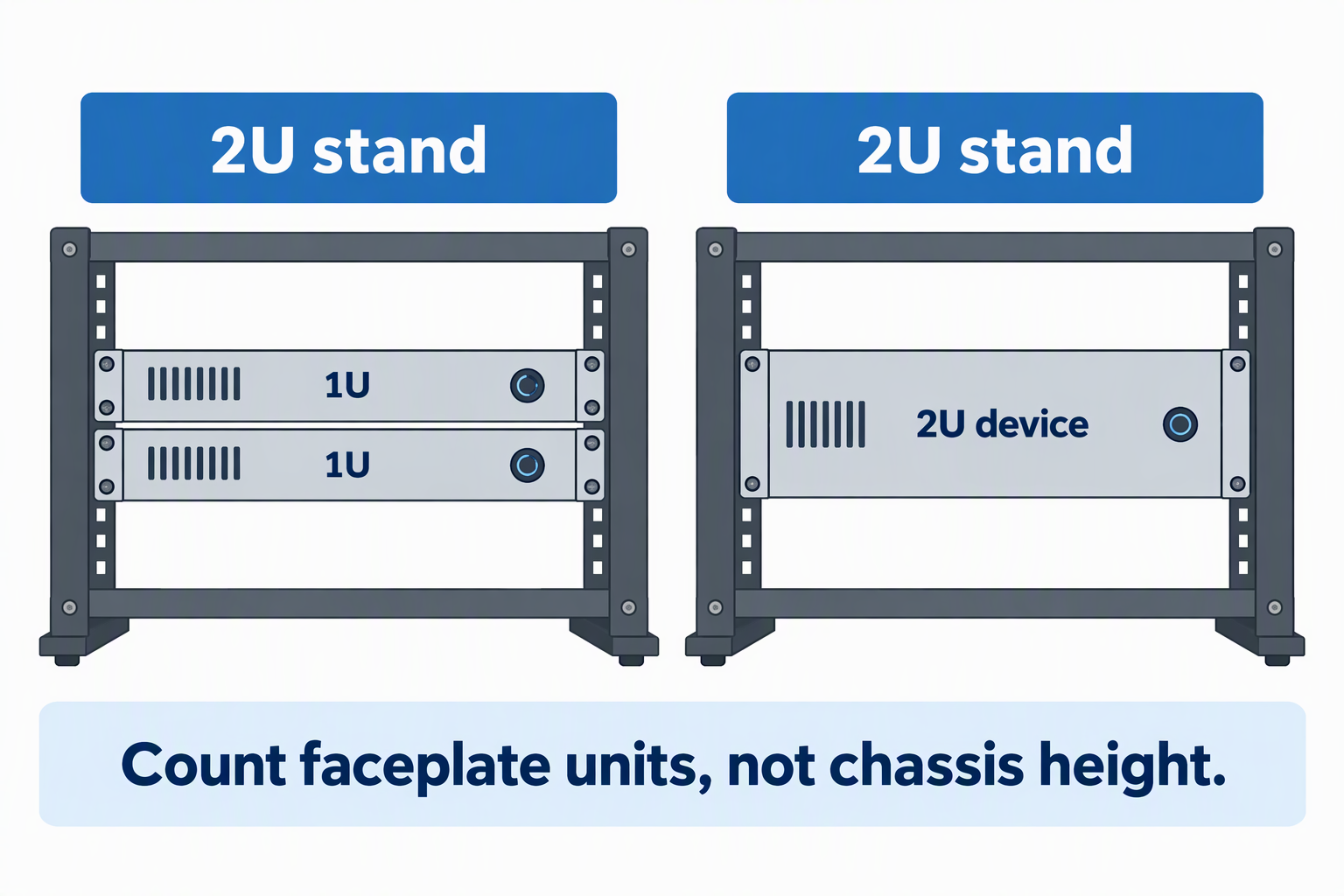
One rack unit equals 1.75 inches of vertical mounting space. A 2U stand fits two 1U devices or one 2U device, while 4U, 6U, and 8U racks add expansion room. Count actual faceplate units rather than estimating from chassis height.
Some equipment needs an empty unit or vent panel above it, while other gear is designed to stack directly. Follow the equipment manual. Extra space can hold a future patchbay or headphone amplifier, but an 8U rack may block displays on a shallow desk. Buy enough capacity without creating a new sight-line problem.
Measure equipment depth and rear cable bends
Front ears do not reveal how far the chassis extends behind the rail. Add the depth of XLR, TRS, USB, power, optical, and MIDI connectors plus a gentle cable bend. Rear cabling often determines the actual desk depth even in an open rack.
Gator Elite states 12.75 inches from front rail to rear lip, while no other stand here states an equipment depth. A two-post rack may leave deep gear supported only by its front ears. Check whether the equipment maker permits two-post mounting, especially for heavier units.
Choose angle for visibility and cable clearance
An angled rack points meters and controls toward a seated user. Gator’s 6U stand has a fixed angle, and the JINGCHENGMEI 8U adjusts from 9 to 24 degrees. More tilt improves visibility but changes the rear and upper clearance around monitors and walls.
Map the highest front edge and the farthest rear connector position at the chosen angle. A nearly upright rack occupies less front-to-back space but may be harder to read. The best angle keeps controls visible without forcing the rack into display or speaker placement.
Check load rating and desk strength together
Published rack capacities range from 50 pounds on the JINGCHENGMEI models to 143 pounds on Tecmojo, with several products unstated. Add every device, shelf, panel, and cable-support accessory. The lower of rack capacity and desk capacity controls the installation.
Keep heavier equipment low to reduce the center of gravity. Tighten all frame and rack screws after initial assembly, then recheck them after moving the stand. A high rack rating does not validate a weak desk surface. Distribute feet over sound material rather than a damaged edge or unsupported extension.
Match square holes, tapped holes, and mounting hardware
Square-hole rails use cage nuts to supply the thread. JINGCHENGMEI and Tecmojo include appropriate cage-nut hardware, while the RIVECO LEAN04 uses tapped holes and supplied screws. Never force a mismatched screw into a threaded rail.
Keep spare mounting hardware labeled by rack. Use washers when specified and support the device while the first screws are started. The Gator records do not list included hardware, so budget for it if necessary. Four correctly fitted fasteners are safer than partially mounted rack ears.
Plan ventilation and cable service
Open frames expose all sides and make cable changes easy, but they also expose connectors and circuit vents to desk clutter. Enclosed sides look cleaner yet may constrain air paths. Follow every device’s clearance and temperature guidance, particularly when several heat-producing units are stacked.
Bundle cables by function without pulling on ports, and leave enough slack to remove one device for service. Keep power supplies supported rather than hanging from rear connectors. Accessible cabling is one of the main reasons to choose a desktop rack, so do not bury the rear against a wall.
Related Home Studio Guides
- Top standalone microphone preamps for laptop recording
- Best XLR phantom power supplies for condenser microphones
- XLR-to-USB adapters for dynamic microphones
- XLR microphone cable snakes for podcast desks
- Best keyboard stands for home music production
- MIDI expression pedals for hands-free DAW control
- Best LED video light panels for small creator studios
- Light stands for portable creator video kits
Frequently Asked Questions
Can a non-rackmount audio interface go in these stands?
Yes, if a compatible 19-inch rack shelf supports it and fits the rack. The shelf consumes at least one rack unit and adds its own depth and weight. The interface should be secured to the shelf, not placed loosely where cable movement can pull it forward.
Some interfaces offer optional rack ears or side-by-side mounting kits. Use approved hardware when available. A desktop case without ears cannot bolt directly to bare rack rails.
Is a two-post rack safe for audio equipment?
It can be appropriate for shallow, light equipment designed for front-ear mounting. Deep or heavy chassis may need rear support or a four-post rack. Follow the equipment manufacturer’s mounting guidance rather than relying only on the stand’s total capacity.
Keep the heaviest suitable device low and support it during installation. Do not let rear cables bear chassis weight. The rack rating and device mounting method are separate requirements.
How many rack units should a small studio buy?
Add the faceplate height of every current device, any shelf, and any required ventilation gap. Then add a modest amount for a realistic next purchase. A 4U or 6U rack often balances current use and growth for a small home setup.
A 2U stand stays low but fills quickly. An 8U rack offers capacity at the cost of height and desk presence. Choose from a written equipment list rather than guessing.
Does rack angle affect audio performance?
Angle does not directly improve the audio signal, but it can improve visibility and access to controls. It also affects cable clearance, center of gravity, and how much desk depth the stand uses. Choose angle for ergonomics and safe placement.
Avoid steep positions that place upper equipment near a display or make the frame easier to tip. Confirm all adjustable posts are locked evenly. A readable front panel is useful only when the stand remains stable.
Are mounting screws included?
RIVECO 6U, both JINGCHENGMEI racks, Tecmojo, and RIVECO LEAN04 list mounting hardware. The exact type differs, since square-hole racks use cage nuts and LEAN04 uses tapped holes. Use only the correct thread and hardware for each rail.
The Gator and LYYL records do not explicitly list mounting screws. Check package contents and keep suitable rack hardware available. Do not substitute wood or sheet-metal screws for proper rack fasteners.
Bottom Line
The RIVECO 6U Desktop Rack offers the best capacity balance for a small audio setup. Choose the JINGCHENGMEI 8U when you want adjustable tilt and expansion, or the Tecmojo 8U when the higher stated load is central. For a compact permanent desk, the Gator Elite 2U provides a finished plywood housing with a useful depth specification. Always confirm that the interface has rack ears or budget rack space for a suitable shelf.