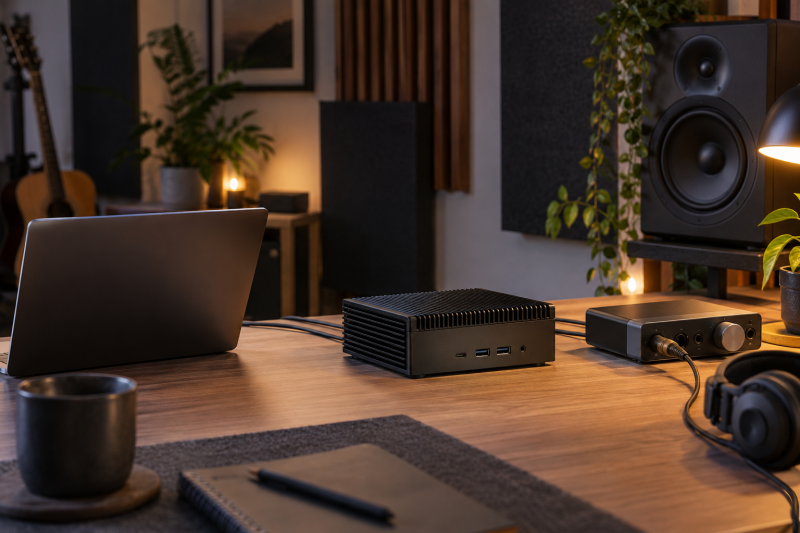
A fanless mini PC removes one source of noise from a recording room, edit bay, or quiet shared office. A fanless design does not make every box the same. Whether the computer suits simple capture, file management, or a more demanding creative workload depends on processor generation, storage, ports, and the way heat leaves the case.
This guide compares six fanless mini PCs whose Amazon US listings identify a passive design. The useful choice is the one that supplies enough performance and connections for the job without putting a noisy tower beside the microphone.
A silent computer is most useful when its ports and performance still match the room’s actual work.Fanless Mini PCs Compared
| Image | Product | Details | Check Price |
|---|---|---|---|
 | MINIX NEO Z300-0dB | Best fit: Balanced fanless studio PC Processor: Intel i3-N300 Memory and storage: 16GB, 512GB PCIe SSD Ports: See listing | Check Price on Amazon |
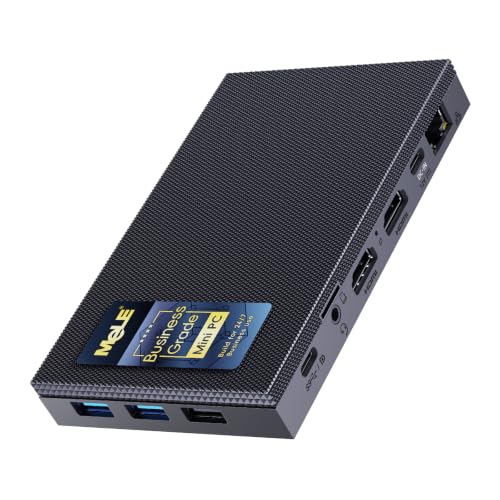 | MeLE Quieter 4C | Best fit: Low-power quiet room pick Processor: Intel N150 Memory: 8GB Storage: Check listing | Check Price on Amazon |
 | KINGDEL NC3000 | Best fit: Legacy studio hardware Processor: 8th-gen Core i7 Memory and storage: 16GB, 512GB NVMe SSD Ports: VGA, 4 USB 3.0, 2 RS232 | Check Price on Amazon |
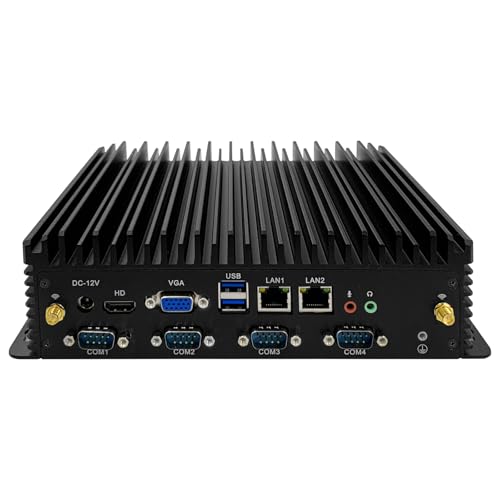 | Nekiuy TJ-190SW03 | Best fit: Multi-serial port alternative Processor: Core i5-7200U Memory and storage: 8GB, 256GB SSD Ports: 6 COM, dual LAN, HDMI, VGA | Check Price on Amazon |
 | WEIDIAN EH3 | Best fit: Basic N100 utility PC Processor: Intel N100 Memory and storage: 8GB, 128GB SSD Ports: See listing | Check Price on Amazon |
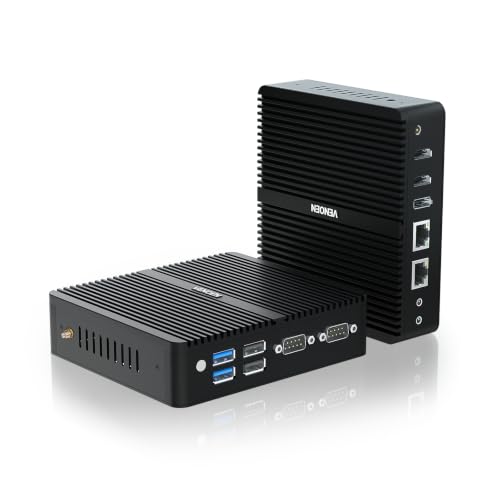 | VENOEN H3D | Best fit: Higher-memory N150 option Processor: Intel N150 Memory and storage: 32GB, 512GB SSD Ports: See listing | Check Price on Amazon |
1. MINIX NEO Z300-0dB Fanless Mini PC Intel i3-N300 — Best Balanced Fanless Studio PC
MINIX lists the NEO Z300-0dB with an Intel i3-N300, 16GB DDR4 memory, and a 512GB PCIe SSD. Those stated parts make it the most straightforward all-purpose option here for a quiet desk that needs office applications, file management, browser-based production, or light media preparation.
The fanless design removes a case-fan sound source, but it does not guarantee the same sustained performance as an actively cooled desktop. Weigh a heavy render, a long transcode, or several attached peripherals against that limit when you choose a passive system.
Our Take Buy the MINIX if your quiet creator room needs modern basic performance rather than industrial ports. The listed 16GB and 512GB configuration is larger than on the smaller entry models.
- Lists an i3-N300, 16GB RAM, and 512GB SSD.
- Fanless enclosure suits noise-sensitive rooms.
- Passive cooling has workload limits.
- Confirm every needed port in the listing.
2. MeLE Quieter 4C Fanless Mini PC N150 — Best Low-Power Quiet Room Pick
MeLE lists the Quieter 4C with an N150 processor and 8GB memory. It is a low-power choice for a room that needs a silent operator station, a lightweight teleprompter controller, a music-library computer, or a browser and document machine.
The MeLE has eight gigabytes of memory, which limits it to smaller jobs. Do not buy it for a large local media library, multitrack projects, or broad multitasking unless you first plan an external drive and a narrower job.
Our Take Buy the MeLE if you want a quiet, small, modest computer. It suits a simple support role in a studio, while the MINIX is the safer all-round option if you expect more local work.
- Lists a newer N150 low-power processor.
- Compact fanless format fits a small room.
- Listed 8GB memory limits heavier multitasking.
- Check the exact storage configuration before buying.
3. KINGDEL Fanless Industrial Computer Core i7 8th Gen — Best for Legacy Studio Hardware
KINGDEL lists an 8th-generation Core i7, 16GB RAM, a 512GB NVMe SSD, 4K output, VGA, four USB 3.0 ports, and two RS232 ports. Those legacy connections are the reason to consider it, especially when a quiet room still uses older control hardware, displays, or serial devices.
Its platform is older than the N-series systems above, and industrial ports do not make it the automatic choice for a simple modern desk built around a laptop and USB devices. Buy it for the ports you need, not for the Core i7 label.
Our Take Buy the KINGDEL if your studio has existing serial, VGA, or multi-port hardware that you would otherwise have to adapt around with a current minimalist mini PC.
- Lists VGA, RS232, and multiple USB ports.
- 16GB RAM and 512GB NVMe are stated.
- Older processor platform than newer picks.
- Industrial ports add value only for matching gear.
4. Nekiuy TJ-190SW03 Fanless Mini PC Core i5-7200U — Best Multi-Serial Port Alternative
Nekiuy lists a fanless mini PC with a Core i5-7200U, 8GB RAM, 256GB SSD, six COM ports, dual LAN, HDMI, and VGA. It is another specialist choice for a controlled setup where legacy serial equipment and network connections are more important than a current consumer platform.
With a 7th-generation processor and a listed 8GB configuration, it suits stable, bounded tasks better than broad modern creation workloads. Use it as a controller that does one fixed job, not as a general replacement for a more recent desktop.
Our Take Buy the Nekiuy only if six COM ports or dual LAN solve a problem with your equipment. For ordinary quiet-room computing, the MINIX and MeLE are a clearer choice, since the Nekiuy has an older platform.
- Lists six COM ports and dual LAN.
- Fanless case supports a quiet installation.
- Older Core i5-7200U platform.
- 8GB RAM narrows the intended workload.
5. WEIDIAN EH3 Fanless Mini PC N100 — Best Basic N100 Utility PC
WEIDIAN lists the EH3 with an Intel N100, 8GB RAM, and 128GB SSD. It is a basic utility computer for a low-demand task such as running a script, a room display, a remote desktop endpoint, or a simple audio-library station.
The listed storage is the major constraint, since a 128GB SSD has little room for cache files, software updates, or locally stored photo and video work. Plan external or network storage before deciding it belongs in a creative room.
Our Take Buy the WEIDIAN if you want a budget utility computer for one narrow job. Do not try to save money here if you need broad local storage or expect a person to work on it all day.
- N100 suits basic low-power desk roles.
- Fanless design keeps the room quieter.
- Listed storage is only 128GB.
- 8GB RAM limits heavier creative apps.
6. VENOEN H3D Fanless Mini PC N150 — Best Higher-Memory N150 Option
VENOEN lists the H3D with an N150 processor, 32GB RAM, and a 512GB SSD. The larger stated memory suits a fanless machine that has to keep more applications, browser tabs, or control software open at once.
More memory does not turn a passive N150 system into a workstation for sustained renders, but it makes the system easier to justify for a busy control desk, provided its exact ports, operating system, and support expectations suit your setup.
Our Take Buy the VENOEN if quiet multitasking counts for more than raw speed on creative work. It is the high-memory option among the low-power systems.
- Lists 32GB RAM and 512GB storage.
- N150 suits low-power quiet-room duties.
- Passive cooling still limits sustained loads.
- Verify the exact port selection before buying.
Buying Guide
Match the processor to the room’s actual task
A fanless mini PC is not automatically a workstation. An N100, N150, or i3-N300 model can be excellent for browsing, file transfer, room control, and light production support, but with a long render, high-bitrate transcode, or large multitrack session you can run into the limits of passive cooling and lower-power CPUs.
Pick a narrow job before choosing the system. A teleprompter computer, a remote display endpoint, and a local editing machine have very different needs. If the box will only support a laptop-based workflow, an N-series system may be enough. If it will replace a desktop, start with the applications and media load instead.
Check storage and memory before chasing silence
8GB of memory and 128GB of storage can work for a dedicated appliance, but they are tight for a shared creative computer. Browser caches, audio libraries, photo previews, and operating-system updates all take room, which can turn a quiet system into a maintenance task.
16GB RAM and a 512GB SSD are a more comfortable starting point for an all-purpose creator-room machine. The MINIX NEO Z300-0dB and VENOEN H3D are the relevant comparisons when local multitasking is a priority.
Treat ports as a compatibility decision
USB, HDMI, Ethernet, VGA, and serial ports solve different problems. A simple modern desk benefits from the ports already on its displays, drives, and audio interfaces. A legacy studio may need VGA, RS232, or dual LAN, which is why the KINGDEL and Nekiuy systems are in this list.
Adapters are not always a substitute for native ports. If a mini PC will run a fixed piece of equipment, map each cable before ordering. See our USB-C dock guide for laptop expansion options, or our quiet laptop guide if a portable computer is the better fit.
Frequently Asked Questions
Are fanless mini PCs completely silent?
The computer itself can avoid a cooling-fan sound, but a quiet room still includes drives, power adapters, external fans, and other connected equipment. Fanless describes the mini PC’s cooling design, not every sound in a finished workstation.
Place the system where its case can shed heat freely and keep cables from blocking ventilation. The lowest-noise setup also depends on the displays, storage, and audio hardware around it.
Is an N100 or N150 mini PC enough for a creator room?
For bounded duties, often yes. Low-power processors suit simple control, browsing, file management, and remote-workstation roles, especially when the main editing happens on another computer.
They are less suitable for demanding exports, big local media libraries, or workloads that run hot for long periods. Define the job first, then compare memory, storage, and ports rather than treating the processor name as the complete answer.
Why would I want serial ports on a studio computer?
Some older controllers, automation gear, and industrial-style devices still use RS232 serial connections. A mini PC with native serial ports can remove the need for several USB adapters in a fixed setup.
For an ordinary camera, laptop, and USB audio-interface desk, those ports may be useless. They are valuable only when they match hardware you already own or deliberately plan to use.
Bottom Line
The MINIX NEO Z300-0dB is the balanced choice for a modern quiet room, while the MeLE Quieter 4C suits a lighter dedicated role. Choose the KINGDEL NC3000 only when its legacy ports solve a compatibility need. Whichever system you choose, match its memory, storage, and connections to a specific job before counting its silence as a complete solution.