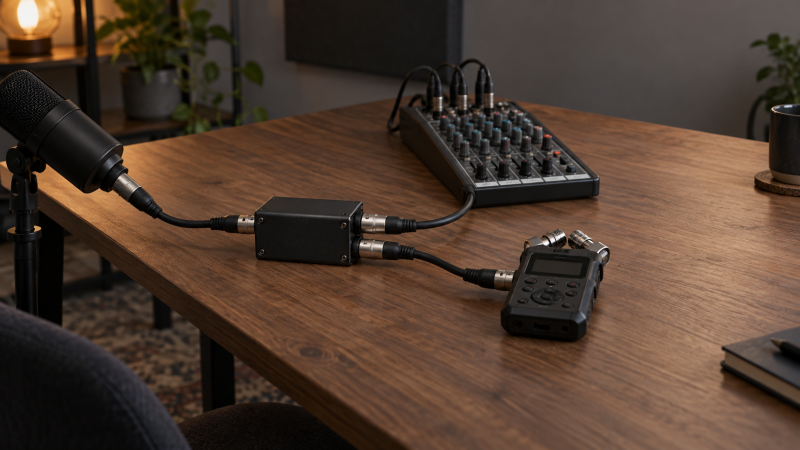
A microphone splitter lets a live console and a separate recorder receive the same mic before either preamp changes the signal. For this job, look for a direct mic output and a transformer-isolated mic output. A Y cable may divide a connector, but it does not provide that isolation.
The first decision is how many microphones need separate recordings. A one-input box is enough for a host mic or solo performer. A four- or eight-channel rack is enough for a small stage. These six products were selected from Amazon US listings with active New offers. Their makers document several different output layouts, so count the destinations before buying.
Count microphone inputs first. Then decide which console owns phantom power and which destination gets the isolated feed.Microphone Splitters Compared
| Image | Product | Details | Check Price |
|---|---|---|---|
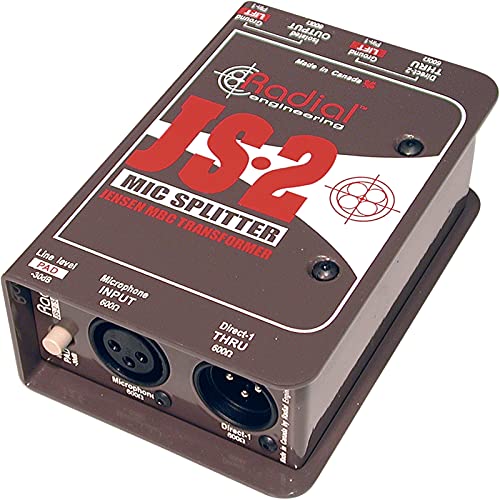 | Radial JS2 | Mic inputs: One Outputs per mic: Two direct, one isolated Main catch: Only one transformer-isolated path Buyer fit: One mic feeding three destinations | Check Price on Amazon |
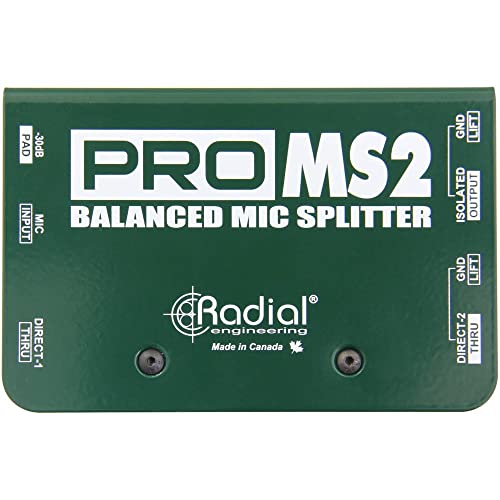 | Radial ProMS2 | Mic inputs: One Outputs per mic: Two direct, one isolated Main catch: Single mic channel Buyer fit: One mic with monitor and record feeds | Check Price on Amazon |
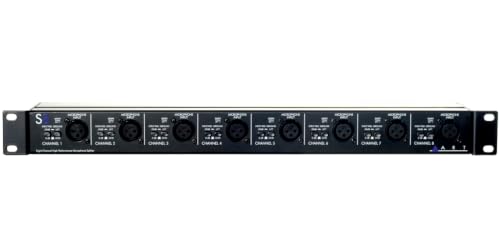 | ART S8 | Mic inputs: Eight Outputs per mic: One direct, one isolated Main catch: Eight-channel rack size Buyer fit: Small band or multitrack stage split | Check Price on Amazon |
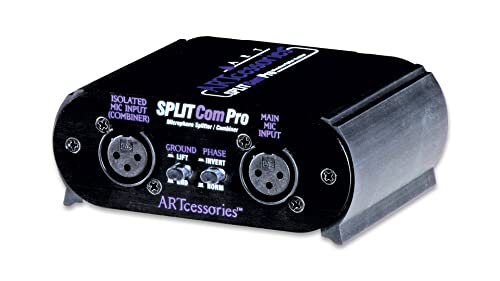 | ART SPLITCom Pro | Mic inputs: One in split mode Outputs per mic: One direct, one isolated Main catch: Combine mode requires deliberate setup Buyer fit: Portable one-mic split | Check Price on Amazon |
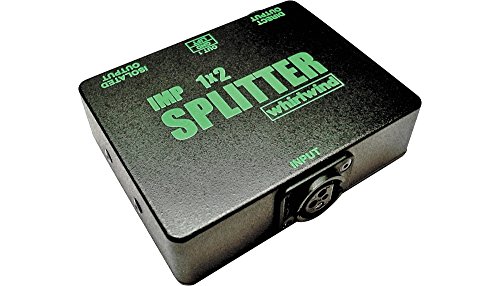 | Whirlwind IMP 1X2 | Mic inputs: One Outputs per mic: One direct, one isolated Main catch: Single mic channel Buyer fit: Simple mixer and recorder pair | Check Price on Amazon |
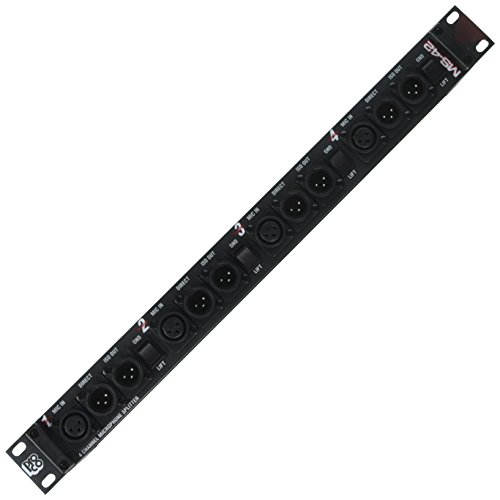 | Pro Co Sound MS42A | Mic inputs: Four Outputs per mic: One direct, one isolated Main catch: Four-channel limit Buyer fit: Small stage or panel split | Check Price on Amazon |
1. Radial JS2 — Best Rugged Single-Mic Split
The JS2 sends one microphone to two direct outputs and one transformer-isolated output. Radial’s guide describes its Jensen transformer and metal enclosure. The JS2 makes sense when one stage mic must reach the house console, a monitor mixer and a separate recorder. The isolated branch gives the recording system its own path without tying its ground directly to the other destination.
The extra direct output is not a second isolated feed. Decide which mixer provides phantom power and trace that path to the input before a show. If you only have a live mixer and recorder, the third output may never be used. The JS2 is a one-mic box, so a four-mic panel still needs four splitter channels, not one JS2 and a larger cable fan-out.
For the recorder side, a field recorder with XLR inputs may give more independent tracks than a stereo board mix, but it does not create additional splitter outputs.
Our Take Choose JS2 when the one-mic, three-destination layout is deliberate and you want a rugged stage box. For several microphones, a multichannel rack will be easier to label and patch.
- Two direct outputs plus an isolated output are documented.
- Jensen transformer and metal enclosure are documented by Radial.
- One box can feed three mic-level destinations.
- Only one microphone input.
- Only one of its three outputs is transformer-isolated.
2. Radial ProMS2 — Best Three-Destination Mic Route
Radial describes the ProMS2 as a one-input splitter with two direct and one isolated output. In the maker’s example, the splitter feeds a main mixer, monitor desk and recorder. One direct branch carries the phantom-power return to the microphone. A second direct branch has ground lift. The transformer branch can go to the recorder. The output count is the reason to consider it, not a promise about the finished sound.
ProMS2 overlaps JS2 in destination count, but they are different exact products and need an explicit choice. If you only need two destinations, either leaves an output unused. If you require two isolated destinations, neither gives that topology. Check connector placement and mounting against your stage box or desk before placing the order.
A multiport USB MIDI interface routes a different kind of signal. MIDI fan-out cannot replace a mic-level split.
A second direct output is useful for another mixer, but it is not a second isolation transformer.Our Take Pick ProMS2 when one microphone must serve a live mixer, monitor mixer and recorder. Choose a two-output box when the job is a mixer and a recorder.
- Three destination outputs from one microphone.
- Radial documents the main phantom-power return path.
- Not a multichannel stage split.
- Two direct outputs should not be mistaken for two isolated ones.
- Third branch may be unused in a two-device rig.
3. ART S8 — Best Eight-Mic Rack Split
ART’s S8 handles eight microphone inputs with a direct and transformer-isolated output per channel. One bank can feed the house mixer while the isolated bank reaches a multitrack recorder or another mic-preamp rack. When a band or panel has several mics, one rack unit is easier to label consistently than eight loose splitter boxes.
Count occupied channels, not only the rack’s eight sockets. An eight-input splitter does not turn a two-channel recorder into an eight-track recorder. The recording rig still needs matching preamp and capture channels. The S8 also adds rack placement and cable-management work. Confirm whether your stage snake and recorder use individual XLR inputs or a different multipin connector before building the patch plan.
The ADAT expansion guide helps count interface inputs later in the chain. ADAT does not remove the need for a physical mic split before separate preamps.
Our Take Buy the S8 when you can use most of its eight channel pairs and have a recorder or interface to capture them. A one-mic event does not need this much patching.
- Eight independent mic inputs in one rack.
- Direct and isolated outputs are documented for each input.
- One consistent patch layout for a small stage.
- Overkill for a single mic.
- Recording eight channels still needs eight capture paths.
4. ART SPLITCom Pro — Best One-Mic Box with Combine Mode
In splitter mode, the SPLITCom Pro provides one direct and one transformer-isolated mic output from a single microphone, according to ART’s manual. Its other named function combines two microphone sources for one input. For a purchase that feeds a live mixer and a recorder, the split function is the relevant one. The combine function is a separate use case, not an extra isolated recording channel.
Read the front-panel labels before a session so both devices are connected to outputs, not to the combine input. ART describes phantom power through the direct side. As with any passive mic split, settle which mixer supplies phantom, then test the mic and both preamps before the room fills. The box is portable and has one channel.
If the recorder will sit beside an audio interface with standalone routing, confirm it can accept the mic-level feed through a preamp, not merely a spare line input.
Our Take Choose SPLITCom Pro for a portable single-mic split when its separate combine mode is useful. For a permanently patched multi-mic rig, use a dedicated rack splitter instead.
- Direct and isolated split documented in ART’s manual.
- Combine mode gives another specific use.
- One mic channel only.
- Extra mode makes port identification important.
- Combine mode does not add a recording destination.
5. Whirlwind IMP 1X2 — Best Compact Direct-and-Isolated Pair
The exact Amazon listing describes the IMP 1X2 as a single-microphone splitter with one direct and one transformer-isolated output. That output count is the straightforward one for a live mixer and a recorder. There is no unused third branch or eight-channel chassis to accommodate when the job is just one interview or vocal mic.
The public manufacturer documentation was not available in the evidence reviewed here, so confirm the exact port labels, phantom path and any ground-lift controls on the unit and seller listing before a show. SP1X2 is the model code on this IMP 1X2 listing. Do not confuse its transformer-isolated split with a generic XLR Y splitter; a similar name is not proof of identical wiring. Test both preamps at rehearsal level.
If your dual-transmitter wireless mic kit already presents a mixed or line-level receiver output, this mic-input splitter may be the wrong point in the chain. Check the receiver output type first.
The 1X2 offers one isolated branch, not a second independent recorder track from two microphones.Our Take Consider IMP 1X2 for one simple feed to a mixer and a recorder, provided the exact listing and port labels match your wiring plan. If you need several mics, start with a multichannel unit.
- One direct and one isolated output fit the two-device job.
- No extra channels to rack or cable.
- Only one mic input.
- Port and phantom details need seller or unit confirmation.
- Similar Whirlwind model names do not prove identical wiring.
6. Pro Co Sound MS42A — Best Four-Mic Rack Split
The Amazon offer identifies a four-channel microphone splitter. Pro Co’s MS-42 technical sheet shows four mic inputs with direct and isolated outputs, plus a ground-lift control for each channel. Four channels can be enough for a small acoustic set, panel or stage section while keeping the patch smaller than an eight-channel rack.
The seller’s suffix is MS42A and the manufacturer sheet says MS-42, so verify the rear-panel markings against the four-channel layout before ordering. A fifth mic needs another splitter. The recorder still needs one preamp per track.
A headphone distribution amplifier can share the resulting cue mix, but it is not a replacement for this preamp-level mic split.
Our Take Choose MS42A when four split channels cover the session and the exact seller unit matches Pro Co’s documented MS-42 layout. If your input list is already growing, buy the channel count you need.
- Four mic channels in one rack unit.
- MS-42 technical sheet shows direct, isolated and per-channel lift layout.
- Four-channel ceiling may be too small for a band.
- Amazon MS42A suffix must be checked against the MS-42 sheet.
Buying Guide
1. Count source mics and destination preamps
Count actual microphone sources before buying. One vocal mic split between a house console and a recorder needs one input and two outputs. Four panel mics need four independent splitter channels. If your recorder has only two preamps, a four-channel splitter does not make four isolated recordings possible. The XLR field recorder roundup helps check the capture side, and headphone cue-mix planning is a separate destination question.
Count the destinations for each mic separately. Two devices generally need one direct and one isolated output. A third monitor console changes the required output map. JS2 and ProMS2 provide two direct branches and one isolated branch, while the ART, Whirlwind and Pro Co options here provide one direct and one isolated output per mic. Write the patch list before comparing brands.
2. Put phantom power on the intended direct path
Only one planned device should supply phantom power to a microphone. Maker documentation for Radial and ART describes phantom return along the direct side, not the transformer-isolated recorder side. Check the exact unit’s manual, identify the direct path, and decide which console owns phantom. Do not infer that every connector marked output will pass phantom to a condenser mic.
Test the full signal chain before the event. With gain down, connect the mic, splitter, mixer and recorder as documented. Raise the needed phantom and confirm healthy level on both preamps. Unplugging a cable mid-show or enabling phantom on the wrong branch is a worse discovery than learning during setup that a label was misunderstood.
3. Separate isolation from simple connector duplication
A transformer-isolated branch solves a wiring problem. It separates the two downstream systems electrically at that output and can help avoid ground-current problems in a live split. It is not a noise-reduction guarantee, a preamp or a substitute for balanced cables. A plain Y cable lacks the transformer boundary these selected devices advertise.
Ground lift is a specific control, not a first-line fix for all noise. Follow the manufacturer’s guidance and test the intended signal path. Do not disconnect protective power earth. If a buzz remains, inspect the mixer, recorder and stage wiring instead of assuming the splitter is defective or that a lift switch will always cure it.
4. Choose the physical patch you can maintain
A rack organizes repeated multichannel work. ART S8 and Pro Co MS42A keep several mic splits together. Label direct and isolated cable banks on both ends, including channel numbers. A patchbay or snake can make setup repeatable, but every additional connector must be included in the pre-show test.
A small box travels more easily for one mic. Radial JS2, ProMS2, ART SPLITCom Pro and Whirlwind IMP 1X2 can sit near the source. Tie down cables so a performer does not drag a splitter by its XLR connectors. Check whether the product’s extra outputs or combine function will ever be used. Features without a job only complicate the patch.
FAQ
Can I record individual mics from a live mixer instead of buying a splitter?
Sometimes, if the mixer provides independent pre-fader direct outputs or a multitrack digital interface and those outputs meet the recorder’s input requirements. A stereo main mix is not the same as separate raw microphone tracks. Check the mixer’s documented routing and whether the record feed changes when the live engineer changes gain or processing.
A split before separate preamps gives the recorder its own input chain. It also adds cables, channels and setup work. Buy it when the recorder needs that independence, not merely because the mixer has several sockets.
Will a transformer-isolated output power my condenser microphone?
Do not assume it will. The maker documentation reviewed for the Radial and ART devices assigns the phantom return to the direct branch. Plan the condenser’s phantom source on that documented path, then confirm the mic works on both downstream audio feeds during a full setup test.
Check the exact manual for any different product. An active Amazon New offer says nothing about phantom wiring, and an XLR connector alone does not establish the electrical route.
How many splitter channels do I need for a four-person panel?
Four, if each person has one separately miked channel and you want four independent mixer and recorder paths. The Pro Co MS42A is the four-channel option here. ART S8 provides eight if expansion is likely. A single two-way splitter only duplicates one mic signal.
Also count the recorder’s mic-preamp inputs and the cables from each isolated output. If the recording system takes only stereo input, the extra splitter channels will not create four tracks by themselves.
Bottom Line
For a small multitrack stage, ART S8 provides eight documented pairs of direct and isolated outputs. A four-mic setup can consider Pro Co MS42A, with a rear-panel check of the exact unit. For one mic and two destinations, ART SPLITCom Pro or Whirlwind IMP 1X2 covers the basic split. The Radial models add a third destination. Choose channel and output topology before brand.