Choosing a Full-Size 256GB SD Card
The six cards here are full-size 256GB SD cards, not microSD cards. Capacity is the same on every card, so the choice comes down to the bus class, video class and speed figures each maker or Amazon listing gives, and to whether the camera or laptop can use the card. A UHS-I V30 card and a UHS-II V60 card answer different needs at the same capacity.
| Image | Product | Best fit | Interface and rating | Listed performance | Video and host fit | Watch-outs | Check Price |
|---|---|---|---|---|---|---|---|
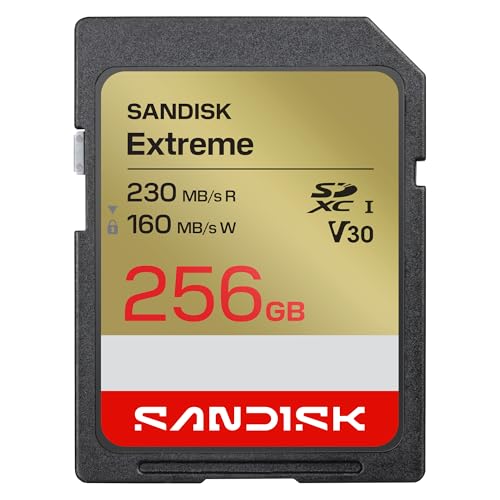 | SanDisk Extreme 256GB | Highest read figure of the six on SanDisk's page | UHS-I, V30, U3, C10 | SanDisk: up to 230MB/s read, up to 160MB/s write | SanDisk: DSLR, SLR and mirrorless cameras; 4K UHD | SanDisk says speeds beyond UHS-I 104MB/s need a compatible device | Check Price on Amazon |
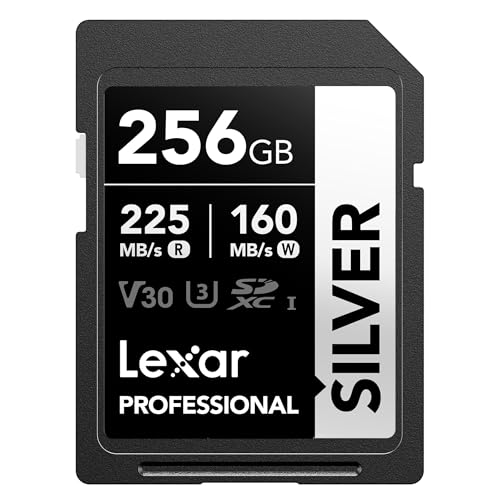 | Lexar Silver 256GB | V30 recording at up to 4K 60fps | UHS-I, V30 | Lexar: up to 225MB/s read, 160MB/s write; footnote gives up to 205MB/s read | Lexar: Canon, Nikon and Sony tested; 4K 60fps | Lexar's page gives two read figures | Check Price on Amazon |
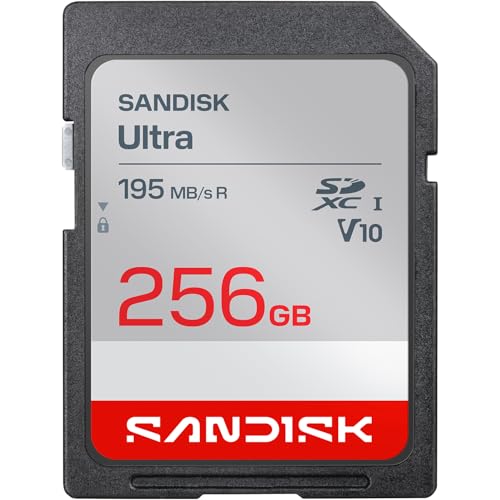 | SanDisk Ultra 256GB | Full HD use in compact and mid-range cameras | UHS-I, U1, C10 | Amazon listing: up to 195MB/s read with the QuickFlow USB-A reader | Amazon listing: Full HD; compact to mid-range cameras and camcorders | 195MB/s figure needs the separately sold QuickFlow reader | Check Price on Amazon |
 | PNY PRO Elite 256GB | Listed 100/90MB/s read and write pair | UHS-I, Class 10, U3, V30 | PNY: up to 100MB/s read, up to 90MB/s write | PNY: point-and-shoot, DSLR and HD video cameras; 4K Ultra HD | Lower figures than the SanDisk Extreme and Lexar Silver pages | Check Price on Amazon |
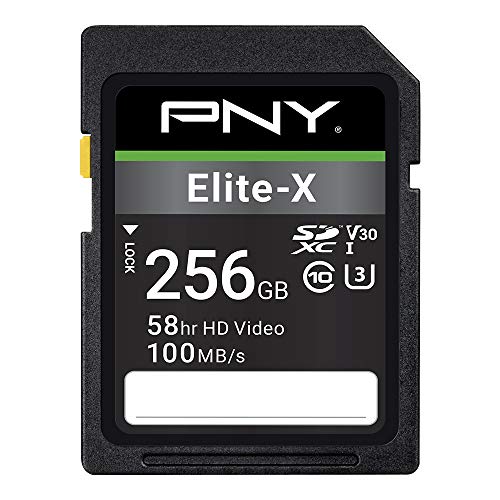 | PNY Elite-X 256GB | V30 burst-mode photography and 4K video | UHS-I, Class 10, U3, V30 | PNY: up to 100MB/s read | PNY: point-and-shoot, DSLR, HD video cameras, desktops and laptops | PNY's page does not list a write speed | Check Price on Amazon |
 | Gigastone 256GB 4K Camera Pro | V30 and A1 card with a mini case included | UHS-I, A1, V30 | Amazon listing: up to 170MB/s; Gigastone series page: up to 150MB/s | Amazon listing: 4K UHD; cameras, camcorders, DSLR and PC | The Amazon listing does not list a write speed | Check Price on Amazon |
SanDisk Extreme lists the highest read figure of the six, taken from SanDisk’s page, and Lexar Silver is the only one of the six whose Lexar page and Amazon listing give 4K 60fps. A camera that requires UHS-II or V60 needs a card from our V60 SD card guide or V90 SD card guide instead.
1. SanDisk Extreme 256GB — Best for the Highest Read Speed Here
SanDisk’s page for model SDSDXV9-256G-GUCIN gives up to 230MB/s read and up to 160MB/s write for its 256GB and 512GB cards, the highest read figure among the six cards here. Lexar Silver’s page gives the same 160MB/s write figure. SanDisk adds that speeds beyond the UHS-I 104MB/s limit need a compatible device able to reach them, and that performance can be lower depending on the host device, interface and usage.
SanDisk rates the card V30 and U3 and lists DSLR, SLR and mirrorless cameras. SanDisk says Full HD and 4K UHD support may vary with the host device and file attributes. The Amazon listing adds C10 in its title and names the SanDisk Memory Zone desktop app for backup and transfer. SanDisk’s page gives a lifetime limited warranty, with a 30-year term in Germany, Canada and regions that do not recognize lifetime warranties.
SanDisk says the 230MB/s read figure needs a device that can reach speeds beyond UHS-I 104MB/s.Our Take Choose the SanDisk Extreme when a V30 camera or reader can reach speeds beyond UHS-I to use its 230MB/s read figure, and you want SanDisk’s lifetime limited warranty.
- SanDisk’s page gives up to 230MB/s read and up to 160MB/s write for the 256GB card, a read and write pair listed by the maker.
- SanDisk rates the card V30 and U3, and lists DSLR, SLR and mirrorless cameras as camera types for the card.
- SanDisk gives a lifetime limited warranty, and buyers in Germany and Canada get a 30-year term.
- SanDisk says the card’s top read figure needs a device able to reach speeds beyond the UHS-I 104MB/s limit.
- SanDisk says Full HD and 4K UHD support may vary with the host device and file attributes.
2. Lexar Silver 256GB — Best for V30 4K 60fps Recording
Lexar’s page for the Professional SILVER SDXC UHS-I card lists up to 225MB/s read and 160MB/s write for 128GB to 512GB, and its part-number table names LSDSILV256G-BNNNU for the 256GB card. Lexar rates the card V30 for up to 4K 60fps video. A footnote on the same page reads “Up to to 205MB/s read transfer, write speeds lower”, and the page does not say how that figure relates to the 225MB/s headline. Lexar adds that its read speeds are fully achieved when the card is paired with its RW360 reader.
Lexar says the card is tested for compatibility with Canon, Nikon and Sony devices. Its page lists waterproofing to IPX7 (1m for 30 minutes), 1.5m drop protection and up to 10,000 plug-and-unplug cycles. Lexar also lists a 1.25 by 0.95 by 0.08 inch body and a weight of 0.061 oz. Lexar includes a limited lifetime warranty and its Recovery Tool with the card, and limits the lifetime warranty to 10 years in Germany and regions that do not recognize lifetime warranties.
Lexar’s page gives both 225MB/s and 205MB/s read figures, so check the card’s read speed in the camera or reader you plan to use.Our Take Pick the Lexar Silver when a camera calls for V30 and 4K 60fps and you want Lexar’s lifetime limited warranty and Recovery Tool.
- Lexar’s page lists both a read figure of up to 225MB/s and a write figure of 160MB/s for 128GB to 512GB.
- Lexar rates the card V30 for video recording of up to 4K 60fps, which fits a camera that calls for V30.
- Buyers with Canon, Nikon or Sony devices find their brands in Lexar’s statement that the card is tested for compatibility.
- Lexar includes a limited lifetime warranty and its Recovery Tool with the card.
- Lexar’s page footnote gives up to 205MB/s read beside the 225MB/s headline figure and does not say how the two figures relate.
- Lexar says the card reaches its read speeds in full when paired with its RW360 reader.
- Lexar’s page describes a UHS-I card, not a UHS-II card, so a camera that requires UHS-II needs a different card.
3. SanDisk Ultra 256GB — Best for Full HD Compact Cameras
The Amazon listing for SDSDUVQ-256G-GN6IN gives this card U1 and C10 ratings and calls it ideal for compact to mid-range cameras and camcorders recording Full HD. It lists up to 195MB/s read for 128GB to 512GB cards used with the SanDisk QuickFlow SD UHS-I Card USB-A Reader, sold separately. The listing does not list a write speed.
SanDisk’s own Ultra page lists a different 256GB code, SDSDUNC-256G-GN6IN, at up to 150MB/s read for 256GB to 512GB, and notes that the reader is not included. The page does not name the SDSDUVQ code, the 195MB/s figure or the QuickFlow reader. The Amazon listing also names the SanDisk Memory Zone desktop app and lists durability claims including waterproof, X-ray proof and shock proof.
The Amazon listing ties SanDisk Ultra’s 195MB/s read figure to the separately sold QuickFlow USB-A reader.Our Take Choose the SanDisk Ultra for a compact or mid-range camera that records Full HD, and treat the 195MB/s read figure as one the Amazon listing ties to the QuickFlow reader.
- The Amazon listing calls the card ideal for compact to mid-range cameras and camcorders recording Full HD.
- The Amazon listing gives U1 and C10 ratings and names Full HD recording as the use, so the card is pitched at Full HD cameras.
- The Amazon listing gives up to 195MB/s read for a card used with the QuickFlow USB-A reader.
- The Amazon listing gives its 195MB/s read figure for use with the QuickFlow reader, which is sold separately.
- The Amazon listing gives U1 and no V30 rating, so check a camera’s own video class requirement before choosing this card.
- The Amazon listing does not list a write speed for the card.
4. PNY PRO Elite 256GB — Best for a Stated 100/90MB/s Pair
PNY’s page for P-SD256V30100PRO-GE lists an SDXC UHS-I card rated Class 10, U3 and V30, with up to 100MB/s read and up to 90MB/s write. PNY says the V30 rating is for uninterrupted 4K Ultra HD video capture at 4096×3072 format, and that photo and video support may vary with the host device and settings. Its page lists point-and-shoot cameras, DSLR cameras and standard and advanced HD-enabled video cameras.
PNY lists operating temperatures of -25 to 85 degrees C and a durability set that includes shock proof, waterproof and X-ray proof. PNY gives a lifetime limited warranty with the card, and its Photo Recovery software is available. PNY’s read and write figures are both below the SanDisk Extreme and Lexar Silver figures.
Our Take Pick the PNY PRO Elite when a V30 card with a written read and write pair and a lifetime limited warranty suits the camera, and the highest read speed is not the goal.
- PNY’s page gives both read and write figures for this card, up to 100MB/s read and up to 90MB/s write.
- PNY rates the card Class 10, U3 and V30, and says the V30 rating is for 4K Ultra HD video capture.
- A buyer with a point-and-shoot camera, a DSLR or an HD-enabled video camera finds that camera type on PNY’s page.
- PNY gives a lifetime limited warranty and makes Photo Recovery software available for the card.
- PNY’s page gives 100MB/s read and 90MB/s write, both below the figures on the SanDisk Extreme and Lexar Silver pages.
- PNY’s page describes a UHS-I card, not a UHS-II card.
5. PNY Elite-X 256GB — Best for V30 Burst-Mode Photography
PNY’s page for P-SD256U3100EX-GE lists an SDXC UHS-I card rated Class 10, U3 and V30 with up to 100MB/s read. PNY’s page names burst mode HD photography and 4K Ultra HD videography as the main uses. The page does not list a write speed, and the Amazon listing does not either.
PNY’s compatibility list covers point-and-shoot cameras, DSLR cameras, standard and advanced HD-enabled video cameras, and desktops and laptops. PNY’s page gives a lifetime limited warranty. The Amazon listing adds magnet proof, shock proof, temperature proof and waterproof durability claims.
PNY’s Elite-X page lists a read figure only, so look at the PRO Elite if your workflow needs a written write figure.Our Take Choose the Elite-X for a V30 photography or HD video camera, or a laptop, where PNY’s read-only figure and lifetime limited warranty are enough.
- PNY rates the card Class 10, U3 and V30, and names burst mode HD photography and 4K video as its main uses.
- A laptop or desktop buyer finds a match on PNY’s page, which lists desktops and laptops beside point-and-shoot, DSLR and HD-enabled video cameras.
- PNY gives a read figure of up to 100MB/s and a lifetime limited warranty for this card.
- PNY’s page does not list a write speed for this card, and the Amazon listing does not either.
- PNY’s read figure of 100MB/s is below the figures given for the SanDisk Extreme, Lexar Silver and Gigastone.
6. Gigastone 256GB 4K Camera Pro — Best for an Included Mini Case
The Amazon listing for the Gigastone 256GB 4K Camera Pro card, sold by Gigastone America, gives UHS-I, A1 and V30 in its title and up to 170MB/s data transfer speed. It lists a full-size card measuring 32mm by 24mm, 4K UHD video compatibility, and use with point-and-shoot cameras, HD camcorders, DSLRs and PCs. The listing also includes one mini case.
Gigastone’s page for its SD Card 4K Camera Pro series lists up to 150MB/s rather than 170MB/s, along with 4K UHD video recording and a mini case. The page does not give a figure for 256GB. Neither the page nor the listing lists a write speed. Among the six cards, only this card’s Amazon title gives the A1 class.
Gigastone’s series page gives up to 150MB/s while the Amazon listing gives up to 170MB/s, so check which speed the packaging states.Our Take Pick the Gigastone when a V30 and A1 card with an included mini case suits a camera or laptop, and a written write figure is not required.
- The Amazon title gives UHS-I, A1 and V30, and among the six cards only this title gives the A1 class.
- A laptop or desktop buyer sees PCs named among compatible devices on the Amazon listing, which also gives up to 170MB/s.
- The Amazon listing for the card, sold by Gigastone America, includes one mini case.
- Gigastone’s series page gives up to 150MB/s, below the Amazon listing’s 170MB/s, so the two sources disagree on speed.
- The Amazon listing does not list a write speed for the card, and neither does Gigastone’s series page.
- The Amazon title describes a UHS-I card, not a UHS-II card, a limit for a camera that requires UHS-II.
Buying Guide: Pick a 256GB SD Card
Check the camera’s bus and video class first
On their pages, SanDisk, Lexar and PNY rate the SanDisk Extreme, Lexar Silver, PNY PRO Elite and PNY Elite-X V30, and the Amazon title gives Gigastone V30 as well. The Amazon listing gives SanDisk Ultra U1 and no V30 rating.
All six are described as UHS-I cards, by the SanDisk Extreme, Lexar and PNY pages and by the Amazon titles for SanDisk Ultra and Gigastone. A camera that requires UHS-II or V60 needs a card from our V60 guide or V90 guide.
Compare read and write figures together
SanDisk’s page gives up to 230MB/s read and 160MB/s write for the Extreme, Lexar’s page gives up to 225MB/s and 160MB/s for the Silver, and PNY’s page gives up to 100MB/s and 90MB/s for the PRO Elite. The Extreme, Silver and PRO Elite are the three cards with both directions listed by their makers.
The Amazon listing ties SanDisk Ultra’s 195MB/s read figure to the QuickFlow reader, while SanDisk’s own page lists up to 150MB/s for a different Ultra code. PNY’s Elite-X page and the Gigastone listing give no write figure.
Check host fit and what is in the box
Lexar’s page says its card is tested for Canon, Nikon and Sony devices. SanDisk’s page lists DSLR, SLR and mirrorless cameras, and PNY’s pages list point-and-shoot, DSLR and HD video cameras. PNY’s Elite-X page also lists desktops and laptops, and the Gigastone listing names PCs. Compare these host lists with your own camera or computer.
The Gigastone listing includes one mini case. The Amazon listing ties SanDisk Ultra’s 195MB/s figure to a QuickFlow reader sold separately, and Lexar’s page ties its full read speeds to the RW360 reader. If a laptop lacks a full-size slot, our laptops with SD card readers guide shows models that have one, and a separate reader is the alternative.
FAQ
Is 256GB enough for a camera SD card?
256GB is a capacity, and no maker page on this list ties it to a recording time. Recording time depends on the camera’s resolution, bitrate and codec.
Pick the speed class and bus the camera requires first, then the capacity. Every card here is 256GB, so the class and figure differences between the six cards are easy to compare.
Which card has the highest stated speeds?
SanDisk’s page for the Extreme gives up to 230MB/s read and 160MB/s write, the highest pair among the six. Lexar’s page gives 225MB/s read and 160MB/s write for the Silver, with a footnote of up to 205MB/s read.
All six are UHS-I cards. SanDisk says speeds beyond UHS-I 104MB/s need a compatible device able to reach them, and a camera that requires UHS-II or V60 needs a different card.
Is SanDisk Ultra suitable for 4K recording?
The Amazon listing for SanDisk Ultra gives U1 and C10 ratings and Full HD use, and gives no V30 rating. SanDisk’s own Ultra page, for a different 256GB code, also describes Full HD video.
SanDisk’s page rates the Extreme U3 and V30 for 4K UHD, and PNY’s pages rate the PRO Elite and Elite-X V30 for 4K Ultra HD video. Check the camera’s own requirements before choosing a card.
Can a laptop use these SD cards?
PNY’s Elite-X page lists desktops and laptops among compatible devices, and the Gigastone listing names PCs. A laptop with a full-size SD slot takes a full-size card, and a laptop without one needs a USB reader.
Two of the figures here come with a reader. The Amazon listing ties SanDisk Ultra’s 195MB/s figure to the QuickFlow USB-A reader, and Lexar ties its full read speeds to the RW360. Our Thunderbolt 3 SD card readers guide covers readers for faster transfers.