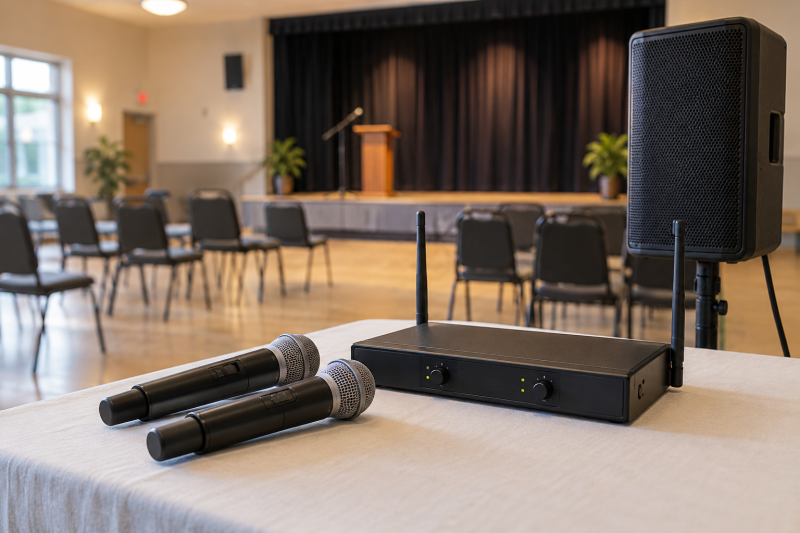
A small event needs a microphone system that reaches the PA or recorder, gives the presenter room to move, and does not create a confusing setup five minutes before people arrive. Check the receiver output and the input on the destination device before you weigh stated range, battery claims, or a long feature list. A handheld system can be a straightforward fit for a host, a speaker, or karaoke, provided the receiver connects to a microphone input, mixer, or PA path that the listing supports.
These six Amazon US handheld systems have active New offers and differ in radio type, transmitter count, battery approach, and receiver connection. Check the receiver output and available channels against your venue’s RF conditions before an event. For the destination side, see our small PA speaker guide and portable recorder guide.
For a small event, start with the receiver output and the input on the PA or mixer. A wireless pair that cannot connect to the destination is not a complete system.Handheld Wireless Microphones Compared


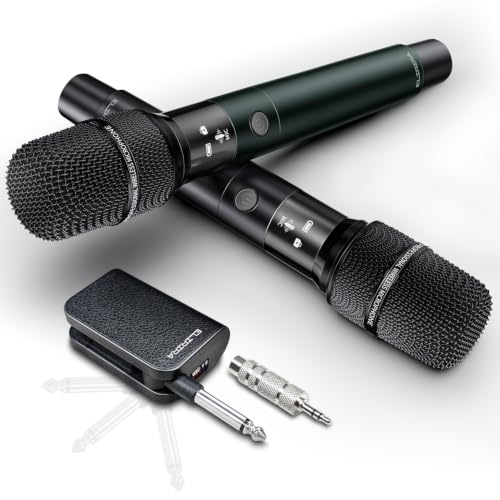

1. AURGIC HM5 — Rechargeable 2.4 GHz Pair
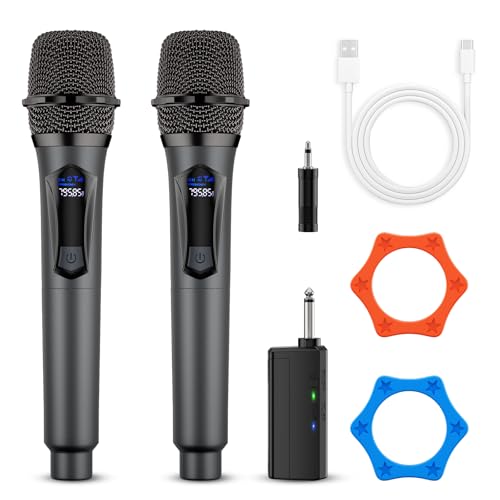
AURGIC lists two handheld microphones and a receiver using 2.4 GHz wireless connection, with a receiver plug for 6.35 mm equipment and a supplied 3.5 mm adapter. The listing says the receiver is for microphone-input equipment and specifically excludes Bluetooth, AUX, phones, computers, and tablets. A physical 3.5 mm jack does not by itself make a device a microphone input.
The package lists rechargeable AA lithium batteries and USB-C charging. Rechargeable batteries can be convenient for a recurring small event, but they also give the organizer one more thing to charge before setup. Check the supplied receiver plug against the mixer or powered speaker, and do a short sound check with the same cable path you will use at the event.
Our Take Buy the AURGIC HM5 if a listed rechargeable two-mic package and a simple 1/4-inch receiver connection fit the destination. Do not treat its 2.4 GHz label as a substitute for testing the room.
- Two handheld microphones are listed.
- Rechargeable batteries and USB-C charging are listed.
- Listing excludes AUX and Bluetooth connections.
- Needs a compatible microphone-input destination.
2. Phenyx Pro PTU-71-2H — Frequency Coordination
Phenyx Pro lists a dual UHF receiver with 100 selectable frequencies per channel and an Auto Scan function intended to identify a frequency with less interference. The listing also describes IR synchronization, a receiver lock function, and two handheld transmitters. Those controls are useful when an event has more radio devices than a simple home karaoke setup, but they still do not guarantee an unused channel in a specific venue.
The box contents list a 1/4-inch audio cable and a 6.5 mm to 3.5 mm adapter. Confirm whether the destination expects mic level, line level, or a balanced input before relying on either. A sound check should include moving with both transmitters active, because a system can appear fine beside the receiver and behave differently where the presenter stands.
Our Take Buy the Phenyx Pro if you want the most explicit listed tools for managing channels in this group. It suits an organizer who will scan and test the channels before the audience arrives.
- Auto Scan and selectable UHF frequencies are listed.
- Two handheld transmitters and a dual receiver are included.
- Channel coordination still needs a venue test.
- Destination input type must be confirmed.
3. TONOR TW360 — Handheld Plus Bodypack Options
TONOR lists two handheld microphones, two bodypacks, two headset microphones, and two lavalier microphones with one receiver. The package is broader than a handheld-only pair. It can be useful when one event has a roaming presenter and another needs a hands-free speaker, but it also means checking the correct transmitter, capsule, and channel before each use.
The listing specifies 10 channels on each microphone and bodypack, plus a 6.35 mm audio cable for mixers, karaoke machines, amplifiers, and powered speakers. It says each handheld or bodypack needs two AA batteries. Put fresh matching batteries in the devices and label the channels before doors open, especially when swapping between a handheld and bodypack during an event.
Our Take Buy the TONOR TW360 if the event needs both handheld and bodypack options. The package is more flexible than a simple pair, but the extra parts call for a labeled, tested setup.
- Lists handheld, headset, and lavalier options.
- Each transmitter type has selectable channels listed.
- More parts to label and check before use.
- AA batteries are not included according to the listing.
4. Pyle PDWM2135 — Basic VHF Pair
Pyle lists a dual-frequency VHF receiver with two handheld dynamic transmitter microphones, independent mic volume controls, and a 1/4-inch mono cable. The simple two-mic format fits a small room where the job is shared announcements, karaoke, or a basic PA handoff rather than expanded wireless coordination.
The product description calls the frequencies fixed. A fixed-frequency system gives less room to respond if the room already has RF problems, so weigh it before choosing. Confirm the receiver has a clear, practical connection to the PA or mixer, and test both microphones at the spots where presenters will stand, not only at the equipment table.
Our Take Buy the Pyle PDWM2135 if a basic two-handheld VHF setup is enough and the venue test is clean. Its fixed-frequency design is less adaptable than the selectable systems here.
- Two handheld transmitters are listed.
- Receiver has independent mic volume controls.
- Listing describes fixed frequencies.
- Uses a 1/4-inch mono receiver connection.
5. ELIRIRA HVM-001 — Foldable-Receiver Storage
ELIRIRA lists a dual-handheld 2.4 GHz system with a foldable receiver, a listed rechargeable receiver, and microphone-input compatibility through 3.5 mm or 6.35 mm connections. The foldable receiver is a practical storage detail for a kit that travels between a community room, classroom, or home event rather than living in a permanent rack.
Its compatibility note excludes AUX, Bluetooth-only devices, phones, tablets, and laptops. Treat the exclusions as an instruction to locate a mic input on the destination speaker, mixer, or PA. The pair may be a tidy portable kit, but it cannot turn a consumer Bluetooth speaker into a wired microphone host.
Our Take Buy the ELIRIRA if compact receiver storage and a simple two-handheld setup are what you want. Treat its stated mic-input requirement as a hard connection check, not a small footnote.
- Foldable receiver is listed for easier storage.
- Two handheld microphones are included.
- Listing excludes AUX and Bluetooth-only devices.
- Needs a matching 3.5 mm or 1/4-inch microphone input.
6. Kaschun KA-328 — Fixed-Frequency UHF Pair
Kaschun lists two UHF handheld microphones, a fixed-frequency receiver, and a supplied 1/4-inch audio cable. The product page says the system is aimed at PA systems, powered speakers, amplifiers, mixers, and karaoke machines. Choose one of those destinations rather than plugging a wireless receiver into whichever audio jack is easiest to reach.
The listing gives an 8-hour battery claim on AA batteries and says the units pair automatically. Battery life is a planning claim, not an event guarantee. Start with fresh batteries and keep spares at the receiver. Run a rehearsal to check that the venue and signal path work together.
Our Take Buy the Kaschun if a simple UHF two-mic set with a stated 1/4-inch cable fits an existing PA path. Its frequency is fixed, so run the room test early.
- Two UHF handheld microphones are listed.
- Supplied 1/4-inch audio cable is listed.
- Listing describes fixed-frequency operation.
- AA battery planning is still required.
Buying Guide: Handheld Wireless Microphones for Small Events
Confirm the receiver-to-PA connection first
A wireless receiver needs the correct destination input. The systems here list 1/4-inch and, in some cases, 3.5 mm receiver connections, but a connector shape does not tell you whether the destination is a microphone input, line input, or something else. Read the PA speaker or mixer manual, identify the input, and bring the needed cable or adapter to the sound check.
AUX and Bluetooth are not interchangeable with a microphone input. Several listings explicitly exclude those connections. If the venue only has a consumer Bluetooth speaker, the correct solution may be a small mixer or a different PA path rather than forcing the receiver into an incompatible socket. Make the connection decision before buying microphones.
Choose fixed or selectable frequencies for the room
Selectable channels give you a way to react to interference. The Phenyx Pro listing names Auto Scan and 100 frequencies per channel, while Pyle and Kaschun describe fixed-frequency designs. In a quiet room a fixed pair may work normally, but it does not give the organizer the same choices if another wireless source creates a problem.
Test with the presenter where they will stand and walk. Staying near the receiver is not the same as using a microphone at the back of a room, beside a PA speaker, or behind an audience. Turn on both transmitters, speak at ordinary event level, and listen for dropouts or noise before guests arrive. A check in the venue is more useful than relying on a stated range.
Plan batteries and handoffs rather than only microphone count
A two-handheld pair is enough for a simple host-and-guest handoff. AURGIC, Phenyx Pro, Pyle, ELIRIRA, and Kaschun list two handheld transmitters. TONOR adds bodypacks, headset microphones, and lavaliers, which can help when a speaker needs hands free. More transmitter types also mean more labeling and more chances for a handoff on the wrong channel.
Prepare batteries and a simple recovery plan. Some products list rechargeable power while others use AA batteries. Charge or replace batteries before the event, carry the matching backup set, and label each microphone with its receiver channel. If a handheld fails during a welcome speech, a prepared second transmitter is more useful than troubleshooting in front of the room.
Frequently Asked Questions
Can I plug a wireless microphone receiver into any speaker?
No. Use a destination with the correct microphone, line, or mixer input for the receiver’s listed output. A 1/4-inch connection can be physically compatible with more than one type of socket, so check the destination documentation instead of assuming every 1/4-inch jack has the same role.
Do not use a Bluetooth-only speaker or an AUX-only input as if it were a microphone host. Several listings specifically warn against that kind of connection. If the room has only consumer playback gear, add a suitable mixer or PA system before planning the wireless microphones.
Is 2.4 GHz or UHF better for a small event?
Neither label settles the question by itself. A 2.4 GHz system and a UHF system both need a room check with the PA, receiver position, and presenter path you plan to use. The main difference in this group is that Phenyx Pro lists selectable UHF channels and Auto Scan, while fixed-frequency designs offer fewer ways to adapt.
Choose based on the room and how much coordination you need. A simple low-stakes event may only need a clean rehearsal, while a venue with many wireless devices benefits from a system with documented tools for selecting frequencies and more setup time.
How many handheld microphones should a small event have?
Two is a practical starting point for a host and a guest, a question-and-answer handoff, or shared karaoke. All six systems in this guide list two handheld microphones, so the choice is more about connection, radio management, and battery plan than trying to find a single-mic system.
If a presenter needs free hands, a package such as TONOR that lists bodypacks and headset or lavalier options may fit better. Do a full handoff rehearsal with the planned speakers, and set the microphone count by what the event needs rather than by the box contents alone.