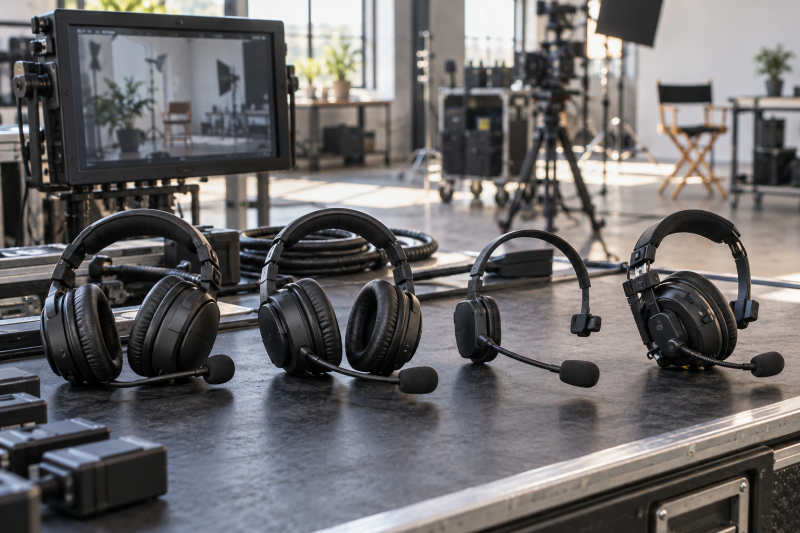
A camera operator cannot watch a hand signal while framing a live shot. A small crew needs a reliable way to call a take, warn about a cable and coordinate a camera change without shouting across the set. Buy the exact number of full-duplex headsets your crew will wear, then test the radio path at the hardest location. A seller’s long line-of-sight range is not a guarantee through walls, bodies or other wireless equipment.
These five four-person kits were selected from Amazon US listings with active New offers; availability can change. They differ in ear coverage, radio, battery and expansion. Range, noise reduction and inter-brand compatibility were not independently tested.
The right crew intercom is the one that stays intelligible through the whole shoot, not the one with the longest range number on the box.Four-Person Wireless Intercom Systems Compared
| Image | Product | Details | Check Price |
|---|---|---|---|
 | Hollyland Solidcom C1 Pro 4-Person Dual-Ear | Crew: 4 users in exact kit Style: Dual-ear Radio: Check exact C1 Pro band Buyer fit: Noisy video set | Check Price on Amazon |
 | Eartec UltraLITE-HD UL4S | Crew: 4 users in exact kit Style: Single-ear Radio: DECT 1.9GHz listed Buyer fit: Awareness on set | Check Price on Amazon |
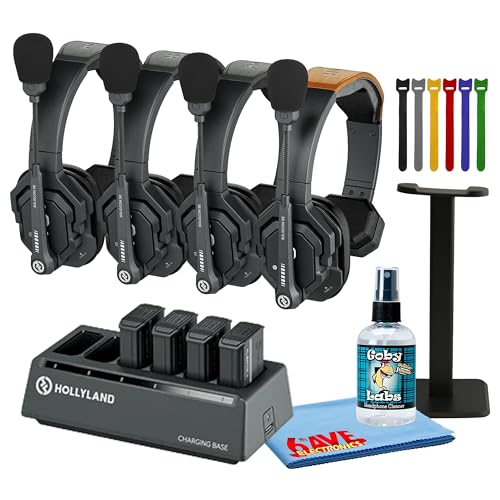 | Hollyland Solidcom SE 4S | Crew: 4 users in exact kit Style: Single-ear Radio: 2.4GHz listed Buyer fit: Simple small crew | Check Price on Amazon |
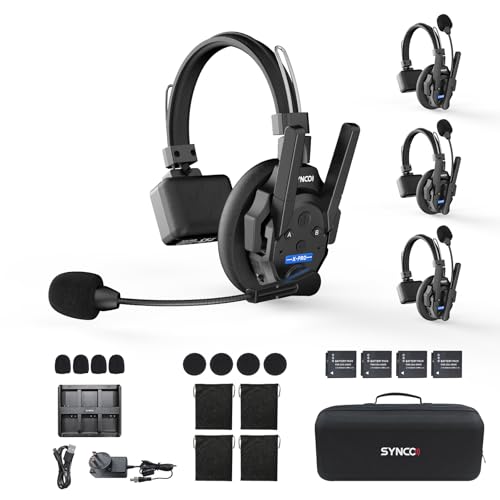 | SYNCO Xtalk XPro 4 | Crew: 4 users in exact kit Style: Check headset fit Radio: Seller-listed 500m line of sight Buyer fit: Long shift and monitoring | Check Price on Amazon |
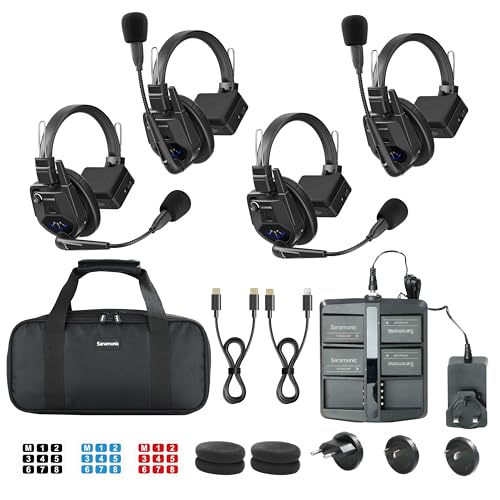 | Saramonic WiTalk9 SE-4S | Crew: 4 users in exact kit Style: Single-ear Radio: Seller-listed 2.4GHz; confirm band Buyer fit: Expandable team | Check Price on Amazon |
1. Hollyland Solidcom C1 Pro — Best for a Noisy Four-Person Set
The exact offer is a four-person Solidcom C1 Pro kit with double-ear headsets, full-duplex talk and environmental noise-cancellation claims. A camera operator may hear cues better with both ears covered on a loud event floor or near fans and monitors. The wearer also has less awareness of nearby movement, so not every crew role should wear the same style. A boom mute or push-to-talk setting may be useful when a person is close to the microphones being recorded.
The seller describes a long open-air range, but an actual video set has light stands, metal walls, moving people and other radios. Walk the route from director to the farthest camera and back with the full kit active. Check the actual core headset count and any spare batteries in the delivered box. Add-on single headsets are not the same as a complete four-person system.
If the crew also runs wireless video transmitters, test both systems at once. A clean intercom trial with the video link turned off is not a useful sign-off. Assign one person to charge and label units between shoots, and make sure a director can take over if the lead headset fails.
Our Take Choose the C1 Pro when two-ear isolation is useful in noisy locations. Test whether the camera and floor roles still need environmental awareness, and verify the kit while wireless video runs at the same time.
- Exact four-person double-ear kit.
- Full-duplex crew conversation.
- Seller-listed noise-cancellation tools.
- Two covered ears reduce awareness of nearby hazards.
- Seller range and noise reduction need a real-set trial.
2. Eartec UltraLITE-HD UL4S — Best for Single-Ear DECT Communication
The UL4S exact offer identifies four single-ear, full-duplex headsets using the 1.9GHz DECT band. With one ear open, a floor manager is better placed to hear talent, a nearby cable call or the room’s natural sound while still receiving intercom cues. The seller describes a hub-free setup and a boom microphone that mutes when raised. The hub-free setup and the boom mute are a practical routine for a small crew that moves between quiet planning and active shooting.
DECT is a separate band from common 2.4GHz Wi-Fi traffic, but no radio band is immune to an actual building. Eartec lists up to 1,000 feet line of sight and roughly six hours of talk time. Treat both as planning figures. Run a route test through the actual doorways and replace or recharge batteries for a full-day schedule. If the shoot spans more than one block, check whether charging can happen without losing every headset at once.
The offer says the system can expand to five users. Confirm which compatible headset is sold separately and how it joins the exact UL4S generation. A separate headphone distribution amplifier is meant for wired monitoring, not wireless crew communication.
Single-ear awareness is useful on a live floor, but check whether speech remains clear when the set itself is loud.Our Take The Eartec UL4S is a good fit for a four-person crew that values open-ear awareness and a simple DECT talk path. Test comfort, boom mute and battery rotation over a whole shoot rather than one short conversation.
- Four single-ear full-duplex headsets.
- DECT 1.9GHz band listed.
- Hub-free setup and boom mute described.
- Six-hour battery claim needs shift planning.
- Open ear admits loud set noise.
3. Hollyland Solidcom SE 4S — Best for a Simple 2.4GHz Crew Kit
The exact Solidcom SE 4S offer contains a four-person single-ear full-duplex system and a few generic cleaning accessories. The core intercom is the reason to buy it, not the bundle extras. The seller lists a 2.4GHz radio, noise cancellation, mute by button or boom and a hub-free pre-paired setup. It is the Hollyland route for a crew that needs to hear the room with one ear open instead of wearing the C1 Pro’s dual-ear set.
Because the listing is a third-party bundle, inspect what is actually in the box and identify the global-version headsets before using a manufacturer accessory chart. Do not assume an SE headset will pair with a C1 Pro system or that spare batteries are interchangeable. Check the seller’s return path if any core unit differs from the listed 4S kit.
The claimed 1,100-foot line-of-sight range is only a starting point. An indoor crew should test from the control position to the farthest camera through actual walls and moving people. If 2.4GHz video links, Wi-Fi cameras or other gear share the location, test them all during the same rehearsal. A clear wireless microphone track does not prove that intercom traffic will be clear too.
Our Take Solidcom SE 4S is a simpler single-ear Hollyland option for four people. Buy the exact core kit, then test its 2.4GHz path alongside every other wireless device on set.
- Four-person single-ear full-duplex kit.
- Pre-paired hub-free setup claimed.
- Button and boom mute options described.
- Third-party bundle requires a box-content check.
- 2.4GHz coexistence must be tested at the location.
4. SYNCO Xtalk XPro 4 — Best for Long Shifts and Monitoring
SYNCO’s exact Xtalk XPro offer identifies a four-user full-duplex kit with replaceable rechargeable batteries. The seller claims more than 24 hours of use, a two-slot charging station and a 3.5mm monitoring jack that can mix device audio with crew conversation. That combination is interesting for a director or field controller who must hear program sound while calling camera moves. Confirm how the monitor input behaves before relying on it for a critical mix.
The seller describes a network that reconnects when a master unit drops out. The reconnect claim is one to test, not a reason to leave the crew without a fallback. Power off the lead unit during rehearsal and time recovery. Then move all four wearers through the set. The quoted 500-meter range is a line-of-sight figure, so it is a poor guide to a concrete hallway or a crowded stage.
Battery duration depends on use and conditions. Rotate charged spares and label them for the shift, then check that the charging station and supplied batteries match the exact four-user package. Test whether consonants get harder to understand in the noise-reduction modes under actual wind or crowd noise. A camera monitor is only helpful when the director also receives clear, timely cues from camera operators.
Our Take Xtalk XPro 4 is a candidate when battery rotation and hearing program audio are daily needs. Prove master-loss recovery and monitoring behavior with the delivered four-user kit.
- Four-user full-duplex package.
- Replaceable batteries and charging station listed.
- 3.5mm device-audio monitoring option.
- 24-hour and 500-meter claims need real use checks.
- Recovery after lead-unit loss is untested here.
5. Saramonic WiTalk9 SE-4S — Best for a Crew That May Grow
The WiTalk9 SE-4S exact offer is a four-person single-ear full-duplex kit. Its bullets describe a hub-free system expandable to nine people, IPX5 water resistance and a wired phone/computer connection for remote communication. Those features make it a candidate for a video team that is four people now but occasionally adds a utility, script or remote producer. Check the exact compatible add-on headset before budgeting for a larger crew.
The listing calls this model 2.4GHz, while pages for other WiTalk9 family members discuss different radio bands. Do not infer the delivered SE-4S band from the family name. Confirm the actual unit and local regulatory version with the seller, then test it alongside the crew’s wireless video and microphone equipment. The 1,150-foot line-of-sight claim should not be treated as a building-penetration measurement.
Single-ear wear and microphone wind protection may be useful on location, but comfort and intelligibility still depend on the person and environment. Give each crew member a headset for a full rehearsal, including eyeglasses, hats and rain protection if relevant. If you need remote phone bridging, test the exact wired connection with the meeting app and identify who controls mute. Never assume you get low-latency talk for all on-set cues over an app call.
Verify the exact SE-4S radio band and accessory compatibility. Other WiTalk9 models do not prove this package’s configuration.Our Take The WiTalk9 SE-4S has a documented path from four to a larger crew. Its expansion and remote-link features are useful only if the exact delivered headsets and connection work in your production routine.
- Four-person single-ear kit.
- Seller lists hub-free growth to nine users.
- Wired phone/computer bridge described.
- Radio band must be confirmed for the exact SE-4S.
- Expansion accessories and remote bridge need testing.
Buying Guide
1. Count the speaking roles and choose ear coverage
A four-person kit must contain four working headsets, not one headset plus accessories. Count the director, camera operators, floor lead and any audio or utility role that needs two-way talk. Check whether the exact package is single-ear, dual-ear or mixed. A person near moving equipment may need one ear open. A person in a noisy control corner may prefer both ears covered. Let each role try the fit with glasses or hearing protection.
With full duplex, crew members can talk and listen at once. Nobody waits for a walkie-talkie turn. Open conversation is useful for fast camera cues, but it can become cluttered if everyone speaks over the take. Agree on short cue words and a mute routine. A stereo direct box or an audio monitor is meant for a different signal problem. Do not count either as a substitute for crew communication.
2. Test the radio at the hardest location
Range figures are usually line of sight. Doors, bodies, metal rigging and nearby radios can reduce usable coverage. Put the director at the actual control point and walk each camera route with all headsets connected. Test the moment a crew member steps outside range and returns. Listen for missed first words, not only whether a connection icon stays on.
Check coexistence under production load. Turn on wireless video, Wi-Fi cameras, phones and microphones during the intercom test. In Eartec’s DECT listing, the band differs from the two 2.4GHz kits, but separate frequencies are not a universal interference guarantee. Have a fallback for safety-critical calls. A system that passes in an empty office may fail on a busy set.
3. Plan batteries, spares and future additions
A rated battery duration is not a shift plan. Calculate setup, rehearsal, shooting and wrap time, then add spare capacity. Mark charged and depleted batteries, assign one charging owner and check whether a failed unit can be swapped without rebuilding the group. Long days may be simpler with replaceable cells, while an included charging case or station may be more convenient for shorter shoots.
Expand only within a proven ecosystem. Check the exact model and generation of compatible add-on headsets. A five-user or nine-user maximum on a product page does not prove that any similarly named headset will pair. If the team expects remote production, test the phone or computer bridge and its latency before promising it as a live cue path.
FAQ
Do wireless intercom headsets record the crew’s production audio?
These kits are for team conversation, not automatically for recording the subject’s dialogue. A headset boom may sound clear to its wearer while the camera records a completely different microphone path. Do not assume an intercom output is present or suitable for an edit without checking the exact system.
Plan the subject and ambient microphones separately. During rehearsal, verify that crew talk does not leak into the production track and that the director can still monitor both. A full test recording should be played back before the actual take.
Is a 1.9GHz DECT kit always better than a 2.4GHz kit?
No. Eartec’s exact UL4S offer lists DECT 1.9GHz, while Hollyland SE lists 2.4GHz. Different bands can face different local interference, but performance depends on design, antennas, room layout and other equipment. A clean frequency label is no guarantee of clear speech through a wall.
Test each candidate at the farthest crew position with the actual wireless video and Wi-Fi equipment active. Compare dropouts, recovery and speech clarity rather than choosing solely by band. Verify the permitted regional version of the exact kit.
Can I mix headsets from these five systems?
Do not assume so. The five kits belong to different wireless intercom ecosystems, and even similarly named generations within one brand may require a specific compatible master or firmware. The exact four-person kit is the safe starting point for a four-person crew.
If you need a fifth or sixth headset, ask for the manufacturer-approved add-on model and pairing steps for your delivered kit. Test the expanded group before the shoot. A spare incompatible headset is not a usable backup.
Bottom Line
Hollyland C1 Pro is the dual-ear four-person route, while Eartec UL4S is a single-ear route on DECT. Hollyland SE 4S is a simpler 2.4GHz single-ear option. SYNCO Xtalk XPro 4 is the pick for batteries and monitoring, and Saramonic WiTalk9 SE-4S has a stated expansion path. Buy the exact four-person kit, then test it on the actual set.