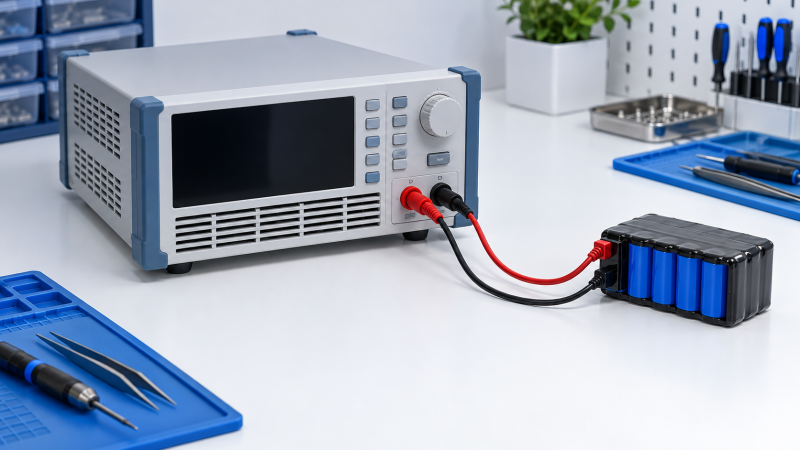
A programmable DC electronic load gives batteries, power supplies, chargers, and adapters a controlled discharge target. The models differ in voltage, current, and power limits, operating modes, dynamic test rate, remote control, and readback resolution. They also differ in whether they fit an occasional repair bench or a demanding lab workflow.
The five loads below all state programmable DC testing and battery-test support, but their ratings vary widely. Start with the voltage and current your device under test can deliver, then compare dynamic behavior and control interfaces before choosing a larger wattage figure.
Choose an electronic load around the actual voltage, current, power, and test mode your battery or supply must survive.Best Programmable DC Electronic Loads for Battery Testing Compared
| Image | Product | Details | Check Price |
|---|---|---|---|
 | mytithger ET5410A+ | Best fit: Feature-rich 400W varied bench testing Range: 0-150V, 0-40A, 400W Modes: 12 stated modes; USB remote control | Check Price on Amazon |
 | Rigol DL3021 | Best fit: 15kHz transient and SCPI testing Range: 150V, 40A, 200W Dynamic: 15kHz; 0.001 A/us to 5 A/us rise speed | Check Price on Amazon |
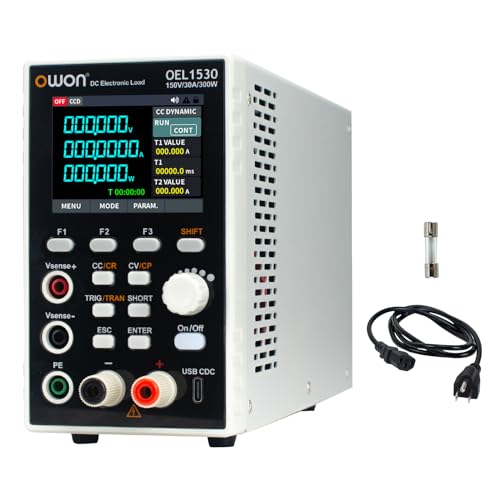 | OWON OEL1530 | Best fit: 300W 150V automated testing Range: 0-150V, 0-30A, 300W Control: USB, RS232, RS485, SCPI; 5kHz dynamic | Check Price on Amazon |
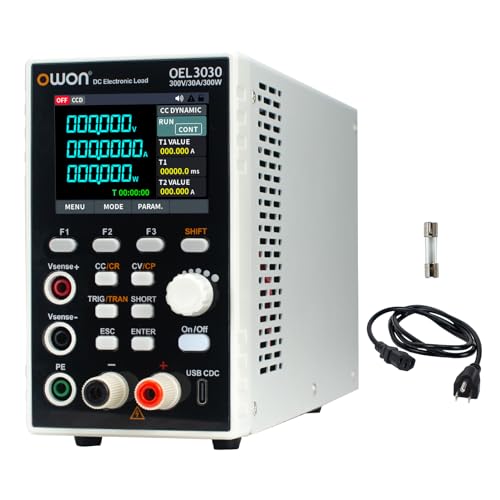 | OWON OEL3030 | Best fit: 300V automated battery and supply tests Range: 0-300V, 0-30A, 300W Control: USB, RS232, RS485, SCPI; 5kHz dynamic | Check Price on Amazon |
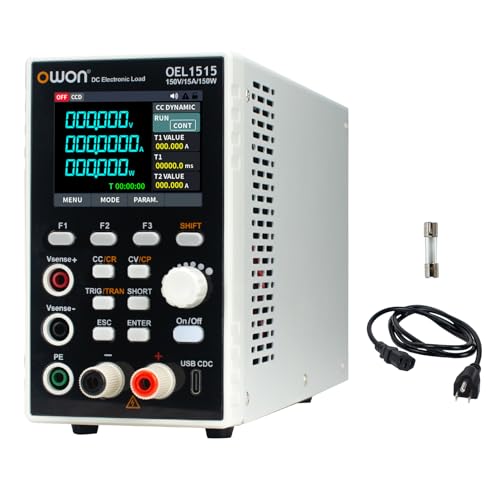 | OWON OEL1515 | Best fit: Compact 150W automated testing Range: 0-150V, 0-15A, 150W Control: USB, RS232, RS485, SCPI; 5kHz dynamic | Check Price on Amazon |
1. mytithger ET5410A+ — Best Feature-Rich 400W Bench Load
The mytithger ET5410A+ offers the most test modes of the mid-power loads in this group. It states a 400W rating, 0 to 150V input, 0 to 40A current, and twelve test modes that include CC, CV, CR, CP, battery, LED, dynamic transition, scan, list, and short-circuit tests.
That combination is useful when one bench evaluates several kinds of DC equipment rather than a single repeated supply. The bench also has a 2.8-inch 320 by 240 screen, USB remote control, a rotary knob, shortcut keys, and several stated protection functions.
Decision point: 400W, 150V, 40A, and twelve named test modes suit a bench that tests more than one type of battery or supply.For related bench planning, see our USB-C power meter guide and our USB oscilloscope guide.
Our TakeBuy the mytithger ET5410A+ if a 400W, 150V, 40A load with twelve named modes and USB control fits varied battery, charger, and supply testing. Choose Rigol DL3021 if its stated 15kHz dynamic mode is the priority rather than the widest stated test menu.
- The 400W, 150V, and 40A ratings give a mid-power bench explicit voltage, current, and power limits.
- Twelve stated modes include CC, CV, CR, CP, battery, LED, dynamic, scan, list, and short-circuit tests.
- Voltage resolution of 1mV or 10mV and current resolution of 1mA or 10mA support clearer stated readbacks.
- USB remote control supports PC operation and automated testing rather than relying on the knob alone.
- Over-voltage, over-current, over-power, over-temperature, and reverse-polarity prompts add several stated safety checks.
- The 400W ceiling is above the remaining 150W to 300W loads, which can be preferable when a smaller range matches the job.
- The listing emphasizes twelve modes but does not state a dynamic frequency comparable with Rigol’s 15kHz figure.
2. Rigol DL3021 — Best 15kHz Transient Testing
The Rigol DL3021 suits a buyer who cares more about dynamic behavior than a long feature list. It states 150V, 40A, and 200W capability, along with CC, CV, CR, and CP modes for battery capacity tests, discharge curves, and power testing.
The stated 15kHz dynamic mode and 0.001 A per microsecond to 5 A per microsecond adjustable rise speed fit power-supply transient response and voltage-regulator stability work. LAN, USB, RS232, and SCPI support also suit a bench that needs programmable automation.
For nearby repair and test choices, see our DC power supply guide and our logic analyzer guide.
Our TakeBuy the Rigol DL3021 if 15kHz dynamic testing, a 150V and 40A range, and LAN, USB, RS232, and SCPI control fit your supply-transient workflow. Choose the DL3021A instead if you need its higher stated 30kHz dynamic mode, since it has the same 200W power limit.
- A 15kHz dynamic mode targets power-supply transient response and voltage-regulator stability measurements on a stated basis.
- The 0.001 A/us to 5 A/us rise-rate range gives a buyer an explicit way to compare transient slew settings.
- CC, CV, CR, and CP modes cover the four core stated load-control methods for batteries and supplies.
- LAN, USB, RS232, and SCPI support fit a PC-controlled or automated production-test bench.
- A 4.3-inch TFT display shows multiple parameters and real-time power, voltage, and current curves together.
- The 200W total rating is lower than the 400W capacity stated for mytithger ET5410A+.
- Its 15kHz dynamic figure exceeds the 5kHz two-level switching figure stated by the OWON models.
3. OWON OEL1530 — Best 300W 150V Automation Load
OWON OEL1530 is designed around a 150V, 30A, 300W range with USB, RS232, and RS485 interfaces plus SCPI protocol support. The range and interfaces make it a middle choice for a lab or production line that needs remote integration without moving to a high-power 1500W instrument.
It lists CC, CV, CR, and CP modes, 5kHz dynamic switching between two levels, a 0.001 A/us to 2 A/us rise-rate range, and battery charge/discharge curves controlled by PC software. Its 2.8-inch display specifies 1mV and 0.1mA resolution.
Decision point: 150V, 30A, 300W, and USB, RS232, RS485, plus SCPI support fit automated mid-power bench testing.For related battery work, see our portable power-station guide and our USB-C meter guide.
Our TakeBuy the OWON OEL1530 if a 150V, 30A, 300W load with three remote interfaces and SCPI support suits automated test work. Choose OEL3030 if the device under test requires the stated 300V range, or OEL1515 if 150W and 15A are enough.
- The 150V, 30A, and 300W range gives a mid-power test bench stated limits for supplies and batteries.
- USB, RS232, RS485, and SCPI support create several listed paths for computer or production-line automation.
- CC, CV, CR, and CP modes cover the four core static operating modes named for programmable DC loads.
- Two-level dynamic switching reaches 5kHz with a stated 0.001 A/us to 2 A/us adjustable rise range.
- PC-controlled charge and discharge curves give battery testing a more structured stated workflow than a single manual run.
- The 30A limit is lower than the 40A stated by mytithger and Rigol DL3021.
- A 5kHz dynamic figure is below the 15kHz rate stated by Rigol DL3021.
- The 150V range cannot cover a device needing the 300V input range stated for OWON OEL3030.
4. OWON OEL3030 — Best for 300V Work
Voltage can rule out an otherwise capable load before dynamic rate or display features come into play. OWON OEL3030 doubles the listed voltage range to 300V while keeping the current at 30A and total power at 300W, so it has the highest stated input voltage among the mid-power OWON choices.
It has the same stated USB, RS232, RS485, SCPI, CC, CV, CR, CP, 5kHz dynamic, battery curve, and protection set as the OEL1530. Pick it when the device under test needs 300V, not because the figure is a larger number on the product sheet.
Buy the OWON OEL3030 if the device under test needs the stated 300V input range with 30A, 300W, and SCPI-enabled remote control. Skip it for OEL1530 when 150V covers the work and a lower voltage range is sufficient.
- The 300V input range doubles the stated 150V range of OEL1530, OEL1515, and the other loads with that range.
- Thirty amps and 300W maintain useful stated current and power limits despite the larger voltage capability.
- USB, RS232, RS485, and SCPI support keep the 300V model usable in a remote or automated test workflow.
- Five protection types include OCP, OVP, OPP, OTP, and reverse-polarity protection for stated device and load safeguards.
- PC-controlled charge and discharge curves support battery capacity and cycle testing with defined cutoff conditions.
- The 300V range is unnecessary for a 150V-or-lower device under test, where OEL1530 provides the same 300W rating.
- A 5kHz dynamic mode is lower than the 15kHz figure stated by Rigol DL3021.
5. OWON OEL1515 — Best Compact 150W Automation Load
OWON OEL1515 is the lower-capacity member of the same remote-control family. It states 150V, 15A, and 150W, together with USB, RS232, RS485, SCPI, CC, CV, CR, CP, 5kHz dynamic testing, and PC-controlled battery charge/discharge curves.
Its compact format and 2.8-inch display with 1mV and 0.1mA stated resolution fit modest supplies and battery work. It is a better choice when a 150W ceiling matches the expected test range, rather than buying a higher-current load the test will not call for.
Decision point: A 150V, 15A, 150W rating with USB, RS232, RS485, and SCPI suits lower-power automated testing. Our TakeBuy the OWON OEL1515 if a 150W, 15A, 150V load and SCPI-capable remote interfaces cover modest battery or supply testing. Choose OEL1530 when 30A and 300W are required, or a Rigol when a faster stated dynamic response is the priority.
- The 150V, 15A, and 150W ratings provide a clearly bounded load range for modest battery and adapter work.
- USB, RS232, RS485, and SCPI support preserve automated-control options despite the lower stated power rating.
- CC, CV, CR, CP, and 5kHz two-level dynamic tests cover the four stated modes plus transient behavior.
- A 2.8-inch display with 1mV and 0.1mA resolution provides stated readback detail for adjustments and monitoring.
- The 15A and 150W limits are half the current and power figures stated for OWON OEL1530.
- Its 5kHz dynamic figure is below the 15kHz number stated by Rigol DL3021.
- The 150V input range does not address testing that requires OEL3030’s stated 300V capability.
Buying Guide
Match voltage, current, and wattage before features
Start with the maximum voltage, current, and power of the device under test. OWON OEL3030 reaches a stated 300V, while mytithger ET5410A+ reaches 40A and 400W at 150V. The two serve different needs, so neither is better without the actual test range.
For a mid-power bench, mytithger ET5410A+ states 150V, 40A, and 400W. OWON rates OEL1530 for 150V, 30A, and 300W, while OEL1515 is rated for 150V, 15A, and 150W. Buy enough range, but do not turn a larger limit into an automatic advantage.
Choose dynamic mode around the transient you need
Dynamic mode is useful when you need to change load current and watch a supply respond. Rigol DL3021 states a 15kHz mode, while the OWON models state 5kHz two-level switching. The figures are directly comparable only when the test procedure uses the stated operating mode.
For a simpler switching pattern, two-level dynamic operation may be enough. OWON OEL1530, OEL3030, and OEL1515 state 5kHz switching between two preset levels with adjustable 0.001 A/us to 2 A/us transition rates. The required waveform should decide whether two levels are sufficient.
Pick CC, CV, CR, and CP only when the test calls for them
The four primary modes, CC, CV, CR, and CP, model different load behavior. Every product on this page states those core modes, so they do not separate one product from another. The question is which added battery, dynamic, list, LED, scan, or short-circuit modes make the actual test easier.
mytithger ET5410A+ states twelve test modes, including battery, LED, dynamic transition, scan, list, and short-circuit tests. OWON models add PC-controlled charge and discharge curves. Choose an additional mode only if the test procedure calls for it.
Plan remote control before building automation
Choose a connection set that matches the laptop or production fixture. Rigol DL3021 specifies LAN, USB, and RS232 with SCPI commands. OWON OEL models specify USB, RS232, RS485, and SCPI, which is useful when serial control and PC software both belong in the planned setup.
Basic USB control can be enough when the operator stays at the bench. mytithger ET5410A+ states USB remote operation with a 2.8-inch display, rotary knob, and shortcut keys. The arrangement suits manual and laptop-assisted testing without requiring several instrument interfaces.
Treat protection and cooling as part of the test plan
Treat the stated protections as a backup check on the chosen range, not as permission to exceed it. mytithger lists over-voltage, over-current, over-power, over-temperature, fan control, a buzzer alarm, and reverse-polarity prompt. OWON lists OCP, OVP, OPP, OTP, and reverse-polarity protection.
For a longer test, the load still needs an appropriate power and heat plan. A 400W mytithger load and a 150W OEL1515 have different stated workloads. Set the required test limits before connecting the device, and use the stated protections as a secondary safety layer.
FAQ
What does a programmable DC electronic load test?
A programmable DC electronic load applies a controlled load to a battery, charger, adapter, or power supply. The models here all state CC, CV, CR, and CP modes, so a buyer has several named ways to define how the unit draws from the device under test.
Different models add different test workflows. mytithger ET5410A+ lists battery, LED, scan, list, and short-circuit tests. OWON models list PC-managed charge and discharge curves. Choose the workflow that matches the required test rather than the longest list of modes.
How much wattage do I need?
You need a load whose stated wattage safely covers the planned voltage and current combination. OEL1515 is rated at 150W, Rigol DL3021 at 200W, OEL1530 and OEL3030 at 300W, and mytithger at 400W.
Higher wattage is not automatically a better fit. A 400W, 40A instrument is useful only when the test requires that stated range. For a small adapter or battery, a lower-rated bench load may better match the available power, space, and test procedure.
Why does dynamic test frequency matter?
Dynamic test frequency describes how quickly a load can change between programmed levels. Rigol DL3021 states 15kHz, and the OWON loads state 5kHz two-level switching.
The right figure depends on the transient behavior you need to evaluate. A simple battery discharge does not necessarily call for the fastest stated mode. A power supply or regulator response test may make dynamic rate and adjustable rise time more relevant than a higher total wattage number.
When should I choose a 300V electronic load?
Choose a 300V load only when the device under test can exceed the 120V or 150V input ranges of the alternatives. OWON OEL3030 states 0 to 300V, 0 to 30A, and 300W, so voltage is its defining advantage over OEL1530 and lower-voltage bench loads.
The larger voltage range does not raise its current or power above every alternative. mytithger states 40A and 400W at 150V. The device must actually need the larger voltage range before voltage becomes the deciding specification.
What interfaces are useful for automated testing?
Interfaces are useful when a laptop or fixture must program the load, repeat a test, or collect results without manual knob changes. Rigol DL3021 lists LAN, USB, RS232, and SCPI commands, while OWON lists USB, RS232, RS485, and SCPI support for its OEL models.
For an operator-led bench, USB may be sufficient. mytithger ET5410A+ specifies USB remote control together with a TFT display, rotary knob, and shortcut keys. Choose the interface set that your software and physical setup actually need before treating additional ports as a benefit.
Bottom Line
Rigol DL3021 is the best fit for stated 15kHz dynamic testing and SCPI control. OWON OEL3030 suits tests that need 300V. For a varied 400W bench, mytithger ET5410A+ offers the broadest stated test-mode selection.