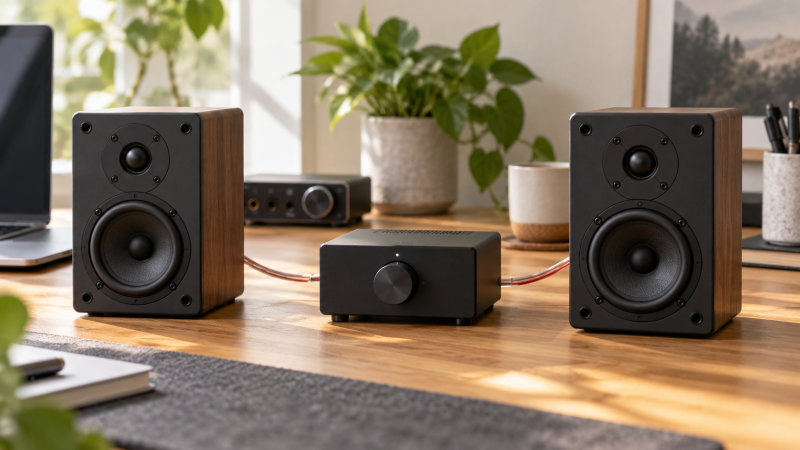
A mini amplifier lets passive speakers work in a laptop desk setup. Choose by speaker-load range, source inputs, physical controls, and the way the unit connects to your DAC or interface, since those decide more than a broad peak-power claim.
This guide compares six Amazon US mini amplifiers with active New offers. Each can drive passive speakers according to its listing, but the advertised inputs and output figures differ. Choose the unit that matches the source you use and check the amplifier’s stated speaker range before connecting a pair.
Match the amplifier’s inputs and stated speaker-load range to the desk system you already own before comparing output labels.Mini Amplifiers Compared




1. WOOPKER AK35 — Many Playback Inputs
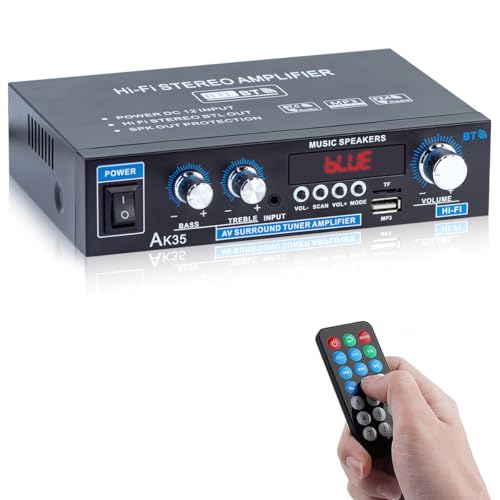
WOOPKER lists the AK35 as a two-channel mini receiver with 30W x2 RMS output and up to 100W plus 100W peak output for compatible passive speakers. Bluetooth 5.0, USB, TF or microSD, and AUX inputs are listed, so it suits a desk that mixes computer audio with local files or a phone.
Bass, treble, and master-volume controls are listed, along with a remote. The wide feature set does not establish how each input behaves with a particular DAC or laptop. Decide whether you need the extra playback modes before choosing it over a simpler amplifier with fewer paths to configure.
Our Take Buy the WOOPKER AK35 if multiple source types are your priority. It is a flexible desk receiver, but plan around its stated RMS figure and compatible-speaker requirement, not the larger peak label.
- Lists Bluetooth, USB, TF, and AUX playback inputs.
- Bass, treble, volume, and remote controls are listed.
- More source modes can complicate a fixed desk path.
- Peak output is not the same as the listed RMS figure.
2. Fosi Audio V1.0G — Simple Analog Class D Setup
Fosi Audio lists the V1.0G as a 50W x2 two-channel Class D amplifier using a TPA3116D2 chip. Its listing describes a 12V to 24V supply range and includes a power adapter, AC cord, and manual. The amplifier suits a desk that already has an analog output from a DAC or interface and does not need a screen or a long list of digital sources.
The listing describes an integrated protection circuit and aluminum chassis. Both are product features, not independent proof of heat or output performance. Check that the speaker pair and cable plan fall inside the limits stated by the amplifier and speaker manufacturers.
Our Take Buy the V1.0G if you want a compact, simple Class D amplifier with a supplied power package. It fits one known analog source better than a desk that needs optical, USB, or built-in wireless playback.
- Lists 50W x2 output and a TPA3116D2 chip.
- Power adapter and AC cord are listed as included.
- Does not list built-in optical or USB audio input.
- Speaker match still needs confirming separately.
3. Hosyond AK35 — Mic-Input Desk Audio
Hosyond lists its AK35 as a two-channel mini amplifier with 30W plus 30W rated power, Bluetooth 5.0, AUX, USB, SD card, and RCA inputs. It also lists two microphone jacks, FM radio, bass and treble controls, a remote, and a digital display. With that input mix, it is a possible mixed-use desk or small-room receiver rather than a minimal amplifier only for one interface output.
The listing gives a compatible passive-speaker range of 4 to 16 ohms. That range should be checked against the exact speaker pair, rather than inferred from a brand or cabinet size. The extra microphone and radio features are useful only if they are part of the job. Otherwise they add controls a simple desktop system may not need.
Our Take Buy the Hosyond AK35 if microphone inputs and several playback sources are useful at the desk. For a single route from a DAC to the speakers, a simpler amplifier may be easier to keep consistent.
- Lists RCA, AUX, Bluetooth, USB, and SD inputs.
- Two microphone inputs and remote are listed.
- Extra karaoke and radio functions are not needed for every desk.
- Speaker impedance must stay within the listed range.
4. 1Mii DeskRoar B75 — Optical and USB Input
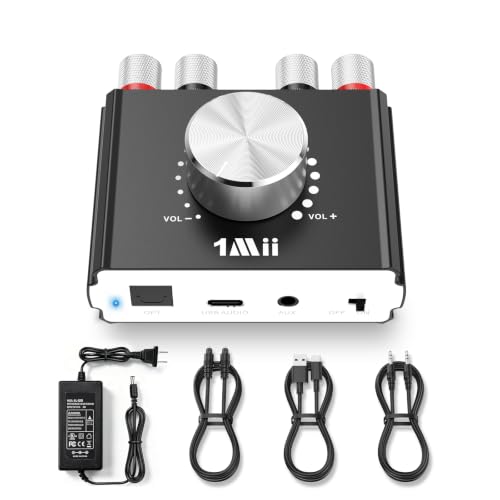
1Mii lists the DeskRoar B75 as a 50W x2 two-channel amplifier for 4 to 16-ohm speakers. USB audio, optical digital input, AUX, and Bluetooth 6.0 are all listed. It is the direct choice in this group if a computer’s USB audio or a separate optical source is part of the desktop path.
The listing also describes an aluminum alloy shell and a physical volume knob. Digital-input availability does not make it automatically better for every laptop, because the source operating system and connector route still need to be set up. It does let you use those listed inputs without a separate digital-to-analog converter.
Our Take Buy the DeskRoar B75 if optical or USB input is the reason to buy a mini amp. Its listed digital inputs cover USB and optical, but confirm your computer’s output path and the speaker load before committing.
- Lists USB, optical, AUX, and Bluetooth inputs.
- Lists 50W x2 output for 4 to 16-ohm speakers.
- Digital source configuration remains a separate task.
- More input choices are unnecessary for one analog source.
5. Fosi Audio TB10D — Higher Listed Output
Fosi Audio lists the TB10D with a TPA3255 chip and 300W per channel output, with compatibility for 2 to 8-ohm speakers. Its listing names RCA input, passive-speaker output, bass and treble knobs, and built-in protection circuits. The TB10D is the option to examine when the passive pair and amplifier requirements call for a higher stated output than a small entry-level unit.
The output label does not decide whether the TB10D suits a compact desktop speaker. Check the speaker manufacturer’s limits, the amp’s connection instructions, and the physical space needed for the amp and its supply. An amplifier with a higher listed ceiling does not make a small desk speaker safe to use without matching the system correctly.
Our Take Buy the TB10D if the passive speaker plan calls for its listed 2 to 8-ohm compatibility and RCA path. Its higher output does not replace the specifications of the speakers you attach.
- Lists 300W per channel and a 2 to 8-ohm range.
- RCA input and bass and treble controls are listed.
- Lists only RCA among source inputs.
- Higher output requires careful speaker matching.
6. Fosi Audio BT20A — Simple Bluetooth and RCA
Fosi Audio lists the BT20A as a compact Class D two-channel amplifier with 100W x2 maximum output, Bluetooth, RCA inputs, and bass and treble controls. Its direct input choices suit a desktop system that wants one analog source plus optional wireless playback without USB media, radio, or microphone functions.
The listing describes a one-touch power switch and an integrated black chassis. Use Bluetooth as a convenience source rather than assuming it matches the path from a dedicated interface. When a laptop desk has a DAC with RCA outputs, the direct analog connection is the clearer starting point for setting speaker level and tone controls.
Our Take Buy the BT20A if you want RCA input plus optional Bluetooth for passive speakers. It suits a buyer who does not need digital inputs or the higher listed output of the TB10D.
- Lists Bluetooth and RCA inputs.
- Bass, treble, and one-touch power controls are listed.
- No optical or USB input is listed.
- Maximum output label needs speaker-side context.
Buying Guide
Match source inputs before comparing power labels
The amplifier must accept the source you plan to use every day. RCA is a common analog path from a DAC, while the DeskRoar B75 also lists USB and optical digital inputs. A built-in Bluetooth receiver is helpful for casual playback, but it is not a substitute for confirming the interface or computer connection you use for the desk system.
Keep one listening path stable for comparisons. An amp with USB, optical, AUX, Bluetooth, and media playback can serve several jobs. For a consistent desk setup, set a primary source and note the amplifier volume and tone positions. Fixed settings make it easier to tell whether a change comes from the source or from the speaker setup.
Confirm the speaker load and connection method
Speaker impedance is part of the purchase decision. The Hosyond AK35 and 1Mii DeskRoar B75 list 4 to 16-ohm support, while the TB10D lists 2 to 8 ohms. Read the exact speaker label and manufacturer instructions before connecting anything. Do not estimate a match from speaker size or a vague passive-speaker category.
Speaker wire and terminals complete the amplifier path. The amplifier has to connect securely to both speakers, and the passive bookshelf speaker guide covers the other half of that choice. Plan the cable route before the desk is full of equipment, because a short tidy path is easier to inspect than wire stretched around furniture.
Put physical controls where you can use them
A compact amplifier still needs reachable controls and ventilation. Volume, bass, and treble knobs are useful when the unit sits near the listening position. Do not bury the amplifier behind a monitor just because its footprint is small. Leave enough access to turn it off, change a connection, and inspect the speaker terminals.
Extra features should solve a need at your desk. The two AK35 variants list many playback modes, while the V1.0G is a simpler analog design. Choose the added controls when you will use them, not because a longer feature list looks like a more complete audio system.
Frequently Asked Questions
Can a mini amplifier connect directly to passive speakers?
Yes. Connecting passive speakers is the main job of these products, but the speaker load and terminal connection still need checking. The amplifier connects to passive speakers with speaker wire, and the listed load range needs to cover the exact pair you select.
The source device follows a separate path. A laptop may feed an amplifier through a DAC, USB audio, Bluetooth, optical output, or an analog connection, depending on what the amp and computer support.
Is more advertised amplifier power always better for a desk?
No. Check the speaker’s stated limits and the amplifier’s supported load before a large output label. The TB10D lists a higher output than the smaller units here, but a higher output does not make it a universal match for every passive speaker.
Choose power after confirming the speaker’s requirements and the way you listen. A compact desk pair can need a different setup from a larger room system, even when both use passive connections.
Should I use Bluetooth or a wired input for a laptop desk?
Use a wired input for focused listening, because a known wired path is easier to keep consistent. Bluetooth can be convenient for casual use. The DeskRoar B75 lists USB and optical alongside AUX and Bluetooth, and the Fosi units offer RCA routes for an external DAC.
Pick the connection that your computer and interface support cleanly. Set a stable source and amplifier level before making comparisons, then use Bluetooth as an alternate input if its convenience is useful to you.
Bottom Line
For a simple analog Class D setup, Fosi Audio V1.0G is the direct starting point. For USB and optical input, 1Mii DeskRoar B75 is the one to look at, since both are listed. For a simple Bluetooth and RCA amplifier, Fosi Audio BT20A is the focused choice.