The Short Version
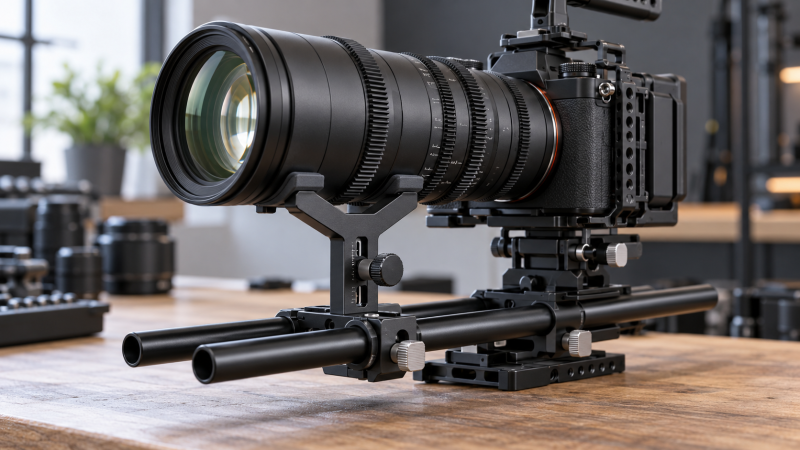
A 15 mm rod lens support takes strain off the camera’s lens mount when a long or heavy lens sits on a shoulder rig, baseplate, or cinema rail system. The support attaches to standard 15 mm LWS rods and raises a padded Y- or V-shaped bracket until it meets the lens barrel, tripod collar, or support foot. The differences that decide the choice are adjustment range, lens diameter clearance, and whether a built-in pulley can ride beneath a moving zoom or focus ring.
Choose the NICEYRIG 475 for the largest stated 64 mm of vertical adjustment. The SmallRig 2727 is the pulley choice for a lens whose zoom or focus ring needs to pass over the support. The SmallRig BSL2681 combines 53.5 mm of adjustment with a stated 50 to 140 mm lens diameter range.
These supports are for standard 15 mm LWS rods and are not a substitute for a baseplate or a tripod collar. The lens needs a compatible contact point, and the rig needs two correctly spaced rods. Start with the lens diameter and the distance from the rods to the underside of the lens. Then choose the adjustment range and bracket style that reach that point without pressing against a moving control.
Quick Picks
- Best largest stated adjustment range: NICEYRIG 475 for 64 mm of vertical travel.
- Best for a moving zoom or focus ring: SmallRig 2727 for a V-bracket with built-in pulley.
- Best 53.5 mm quick-adjust support: SmallRig BSL2681 for 50 to 140 mm lenses and rubber cushions.
- Best universal long-lens support: SmallRig BSL2680 for 50 to 140 mm lens diameters on 15 mm rods.
- Best pulley-style budget support: Leftfoto Y-Shaped Lens Support for adjustable wingnuts and a built-in pulley.
How We Picked
Every product here is a height-adjustable Y- or V-bracket support for a 15 mm LWS rod system. Three of the five list an adjustment figure, from 30.5 mm through 64 mm. Three state a large 50 to 140 mm lens diameter range, and two include a built-in pulley according to manufacturer specifications. A baseplate and a matte-box support were excluded because neither is itself a Y- or V-shaped lens support.
Lens support is one part of a field camera setup. A buyer might pair it with a camera monitor arm, external SSD, wireless lavalier system, USB microphone, or creator shoulder bag. The support should fit beneath the lens without interfering with those accessories or the camera’s normal adjustments.
Comparison Table
| Image | Product | Details | Check Price |
|---|---|---|---|
 | SmallRig BSL2680 | Best fit: Universal long-lens support Rod system: 15 mm LWS Lens diameter: 50–140 mm Contact: Y bracket with rubber washers | Check Price on Amazon |
 | NICEYRIG 475 | Best fit: Largest stated adjustment range Rod system: 15 mm LWS Vertical adjustment: 64 mm Contact: Y bracket with rubber pads | Check Price on Amazon |
 | SmallRig 2727 | Best fit: Lens with moving zoom or focus ring Rod system: 15 mm LWS Vertical adjustment: 30.5 mm Contact: V bracket with pulley | Check Price on Amazon |
 | SmallRig BSL2681 | Best fit: 53.5 mm quick-adjust support Rod system: 15 mm LWS Vertical adjustment: 53.5 mm Lens diameter: 50–140 mm | Check Price on Amazon |
 | Leftfoto Y-Shaped Lens Support | Best fit: Budget pulley-style support Rod system: 15 mm LWS Adjustment: Wingnuts Contact: Y bracket with pulley | Check Price on Amazon |
1. SmallRig BSL2680 — Best Universal Long-Lens Support
When a long lens sits on a standard 15 mm LWS rig and you want a padded cradle rather than a pulley, the SmallRig BSL2680 is the straightforward universal choice. Its Y-shaped bracket screws onto the rod clamp and supports lenses with a stated 50 to 140 mm diameter range. Rubber washers protect the lens finish, while the groove and slot design can work with a Velcro strap for additional restraint where the lens needs it.
The listing calls the height adjustable but gives no numerical travel figure. Measure the distance from the rods to the lens rather than assuming the 50 to 140 mm diameter range guarantees clearance on every baseplate. The BSL2680 is the simple pick when a padded Y cradle is more useful than a pulley beneath moving lens rings.
Pros
- Standard 15 mm LWS compatibility makes it a direct add-on for common shoulder rig rod systems.
- The stated 50 to 140 mm lens diameter range covers many long still and cinema lenses.
- A Y-shaped bracket and rubber washers support the lens while protecting its finish at the contact point.
- The groove and slot design accepts a Velcro strap for additional restraint on a heavy lens.
Cons
- The listing gives no numerical vertical travel figure, so the distance from the rods to the lens needs direct measurement.
- A fixed Y cradle is less suitable than a pulley when a ring must move across the support.
2. NICEYRIG 475 — Best Largest Stated Adjustment Range
The NICEYRIG 475 is the choice for a long lens whose underside sits farther above the 15 mm rods. It gives a stated 64 mm of vertical travel through a thumbscrew and uses a Y-bracket with rubber pads. The listing also describes a half-open rod clamp, which lets you mount or remove the support on 15 mm rods without taking the whole rod setup apart.
Its specified lens diameter range is 50 to 140 mm, the same broad range stated by both SmallRig long-lens supports. Strap slots on each side offer another security option, and the body is aluminum alloy. Pick it when vertical reach, not a pulley, is the problem to solve.
Pros
- The stated 64 mm adjustment range is the largest explicit vertical travel figure in this group.
- A half-open 15 mm rod clamp can mount or remove without taking the rod system apart.
- The 50 to 140 mm lens diameter range suits many long lenses and collars on a cinema rig.
- Rubber pads and side strap slots add protective contact and an optional extra retention path.
Cons
- It uses a Y cradle rather than a pulley, so a moving ring must clear the support position.
- The taller 64 mm travel should be set carefully to avoid lifting the lens instead of supporting it.
3. SmallRig 2727 — Best for Moving Zoom or Focus Rings
When a zoom or focus ring has to move at the spot where the lens needs support, the SmallRig 2727 is the practical option. Its V-shaped bracket has a built-in pulley, which allows the contact point to roll rather than lock the usable position to one gap between rings. The support fits 15 mm LWS rods, lists 30.5 mm of vertical adjustment through a quick-release thumbscrew, and accommodates stated lens diameters from 73 to 108 mm.
SmallRig also states that this support is suitable for lenses within 2 kg. The 2727 is therefore a fit for the lens sizes in its listed diameter range, not a universal answer for every heavy cinema zoom. Choose it when the pulley solves a ring clearance problem and the 30.5 mm adjustment reaches the lens from the existing rods.
Pros
- The built-in pulley lets a zoom or focus ring move past the V-bracket instead of rubbing a fixed cradle.
- A stated 30.5 mm adjustment range makes the clearance between the rods and the lens more predictable before installation.
- The 73 to 108 mm diameter range narrows the choice to lenses the V-bracket is designed to contact.
- A quick-release thumbscrew allows height changes without a separate adjustment tool.
Cons
- The stated 2 kg lens limit is lower than the broad long-lens role implied by the Y-cradle supports.
- Its 73 to 108 mm range excludes some narrower and wider lenses covered by 50 to 140 mm alternatives.
4. SmallRig BSL2681 — Best 53.5 mm Quick-Adjust Support
The SmallRig BSL2681 suits a buyer who wants both a wide diameter range and a stated adjustment figure. SmallRig specifies that its Y-shaped bracket mounts to standard 15 mm LWS rods and supports lenses from 50 to 140 mm in diameter. The manufacturer provides a centered quick-release knob for 53.5 mm of vertical adjustment, while two rubber cushions increase friction and protect the lens contact surface.
The support is intended to remove stress from a cinema-lens support foot or a still-lens tripod collar, rather than carry a lens by pressing a random moving ring. Strap slots on both sides offer another retention option. It is the all-round choice when you want stated vertical travel and a large diameter range without the pulley mechanism of the 2727.
Pros
- The stated 53.5 mm vertical adjustment provides substantial height control on standard 15 mm rods.
- A 50 to 140 mm lens diameter range covers both medium and long lens barrel support jobs.
- Two rubber cushions increase grip while protecting the lens or support foot contact surface.
- A centered quick-release knob makes height changes direct during initial rig balancing.
- Side strap slots offer an additional security option for an appropriate long-lens setup.
Cons
- Its fixed Y-shaped contact does not offer the rolling ring clearance of the SmallRig 2727 pulley.
- The support still needs a compatible support foot, collar, or safe barrel contact point beneath the lens.
5. Leftfoto Y-Shaped Lens Support — Best Pulley-Style Value
When a lens ring has to move at the support position and you don’t want a design built for one camera, the Leftfoto Y-shaped support is the pulley alternative for a 15 mm LWS rig. Leftfoto states the adjustable wingnuts change the support height, and its built-in pulley lets the bracket sit under a moving zoom or focus area. The listing says the support is suitable for lenses within 2 kg and uses aluminum alloy construction.
According to the manufacturer, it uses locking knobs for rod attachment, so it can add to most shoulder rigs without a cage made for one camera body. The listing gives no numerical adjustment range or lens diameter range. Measure the lens and rod geometry before choosing it, especially when the support must reach a tall cinema lens barrel.
Pros
- A built-in pulley gives moving zoom or focus rings a rolling contact instead of a static support surface.
- Adjustable wingnuts allow height changes on a standard 15 mm LWS rod setup.
- The stated 2 kg lens suitability provides a practical ceiling for lightweight and midweight lens support.
- Locking knobs and aluminum construction keep the design simple for a shoulder rig installation.
Cons
- No vertical adjustment range or lens diameter range is stated, unlike the 50 to 140 mm and 73 to 108 mm ranges on the other supports, so rod and lens geometry must be measured first.
- The pulley adds a moving contact where a padded Y cradle may suit a fixed support foot better.
Buying Guide: How to Choose a Height-Adjustable 15 mm Lens Support
Verify the Rod Standard and Lens Contact Point
All five supports fit a 15 mm LWS rod system, but the rods need to be present, correctly spaced, and positioned beneath the lens. A support doesn’t replace a baseplate. It clamps to the rods that the baseplate or camera rig already provides. The contact point should be a lens support foot, a tripod collar, or a safe underside of the barrel rather than a control ring.
Confirm the lens has a stable support point before tightening the bracket. A Y or V support should relieve load from the mount, not push upward hard enough to change alignment. If the lens has no safe contact area or the rods sit too low for the available vertical travel, a different rig geometry is required.
Measure Vertical Travel Against the Existing Rig
Vertical travel determines whether the bracket reaches the lens from the rods. The NICEYRIG 475 is rated for 64 mm, the SmallRig BSL2681 lists 53.5 mm, and the SmallRig 2727 specifies 30.5 mm. The three figures describe different adjustment windows. More travel can solve a tall lens setup, while a shorter mechanism can work neatly where the lens already sits close to the rods.
Measure from the rod centerline to the intended contact point. This simple check keeps you from buying a support that is correctly sized for the lens diameter but cannot rise high enough. Set the bracket to support the lens gently, then verify that the camera mount and lens remain unstressed when the rig is moved.
Match the Bracket to Moving Lens Rings
A fixed Y bracket suits a support foot, a collar, or a stationary barrel section. The SmallRig BSL2680, NICEYRIG 475, and SmallRig BSL2681 use padded Y-shaped contact. The SmallRig 2727 and Leftfoto use a built-in pulley, which lets a moving zoom or focus ring pass over the support instead of rubbing against a static cradle.
Choose a pulley when the lens ring must move at the support location. A pulley isn’t automatically better for every lens. It adds a moving contact mechanism where a padded Y cradle may be more appropriate for a fixed support foot. The right choice follows the physical layout of the lens.
Use Diameter Ranges as Fit Limits, Not General Labels
The SmallRig BSL2680 and BSL2681 state 50 to 140 mm lens diameter ranges, and the SmallRig 2727 states 73 to 108 mm. A range helps show whether the cradle can reach and contact the barrel shape correctly. The Leftfoto listing gives no diameter range or adjustment range, so its fit needs closer measurement against the rig.
Compare the lens’s outside diameter where the support will touch. Don’t use the front filter thread or the widest hood diameter as a substitute if the support contacts another barrel section. A range that matches the actual contact zone is more useful than the lens’s marketing name or focal length.
Support Weight Without Lifting the Lens
The SmallRig 2727 and Leftfoto listings state suitability for lenses within 2 kg. The other long-lens supports describe relieving stress from the camera mount without giving the same figure for the product. The support should carry some of the lens load without pushing the lens out of its natural position relative to the camera.
Set the bracket to meet the lens, then lock it without forcing upward pressure. Check the rig while holding the lens and camera naturally. If the support changes focus, alignment, or rod position as it tightens, reposition it rather than applying more force.
Frequently Asked Questions
Do I need a lens support for every lens on 15 mm rods?
No. A lens support is most useful when a long or heavy lens places meaningful stress on the camera mount or has a support foot or collar designed for the job. The SmallRig BSL2680 and BSL2681 cover stated 50 to 140 mm barrel diameters, while the 2727 and Leftfoto list 2 kg lens suitability for their pulley supports.
Use a support when the rig and lens justify it. The presence of rods is not a reason on its own. A small lightweight lens may not need another contact point, while a longer lens can benefit from having its load shared with the rod system.
What is the advantage of a pulley lens support?
A pulley lets a moving zoom or focus ring roll across the support point instead of rubbing against a fixed Y bracket. The SmallRig 2727 and Leftfoto include built-in pulleys, which makes them useful where the lens’s adjustment ring occupies the natural support position. The 2727 specifically pairs that design with 30.5 mm vertical adjustment.
Use a fixed padded Y bracket for a static support foot or collar. A pulley answers a clearance problem with moving rings. It doesn’t improve a lens that already has a stable fixed point beneath it.
How high should I set the lens support?
Set it high enough to meet the lens or its support foot gently, without lifting the lens above its natural position. The NICEYRIG 475 has 64 mm of stated travel, the SmallRig BSL2681 has 53.5 mm, and the SmallRig 2727 has 30.5 mm, so each support begins from a different height range.
The correct setting shares load without forcing alignment. After tightening the rod clamp and height control, move the rig carefully and check that the lens, camera mount, and focus or zoom rings still operate naturally.
Will a 50–140 mm lens support fit my lens?
It can fit if the outside diameter at the intended contact point falls within the stated range. The SmallRig BSL2680 and BSL2681 list 50 to 140 mm, while the 2727 lists 73 to 108 mm. Measure the barrel, collar, or support foot where the bracket will actually touch rather than using the front diameter or the lens name.
Diameter is only one part of the fit. The rods must sit at the right height, the support needs sufficient adjustment travel, and the contact point must be stationary or use a pulley when it moves. Check all three before buying.
Can a lens support replace a tripod collar?
No. A tripod collar is a lens-mounted balance and support point, while a 15 mm lens support is a rig accessory that meets the lens from rods below. The BSL2681 listing describes relieving mount stress through a cinema-lens support foot or still-lens tripod collar. It doesn’t replace either one.
Use the two parts together when the lens supports that workflow. The collar or foot provides the safe contact point, and the bracket on the rods helps transfer part of the lens load away from the camera mount.
Bottom Line
Choose the NICEYRIG 475 for the largest stated 64 mm vertical range, the SmallRig 2727 when a built-in pulley needs to clear moving rings, or the SmallRig BSL2681 for 53.5 mm travel and a 50 to 140 mm diameter range. Measure the rods, the lens contact point, and the moving rings before buying. A support works best when it gently shares lens load without changing the rig’s alignment.