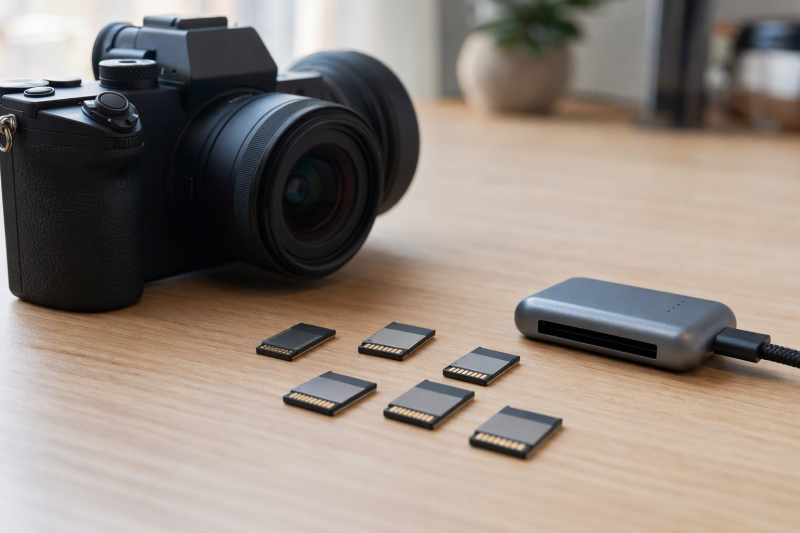
A Sony camera may accept both SD and CFexpress Type A cards, yet a high-data-rate movie mode can require a specific card class. Check the camera’s recording-mode media table first, then the exact card model, capacity, and VPG marking. Peak “read up to” numbers mainly describe offload with a matching reader. They do not prove the card can sustain a particular video mode in your camera.
This six-card selection covers VPG200 and VPG400 classes, 240 to 640 GB capacities, and both CFexpress 2.0 and 4.0 products. Camera compatibility, dropped-frame behavior, transfer speed, and durability were not independently tested for this guide. CFexpress Type B is physically different and is not a substitute for a Sony Type A slot. Use the camera maker’s current media table for the actual body, firmware, codec, frame rate, and S&Q setting.
Write down the exact camera body and recording mode. Match its required Type A/VPG class before choosing capacity or the fastest number on a product box.CFexpress Type A Cards Compared
Capacities, VPG classes, and peak speeds below are manufacturer-listed specifications, not independently measured results.
| Image | Product | Details | Check Price |
|---|---|---|---|
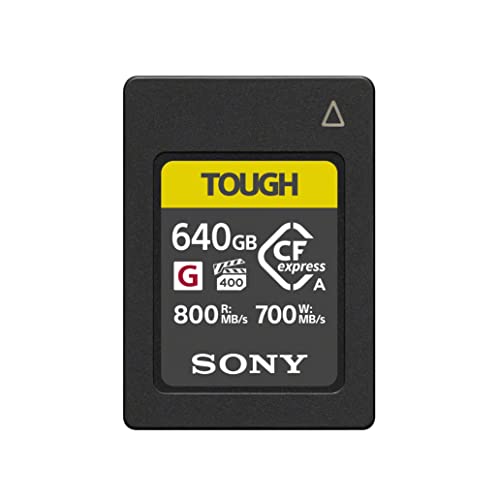 | Sony TOUGH 640GB | Capacity: 640 GB Class: Type A 2.0; VPG400 Peak read: 800 MB/s stated Best fit: Large Sony card | Check Price on Amazon |
 | Angelbird AV PRO 256GB | Capacity: 256 GB Class: Type A 4.0; VPG400 Peak read: 1800 MB/s stated Best fit: VPG400 rotation | Check Price on Amazon |
 | OWC Atlas Pro 480GB | Capacity: 480 GB Class: Type A 4.0; VPG200 Peak read: 1850 MB/s stated Best fit: Mid-size VPG200 | Check Price on Amazon |
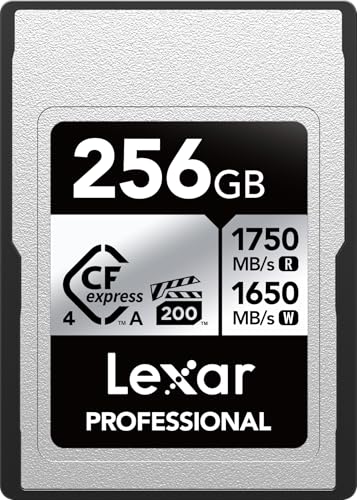 | Lexar SILVER 256GB | Capacity: 256 GB Class: Type A 4.0; VPG200 Peak read: 1750 MB/s with reader Best fit: Fast reader pairing | Check Price on Amazon |
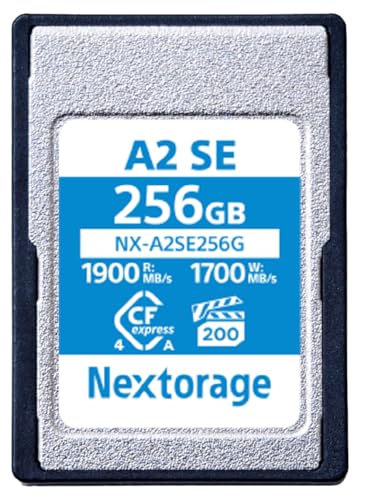 | Nextorage NX-A2SE 256GB | Capacity: 256 GB Class: Type A 4.0; VPG200 Peak read: 1900 MB/s stated Best fit: Plain VPG200 candidate | Check Price on Amazon |
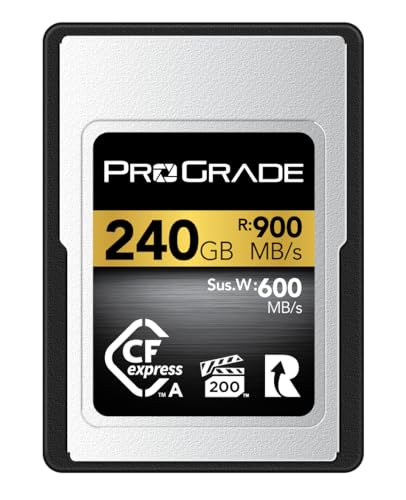 | ProGrade Gold 240GB | Capacity: 240 GB Class: Type A 2.0; VPG200 Peak read: 900 MB/s stated Best fit: Smaller card rotation | Check Price on Amazon |
1. Sony TOUGH 640GB — Best Large Sony-Made Card
The exact Sony CEA-G640T is a 640 GB CFexpress Type A card with up to 800 MB/s read and 700 MB/s write in its checked listing. Sony’s product page names VPG400 for this model and describes TOUGH construction. With the most capacity of the six cards, you can swap cards fewer times on a long shoot, but more footage sits on one physical card. Plan a card rotation and verified second copy rather than treating one large card as an archive.
Do not confuse this older CEA-G640T CFexpress 2.0 product with Sony’s newer CEA-G480T/960T CFexpress 4.0 family. The 800/700 MB/s peak figures are not a guarantee of offload speed through any reader, and VPG400 is a sustained-video certification class, not a promise of footage survival. Confirm the Sony body and mode in its help guide. Sony-branded media alone does not automatically enable every codec or frame rate.
Our Take Choose the CEA-G640T if you want a large Sony-made VPG400 card. Check the exact model and card generation before trusting the TOUGH branding.
- 640 GB capacity in exact offer.
- Sony product page states VPG400.
- TOUGH construction described.
- CFexpress 2.0-era 800/700 MB/s peaks.
- One card concentrates shoot risk.
2. Angelbird AV PRO 256GB — Best VPG400 Creator Option
Angelbird’s exact AVP256CFXAMK2 offer is a 256 GB CFexpress 4.0 Type A card with VPG400 in the listing. The CompactFlash Association certified-card list also lists the 256 GB AV Pro CFexpress A MK2 Type A card at VPG400. The certification list is stronger evidence for the video class than a seller’s “8K+” phrase. The seller states up to 1,800 MB/s read and 1,650 MB/s write with an 800 MB/s consistent-write claim. Read that consistent-write number as product marketing beyond the certified minimum.
The listing names multiple Sony Alpha and FX cameras, but camera-mode support still belongs to the body-specific Sony table. Angelbird also mentions firmware updates via its Type A reader and an in-house data recovery service. Neither the firmware updates nor the recovery service replaces an on-set backup. A 256 GB card may suit a rotation where exposed cards are offloaded frequently, while a long high-bitrate session may call for more capacity or more cards.
Our Take Choose Angelbird if you want a compact VPG400 card with an exact-model certification record. Check your reader and camera workflow before paying for peak transfer figures.
- Exact 256 GB MK2 model listed VPG400.
- CFexpress 4.0 Type A.
- Firmware/recovery services described.
- 256 GB needs more swaps than large cards.
- Maximum speed needs a compatible reader.
3. OWC Atlas Pro 480GB — Best Mid-Size VPG200 Card
OWC’s Atlas Pro offers 480 GB and CFexpress 4.0 Type A in the checked listing. It states VPG200 and a 400 MB/s minimum sustained-write product claim, with peaks up to 1,850 MB/s read and 1,700 MB/s write. The VPG200 marking is the certified class, while the 400 MB/s number is a separate vendor claim. Do not turn one into the other. The CompactFlash Association defines VPG levels by their own minimum sustained recording performance.
OWC lists Sony Alpha, FX, and FR7 families and bundles its Innergize management tool. The exact Sony mode table remains decisive. A family-level compatibility list cannot prove that every slow-motion or intraframe setting works. The 480 GB capacity is a compromise between 256 GB rotation and the 640 GB Sony card. Check how many minutes your codec and bitrate consume, then leave room for a safe card change before the media fills.
Our Take Choose the Atlas Pro if you want middle capacity on CFexpress 4.0 and VPG200 meets your camera mode. OWC’s sustained-write number should not be mistaken for the VPG class definition.
- 480 GB capacity.
- VPG200 stated.
- Innergize tool listed.
- No VPG400 claim for this exact card.
- Offload peaks require an appropriate reader.
4. Lexar SILVER 256GB — Best Fast Reader Pair
The exact Lexar SILVER 256 GB Type A card lists CFexpress 4.0 and VPG200. The CFA certified-card list names the Lexar Professional SILVER 256 GB Type A model at VPG200. The offer advertises up to 1,750 MB/s read, 1,650 MB/s write, and up to 1,300 MB/s sustained write, but its fastest read number requires Lexar’s separate CFexpress Type A USB4 reader. The card is not automatically that fast through an older USB reader or the camera body.
The seller also claims IP68 and 5 m drop resistance; those claims are not independently verified here. Those labels do not replace immediate media copies after a shoot. Lexar’s listing says “8K Video,” but that phrase does not establish compatibility with every 8K-capable Sony body or every format. Decide from the camera’s Type A/VPG requirement and the exact recording mode, then choose a reader that can use the card’s speed if offload time is a priority.
Our Take Choose Lexar SILVER if you want a VPG200 card and will pair it with the separate reader Lexar names for its top read speed. Buy for a compatible Sony mode, not the isolated 1,750 MB/s headline.
- Exact SILVER 256 GB appears in CFA VPG200 list.
- CFexpress 4.0 Type A.
- Reader dependency is stated.
- Fast reader sold separately.
- Durability and sustained-speed claims untested here.
5. Nextorage NX-A2SE 256GB — Best Plain VPG200 Starter
Nextorage’s NX-A2SE256G is a 256 GB CFexpress 4.0 Type A VPG200 card. Its model-specific documentation confirms the Type A 4 and VPG200 identifiers. The listing says up to 1,900 MB/s read and 1,700 MB/s write when paired with a CFexpress 4.0 reader, plus a separate rescue-software download. The read and write speeds and the rescue software are useful planning details, not proof of a guaranteed camera recording rate or successful recovery of deleted footage.
One seller bullet incorrectly treats VPG200 as a 400 MB/s minimum. Use the CompactFlash Association’s VPG definition instead. VPG200 is the 200 MB/s class. Because the seller and the association disagree, trust the model document over the seller’s bullet. A Sony camera may require VPG200 or higher for a given mode, but check the body’s current help guide. Ignore claims of “buffer-free” continuous shooting, because buffer behavior also depends on camera and file settings.
Our Take Choose Nextorage if you want a 256 GB Type A VPG200 candidate and will disregard the seller’s VPG error. It does not replace the camera-mode table.
- Model document confirms Type A 4/VPG200.
- Reader dependency is described.
- Rescue-software access listed.
- Seller misstates VPG200 minimum speed.
- 256 GB requires more rotation.
6. ProGrade Gold 240GB — Best CFexpress 2.0 Rotation Card
ProGrade’s Gold offer is a 240 GB CFexpress 2.0 Type A card with VPG200 in the checked listing. It advertises up to 900 MB/s read, up to 800 MB/s write, and 600 MB/s sustained write. The last number is a vendor claim, not the VPG200 definition. For a studio that already has Type A 2.0 readers and favors frequent card rotation, the card can be a sensible fit if the exact Sony recording mode accepts VPG200.
The seller mentions serialized tracking, a three-year warranty, and an optional Refresh Pro tool. Optional software does not create a backup, and no card here makes camera-media handling risk-free. At 240 GB, the smallest capacity here, plan enough spare cards for the day’s recording bitrate and offload schedule. The checked listing’s broad “4K, 8K, RAW” language is not a camera-mode compatibility chart. Verify the actual model and format before relying on it for a paid shoot.
Our Take Choose ProGrade Gold if you want a small CFexpress 2.0 card for rotation and your Sony mode accepts VPG200. It is not an automatic substitute for higher-class media.
- VPG200 stated for exact offer.
- 240 GB can suit card rotation.
- Optional management tool listed.
- CFexpress 2.0-era peak read speed.
- No VPG400 claim.
Buying Guide: Choose the Recording Guarantee First
Read the Sony media table for your exact mode
Sony’s body-specific memory-card guide shows that format, bitrate, and S&Q settings change the required media. A card can work for stills or ordinary video yet fail a particular high-data-rate setting. Do not generalize one camera’s table to all Sony Alpha and FX bodies. Confirm the body model, firmware, selected codec, frame rate, and whether the slot is CFexpress Type A/SD shared.
Type A is physically different from Type B, and CFexpress 4.0 peak reader speed does not change the camera’s own interface limit. The CompactFlash Association card-types page distinguishes the form factors. For another camera brand, recheck its own slot and format requirements rather than trying to reuse a Sony Type A purchase. These six cards are not an all-camera compatibility list.
Understand VPG and peak speed separately
The CompactFlash Association VPG program defines certified minimum sustained-video classes. VPG200 and VPG400 describe 200 and 400 MB/s classes, respectively, under the association’s test protocol. They are more directly relevant to high-data-rate capture than a card’s best-case read burst. Check the certified-card list for the exact part number. A brand can sell multiple capacities and generations with different ratings.
A seller’s “up to” write or “sustained” number is not the VPG certification itself. OWC documents a 400 MB/s minimum while carrying VPG200. Nextorage’s listing incorrectly calls VPG200 a 400 MB/s guarantee. Use the class marking and the Sony mode table for recording eligibility. Choose VPG400 only when your mode or risk tolerance calls for it. A faster class does not make unverified footage backed up.
Plan card capacity and offload as one workflow
Calculate approximate recording time from the camera’s actual bitrate and usable card capacity, leaving margin before a card fills. The six Amazon listings specify manufacturer-rated capacities of 240, 256, 480, and 640 GB. A large card reduces swaps but can contain more uncopied footage. Several smaller cards allow rotation while earlier cards are ingested. Neither pattern is inherently safe unless the copies are verified and cards are clearly marked.
For fast offload, match a Type A reader and host USB bandwidth to the card generation. Lexar rates its 1,750 MB/s peak with a separate USB4 reader. Nextorage also names a CFexpress 4.0 reader for its peak. Our USB-C hub guide helps with laptop host ports, and the USB-C docking station guide covers fixed desks. Neither guide guarantees reader speed or verifies a copy. Keep source cards intact until at least two separate copies have been checked.
Frequently Asked Questions
Is VPG200 enough for every Sony high-bitrate video mode?
No blanket answer is safe. The exact Sony body and recording setting decide, and some modes may require Type A media at a stated VPG level. Consult the current media table in that camera’s help guide. A card sold as “8K-ready” does not establish every codec, frame rate, and S&Q combination.
VPG200 is a certified sustained-performance class, not a prediction of how much footage fits. If the table calls for higher-rated media, select an exact VPG400 model and verify it in the camera before a critical shoot. Do not rely on a product-family name alone.
Will a CFexpress 4.0 Type A card offload at 1,800 MB/s on my laptop?
You get that speed only under a suitable end-to-end path. The card, Type A reader, cable, host port, and destination drive all affect transfer speed. Lexar conditions its peak read figure on a particular separate USB4 reader. Nextorage also points to a compatible 4.0 reader. A slower reader can still read the card but will not reach the headline speed.
The camera’s recording interface may have a different limit from the reader. Select the VPG class for capture first, then improve offload only if the editing workflow needs it. No peak speed figure proves copied files are complete.
Can I use a CFexpress Type B or SD card instead?
Type B will not physically fit a Type A slot. Some Sony cameras share slots between Type A and SD, but a demanding recording mode may require Type A/VPG media rather than a particular SD class. The camera’s mode table is the source of truth, not the appearance of the slot door.
If SD is allowed for your actual mode, check its required speed class and capacity separately. For paid work, test the chosen card in the camera, record sample footage, and verify it after offload before assuming an untested card combination is dependable.
Bottom Line
Choose Sony TOUGH 640GB for a large Sony-made VPG400 card, Angelbird AV PRO 256GB for a smaller certified VPG400 candidate, or OWC Atlas Pro 480GB for middle capacity at VPG200. Match the exact Sony mode first, then plan card rotation and verified offload.