



But the sad thing is unless the tech for wireless data transfer drastically improves in the coming years (it doesn’t look like it), we’re stuck with cables.
There are a few ways to reduce the number, though, and if you’re working with multiple PCs but using the same peripherals, a KVM switch will work wonders for your setup’s aesthetics and efficiency.
For example, if you have a gaming PC and a work laptop. You can hook up your display unit and other peripherals to the KVM switch and then connect the KVM to your computers. Using a KVM, you can switch between each computer with a click of a button, so you won’t have to juggle wires whenever you switch between your PC and laptop.
In the past, KVM switches were only used in workplaces to increase efficiency, but they have also found their way aboard home stations. The market is medium-sized, with several local and international power electronics companies producing these.
Most of the switches here connect to your computers over USB-C using DisplayPort Alt Mode, not Thunderbolt. Pick 7 is the only exception, and only on one of its two inputs. The TESmart HDC202-X24 takes a Thunderbolt 4 laptop on one side, while its second host connects through separate HDMI, DisplayPort, and USB cables.
We’ve assembled a list of KVM switches equipped with USB-C ports, making them easier to hook up with your monitor and other peripherals. Read our buying guide at the end; it’ll help you decide which switch is better.
Table of Contents
Comparison of the Best USB-C KVM Switch
Choose by setup first.
- Two USB-C laptops and one display: Start with pick 1, the IOGEAR GCS1602CC. Add a suitable USB-C power adapter and it can charge host 1.
- Two USB-C laptops and two displays: Pick 2, the Cable Matters 201085-BLK-N3, is the one to look at, and it does not charge either laptop. macOS mirrors the second screen on this model. If both screens have to run independently, compare our dual-monitor KVM switches.
- One Thunderbolt 4 laptop and one HDMI or DisplayPort desktop: Go straight to pick 7, the TESmart HDC202-X24, for two displays and EDID. TESmart rates laptop charging at up to 60W, and some hosts get less.
- You need to charge a laptop: Pick 1 charges one compatible host. Pick 3, the VisionTek VT4950, can supply up to 100W to each compatible host. Check the adapter each one includes or requires, and check the power your laptop accepts.
If you want more ports for a single computer rather than a switch between two, see our USB-C docking stations. If you are buying a new monitor anyway, compare monitors with built-in KVM switches.
| Image | Product | Details | Check Price |
|---|---|---|---|
 | IOGEAR 2-Port 4K USB-C KVM GCS1602CC | Devices: 2 USB-C Video Port: DisplayPort (4K@60Hz) Audio Jack: No USB-A: 4xUSB 3.2 Gen 1 USB-C Power Delivery: 100W USB-C Alt Mode: Yes, DisplayPort Remote: Yes, Wired Mounting Bracket: No | Check on Amazon |
 | Cable Matters 201085-BLK-N3 Dual 4K USB-C KVM Switch | Devices: 2 USB-C laptops Video: DisplayPort (8K@30Hz single) and HDMI (4K@60Hz); dual 4K@60Hz on compatible Windows/Linux MST hosts Audio Jack: No USB-A: 4xUSB 3.0 USB-C Power Delivery: No USB-C Alt Mode: Yes, DisplayPort Remote: Yes, Wireless RF Mounting Bracket: No | Check on Amazon |
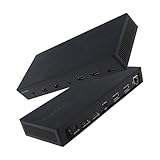 | VisionTek VT4950 | Devices: 2 USB-C Video: Two DisplayPort (4K@60Hz) and HDMI Alt Mode (4K@60Hz) Audio Jack: Yes USB-A: 4xUSB 10Gbps USB-C Power Delivery: 100W USB-C Alt Mode: Yes, DisplayPort Remote: No Mounting Bracket: No | Check on Amazon |
 | StarTech.com 2 Port USB C KVM Switch | Devices: 2 USB-C Video: HDMI (4K@60Hz) Audio Jack: No USB-A: 2xUSB 2.0 USB-C Power Delivery: N.A. USB-C Alt Mode: Yes, DisplayPort Remote: No Mounting Bracket: No | Check on Amazon |
 | TESmart USB-C KVM Switch 3 in 1 Out | Devices: 3 USB-C Video: HDMI (4K@60Hz) Audio Jack: No USB-A: 3xUSB 2.0 USB-C Power Delivery: Yes USB-C Alt Mode: Yes, DisplayPort Remote: Yes, Wireless Mounting Bracket: No | Check on Amazon |
 | StarTech.com Dual-Laptop USB-C KVM Docking Station | Devices: 2 USB-C Video: Two DisplayPort (4K@60Hz) Audio Jack: Yes USB-A: 2xUSB 2.0 and 2xUSB 10 Gbps USB-C Power Delivery: 90W and 45W USB-C Alt Mode: Yes, DisplayPort Remote: No Mounting Bracket: No | Check on Amazon |
 | TESmart HDC202-X24-USBK | Devices: 1 Thunderbolt 4 laptop and 1 HDMI/DisplayPort desktop Video: 2x HDMI (dual 4K@60Hz) Audio Jack: Yes USB-A: 1x10Gbps, 1x5Gbps, plus keyboard/mouse USB-C Power Delivery: Up to 60W, laptop host only USB-C Alt Mode: Thunderbolt laptop host path Remote: Yes, IR; hotkeys, mouse, and front button Mounting Bracket: N.A. | Check on Amazon |
1. IOGEAR 2-Port 4K USB-C KVM GCS1602CC – KVM Switch For Mac Devices

A worthy upgrade, this KVM switch from IOGear offers 4K@60Hz video and has 100W Power Delivery, compared to 4K@30Hz and 75W of the Access Pro 2 from IOGear.
Like the IOGear Access Pro 2, the GCS1602CC is a compact KVM switch that offers considerable utility while retaining an insignificant footprint. Thus, it requires very little space at your workstation, and its form factor makes it convenient to carry wherever work takes you.
Moreover, its design is aesthetically pleasing, and the switch looks like it belongs to Apple’s line of products. Its simple design features the four USB-A ports on the front, with all other ports on the rear panel. The top panel has indicators that show the active host, and the switch has a wired remote to toggle between the host computers.
The USB-C ports are compatible with the Thunderbolt ports on Mac-based computers and the iPad Pro, and you can use it with USB-C devices like laptops, smartphones, and tablets.
Ports
- 2x USB-C
- 1x DisplayPort v.1.4
- 1x USB-C Power pass-thru (100W)
- 4x USB-A 3.2 Gen 1
The IOGear GCS1602CC is a versatile KVM switch compatible with Mac-based devices. Apple loyalists will love the aesthetic as the switch doesn’t feel out of place when you use it with Apple products. Moreover, its compact form factor makes it a handy device to carry when you are on the move.
- Host port 1 supports Power Delivery once you add a suitable USB-C power adapter, which IOGEAR sells separately. The charging rate depends on that adapter and on your laptop.
- The switch supports 4K@60Hz video.
- Four USB-A ports enable you to share several peripheral devices.
- The compact size makes it suitable for travel.
- Versatile compatibility with Windows, Mac, and Android devices.
- No support for dual-display setups.
- No wireless remote to toggle between hosts.
- The power adapter is not included.
2. Cable Matters 201085-BLK-N3 Dual 4K USB-C KVM Switch: Dual-monitor USB-C KVM without laptop charging
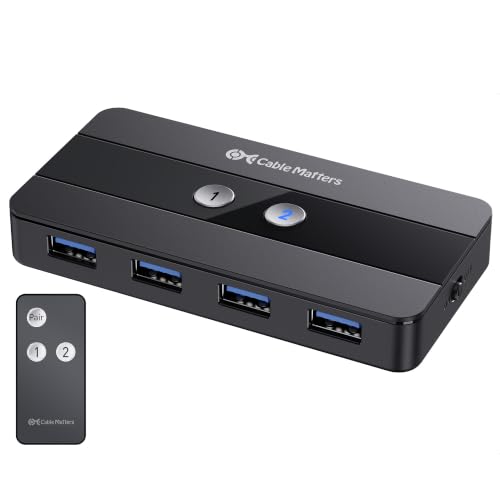
The Cable Matters 201085-BLK-N3 is built for two laptops and two screens. Each laptop connects over USB-C and drives one HDMI display, one DisplayPort display, and four shared USB devices. Both laptops need a USB-C, USB4, or Thunderbolt port that carries video through DisplayPort Alt Mode. A desktop with only HDMI or DisplayPort video outputs cannot use this switch.
Cable Matters rates both displays at up to 4K@60Hz, but only on a Windows or Linux host that supports DisplayPort MST. macOS behaves differently. It uses both outputs, and the second screen mirrors the first instead of extending the desktop onto it. A single DisplayPort display can instead reach 8K@30Hz when the host, GPU, cable, display, and settings all support it.
There is no USB-C Power Delivery here, so each laptop stays on its own charger. Cable Matters includes two USB-C host cables and an RF remote for switching between hosts. The optional Micro-B input powers the switch and the connected USB devices, and it sends nothing to either laptop.
The 201085 has no EDID emulation, which is the main thing to check before you buy. The laptop you switch away from can see the displays drop off, and Windows 11 may rearrange your window layout when you switch back. If you want the display information held open for both laptops, choose a model that lists EDID support.
Ports
- 2x USB-C host inputs
- 1x DisplayPort output
- 1x HDMI output
- 1x Micro-B optional power input
- 4x USB-A 3.0
Buy the Cable Matters 201085-BLK-N3 if you run two USB-C laptops across two screens and you are happy to keep both chargers plugged in. It is at its best on a Windows or Linux host with MST. On a Mac you get one extended screen and one mirrored screen, so decide whether the mirroring suits you before you order.
- Two extended 4K@60Hz displays on a compatible Windows or Linux MST host.
- Four shared 5Gbps USB-A ports.
- An RF remote is included for switching hosts.
- Two USB-C host cables are included.
- No laptop charging.
- macOS mirrors the second display instead of extending it.
- No EDID emulation.
- Not for a desktop with only HDMI or DisplayPort video.
3. VisionTek VT4950 – KVM For Dual 100W Power Delivery
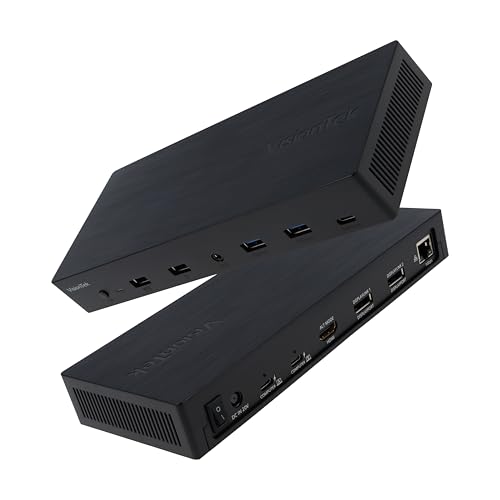
VisionTek rates the VT4950 at up to 100W of Power Delivery for each USB-C host, and each laptop has to support USB-C charging for that to work. The included 230W adapter powers the dock, and how much of that power a laptop actually draws depends on the laptop.
The switch is thoughtfully designed and includes several features, the chief among them being compatibility with all leading operating systems. The VT4950 is among the few KVM switches with a sharable USB-C (10Gbps) and Gigabit Ethernet port, enabling you to share a LAN connection and use newer peripheral devices such as USB-C flash drives or external SSDs.
The three video outputs do not all work the same way. The two DisplayPort outputs run on DisplayLink, so you have to install the DisplayLink driver. The HDMI output uses the host’s native DisplayPort Alt Mode instead, so the host must support that mode before the third display will work. Check both the driver and the display limits of your own host before you plan on three monitors.
The VT4950 uses a 230W external power adapter to power up the device and provide Power Delivery to both host computers. Combined with an impressive selection of sharable ports that include two USB-A 10Gbps ports, the VT4950 is a bulky device that will need considerable space at your workstation.
Ports
- 2x USB-C
- 2x DisplayPort (DisplayLink)
- 1x HDMI (Alt Mode)
- 1x USB-C 10Gbps
- 2x USB 2.0
- 2x USB-A 10Gbps
- 1x Audio jack
- 1x Gigabit Ethernet
Choose the VisionTek VT4950 when both laptops need to charge from the switch, at up to 100W each on a compatible host, and you can work with a mix of DisplayLink and native DisplayPort Alt Mode outputs. Its shared USB-C, USB-A, audio, and Ethernet ports also cover a desk that still runs older peripherals.
- The switch is compatible with all leading operating systems.
- VisionTek rates Power Delivery at up to 100W per compatible host.
- The two DisplayLink outputs run at 4K@60Hz, and the third HDMI output needs DisplayPort Alt Mode.
- The versatile port selection enables you to use new and legacy devices.
- You can share a LAN connection using the Gigabit Ethernet port.
- The two DisplayPort outputs need the DisplayLink driver installed.
- Expensive
- No remote
4. StarTech.com 2 Port USB C KVM Switch – A mini USB-C switch with no power lead

Startech’s KVM switch might be the most miniature switch on this list, but it packs quite a punch. Your first reaction when you buy it will be that of surprise. It is tiny in size, and it does not use a power adaptor but is instead powered by the USB bus. It means the switch will draw power from your laptop, so the adaptor hasn’t vanished as much as it has moved to a different device.
The switch can deliver 4K video at 60Hz, which is impressive for such a small device. You’ll get two USB-C inputs and two USB-out ports on the same side. The HDMI out port is on the other side, so you’ll have trouble choosing a wireless side to face you when you put the switch in your workstation. The device is compatible with most manufacturers. There is no remote, though; a single button lies on the device for switching.
Ports
- 2 x USB-C ports (Thunderbolt compatible)
- 2 x USB-out ports
- 1 x HDMI-out port
This device does everything a KVM should do but nothing else. That’s not a bad quality, though; for the size and price this switch offers, it gives you more bang for your buck. First-time KVM users will especially enjoy it because of its portability and simplicity.
- The small size and portability are pretty impressive
- 60Hz at 4K is more than what you’ll usually get for this price range
- No power adaptor, so there is less of a cluster
- No remote, wired or wireless to toggle between computers
- Inconvenient design, with HDMI port on a separate panel
- No Power Delivery on USB-C ports
- Bus-powered, which means it will draw power from your computer
5. TESmart USB-C KVM Switch 3 – KVM Switch For Three Hosts

Most USB-C KVM switches allow you to connect only two hosts, but the TESmart USB-C KVM has USB-C ports to connect three hosts. While this is its most notable feature, it’s worth noting that only one of the three ports offers Power Delivery.
The TESmart USB-C KVM switch is an externally powered device. Despite that, it has an additional USB-C port for power pass-thru to enable Power Delivery to the host computer. While it adds to the wire clutter, it also gives you flexibility if you use the switch to connect desktop computers.
The switch has one HDMI port and supports 4K@60Hz video. Further, each input port has an EDID emulator that informs the host about the display settings, allowing it to tweak the video signals to give you ideal picture quality.
The device is compatible with all leading operating systems, allowing you to use any computer. Moreover, TESmart includes a wireless IR remote, enabling you to toggle between host computers conveniently. You can switch sources with mouse gestures, keyboard hotkeys, or the front panel button.
Ports
- 3x USB-C
- 1x HDMI
- 3x USB-A 2.0
- 1x Audio jack
- 1x USB-C Power Pass-thru
The TESmart USB-C KVM switch is unique because it lets you connect three computers, whereas most other USB-C KVM switches allow only two. While it lacks support for dual monitors, it supports a single 4K@60Hz monitor and is compatible with all major operating systems.
- It supports three USB-C hosts.
- The wireless remote makes it convenient to switch sources.
- HDR10 and Dolby Vision give you premium-quality video.
- The EDID emulators ensure optimized video quality.
- Power Delivery for charging host laptop.
- The outdated USB-A ports are unsuitable for newer peripheral devices.
- Price
- Power Delivery is limited to only one host.
6. StarTech.com Dual-Laptop USB-C KVM Docking Station – USB-C KVM Switch Cum Docking Station

The StarTech.com Dual-Laptop USB-C KVM Docking Station combines two handy devices: a KVM switch and a Docking Station. Doing this helps you minimize cable clutter and eliminate the need for an additional device, helping you save space at your workstation.
The device supports two hosts via the USB-C ports, providing a combined Power Delivery of 135W. While the active host receives 90W, the inactive host receives 45W Power Delivery. StarTech.com uses a 180W external power adapter to support this, which connects to a DC pin next to the Power Switch.
The switch supports dual 4K monitors at a 60Hz refresh rate, which you can connect using two DisplayPort. Unfortunately, the device doesn’t have a remote toggle, and you’ll have to use the button on the front panel to switch sources.
The front panel is also where you’ll find all the expansion ports, including two USB-A and one USB-C 10Gbps port, suitable for connecting newer peripheral devices. Using this switch/dock, you can also share a single LAN connection, as the device features one Gigabit Ethernet port.
Lastly, the switch is compatible with all operating systems and Apple devices using the M1 and M2 processors, making this the most versatile KVM switch.
Ports
- 2x USB-C
- 2x DisplayPort v.1.4
- 1x Gigabit Ethernet
- 2x USB-A 2.0
- 2x USB-A 10Gbps
- 1x USB-A 10Gbps
- 1x Audio jack
- 1x Microphone jack
The StarTech.com Dual-Laptop USB-C KVM Docking Station is a versatile device that comes with a KVM switch and docking station into one. Because of its impressive selection of ports and support for dual-4K video, the StarTech.com Dual-Laptop USB-C KVM Docking Station is perfect for efficient multitasking with computers running on any OS platform.
- It supports Power Delivery to both USB-C ports.
- It has a versatile selection of ports for connecting legacy and new-generation peripheral devices.
- DisplayLink certified with support for extended display on Apple computers using the M1 and M2 chip.
- It supports dual-4K monitor configurations.
- It supports keyboard hotkeys to switch between computers.
- Expensive
- No remote
7. TESmart HDC202-X24-USBK: Thunderbolt 4 laptop plus a conventional desktop

The TESmart HDC202-X24-USBK is built for one specific pairing, so check the host layout before you buy. One side takes a laptop over a single Thunderbolt 4 connection. The other side takes a desktop over separate HDMI, DisplayPort, and USB paths. It is not a switch for two Thunderbolt hosts.
TESmart rates the two HDMI display outputs at up to 4K@60Hz. Every input has EDID emulation, which holds the display information open for both hosts, so you see fewer resolution changes and fewer rearranged desktop icons when you switch. The KVM also shares Gigabit Ethernet, USB devices, and a 3.5mm audio and microphone port.
Charging is the part to check closely. The built-in charging module supplies up to 60W, and only to the laptop host. TESmart warns that laptops without 20V DC charging may receive only 7.5W, and that some ThinkPad models may not receive 60W. The desktop host gets no charging power at all.
TESmart includes the Thunderbolt 4 laptop cable, the desktop KVM cable, a DisplayPort cable, an IR remote, and the 20V power adapter, so the cabling for both hosts is covered. You can switch from the front button, the IR remote, keyboard hotkeys, or an optional mouse-wheel command.
Ports
- 1x Thunderbolt 4 laptop host
- 1x desktop host set with DisplayPort, HDMI, and USB
- 2x HDMI display outputs
- 1x Thunderbolt expansion port for the laptop host
- 1x Gigabit Ethernet
- 1x 3.5mm audio and microphone port
- 2x USB 3.2 Gen 2
- 1x USB 3.2 Gen 1 plus keyboard and mouse ports
Buy the TESmart HDC202-X24-USBK for one exact job. You have a Thunderbolt 4 laptop and a desktop on HDMI or DisplayPort, and they need to share two monitors. EDID emulation and the mixed host inputs are what you are paying for. It is the one switch on this page with a Thunderbolt 4 input, and its second host is still a conventional desktop connection.
- One Thunderbolt 4 laptop input and one conventional desktop input.
- Two HDMI displays at up to 4K@60Hz.
- EDID emulation holds display information open for both hosts.
- The power adapter and the main host cables are included.
- Gigabit Ethernet and shared USB ports are built in.
- It does not take two Thunderbolt hosts.
- Charging reaches the laptop host only, and the rate varies by laptop.
- The desktop needs separate video and USB connections.
The Ultimate Buying Guide for USB-C KVM Switches
People usually go for a KVM switch after they’ve spent a lot of time and money on setting up their Computing system, so they end up not paying attention to the KVM switch. That could be a mortal sin because a bad KVM switch will render most of your functionality useless. By a bad KVM switch, we do not necessarily mean a device of poor quality but rather suitability.
It doesn’t matter what you’re buying; the first question should always be why. You need to know precisely your requirements before you wander into a store, or all the tech will fog your judgment, and you’ll waste your money.
Are you buying the switch for your home setup or an office? What kind of work do you do on your computers? Are you a gamer? How far will the KVM switch be from your computer and peripherals? It would be best if you considered all these factors before you buy.
In this guide, we’ll talk mostly about domestic buyers or small office workspaces; however, if your needs are more extensive, you need a pre-buying audit before entering the market.
Number of computers
If you’ve only got a laptop and a PC to switch between, you can buy something portable and efficient, with extra features such as charging or wireless remotes. If switching between many computers, you should look for KVM switches with excellent protection and synchronization capabilities.
You should also check how the KVM switch connects to your computer—the switches in our list use USB-C. Still, if you’re going for a device that uses another connection, then you’ll need to connect more than one wire from your computer to the KVM switch, e.g., for a USB-B connection, you’ll need the USB bus for data and an HDMI or VGA cable for video transfer.
Using a USB-C KVM switch negates this requirement, as USB-C allows data, power, and video signals on a single cable. Thus, USB-C KVM switches minimize wire clutter and help optimize your workstation.
Video Output
You must know what kind of video is transported through the KVM switch. For example, all switches on the list will do if you’re watching 4K resolution on a 30Hz refresh rate. However, if you’re a gamer or graphics designer, you probably have a graphics card and a monitor capable of handling higher frame rates and better resolution. In that case, you’ll need a KVM switch with the same specs.
If you’re using multiple monitors, you should buy a switch that can transition between monitors. In that case, you might have to settle for a lower resolution or response time, or the switch will be too slow.
Compatibility
A USB-C connector alone does not guarantee video. If the KVM uses DisplayPort Alt Mode, both the host port and the cable have to carry that video mode. DisplayLink works another way. It sends display data over USB, and the computer needs a compatible driver installed. Check which of the two paths each video output uses, especially if you plan on more than one display or you are on macOS.
Audio Support
Most KVM switches transfer audio via the HDMI cable or a DisplayPort unless they use USB-C. If your professional work deals with a wide range of audio frequencies, these connections might not be enough, so you’ll need additional transfer ports for sound. These ports will suffice for everyday use, such as office work or gaming.
An analog audio jack tells you where the sound is routed, and it says nothing about how good the sound is. Decide whether you need a separate shared audio port, or whether monitor audio over HDMI or DisplayPort already covers you.
Cable length
Keep the host and display cables within the lengths the KVM maker specifies. Use the cables in the box, or cables that clearly state they support the video and charging features your setup needs.
Remember that the switch button is often on the KVM device, which means the device should be close to you.
If your switch has a remote toggle, check its range; it’s usually 15 feet for domestically used KVM switches.
Electrical Power
A bus-powered KVM takes its operating power from a connected host, and it usually cannot charge that host back. A KVM that does charge a laptop needs either its own power input or separate USB-C power adapters.
Check two things before you buy. Find out whether the required adapters are included, and find out how much power actually reaches each host. A power supply input rating, or a combined total across the ports, is not the same number as the charging power delivered to a laptop.
Ports
Count the shared USB ports you actually need, and check their speed if you plan to connect storage, webcams, or other peripherals. Hotkey support depends on the KVM’s own keyboard emulation and firmware, and not on which USB generation the ports use. Go by the switching methods listed for the exact model you are buying.
Best USB-C KVM Switch -Frequently Asked Questions
Why Should I Use a KVM Switch?
If you have to use multiple computers simultaneously, you will need to deal with various keyboards and mice. Further, you will need to install as many monitors as computers.
A KVM switch reduces the number to one (each). Therefore, you must attach one keyboard, mouse, and monitor to the KVM switch. The KVM switch will display the video of the active computer and allow you to use its peripherals.
With just one button, you can switch between computers without juggling the peripherals. This reduces the number of devices you need, thus reducing the clutter on your workstation.
Will my computer detect the KVM switch?
Your computer detects the display and the USB devices that the KVM presents to it. What the inactive host sees depends on the EDID and USB emulation in the switch. The devices may stay connected, disconnect, or reconnect when you switch.
How are USB-C ports helpful on KVM switches?
USB-C is only the connector, so the cable features you need depend on the KVM. For video, the host port and the cable must support DisplayPort Alt Mode or Thunderbolt, whichever the switch specifies. For charging, the cable and the adapter must support the required USB Power Delivery level. A 10Gbps data label on its own does not prove video support.
How reliable are KVM switches?
It’s very reliable, but only if you get the right one. Users complain about issues when switching or inconsistencies in data transfer, such as latency, but these problems are commonly attributed to the poor compatibility of the attached devices and the switch. Since KVM switches are not manufactured by the same companies that make laptops, displays, or peripherals, compatibility issues are frequent. You’ll need quite a lot of research to find the ideal KVM switch for your system, but once you have it, it won’t bother you for a long time.


The power delivery outputs on the Sabrent 2-port do NOT provide any usb-c data out – they are power ONLY. I was disappointed to discover that I couldn’t use it to also switch my second display or any other peripherals between my two computers.
I wanted to share a LG display using its USB-C connector with a Mac mini and a PC laptop. So I bought a SABRENT 2-PORT USB SWITCH, based on this declaration on the article: “You can also use one of these USB-C out ports to transfer video instead of the HDMI 2.0.”
I was able to install the switch and make it work without any problem when I use the HDMI port. But impossible to use one of the USB-C out ports for the video. Can you tell me how to do this? It would be very useful as I plan to upgrade to an Apple Studio Display which has USB-C connector only (no HDMI).
Thanks.
Hi,
Some monitors have multiple USB-C ports. Only some of them will work as video input, while others are for peripherals.
My first thought would be to make sure I’m using the right USB-c port on my monitor.
Good luck 🙂
Thanks George. I know that the unique USB-C port on the LG monitor is fine for video input. When I connect it directly to the Mac or PC, the display is working fine. But the Sabrent switch does not seem to output video through USB-C, only through HDMI.
Any idea of a switch that outputs video through a USB-C port? All I have seen use HDMI. Thanks.
“Adding Thunderbolt would only increase the cost of these devices, as the bandwidth of 40GBs would be overkill.”
This is a peculiar statement, given the absence of multiple monitor support in any of the devices. ATEN makes Displayport (sigh) KVMs for up to a triple monitor setup. I would love a dual (or even triple) monitor KVM that required only one cable to be plugged in, and would gladly ensure that I had appropriate TB3/TB4 out from all my systems to allow it to work in a KVM.
Haha, finally a guide that admits your expensive computer setup is useless without a decent KVM! Its like buying a sports car but forgetting the steering wheel. Who knew picking the right traffic controller for your digital life could be so crucial? The article brilliantly breaks down the essentials – power delivery (because lets face it, your laptop will die before you finish that spreadsheet), video quality (1080p is so 2020), and the joy of fewer cables (my desk used to look like a bowl of spaghetti!). Choosing the right KVM is serious business, apparently, involving more consideration than picking what to wear. Highly recommend it for anyone whose mouse has more connections than a Swiss watch!