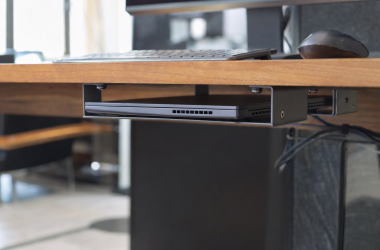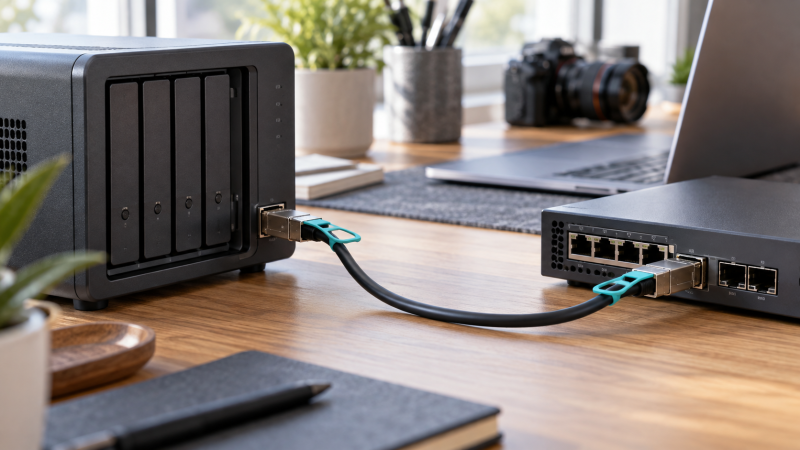
An SFP+ direct attach copper cable connects two nearby SFP+ ports without separate optical transceivers. For a workstation beside a switch, or a NAS in the same rack, a passive DAC can be a low-power, low-latency way to build a 10GbE link. The cable and SFP+ ends form one fixed assembly, so there are fewer parts to match than with paired optics and fiber.
The five options below cover very short 0.25-meter jumpers and common 0.5- and 1-meter links. Length and coding compatibility decide the fit. A cable that is too short strains ports, and one that is needlessly long adds bulk. A correctly shaped SFP+ end can also be rejected by equipment with restrictive compatibility rules.
Measure the routed path between SFP+ cages, including bends and connector bodies. As manufacturers like 10Gtek and H!Fiber note, product lengths commonly include both end connectors, so the usable flexible cable span is shorter than the advertised end-to-end measurement.- Best ultra-short jumper: 10Gtek 0.25 m DAC is a compact 0.82-foot passive twinax link that 10Gtek states is tested with TDR and VNA methods.
- Best general 1 m cable: Cable Matters 1 m DAC combines a useful 3.3-foot length, 30 AWG conductors, die-cast backshells, and a quick-release latch.
- Best broad 0.5 m compatibility list: H!Fiber 0.5 m DAC names Cisco, Ubiquiti, Meraki, MikroTik, Intel, Fortinet, Netgear, TP-Link, and other platforms.
SFP+ Direct Attach Cable Comparison
| Image | Product | Details | Check Price |
|---|---|---|---|
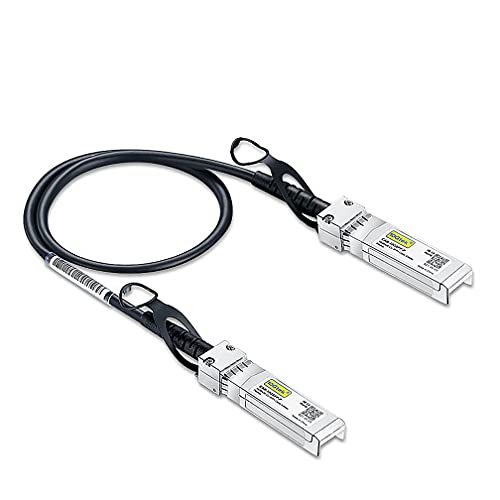 | 10Gtek 0.25 m 10G SFP+ DAC Cable | Length: 0.25 m / 0.82 ft Type: Passive 10GBASE-CU twinax Testing: TDR and VNA stated Compatibility: Cisco, Ubiquiti, Fortinet and more | Check Price on Amazon |
 | H!Fiber 0.5 m 10G SFP+ DAC Cable | Length: 0.5 m / 1.64 ft Type: Passive 10GBASE-CU twinax Gauge: 30 AWG Rate: 10 Gbps Warranty: 3 years stated | Check Price on Amazon |
 | Cable Matters 1 m 10Gbps DAC Twinax Cable | Length: 1 m / 3.3 ft Type: Passive 10GBASE-CU twinax Gauge: 30 AWG Connector: Metal backshell, quick-release latch Compatibility: Cisco-oriented, SFF-8431 | Check Price on Amazon |
 | ipolex 0.5 m 10G SFP+ DAC Cable | Length: 0.5 m stated selection Type: Passive copper twinax Rate: 10 Gbps Testing: TDR and VNA stated Warranty: 3 years stated | Check Price on Amazon |
 | Wiitek 0.5 m White 10GbE SFP+ DAC | Length: 0.5 m Type: Passive copper twinax Gauge: 30 AWG Rate: 10GbE Color: White | Check Price on Amazon |
1. 10Gtek 0.25 m DAC — Best Ultra-Short Jumper
If two SFP+ ports sit almost directly beside each other, the 10Gtek is the cable that fits. At 0.25 meter, or 0.82 foot, it is the shortest clearly specified cable in this group. It suits adjacent switch and NIC ports and a top-of-rack connection, but it is too short for casual under-desk routing, so measure the actual connector-to-connector path rather than the straight-line gap.
This cable is a passive 10GBASE-CU twinax assembly using two differential pairs and EEPROM I2C. The listing identifies compatibility with Cisco SFP-H10GB-CU0.25M, Ubiquiti, Fortinet, and other equipment. Compatibility language is broad rather than exhaustive, so confirm both endpoint vendors and device models when either side enforces coded-cable requirements.
10Gtek says each cable receives TDR and VNA measurement after an automated assembly process involving cutting, shielding preparation, reshaping, soldering, and ultraviolet curing. These manufacturing claims are useful, but they do not replace testing in the intended switch and network card. The stated length includes the two end connectors.
[accentbox]Choose the 0.25-meter 10Gtek only when the SFP+ cages are nearly adjacent. A tight cable under tension is worse than a slightly longer, properly supported run.[/accentbox]- Compact 0.25 m length
- Passive 10GBASE-CU design
- TDR and VNA testing stated
- Too short for many desk routes
- Full compatibility list not provided
2. H!Fiber 0.5 m DAC — Best Broad Compatibility List
H!Fiber’s passive cable measures 0.5 meter, or 1.64 feet, including both SFP+ connectors. It uses 30 AWG twinax and supports a stated 10Gbps data rate under 10GBASE-CU. Half a meter suits a small rack, or a desktop switch with a workstation placed immediately beside it, and it gives more routing tolerance than a 0.25-meter jumper.
The listing names an unusually broad set of platforms: Cisco, Ubiquiti UniFi, Meraki, MikroTik, Intel, Fortinet, Netgear, TP-Link, Linksys, Broadcom, Zyxel, Quanta, Solarflare, Palo Alto, and F5. A broad list reduces ambiguity but does not prove every firmware and device combination. Match the cable’s coding to both endpoints, not just one.
H!Fiber presents the cable as a low-cost, low-power, low-latency alternative to separate transceivers and states that products pass TDR and VNA testing. Support terms include 24/7 customer service, a 30-day return period, three-year warranty, and lifetime technical support. These support terms may help when compatibility must be tested after arrival.
[accentbox]The 0.5-meter length and long named-vendor list make this the easiest short general-purpose pick when both devices sit within the same rack section or desk zone.[/accentbox]- Practical 0.5 m length
- Broad named compatibility
- Three-year warranty stated
- Still too short for separated desk devices
- Vendor-level compatibility is not model-level proof
3. Cable Matters 1 m DAC — Best General 1-Meter Pick
The Cable Matters assembly measures 1 meter, or 3.3 feet, which is enough reach for a workstation and switch on the same desk, devices in nearby rack positions, or a short NAS connection. It remains compact enough to manage without a large cable loop. The product is a passive 10GBASE-CU design intended for switches, servers, NICs, NAS, SAN, and other high-bandwidth equipment.
The manufacturer specifies construction details including 30 AWG wire, metal die-cast connector backshells, and a quick-release latch that holds the SFP+ connector until its tab is pulled. The listing emphasizes EMI performance, minimal insertion loss, low power use, and low latency. It also says passive SFP+ cable can connect equipment up to seven meters, but the product covered here is the 1-meter version.
Compatibility is framed around Cisco SFP-H10GB-CU1M and the SFF-8431 multi-source specification, with Ubiquiti, Huawei, Netgear, and Supermicro named in the title. The description says it is designed for the majority of suitable switches, adapters, and NAS equipment rather than guaranteeing every device. Verify any vendor-lock requirements before installation.
[accentbox]A 1-meter DAC is the safest default when a switch and workstation share a desk or rack but are not directly adjacent. Route the cable once before removing packaging or labels needed for a return.[/accentbox]- Useful 1 m length
- Metal backshell and quick-release latch
- 30 AWG passive twinax
- May create excess loop in a tight rack
- Not guaranteed for every coded platform
4. ipolex 0.5 m DAC — Best Length-Planning Guidance
The ipolex cable uses passive copper twinax and supports a 10Gbps SFP+ to SFP+ link. The selected model is described as 0.5 meter, while the supplied bullet says each connector is 0.06 meter and recommends adding 0.12 meter when calculating the flexible wire length. The ipolex guidance helps when a precisely measured rack path has little slack.
Compatibility includes Cisco, Meraki, Ubiquiti, Intel, Netgear, Supermicro, and other MSA-aligned equipment, with EEPROM I2C used for recognition. The cable is hot-swappable and described as plug and play. TDR and VNA testing is stated, along with a three-year warranty and custom lengths from 1 to 7 meters on request.
ipolex recommends keeping passive DAC links within 5 meters for switch-to-switch and 3 meters for switch-to-NIC connections, and it suggests an active optical cable (AOC) when longer reach is required. These distances are vendor guidance rather than a universal limit for every environment, but they give buyers a useful boundary. This 0.5-meter model sits comfortably inside either recommendation.
[accentbox]Use ipolex when precise routing is the priority, because its description explicitly distinguishes overall cable length from the flexible wire span and gives separate switch and NIC distance guidance.[/accentbox]- Detailed length calculation guidance
- Broad named-vendor support
- Three-year warranty stated
- Half-meter reach limits desk routing
- Longer runs may need AOC instead
5. Wiitek 0.5 m White DAC — Best Cable-Color Visibility
Wiitek’s 0.5-meter white cable is the easiest one to distinguish visually from the common black patching in a rack or behind a desk. Color can serve a functional purpose when a studio reserves one visual scheme for storage, uplinks, production traffic, or temporary routing. The assembly uses passive 30 AWG copper twinax with two SFP+ ends.
The cable is rated for 10GbE and is intended to connect suitable switches, routers, NAS servers, network cards, and adapters. Named compatibility includes Ubiquiti UniFi, Fortinet, MikroTik, Netgear, Supermicro, TP-Link, Cisco Meraki, and open-source switches. It is described as compliant with SFP+ MSA and SFF-8432, with a stated operating range of 0 to 70 degrees C.
Packaging is antistatic, and the listing includes three years of product-quality assurance plus lifetime technical support. As with every cross-vendor DAC, broad compatibility language should be checked against the exact firmware and model at each end. The white jacket is useful for identification but can show dirt more readily in an exposed installation.
[accentbox]Pick Wiitek when a white 0.5-meter link makes the storage or uplink path easier to identify during changes and troubleshooting.[/accentbox]- Distinctive white jacket
- 0.5 m, 30 AWG passive twinax
- Three-year assurance stated
- Short for separated desk devices
- White jacket can show grime
Buying Guide: Choosing a Short SFP+ DAC
Measure the routed path, not the straight-line gap
Measure from one SFP+ cage to the other along the path the cable will actually follow. Include vertical travel, turns around equipment, rack rails, cable managers, and a modest service loop. The advertised length may include both connector bodies, as 10Gtek, H!Fiber, and ipolex explicitly note.
A 0.25-meter cable is best for nearly adjacent ports. A 0.5-meter link is rated to allow a little routing freedom within one rack section, while 1 meter is specified as more forgiving across a desk or between separated rack units. Avoid a taut connection that pulls sideways on an SFP+ cage, even if the cable technically reaches.
Check coding at both endpoints
The physical SFP+ form does not guarantee acceptance. Switches, routers, network cards, and storage devices may expect particular EEPROM coding. A cable advertised for one platform can work across others under MSA rules, but both endpoints must accept the assembly.
Compare exact device models and firmware with the seller’s compatibility information. H!Fiber, ipolex, and Wiitek name many vendors. 10Gtek names a smaller set, and Cable Matters emphasizes Cisco compatibility and MSA design. Broad compatibility language still needs confirmation at both endpoints.
Understand passive DAC limits
All five selections are described as passive. Passive DAC consumes little power and avoids separate optical modules, so it suits short in-rack and desk links. ipolex recommends no more than 5 meters switch-to-switch and 3 meters switch-to-NIC for its passive assemblies, with AOC preferred for longer distances.
The ipolex distances should not be stretched simply because a longer passive cable is sold. Longer copper assemblies become harder to route and may be less suitable for the intended equipment. When distance, bend routing, electrical isolation, or cable weight becomes a concern, compare an active optical cable or paired fiber transceivers instead.
Choose cable gauge and connector construction
H!Fiber, Cable Matters, and Wiitek specify 30 AWG conductors. Cable Matters also lists metal die-cast backshells for EMI performance and a quick-release latch. Other products focus on signal testing or compatibility rather than mechanical construction.
Gauge alone does not settle quality or compatibility. Look for secure latches, manageable bend behavior, connector clearance, and strain relief. Never pull a DAC out by the cable body. Use the release mechanism. Support the run so its weight does not hang from the SFP+ connector and cage.
Treat 10Gbps as a link rating, not a transfer guarantee
A 10GbE DAC can form a 10Gbps-rated link between compatible endpoints, but file transfers depend on the NIC, switch, storage, protocol, CPU, and workload. A slow disk or congested NAS can limit throughput far below the 10GbE line rate.
After installation, confirm that both ports negotiate at the intended speed and test sustained transfers. Link lights alone do not prove error-free operation. If the link drops or reports errors, check coding, seating, bend stress, firmware, and the cable before blaming the application.
Use color and labels for serviceability
Most DACs look alike once several are installed. The white Wiitek cable creates an obvious visual distinction, but any cable can be labeled at both ends. A consistent scheme for storage, switch uplinks, and workstation links reduces accidental disconnection during maintenance.
Record the endpoint names, ports, length, and cable model in the network notes. Keep labels clear of release tabs and airflow. In a small studio, the person troubleshooting a failed storage link may also be the editor waiting to resume work, so clear labels save time.
Frequently Asked Questions
Does a DAC need separate SFP+ transceivers?
No. A direct attach cable has an SFP+ end fixed to each side, so it plugs into two compatible cages as one assembly. The fixed ends are the main difference from a fiber patch cable, which needs a separate transceiver at each end.
The integrated ends still need compatible coding and link support. A DAC cannot plug directly into an ordinary RJ45 Ethernet port or bare fiber connector.
Is a 0.25-meter cable long enough?
It is long enough only for nearly adjacent ports. The 0.25-meter measurement includes the connectors on the 10Gtek, so less flexible cable is left between them. Rack handles, rails, and port orientation can consume the available reach.
Measure the routed path and allow strain relief. If there is any doubt, a 0.5-meter cable usually gives safer slack without creating a large loop.
Can I use a DAC between different brands?
Often, yes, if both endpoints accept the cable’s coding and support the link mode. The H!Fiber, ipolex, Cable Matters, and Wiitek listings name multiple brands, so cross-vendor use is an intended scenario.
Compatibility is still model- and firmware-dependent. Check both devices, especially where a vendor restricts accepted modules or cables. Keep the return window available until the link has been tested.
When should I choose AOC or fiber instead?
Choose another medium when the run exceeds comfortable passive-DAC distance, needs smaller or lighter routing, or benefits from electrical isolation. ipolex points buyers toward AOC for longer links beyond its recommended passive ranges.
Fiber also makes sense between rooms or racks where reach and pathway matter more than the simplicity of one copper assembly. The optics, fiber type, wavelength, and connectors must then match at both ends.
Related Studio Network Guides
- SFP+ network cards for small 10GbE studios
- Managed 2.5GbE switches for small editing networks
- Wi-Fi 7 PCIe cards for desktop workstations
- Ethernet adapters for laptops
- Rack shelves for non-rack studio gear
Bottom Line
The Cable Matters 1 m DAC is the most forgiving general choice for devices on the same desk or in nearby rack positions. Use the 10Gtek 0.25 m to eliminate excess loops between adjacent ports, or the H!Fiber 0.5 m when half-meter reach and a broad named-vendor list fit the setup.