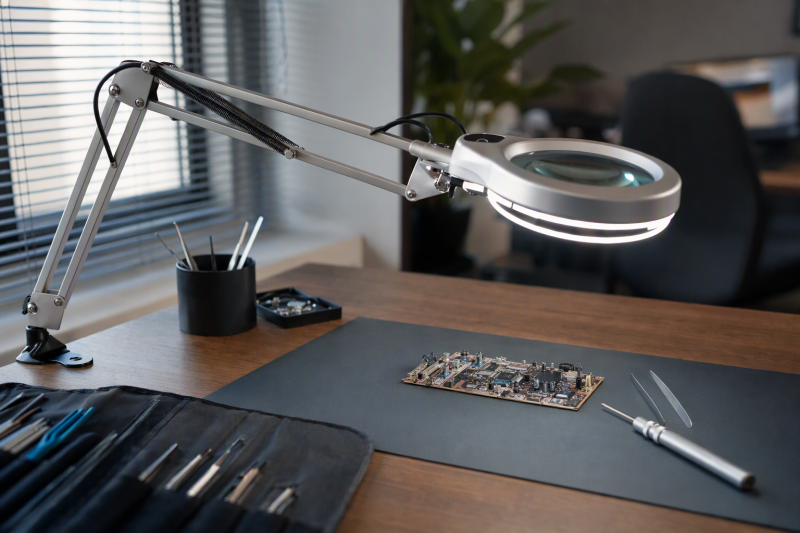
An illuminated magnifier can help you inspect tiny connectors, board traces, and solder joints without occupying a hand. But the biggest magnification number on an Amazon title is rarely the decisive feature. For electronics work, usable working distance and room for tools below the lens are as important as enlargement.
This guide covers six exact Amazon US magnifying lamps with active New offers. They differ in lens shape and size, clamp limits, arm reach, and whether a weighted base is available. Listing claims do not establish measured optical magnification, distortion, light output, or working distance. Seller phrases such as “flicker-free” and “eye protection” are not independent test results. Before buying, decide whether you need broad board scanning, close spot inspection, or hands-free work while a tool approaches the board.
Mock up the lens position over your board. Leave enough space for your fingers, tweezers, and any hot tool before choosing a magnification claim.Magnifying Desk Lamps Compared
| Image | Product | Details | Check Price |
|---|---|---|---|
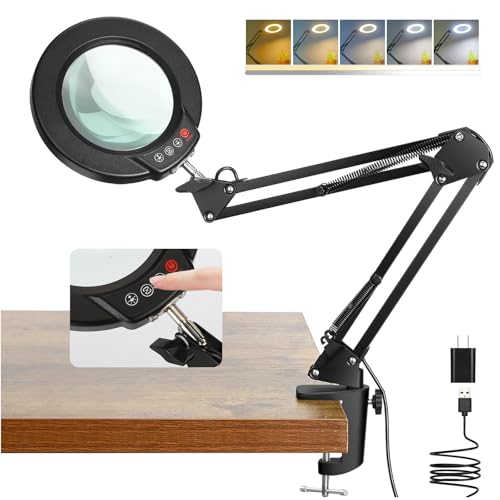 | Coyeth 10X round lens | Lens: 4.3-in glass; 10X claim Mount: Clamp up to 2.1 in Light: Five color modes; stepless dimming Best fit: General board inspection | Check Price on Amazon |
 | 10X clip-on small lens | Lens: 2.2-in glass; 10X claim Mount: Clip for 1-3 cm edge Light: Three colors; 12 levels Best fit: Small inspection area | Check Price on Amazon |
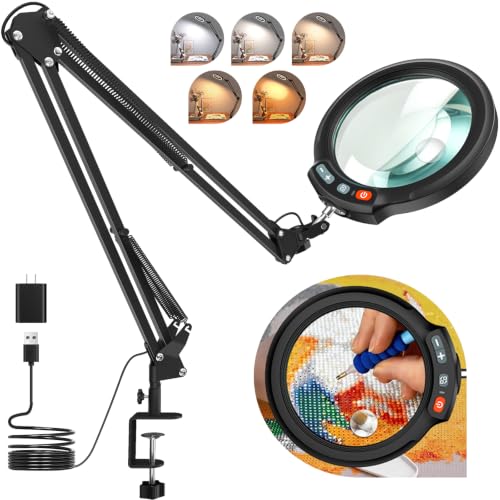 | 12X and 30X spot lens | Lens: 5-in main 12X; 30X spot claim Mount: Clamp up to 2.55 in Reach: Two 14.5-in arm sections Best fit: Board scan plus spot inspection | Check Price on Amazon |
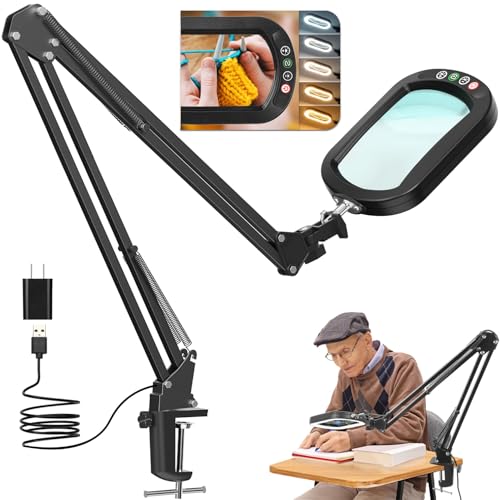 | 10X rectangular lens | Lens: 5 x 3-in glass; 10X claim Mount: Clamp up to 2.1 in Light: Five colors; dimming Best fit: Wide rectangular board view | Check Price on Amazon |
 | KIRKAS 12X long-arm | Lens: Optical glass; 12X claim Mount: Clamp up to 2.5 in Reach: Up to 35 in claim Best fit: Reach across a deep bench | Check Price on Amazon |
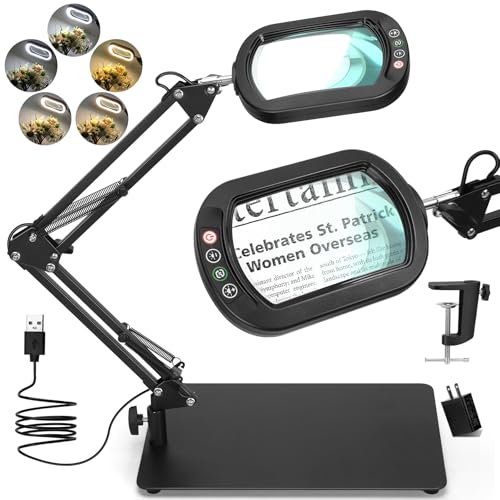 | Drdefi 12X square lens | Lens: Glass; 12X claim Mount: Weighted base or clamp up to 2.1 in Light: Five colors; stepless dimming Best fit: Portable bench placement | Check Price on Amazon |
1. Coyeth 10X Round Lens — Best General Board View
Coyeth lists a 4.3-inch glass lens with a 10X magnification claim. A round illuminated field can help scan a small circuit board or read a part marking while keeping both hands available. The head-mounted control cycles five color modes and adjusts brightness without searching along the cord. Its spring arm and clamp are described for a flat desk edge up to 2.1 inches thick. Check that your workbench lip is flat and accessible before relying on that number.
The listing promises a clear, distortion-free image and claims the springs prevent sagging, but provides no independent verification of either. With a high claimed magnification, the lens may need to sit closer to the board than a lower-power magnifier, leaving less tool clearance. Check that geometry if soldering is the job, rather than assuming a craft-use title proves good iron access. The seller also describes long LED life and benefits as a vision aid. Neither is established by independent measurements.
Our Take Choose Coyeth if you want a broad round lens for bench inspection. Judge it by optical clarity and working distance, both untested here.
- 4.3-inch glass lens stated.
- Controls are on the lamp head.
- Clamp limit is specified.
- Working distance not given in checked bullets.
- Optical and medical claims unverified.
2. 10X Clip-On Small Lens — Best Tiny Inspection Area
This clip-on model lists a 2.2-inch glass lens and a 10X magnification claim. The small viewing field is better suited to reading a tiny marking or checking one connector than surveying a broad laptop board. The listing describes three color modes, 12 brightness levels, and a flexible gooseneck arm. A clip can move to another table more easily than a bolted lamp, but its supported edge thickness is limited to 1 to 3 centimeters.
The seller calls the lens distortion-free and the clip stable without providing independent measurements. Small optics can require frequent board repositioning and may put your head close to the work if the claimed magnification has a short focal distance. A head that close is especially awkward for active soldering. Use it as a spot inspection option, not a substitute for a large lens or a microscope if you need a sustained, wide hands-free view.
Our Take Choose the small clip-on if you want occasional spot checks and a lens that takes little space. The narrow view makes it a poor fit for prolonged work over an entire board.
- Compact 2.2-inch glass lens.
- Multiple light levels in a clip-on form.
- Small view requires more repositioning.
- Clip only fits the stated 1-3 cm edge.
3. 12X and 30X Spot Lens — Best Detail Switching
This model lists a 5-inch main lens claimed at 12X plus a small 30X spot lens built into it. The idea is to scan a broader area through the main glass, then check a tiny detail through the spot. Do not read the 30X figure as a broad 5-inch field. The seller describes two 14.5-inch arm sections, a clamp opening up to 2.55 inches, and adjustment knobs that hold the head’s angle. The two arm sections can reach over a work mat without placing the clamp beside every board.
The listing also offers five color modes and dimming. It does not establish measured magnification, edge clarity, or whether the spot lens leaves enough working distance for tweezers and probes. A high-power inset may be useful after a soldering pass, yet impractical during one if your tool must fit between lens and board. Choose it for optional close inspection and make sure the main field alone is comfortable for the longer part of the job.
The 30X claim applies to a small inset, not to the full five-inch viewing field.Our Take Choose this lamp if you want a broad main view with a small inset for close checks. The wide clamp limit is useful. Verify the main lens’s comfortable distance before treating the inset as an upgrade.
- Large main lens plus spot inset.
- Long arm sections and wide clamp claim.
- 30X field is small.
- High-magnification working distance unknown.
4. Rectangular 10X Glass Lens — Best Wide Board View
The manufacturer specifies a 5-by-3-inch rectangular glass lens with a 10X magnification claim. The rectangular shape can align with a row of components or a narrow circuit board better than a smaller circle. A head button operates five color modes and stepless dimming, while a spring swing arm and clamp are listed for surfaces up to 2.1 inches thick. Think about whether the long side of the lens can actually line up with the board at your chosen clamp position.
The seller describes dual-axis head adjustment and no sag under its own weight, neither tested here. More viewing area does not guarantee sharp optics across the entire rectangle. If the edges distort, you may still end up using only the center. The listing does not establish a focal distance or tool clearance for soldering. Treat it as a promising field shape, then verify how it feels over the exact board size you repair most often.
Our Take Choose the rectangular lens if you scan longer rows of components. Check edge clarity and workroom under the glass, not just the advertised 10X.
- 5-by-3-inch glass field stated.
- Head controls and adjustable clamp arm.
- Edge clarity unverified.
- Working distance not stated in checked bullets.
5. KIRKAS 12X Long-Arm — Best Deep Bench Reach
KIRKAS lists a 35-inch maximum arm reach and a metal clamp for surfaces up to 2.5 inches. The long reach helps when the only usable clamp point is behind a wide work mat or monitor. The seller describes a three-section arm, six springs, and knobs that adjust light brightness and color temperature separately. The stated color range is 2500K to 8500K, but the listing does not establish measured color accuracy.
The optical glass is claimed at 12X, but the checked bullets do not state its diameter or focal working distance. The omission is important because a long arm can position the lens over a board, yet the head still has to leave room for hands and tools. The listing says it folds for storage and claims flicker-free, fatigue-free light. Both are seller descriptions, not observed performance. If the bench is deep, verify clamp strength at full extension before putting a hot tool beneath the lens.
Our Take Choose KIRKAS if your clamp point is far from the work area. The long arm is useful only if the clamp stays stable and the lens’s actual focus leaves working room.
- 35-inch reach and 2.5-inch clamp claim.
- Separate brightness and color knobs.
- Lens diameter absent in checked bullets.
- Stability and working distance untested.
6. Drdefi 12X Square Lens — Best Base or Clamp Choice
Drdefi lists a glass 12X rectangular lens, a weighted base, and a clamp for surfaces up to 2.1 inches. Having both mounts is useful if the electronics bench changes or if a clamp point is temporarily blocked by a monitor arm. The lamp head has a control button, five color modes, and stepless dimming. The listing does not give a measured lens size in the checked bullets, so confirm the viewing field before assuming “square” means a broad board view.
The weighted base takes bench space, while the clamp can free it at the cost of needing a sound edge. The listing does not establish either mount’s stability, lens flatness, or measured LED performance. A high magnification claim can be a drawback if it brings the lens too close to a soldering iron. For a fixed repair mat, choose the mounting style that lets the lens swing away quickly when you need an unobstructed view of the board.
Our Take Choose Drdefi if you want the choice of a weighted base or a clamp. Resolve lens dimensions and working distance before buying it specifically for soldering.
- Weighted base and clamp are both listed.
- Head controls and dimmable light.
- Checked bullets omit lens dimensions.
- Base consumes bench space.
Buying Guide: See the Board and Keep Tool Clearance
Decide between board scanning and spot inspection
For tracing a connector row, lens field size and shape may be more important than the largest magnification label. A 5-by-3-inch rectangle can show more of a board at once than a 2.2-inch circle. A small high-power spot lens is useful for checking one joint but forces frequent repositioning if you try to use it as the main view. Think through the longest uninterrupted task you do under the lens.
Higher magnification usually trades away working distance and field of view, so avoid ranking 10X, 12X, and 30X titles as if they were directly measured optical results. Ask for the actual focus distance if soldering or probing under the lens is important. A lens that works for inspection after a repair may be too close to the board during the repair itself. A product-family datasheet from Time Electronics confirms illuminated bench magnifiers are made for circuit work, but does not validate these Amazon models.
Check arm reach, clamp fit, and bench geometry
Measure from the desk edge to the repair mat. Coyeth and the rectangular 10X model list 2.1-inch clamp limits. KIRKAS lists 2.5 inches and a 35-inch arm reach. A beveled bench edge or thick rear cable tray can still prevent a nominally compatible clamp from seating well. Keep the arm out of the monitor’s path and make sure it can swing away when not needed.
Check stability at full arm extension. A head can wobble even if a seller calls the springs sturdy; the listing does not establish measured stability. A base like Drdefi’s avoids clamp fit but occupies room beside tools. Map where your hand, tweezers, and soldering iron will approach the board. A lamp that blocks that approach defeats the hands-free benefit. If you need a powered peripheral at the bench, our USB-C hub guide covers port choices, not optical work.
Separate lighting controls from optical claims
Most lamps here offer multiple color modes and brightness levels. Those settings can help reveal dark traces or reduce harsh reflections on a shiny board. A convenient head button is useful when the lens is directly over the work. But “flicker-free,” “glare-free,” and “eye-caring” are listing language here. None was measured in this comparison.
Glass material and a magnification number do not prove edge clarity or long-session comfort. Pay attention to lens diameter and focus distance if the maker provides them. Keep hot tools away from the lens and cable, and follow electronics repair safety practices independently of the lamp. For a related small-tool roundup, our USB-C electric screwdriver guide compares a different repair aid.
Frequently Asked Questions
Is 12X or 30X always better for soldering than 10X?
No. The available space below the lens may be more important than the advertised enlargement. A very close focus can block your iron, tweezers, or fume extraction. The 30X claim on one model belongs to a small inset, not the whole five-inch field. These magnification numbers were not independently measured here.
Choose a viewing field that fits the board area you work on most. If you mainly inspect joints after soldering, a stronger spot lens may help. If you need to work through the lens continuously, ask about the working distance and try the geometry over a sample board before committing.
Is a glass lens enough to guarantee a clear view?
No. Glass describes a material, not verified optical flatness, edge sharpness, or distortion. Several sellers here claim glass or optical glass without providing independent lens measurements. A large field may still be useful only in the center if edge distortion is strong.
Check lens dimensions and any credible measured optical data for the exact model. The small clip-on lens may be clear at its center but still require frequent board movement. Good light positioning and stable support are important alongside the lens itself.
Should I use a clamp or a weighted base at a repair bench?
A clamp frees space around the work mat if the bench has a sound, flat edge within the maker’s thickness limit. Make sure the arm can reach the repair area without sagging. An existing monitor clamp or cable tray may leave less usable edge than it appears.
A weighted base makes repositioning easier when the work zone changes, but it takes surface area and can be bumped. Drdefi lists both options. Neither mount is automatically safe at full arm extension. Keep hot tools and cables clear of the lamp structure and verify stability in your own setup.
Bottom Line
Coyeth is the general starting point with a round lens, the rectangular 10X model suits a longer board view, and KIRKAS is the pick for a deep bench with a remote clamp point. None can be ranked on optics from listing claims alone. Choose the lens field and mount that let you see the board while your tools still fit under it.