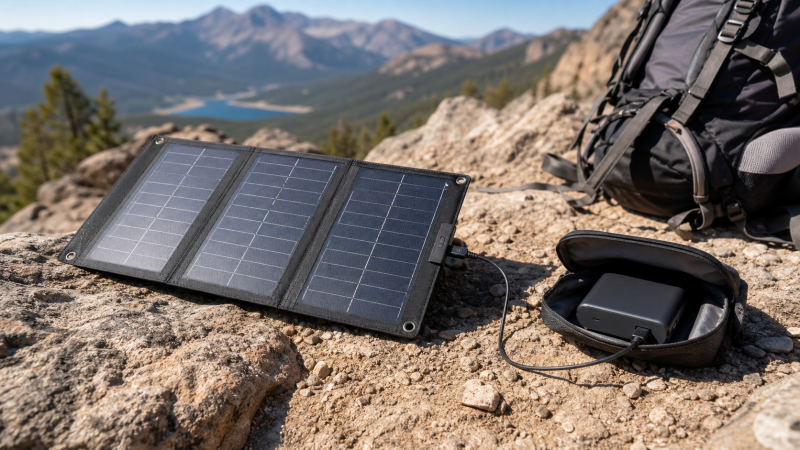
A foldable solar panel with a USB-C output solves a specific backpacking problem. It charges phones, headlamps, and small electronics when there is no wall outlet for days at a time. Unlike a solar power bank, every panel in this guide converts sunlight to power in real time and sends it straight out its USB-C, USB-A, or DC port, with no battery cell inside to store a charge for later.
Ten active USB-C solar panels made this list, from BLAVOR’s 10 watt minimalist option to LUMOPAL’s 60 watt panel built for laptops and other high draw gear. Ratings, port counts, and feature claims below come directly from each product’s own Amazon listing, verified as an active New offer during compilation. None of these panels were independently power tested for this guide, so treat every rated wattage as a manufacturer ceiling, not a field measurement.
Key Takeaway: A USB-C solar panel with no integrated battery only outputs power while the sun is hitting it directly. Match the panel’s rated wattage and USB-C port cap to the device you actually plan to charge, since a higher panel wattage does not always mean a higher USB-C charging speed.
Quick Picks
- Best Overall: FlexSolar 40W
- Best Budget: SOLUPUP 30W
- Best for Laptops: LUMOPAL 60W
- Best Lightweight: FlexSolar 36W
- Best Ultralight: BLAVOR 10W
- Best Waterproof: BigBlue 25W
| Image | Product | Details | Check Price |
|---|---|---|---|
 | FlexSolar 40W | Panel rating: 40W USB-C output: PD2.0, 18W max Other outputs: USB-A and DC Storage: No integrated battery | Check Price on Amazon |
 | BigBlue 28W Dual USB-C | Panel rating: 28W USB-C output: Two 5V/3A ports Other outputs: USB-A Storage: No integrated battery | Check Price on Amazon |
 | SOLUPUP 30W | Panel rating: 30W USB-C output: 5V/3A, 15W max Other outputs: USB-A Storage: No battery capacity stated | Check Price on Amazon |
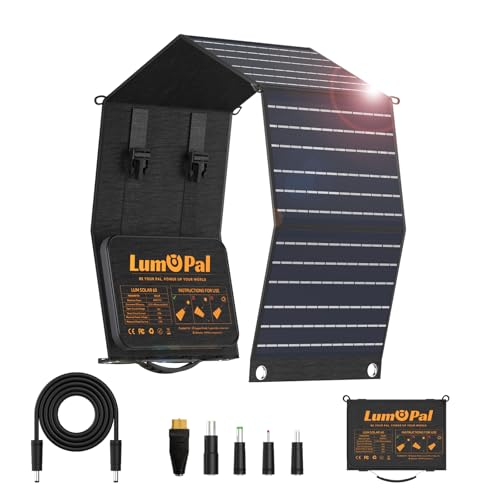 | LUMOPAL 60W | Panel rating: 60W USB-C output: PD 60W max Other outputs: QC3.0 USB-A Storage: No battery capacity stated | Check Price on Amazon |
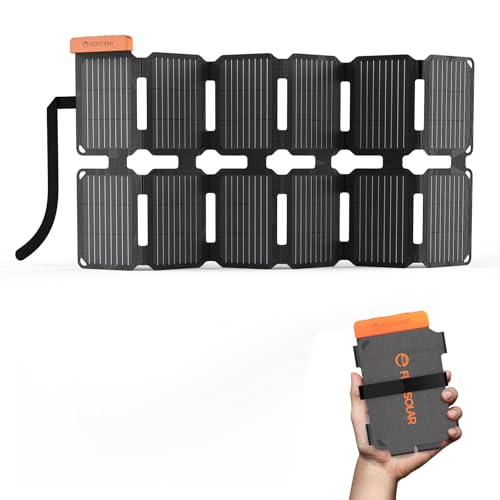 | FlexSolar 36W | Panel rating: 36W USB-C output: USB-C output Other outputs: USB-A and DC Storage: No battery capacity stated | Check Price on Amazon |
 | BLAVOR 10W | Panel rating: 10W USB-C output: 5V/2A max Other outputs: USB-A Storage: No battery capacity stated | Check Price on Amazon |
 | FlexSolar 20W | Panel rating: 20W USB-C output: 5V USB-C Other outputs: USB-A Storage: No battery capacity stated | Check Price on Amazon |
 | BigBlue 25W | Panel rating: 25W USB-C output: 5V/3A Weight: 0.84 lb Weather rating: IP68 | Check Price on Amazon |
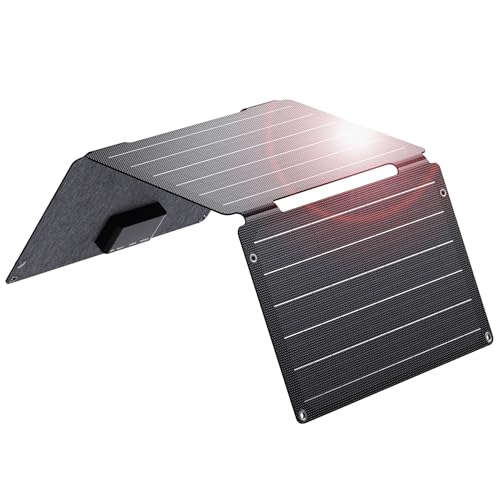 | BigBlue 30W | Panel rating: 30W USB-C output: PD 18W Other outputs: USB-A and DC Storage: No integrated battery | Check Price on Amazon |
 | BigBlue 28W Ammeter | Panel rating: 28W USB-C output: Up to 3A Feature: Digital ammeter Storage: No integrated battery | Check Price on Amazon |
1. FlexSolar 40W Foldable Solar Panel — Best Overall Power and Port Mix
FlexSolar rates this panel at 40 watts, the second highest output in this lineup, and lists a PD2.0 USB-C port alongside USB-A and a 5.5mm DC barrel output. The listing describes it as an instant energy conversion device with no energy storage, so power only flows while the panel faces the sun directly.
FlexSolar rates the USB-C port itself at an 18-watt cap, well under the panel’s 40-watt total rating. That gap is normal for panels with multiple output ports splitting the available power, but it means a device that needs more than 18 watts over USB-C should plug into the DC port instead, if the device supports it.
Our Take The three port spread makes this panel the most flexible pick here for a group or a multi device setup, as long as you route higher draw gear to the DC port instead of USB-C.
- FlexSolar rates the panel at 40W, near the top of this list
- Three output types (USB-C, USB-A, and DC) cover more device types than a single port panel
- Listing states the panel performs instant energy conversion with no internal storage to fail or degrade over time
- The USB-C port caps at 18W even on the 40W rated panel, so higher draw charging depends on the DC port instead
2. BigBlue 28W Dual USB-C Solar Charger — Best for Charging Two Devices at Once
BigBlue’s listing states this panel outputs 5V/3A, about 15 watts, from each of its two USB-C ports, plus a separate USB-A port. Running two USB-C ports at once lets two phones, or a phone and a headlamp battery, charge side by side from the same panel face.
The listing is explicit that the panel cannot store electricity and must be used in direct sunlight, with no internal battery to buffer output when a cloud passes overhead. Charging pauses the moment direct sun is blocked and resumes once it returns.
Our Take Two independent USB-C ports at matched output make this the practical pick for two people or two devices sharing one panel, provided both stay in direct sun together.
- BigBlue lists two independent USB-C ports rated 5V/3A each, plus a separate USB-A port
- Charging two devices at once avoids taking turns on a single port
- 28W rated total keeps the panel in a moderate, packable size range
- BigBlue’s own listing states the panel has no internal battery and stops output as soon as it loses direct sunlight
3. SOLUPUP 30W Foldable Solar Charger — Best Budget Pick
SOLUPUP’s feature text lists a 30 watt panel with a USB-A and USB-C dual output rated at 5V/3A, 15 watts max. That output cap sits in the same range as several other panels in this guide, and the listing does not publish a separate storage capacity, consistent with a direct charging panel rather than a battery pack.
Beyond the port specification, SOLUPUP’s listing states 23%+ energy conversion efficiency and an IPX5 water resistance rating, but it does not detail fold count, so buyers weighing this panel against FlexSolar’s or BigBlue’s more detailed listings should check current photos and the Q&A section for panel dimensions before ordering.
Our Take This panel is the pick for a buyer who wants USB-C solar charging without paying for extra ports, and who is comfortable with a shorter feature list on fold count and dimensions on the listing itself.
- SOLUPUP states a 30W rated panel with a 15W USB-C output
- Dual USB-A and USB-C ports cover the two most common device connectors
- Check current price on Amazon for a comparison against the higher port count options above
- SOLUPUP’s listing gives fewer construction and fold details than FlexSolar’s or BigBlue’s, so confirm folded size before packing it for a specific trip
4. LUMOPAL 60W Foldable Solar Panel — Best for Laptops and High-Power Devices
LUMOPAL rates this panel at 60 watts, the highest output in this guide, and pairs it with a PD USB-C port rated up to 60 watts along with a QC3.0 USB-A port. Unlike several other panels here, the USB-C port cap matches the panel’s full rated output instead of falling well short of it, so a laptop or tablet that accepts USB-C PD charging can draw closer to the panel’s actual ceiling in strong sun.
As with every panel in this guide, LUMOPAL’s listing states no battery capacity, so the 60 watt figure describes instantaneous output under ideal sun, not stored energy available after dark.
Our Take The matched 60W panel to port rating makes this the pick for laptop or tablet charging in the field, where a device actually needs more than the 15 to 20 watts most panels here cap their USB-C port at.
- LUMOPAL rates the panel at 60W, the highest in this comparison
- PD USB-C output is rated up to 60W, matching the panel instead of capping well below it
- QC3.0 USB-A port adds a second fast charging option for phones
- LUMOPAL states an IP65 water resistance rating, a lower published rating than BigBlue’s IP68 panels in this list
5. FlexSolar 36W Ultra-Portable Solar Panel — Best Lightweight Pick for Long Trails
FlexSolar’s feature text describes this 36 watt panel as equipped with USB-A, USB-C, and a 5.5mm by 2.1mm DC output, targeting weight and pack size over raw port count. The listing markets it specifically as ultra portable and lightweight, positioning it as the pick for hikers who count grams on a multi day route.
The listing states the three output types but does not break out a separate USB-C wattage cap the way FlexSolar’s 40W panel does, so buyers who need a guaranteed fast charge speed over USB-C specifically should confirm the exact port rating in the current listing before relying on it for a power hungry device.
Our Take This panel is FlexSolar’s lightweight sibling to its 40W panel above, a reasonable trade for a backpacker prioritizing pack weight over the fastest possible USB-C charge speed.
- FlexSolar markets this panel specifically as ultra portable and lightweight
- Three output types (USB-A, USB-C, DC) match the flexibility of FlexSolar’s larger 40W panel
- 36W rated output keeps it competitive with the higher wattage panels in this list
- The listing does not break out a specific USB-C wattage cap the way FlexSolar’s own 40W listing does, so confirm the exact charge speed for power hungry devices
6. BLAVOR 10W Portable Solar Charger — Best Ultralight Minimalist Pick
BLAVOR rates this panel at 10 watts with a 5V/2A max output split across USB-C and USB-A ports, the lowest rated output of any panel in this guide. The small size that comes with a low wattage rating makes it the panel most likely to fit in a hip belt pocket or the outside mesh of a daypack rather than needing to be strapped flat across a pack’s top.
At 10 watts, this panel suits topping off a phone or a small headlamp battery over the course of a day in the sun, not fast charging a larger device or a power bank from empty.
Our Take Pick this one when panel size and pack weight are more important than charge speed, and the plan is topping off a phone rather than fast charging anything larger.
- BLAVOR states a compact, small folded size that suits a hip pocket rather than a pack’s exterior straps
- USB-C and USB-A outputs cover both common device connectors
- Check current price on Amazon for the lowest entry point in this comparison
- 10W is the lowest rated output in this guide, so expect slower charging than the 20W and up panels above
7. FlexSolar 20W Foldable Solar Panel — Best Compact Mid-Power Pick
FlexSolar’s title states this panel outputs 5V from both a USB-A and a USB-C port at 20 watts rated total, positioning it between the brand’s smaller options and its own 36W and 40W panels above. It is FlexSolar’s third panel in this guide, giving buyers a wattage ladder from the same manufacturer to compare against BigBlue’s and LUMOPAL’s competing panels.
The listing states the 5V output line but does not publish a separate per port amperage figure, so confirm the practical charge speed for a specific USB-C device in the current listing photos or Q&A before assuming it matches the fastest port on FlexSolar’s larger panels.
Our Take A mid size, mid wattage option from a brand that also makes the lightest and the highest port count panel in this guide, useful for buyers who want to stay within one manufacturer’s lineup.
- FlexSolar states a 20W rated output, a middle ground between its 36W and lower wattage panels
- USB-A and USB-C outputs cover the two most common device connectors
- Comes from the same manufacturer as two other panels in this comparison, useful for buyers standardizing on one brand
- The listing states a 5V output line without a separate per port amperage figure, so confirm the exact USB-C charge speed before buying for a specific device
8. BigBlue 25W Ultra-Light Solar Panel — Best Waterproof Pocket-Size Pick
BigBlue lists this panel at 25 watts with a USB-A port rated 5V/2.4A and a USB-C port rated 5V/3A, and states an IP68 waterproof rating along with a 0.84 pound weight, the only panel in this guide with both figures published on the listing. The combination targets buyers who want a panel that survives an unexpected rain shower on the trail without needing to be packed away first.
At 25 watts spread across a smaller, lighter panel body than the 40W and 60W options above, expect a longer charge time in the same sun conditions. BigBlue’s own listing frames this panel around portability and weather resistance rather than raw output.
Our Take The stated IP68 rating and sub 1 pound weight make this the pick for wet weather trips or ultralight setups where panel durability outweighs charging speed.
- BigBlue states an IP68 waterproof rating
- Listed weight of 0.84 pounds is lighter than most other panels in this comparison
- USB-C port rated 5V/3A keeps charge speed competitive despite the compact size
- 25W rated output is lower than FlexSolar’s 40W and LUMOPAL’s 60W panels above, so expect a longer charge time in the same sun
9. BigBlue 30W Fast Charging Solar Charger — Best for Fast Phone Charging
BigBlue rates this panel at 30 watts and states a PD 18W USB-C port alongside USB-A and DC outputs. As with FlexSolar’s 40W panel earlier in this guide, the USB-C port caps well below the panel’s total rated output, in this case 18 of 30 watts, with the remaining capacity available through the other two ports.
BigBlue’s feature text states plainly that this folding solar panel cannot store electricity, the same direct charging design shared by every panel in this comparison. Fast PD charging over USB-C requires a PD compatible device and, like every panel here, continuous direct sunlight.
Our Take A reasonable middle wattage BigBlue option for a buyer who wants PD speed phone charging over USB-C without needing the brand’s higher wattage models.
- BigBlue states a PD 18W USB-C port for faster than baseline phone charging
- Three output types (USB-C, USB-A, DC) add flexibility beyond a single port panel
- 30W total rating sits comfortably in the middle of this comparison’s wattage range
- The 18W USB-C cap leaves 12 of the panel’s 30 rated watts available only through the USB-A or DC ports, not USB-C
10. BigBlue 28W Solar Panel with Digital Ammeter — Best for Monitoring Charge Output
BigBlue lists this 28 watt panel with a USB-C port rated up to 3A and a built in digital ammeter that displays real time charging current on the panel itself. That readout lets a hiker check whether the panel is actually producing power, useful for confirming panel angle and cloud cover without opening a phone screen to check charge status.
The listing states twice that this solar charger does not store energy and has no internal battery, charging connected devices directly instead. The ammeter reports live output, not stored capacity, since there is no capacity to store.
Our Take The built in ammeter is the one feature in this guide that lets you see, not guess, whether repositioning the panel toward the sun actually improved output.
- BigBlue states a built in digital ammeter that shows real time charging current
- USB-C port rated up to 3A keeps output competitive with this guide’s other 25 to 30 watt panels
- The ammeter helps confirm panel angle and sun exposure without checking a connected device’s screen
- BigBlue’s listing states twice that the panel has no internal battery, so the ammeter reading drops to zero the instant direct sun is blocked
Buying Guide
Panel Wattage vs. USB-C Port Wattage
A panel’s total rated wattage is not the same number as its USB-C port’s rated wattage, so check the gap between the two figures rather than the headline number alone. FlexSolar rates its 40W panel’s USB-C port at an 18-watt cap, splitting the rest of its output across USB-A and DC ports, while LUMOPAL rates its 60W panel to match the full 60 watts over USB-C, one of the only panels in this guide where the two figures line up.
When a laptop, tablet, or larger power bank needs actual wattage over USB-C specifically, check the port’s own rated figure, not just the panel’s headline wattage, before assuming a higher wattage panel automatically means faster USB-C charging. A phone or headlamp battery rarely needs more than 15 to 18 watts, so most of the panels in this guide, including BigBlue’s 28W and 30W options, cover that use case comfortably even with a lower USB-C cap. Use a suitable USB-C cable for the device connection, because the cable and the panel port must both suit the charging job.
No Battery Means No Charging After Dark
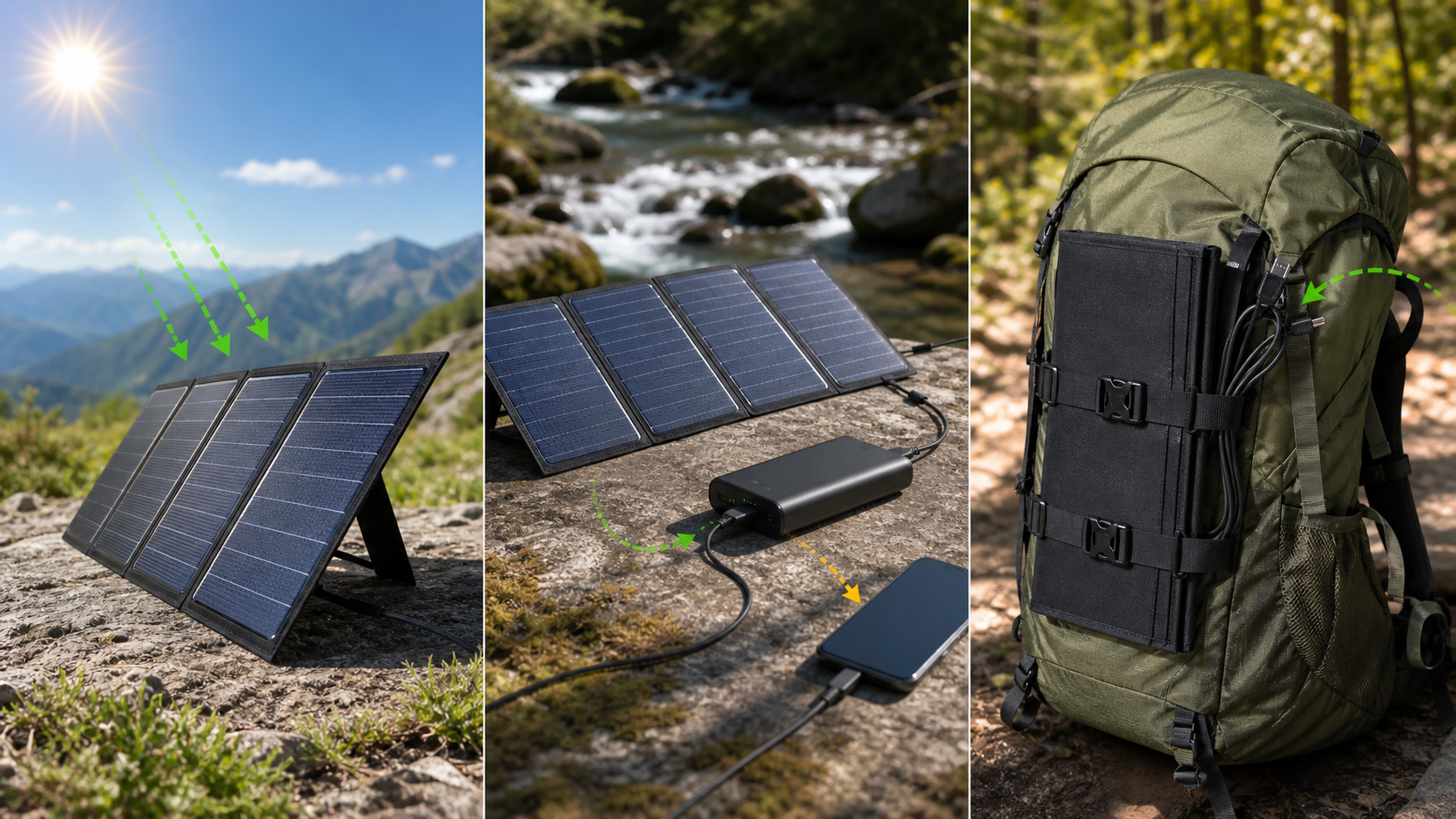
Every panel in this guide shares one identity trait. None of them store power. BigBlue’s listings for its 28W, 30W, and dual USB-C panels each explicitly state they cannot store electricity and have no internal battery, and the same direct charging design applies to every other panel here, including FlexSolar’s three panels and LUMOPAL’s 60W model. Power flows only while the panel faces the sun, and stops the instant it doesn’t.
That tradeoff is why a solar panel and a portable power bank solve different problems on a trip. A panel like the ones in this guide works well tied to the outside of a pack while hiking in daylight, feeding a phone or a power bank slowly through the day. A separate battery pack, charged from the panel during the day, is what actually delivers power once the sun goes down. Buyers looking for a single device that both catches sun and stores charge want a solar power bank instead of a direct charging panel like the ten covered here. For a device that needs portable reserve power, compare the charging workflow with a USB-C power bank for a handheld gaming PC before assuming a direct-output panel can replace stored energy.
Real-World Output Rarely Matches the Rated Wattage
The wattage figures throughout this guide, from BLAVOR’s 10 watts to LUMOPAL’s 60 watts, describe each manufacturer’s rated maximum under close to ideal sun conditions, not a guaranteed field result. None of these panels were independently power tested for this guide, and cloud cover, panel angle, ambient temperature, and even the connected device’s own charging circuitry can all reduce real world output well below the number printed on the listing.
A practical way to plan around that gap is to treat the rated wattage as a best case ceiling and expect meaningfully less on a partly cloudy day or when the panel is not angled directly at the sun. Panels with a higher rated wattage, like FlexSolar’s 40W or LUMOPAL’s 60W panel, still tend to hold a real world advantage over a 10W or 20W panel even after that discount, since the gap scales with the base rating.
Matching Panel Size and Weight to Trip Length
The ten panels in this guide span a wide range, from BLAVOR’s compact 10W panel built for a hip pocket to LUMOPAL’s 60W panel sized for higher output. A short trip or a light daypack favors the smaller, lower wattage end of that range, where the panel adds little bulk for topping off a phone. A longer trip with more devices, or a laptop that actually needs meaningful USB-C wattage, justifies carrying a larger, heavier panel for the higher ceiling.
BigBlue’s 25W panel, listed at 0.84 pounds with an IP68 rating, sits in a different part of that tradeoff space entirely, prioritizing low weight and weather resistance over the raw output of the 40W and 60W panels above it. Weigh the panel against how many devices need charging and how much daily sun the route actually gets before picking the high end or the low end of this range. Backpackers powering camp lighting can pair this choice with the USB-C camping lantern guide to keep the panel, cable, and light roles clear.
Water Resistance and Build Details
BigBlue’s 25W panel and BigBlue’s 30W panel both state a published IP68 waterproof rating, the highest rating stated in this guide. LUMOPAL states IP65, SOLUPUP states IPX5, and BLAVOR states IPX4, and the other five listings in this comparison do not publish a water resistance figure, which is not the same as being unprotected, it simply means that detail isn’t stated where it could be checked for this guide. None of these ratings were independently field tested for this guide, so treat each one as a manufacturer claim rather than a verified result.
For a trip where rain is possible, either lean toward the panel with a stated rating or plan to pack any panel away during active rain, regardless of what the listing does or doesn’t say. Checking current listing photos and the manufacturer’s own product page, when available, is the more reliable way to confirm build details a title and feature list alone don’t fully cover. If the same kit must replenish a camera setup, see the separate USB-C camera battery charger guide for the battery-specific compatibility check.
Frequently Asked Questions
Can a USB-C solar panel charge my phone directly in the sun?
Yes. Every panel in this guide sends power straight out its USB-C port while sunlight is hitting the panel, the same way a wall charger sends power to a connected cable. Plug a phone into the panel’s USB-C port, angle the panel toward the sun, and charging begins as soon as the connection is made and the panel is producing power.
Charge speed depends on the panel’s rated USB-C output and how directly the sun is hitting it. A panel like BigBlue’s dual USB-C 28W model, rated 5V/3A per port, charges a phone close to a standard wall charger speed in strong, direct sun, while a lower output panel like BLAVOR’s 10W model charges more slowly and works better for topping off than for a fast charge from empty.
For the wall-powered part of the same kit, use the USB-C charger guide to match a charger to the device rather than treating the panel as the only charging source.
Do these solar panels store power for use after dark?
No. None of the ten panels in this guide have an internal battery. BigBlue’s own listings for its 28W, 30W, and dual USB-C panels state this explicitly, and the same direct charging design applies across every panel here, including FlexSolar’s and LUMOPAL’s models. Once the sun sets or the panel is shaded, output stops immediately, whether or not a device is still connected.
For power after dark, the panel needs to charge a separate battery pack during the day, and that battery pack is what powers a device once the sun is gone. None of the ten panels in this guide fill that role themselves, since a battery inside the panel would make it a solar power bank rather than the direct charging panels covered here.
Keep that storage distinction in mind when charging a USB-C camping lantern after sunset.
How much real-world wattage should I expect compared to the rated number?
Expect less than the rated figure printed on each listing, since that number describes a manufacturer’s maximum under close to ideal sun conditions rather than a guaranteed field result. This guide did not independently power test any of the ten panels, so treat the wattage figures throughout, from BLAVOR’s 10W to LUMOPAL’s 60W, as ceilings rather than promises.
Several factors commonly reduce real world output below the rated maximum: – Cloud cover or haze, which reduces the sunlight reaching the panel’s cells – Panel angle, since output drops when the panel isn’t facing the sun directly – Ambient temperature, which can affect cell efficiency at temperature extremes – The connected device’s own charging circuitry, which may draw less than the panel’s maximum output regardless of what the panel can produce
A higher rated panel, such as FlexSolar’s 40W or LUMOPAL’s 60W model, still tends to produce more real world power than a 10W or 20W panel under the same conditions, since the shortfall scales with the base rating rather than erasing the gap between panels entirely.
Can I charge a laptop with one of these solar panels?
It depends on the laptop’s charging requirements and which panel’s USB-C port matches them. Most panels in this guide cap their USB-C output well below their total panel wattage, useful for phones and small electronics but not for a laptop that needs a higher sustained wattage. LUMOPAL’s 60W panel is the exception in this list, with a PD USB-C port rated up to the panel’s full 60 watts, the closest match here to laptop level charging needs.
Even with a matching port rating, a laptop draws its full rated wattage more consistently than a phone does, so real world charging in variable sun is more likely to slow the laptop’s battery drain than fully charge it while in active use. Confirm the laptop’s own USB-C PD charging requirements against the panel’s stated PD wattage before relying on solar charging as a primary power source for laptop work in the field.
The USB-C charger guide is also useful for checking the laptop’s wall-power baseline before planning a solar alternative.
Are foldable solar panels durable enough for backpacking?
Durability varies by panel, and five of the ten products in this guide state a water resistance figure on their listing. BigBlue’s 25W and 30W panels both state an IP68 waterproof rating, the highest published figure among the ten panels covered here. LUMOPAL states IP65, SOLUPUP states IPX5, and BLAVOR states IPX4. The other five listings do not publish a water resistance or drop durability rating, which means that detail simply isn’t stated on the listing, not that the panel lacks any protection.
For a trip with exposure to rain or rough handling, favor the panel with a stated rating, or plan to pack any panel away during active rain and rough scrambling regardless of what its listing states. Checking current listing photos and Q&A sections, and the manufacturer’s own site when it’s reachable, is a reasonable way to gather more construction detail than a title and feature list alone provide.
Do I need a power bank in addition to a solar panel?
For most backpacking trips, yes. Since none of the ten panels in this guide store power, a device that needs charging after dark, or during a stretch of cloudy weather, needs a separate battery to draw from. The typical setup pairs one of these panels with a power bank: the panel charges the battery pack during the day while hiking, and the battery pack charges phones, headlamps, or other gear at night or on demand.
That two device approach also protects against the direct sun requirement every panel here shares. BigBlue’s dual USB-C panel or FlexSolar’s 40W panel, both with multiple output ports, can charge a power bank and a phone at the same time during a sunny stretch, banking power in the battery pack for use later when the panel itself is packed away or the sky clouds over.
Keep a compatible USB-C cable in that setup so the panel can reach the battery pack without relying on the device’s supplied lead.