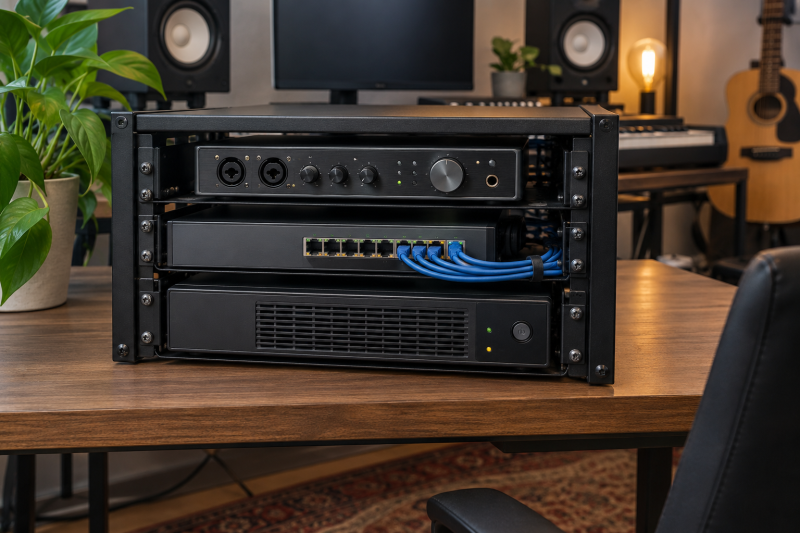
A rackmount UPS protects a NAS, switch, recorder, or studio computer during outages and voltage problems without taking floor space beside the rack. Load in watts, rack height, rack depth, outlet count, battery behavior, and monitoring all decide whether the unit fits the job, and the VA label is one input among them.
This guide compares six Amazon US rackmount UPS units with active New offers. Measure the installed load before buying, then choose the shallowest rack-compatible unit that has enough watt capacity and the right outlet layout.
Match the UPS watt rating and rack dimensions to the equipment you actually need to keep running.Rackmount UPS Units Compared




1. CyberPower CP1500PFCRM2U — Short-Depth Sine-Wave Pick
CyberPower lists the CP1500PFCRM2U as a 1500VA/1000W PFC sine-wave UPS in a short-depth 2U rackmount chassis. Its listed 10.5-inch depth can make it easier to place in a shallow wall rack than a longer conventional UPS.
It has eight NEMA 5-15R outlets, automatic voltage regulation, and a color LCD. The unit is a good starting point for a compact rack holding active-PFC computer hardware, network equipment, or audio/video gear, provided the total watt load stays inside its stated rating.
Our Take Buy the CP1500PFCRM2U if shallow rack depth and sine-wave output are the core requirements. Verify rails, input power, and the actual connected load before treating 1000W as spare capacity.
- Lists 1000W sine-wave output.
- Short 10.5-inch listed depth.
- Uses 2U of rack space.
- Needs a measured load plan.
2. Eaton Tripp Lite SMART1500LCD — 2U 900W Workhorse
Eaton lists the SMART1500LCD as a 1500VA/900W 2U rackmount UPS with eight NEMA 5-15R outlets. It can also mount vertically with the included adapter, which helps when a conventional rack position is not the only possible installation.
Its listing names automatic voltage regulation, a rotatable LCD, and user-replaceable internal batteries. The battery-mode output description differs from the AC-mode description, so the exact hardware load still counts when selecting it for a studio computer or sensitive equipment.
Our Take Buy the SMART1500LCD if the rack has several standard outlets to protect. It is a practical 2U option, so check the battery-mode output requirement of your gear rather than assuming every load has the same needs.
- Eight listed NEMA outlets.
- User-replaceable battery is listed.
- Consumes 2U of rack height.
- Rated 900W, not 1000W.
3. APC SMC1500-2UC — APC Smart-UPS Option
APC lists the SMC1500-2UC as a 1500VA/900W pure sine-wave line-interactive UPS in a 2U rackmount design. It includes six NEMA 5-15R outlets, automatic voltage regulation, and rack support rails.
The listing also names SmartConnect remote monitoring, with a stated six-month free trial for qualifying purchase or registration dates. SmartConnect can be useful for a remote NAS rack, but it should not replace a local shutdown and alert plan.
Our Take Buy the APC if its six-outlet layout, rails, and SmartConnect monitoring fit the rack. Keep the 900W ceiling central to the decision, especially with a NAS and workstation sharing one unit.
- Pure sine-wave output is listed.
- Includes rack support rails.
- Six outlets, fewer than some alternatives.
- Monitoring terms need checking.
4. Eaton BC1500RT1ULNC — 1U Lithium Cloud Upgrade
Eaton lists the BC1500RT1ULNC as a 1500VA/1050W lithium-ion rackmount UPS that occupies 1U. The listing gives 12 minutes at half load and two minutes at full load, so it is better suited to a protected shutdown or a short outage than to extended runtime.
It includes six outlets, with four split into switchable banks, plus cloud-connected monitoring through the Brightlayer app or browser. The 1U height and the listed lithium service life of five years or more are the main reasons to consider it.
Our Take Buy the BC1500RT1ULNC if 1U space and remote management are important enough to justify the lithium design. Confirm the rack’s depth, heat, and load budget before relying on its stated runtime figures.
- Only 1U of rack height.
- Lists 1050W capacity and cloud monitoring.
- Runtime changes with load.
- Has six outlets.
5. CyberPower OR500LCDRM1U — Light Network-Rack Load
CyberPower lists the OR500LCDRM1U as a 500VA/300W 1U UPS for network devices, telecom installations, and smaller server loads without active-PFC power supplies. It has six NEMA outlets, with four battery-backup outlets and two surge-only outlets.
The lower watt rating makes it a fit for a switch, modem, router, or light NAS arrangement rather than a studio computer with a high draw. Its LCD displays runtime and battery status, while remote management requires an optional management card.
Our Take Buy the OR500LCDRM1U if you have a light network rack where one rack unit counts for more than long runtime. Do not choose it for a load that approaches a workstation-class UPS requirement.
- Compact 1U design.
- Separates battery and surge-only outlets.
- Only 300W rated capacity.
- Remote card is optional.
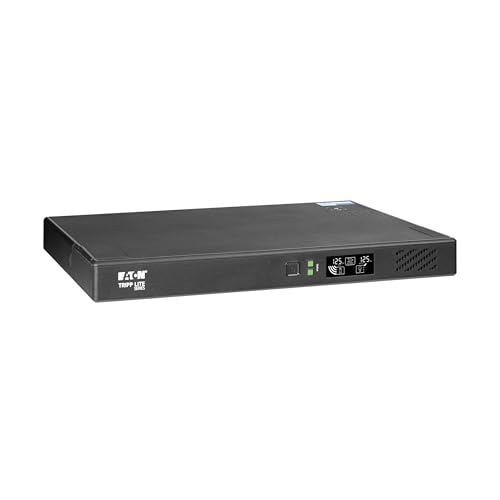
6. Eaton Tripp Lite SMART500RT1U — Compact 1U AVR Option
Eaton lists the SMART500RT1U as a 500VA/300W line-interactive 1U rack or tower UPS with automatic voltage regulation. Its installed depth is listed as 11.8 inches, and it has USB, RS232, EPO, and support for an optional SNMP or web card.
It is another compact choice for a small network shelf rather than a studio computer. One outlet is individually controllable for load shedding, which can help prioritize essential hardware during a longer outage.
Our Take Buy the SMART500RT1U if you need a 1U rackmount UPS for a shallow rack and a network load with low power draw. Its modest 300W rating is the boundary, not a detail to overlook.
- 1U rack or tower form factor.
- Listed AVR and controllable outlet.
- Only 300W capacity.
- Network card is optional.
Buying Guide
Size by watts before VA
The watt rating must cover the actual equipment load. A NAS, switch, audio interface, and studio computer have different power demands, and the combined load sets the realistic ceiling. List each device and its expected draw before comparing UPS units.
Battery runtime falls as load rises. The Eaton lithium model lists different runtime figures at half and full load, which shows why a manufacturer runtime number is only meaningful with the matching load. Use the UPS sizing guide to plan the shutdown target.
Measure the rack before choosing 1U or 2U
Rack height is an operating constraint. A 1U unit preserves more vertical space for switches and patch panels, while 2U models may offer different outlet counts or power capacity. Count free U positions before choosing on capacity alone.
Rack depth and rails need checking too. The CyberPower CP1500PFCRM2U lists a 10.5-inch depth, and the Eaton 500VA lists 11.8 inches. Compare those figures with the installed rack and cable clearance rather than assuming every rackmount chassis fits.
Plan outlet and monitoring needs
Outlet layouts determine what can be protected. Some units list six outlets while others list eight, and the CyberPower OR500LCDRM1U separates battery-backed from surge-only outlets. Place critical gear on the correct outlet group first.
Use remote management alongside local shutdown planning. APC lists SmartConnect, Eaton lists cloud monitoring on the lithium model, and some smaller units need an optional card. Decide whether alerts and orderly shutdown are necessary before paying for management features.
Frequently Asked Questions
Is a 1U UPS enough for a NAS and switch?
It can be, if the combined watt load stays below the UPS rating. The two 1U 500VA units here are rated by their manufacturers at 300W, so they suit lighter network equipment better than a loaded studio computer.
Measure the NAS, switch, and any attached storage before deciding. If the load needs more capacity or longer runtime, a 2U 900W or 1000W class unit may be the more appropriate starting point.
Do I need sine-wave output?
The answer depends on the connected power supplies. Sine-wave output is listed on the CyberPower CP1500PFCRM2U and APC SMC1500-2UC, while the Eaton SMART1500LCD listing distinguishes its battery-mode output from its AC-mode description.
Check the requirements of the computer, audio, and network hardware you intend to connect. Do not treat the UPS topology as interchangeable when the connected load has a specific requirement.
How many outlets should a rack UPS have?
Count critical devices, then identify which outlets provide battery backup. Six and eight outlet layouts are both represented here, but outlet count alone does not tell you which devices should remain active during a long outage.
Prioritize the modem, router, switch, NAS, and shutdown host according to your own recovery plan. A controllable outlet bank can help, but it does not replace knowing which devices need battery power.
Bottom Line
The CyberPower CP1500PFCRM2U is the strongest starting point for a short-depth rack that needs sine-wave output and 1000W of listed capacity. For a 1U rack or lighter network load, the Eaton lithium model and the two 300W units make more sense. Measure watts, rack dimensions, and outlet roles before selecting any of them.
Source boundary
Product identity, stated rack height and depth, VA and watt ratings, listed outlets, runtime figures, and monitoring features come from the Amazon US listings in data/topic-bank-2026-10-01.json. This guide does not claim independently measured runtime, load behavior, or power quality.