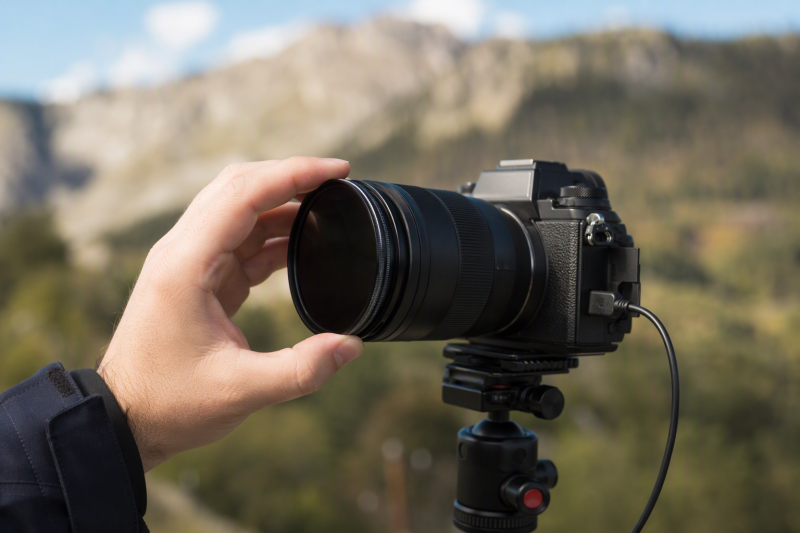
A variable neutral-density filter reduces light before it reaches the lens. It helps a video creator hold the intended shutter speed and aperture as daylight changes. Rotating one filter is faster than swapping several fixed filters, but the convenience brings compatibility and image-quality decisions. The thread diameter must match the lens, and the stop range must cover the scene. Wide-range designs can also develop an X-shaped cross near their darkest setting.
This guide evaluates seven filters with active New Amazon listings. Several details decide which filter fits: optical range, thread size, cap size, hard-stop design, color claims, polarizing behavior, wide-angle compatibility, and lens-hood restrictions. Controlled usable ranges and clearly stated fit matter more than the largest maximum number. Manufacturers recommend verifying variable ND performance across planned focal lengths before a paid or unrepeatable shoot.
The PolarPro PMVND Edition II is our best overall video choice because its selected 2-to-5-stop range uses hard stops, claims no X pattern, and includes a custom cap and protective case. The NEEWER Series S 77mm is the strongest 77 mm limited-range choice, with tactile stops from ND2 to ND32. Creators who need both variable ND and reflection control on a 77 mm lens should consider the K-and-F Concept True Color ND and CPL.
Variable ND Filter Comparison
| Image | Product | Details | Check Price |
|---|---|---|---|
 | K&F Concept SKU0128 72mm Variable ND2-400 Filter | Lens thread: 72 mm Density range: ND2-ND400; 1-9 stops Control design: Continuous 360-degree rotation Optical construction: AGC glass; 8 coating layers Important limit: X pattern may appear near maximum; needs 77 mm cap | Check Price on Amazon |
 | PolarPro 82mm Peter McKinnon PMVND Edition II 2-5 Stop Filter | Lens thread: 82 mm Density range: ND4-ND32; 2-5 stops Control design: Hard stops with haptic feedback Optical construction: Quartz glass; 16 coating layers Important limit: No ordinary hood or cap; custom cap included | Check Price on Amazon |
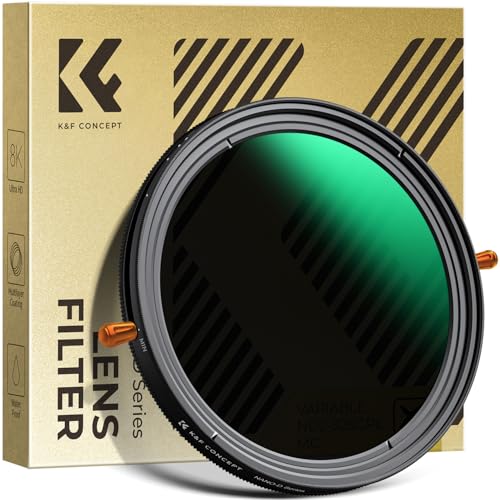 | K&F Concept 62mm Variable ND2-32 and CPL Filter | Lens thread: 62 mm Density range: ND2-ND32; 1-5 stops Control design: Self-locking range with adjustment lever and CPL Optical construction: AGC glass; 24 coating layers Important limit: Combined polarizing effect; needs 72 mm cap | Check Price on Amazon |
 | NEEWER Series A 82mm Variable ND2-400 Filter | Lens thread: 82 mm Density range: ND2-ND400; 1-9 stops Control design: Continuous rotating ring Optical construction: 4-element glass; NITTO film; 42 coating layers Important limit: X glare may appear near ND256; needs 86 mm cap | Check Price on Amazon |
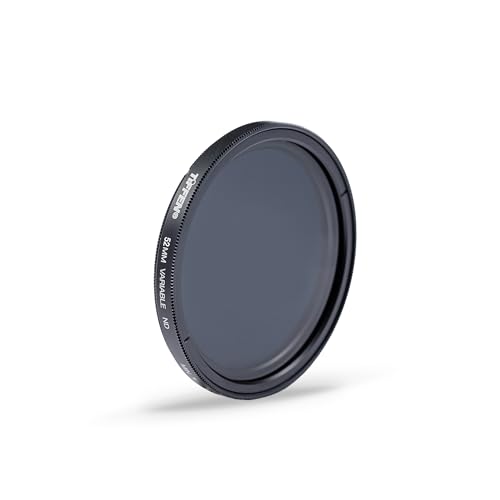 | Tiffen 52VND 52mm Variable ND Filter | Lens thread: 52 mm Density range: 0.6-2.4 optical density; 2-8 stops Control design: Smooth rotating ring Optical construction: Tiffen ColorCore glass Important limit: Hard stops, cap size, and X behavior not stated | Check Price on Amazon |
 | NEEWER Series S 77mm True Color Variable ND2-32 Filter | Lens thread: 77 mm Density range: ND2-ND32; 1-5 stops Control design: Clicked hard stops Optical construction: HD glass; 30 coating layers on both sides Important limit: Front-cap size not stated | Check Price on Amazon |
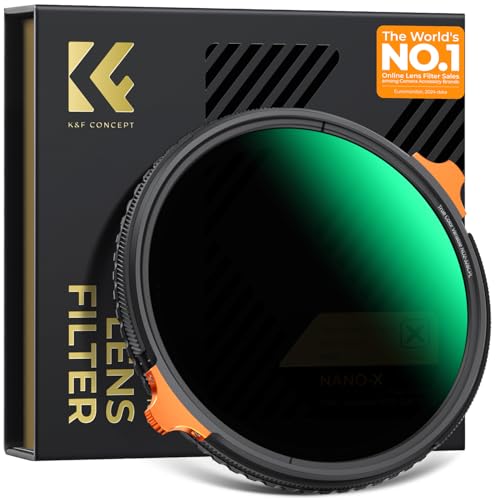 | K&F Concept 77mm True Color Variable ND2-32 and CPL Filter | Lens thread: 77 mm Density range: ND2-ND32; 1-5 stops Control design: Self-locking range with CPL Optical construction: AGC glass; 28 layers; titanium coating Important limit: Combined polarizing effect; needs 82 mm cap | Check Price on Amazon |
Thread size is a physical requirement, not a camera-brand feature. Check the diameter mark on the lens itself. Several filters use an oversized front ring, so their cap requirement differs from the rear thread: the 72 mm K&F needs a 77 mm cap, the 62 mm K&F needs a 72 mm cap, the 82 mm NEEWER needs an 86 mm cap, and the 77 mm K&F needs an 82 mm cap.
1. K-and-F Concept SKU0128 72mm VND — Best Wide-Range 72mm Value
The K&F Concept SKU0128 covers a broad ND2-to-ND400 range, which the manufacturer lists as 1 to 9 stops. That span can handle moderate light reduction and much brighter conditions with one 72 mm filter. Its front element rotates through 360 degrees rather than stopping at a fixed maximum.
The filter uses AGC optical glass with eight coating layers. An oxidized sandblasted metal surface is intended to reduce stray reflections, while the CNC-patterned ring gives better grip during mounting and adjustment. K&F specifies a 7.4 mm thick frame, a relatively slim construction intended to keep handling compact.
K&F explicitly warns that the darkest positions can produce a black X pattern depending on the lens and focal length. Treat 9 stops as a nominal limit rather than a promise that every point is clean on every lens. The rear thread fits 72 mm lenses, but the front requires a 77 mm cap. For controlled 1-to-5-stop use without the stated cross warning, compare the NEEWER Series S 77mm if the lens size is compatible.
[greenbox] Best for a 72 mm lens when broad light reduction is more important than hard-stop control at the darkest end. [/greenbox] Our TakeThe SKU0128 is a practical wide-range entry point, but creators should mark the clean limit for each lens rather than automatically rotating to the maximum.
- Broad 1-to-9-stop range
- Slim 7.4 mm frame
- Grip-textured rotating ring
- X pattern may appear near maximum density
- Requires a separate 77 mm front cap
2. PolarPro PMVND Edition II 82mm — Best Overall
This PolarPro is the 82 mm, 2-to-5-stop PMVND Signature Edition II. The limited ND4-to-ND32 range is well suited to video exposure changes without pushing one rotating pair across an extreme span. Hard stops and haptic feedback mark the minimum and maximum positions, so the operator does not need to watch the scale continuously.
PolarPro claims no X pattern or vignetting through the designed range, with zero vignetting down to a 16 mm focal length. That focal statement is a manufacturer claim for the filter, and the actual result still depends on lens construction and camera format. Cinema-grade quartz glass and 16 coating layers are listed for color accuracy, scratch resistance, and reflection control.
Check compatibility before ordering. This version fits 82 mm lenses and does not work with ordinary lens hoods or lens caps. A custom cap, microfiber cloth, and magnetic Defender360 case are included. The listing also mentions a separate 6-to-9-stop option, but the selected product is the 2-to-5-stop version. For a wider 82 mm range with an acknowledged dark-end limit, see the NEEWER Series A 82mm.
[bluebox] Best for 82 mm creator-video lenses that need a controlled 2-to-5-stop range and can operate without the normal hood. [/bluebox] Our TakeThe hard stops, constrained range, and included protection make this one of the most video-focused options here. The no-hood rule is a workflow cost, so accept it before buying.
- Hard-stop 2-to-5-stop range
- No-X and 16 mm no-vignetting claims
- Custom cap, cloth, and magnetic case included
- Does not work with lens hoods
- Limited to 82 mm lens threads
3. K-and-F Concept 62mm ND and CPL — Best Compact ND and CPL Combination
This 62 mm K&F has a variable ND2-to-ND32 range and a circular-polarizing effect. K&F Concept states the 1-to-5-stop light control can support daylight video, while the polarization component is designed to reduce reflections from nonmetallic surfaces such as water and glass and change apparent contrast in skies.
The frame uses self-locking technology across the 1-to-5-stop range and is designed to avoid a black X pattern. A small adjustment lever makes density changes easier without gripping the full ring. According to the manufacturer, the AGC optical glass carries 24 coating layers described as waterproof and designed to preserve color and definition.
Because ND and CPL share one filter, density and reflection behavior are tied together. Test the effect while rotating and reframing, especially on skies or reflective backgrounds. The filter is rated to fit 62 mm lens threads and, according to K&F, requires a 72 mm front cap. The filter does not list a cap as included. For the same combined concept in 77 mm with a true-color coating claim, compare the K-and-F Concept 77mm True Color ND and CPL.
[greenbox] Best for a 62 mm lens when controlled variable density and polarizing reflection management are both required. [/greenbox] Our TakeThis filter suits compact lenses and reflective outdoor scenes. The combined polarizing effect needs deliberate monitoring because it changes more than exposure.
- Variable ND and CPL in one filter
- Limited 1-to-5-stop range with no-X design
- Adjustment lever
- Polarization changes with filter adjustment and camera angle
- Requires a 72 mm front cap
4. NEEWER Series A 82mm VND — Best Wide-Range 82mm Filter
The NEEWER Series A spans ND2 to ND400, listed as 1 to 9 stops. It uses Japanese NITTO polarizing film, four-element optical glass, and 42 coating layers. NEEWER lists a minimum light reflectance of 0.1 percent along with resistance to moisture, oil, dust, and scratches.
Its 9.5 mm frame uses a wider outer ring intended to reduce vignetting on wide-angle and telephoto lenses. Because of the oversizing, an 86 mm cap is needed for this 82 mm rear-thread filter. Verify clearance with the lens hood because hood compatibility is not stated.
NEEWER warns that X-shaped glare or ghosting may appear around ND256 and that actual minimum and maximum effects can vary with environment and brand markings. NEEWER also directs true long-exposure buyers toward fixed ND1000 or ND2000 filters. NEEWER’s open warnings make the filter useful for creators prepared to avoid the darkest problematic region. A 2-to-5-stop hard-stop workflow is better served by the PolarPro PMVND Edition II.
[bluebox] Best for an 82 mm lens when a broad density range is needed and the operator will test and avoid the X-pattern boundary. [/bluebox] Our TakeThe Series A offers the largest coating count and a broad range, but NEEWER clearly acknowledges X effects near ND256. Treat the range as adjustable headroom, and do not assume every setting is production ready.
- 1-to-9-stop adjustment
- 42 coating layers
- Wide outer frame intended to reduce vignetting
- X glare or ghosting may appear near ND256
- Requires an 86 mm front cap
5. Tiffen 52VND 52mm Filter — Best 52mm Broad-Range Option
The Tiffen 52VND has 2 to 8 stops of adjustment, corresponding to 0.6 to 2.4 optical density. That range can support daylight video, wide-aperture portraits, and intentional motion blur without changing among several fixed filters. Rotating the ring changes the exposure continuously.
Tiffen specifies ColorCore glass and New York manufacture. The product description covers the exposure range and application and does not state coating count, frame thickness, cap size, hard stops, or X-pattern behavior. Buyers should not infer those missing details from brand reputation.
The Tiffen is the only 52 mm option among the seven products here and therefore the direct fit for a lens with that thread. Test the darkest positions and wide focal lengths before production because the description does not state a range that avoids the cross. For a narrower range with explicit hard stops, compare the NEEWER Series S 77mm on compatible lenses.
[graybox] Best for a 52 mm lens owner who needs a broad 2-to-8-stop range and accepts fewer published design details. [/graybox] Our TakeThe Tiffen suits a 52 mm lens with a useful range and ColorCore glass. Missing cap, coating, and dark-end behavior details call for careful lens-specific testing.
- 2-to-8-stop adjustment
- ColorCore glass
- Direct 52 mm fit
- No hard-stop or X-pattern claim supplied
- Coating count and cap size are not stated
6. NEEWER Series S 77mm True Color VND — Best 77mm Hard-Stop Filter
The NEEWER Series S limits adjustment to ND2, ND4, ND8, ND16, and ND32, corresponding to 1 through 5 stops. The hard stops give tactile feedback and a click at each gear position. The fixed steps help you repeat a density setting, and they prevent the ring from rotating beyond its designed range.
NEEWER claims no black cross and true-to-life color reproduction across the limited range. The HD optical glass has 30 nano-coating layers on both sides for reflection control and resistance to water, dust, oil, fingerprints, and scratches.
The aluminum frame is described as ultra slim and uses a knurled ring for mounting and removal. Unlike the 77 mm K&F listing, this listing does not state a larger cap requirement or a CPL function. Choose it when predictable hard stops are more important than polarization. The K-and-F Concept 77mm True Color ND and CPL is the alternative for reflection control.
[greenbox] Best for 77 mm creator-video lenses that need tactile 1-to-5-stop adjustment without a combined CPL effect. [/greenbox] Our TakeThe Series S has the simplest 77 mm video workflow in this group. Its five click positions give repeatability, but not the continuous feel and broader range of other filters.
- Tactile hard stops from 1 to 5 stops
- No-X and true-color claims
- Thirty coating layers on both sides
- Limited to five stops
- Front-cap requirement is not stated
7. K-and-F Concept 77mm True Color ND and CPL — Best 77mm ND and CPL Combination
This 77 mm K&F has 1-to-5-stop variable density with a CPL effect for water, glass, sky, and other nonmetallic reflections. The filter’s self-locking rotation is limited to ND2 to ND32 and is designed to prevent the black X pattern.
Its AGC glass uses 28 coating layers plus a titanium true-color coating. K&F describes the filter as waterproof and scratch resistant and claims the titanium treatment addresses partial yellowing and color shift. Old and new packaging may ship randomly, but the listing says product contents do not change.
It fits 77 mm lens threads and requires an 82 mm front cap. As with the 62 mm version, the CPL response must be judged alongside density because one combined optic influences both. The combined optic suits creators who deliberately control reflections, but it is less neutral than a filter without CPL. For simple hard-stop exposure adjustment, the NEEWER Series S 77mm is easier to judge.
[bluebox] Best for a 77 mm lens shooting daylight scenes where reflection control and variable density are both intentional. [/bluebox] Our TakeOf the two combined ND-and-CPL filters here, the 77 mm K&F has the more detailed coating description. Its extra optical effect is useful only when the creator actively monitors reflections and sky response while adjusting exposure.
- Variable ND and CPL in one filter
- Self-locking 1-to-5-stop range
- Titanium true-color coating claim
- CPL response adds another exposure variable
- Requires an 82 mm front cap
Buying Guide: Choosing a Variable ND Filter for Video
Match the lens thread before comparing optics
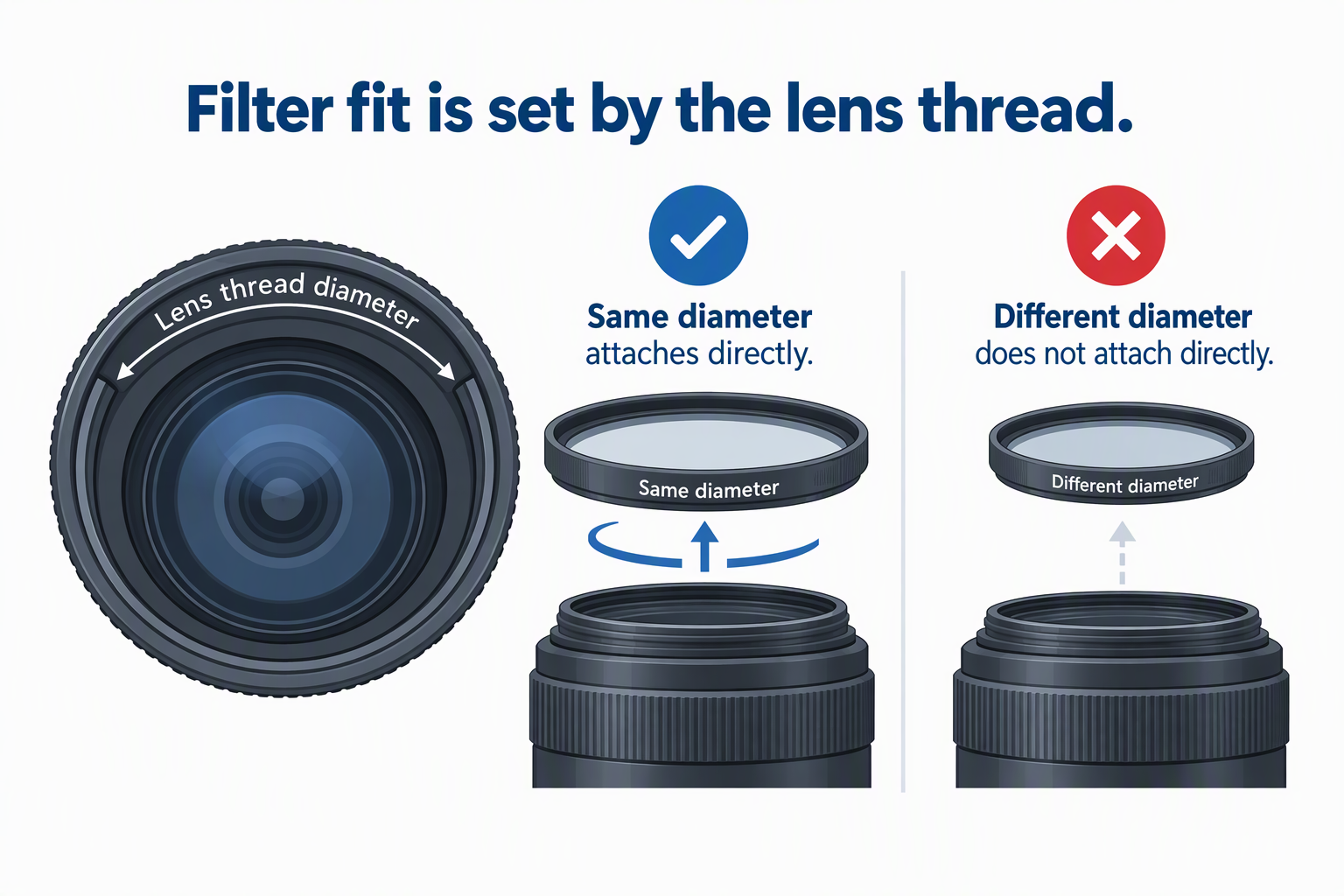
Read the diameter marking on the lens, usually shown beside the diameter symbol. A 77 mm filter does not attach directly to a 72 mm or 82 mm thread. Filter fit is determined by the lens thread, not by the camera mount, sensor format, or brand.
An adapter ring can change the physical pairing, but it may affect hood use, cap fit, and vignetting and is not part of these product listings. The selected filters span 52, 62, 72, 77, and 82 mm. Confirm the exact lens and front-accessory plan before ordering.
Choose a controlled range before a maximum range
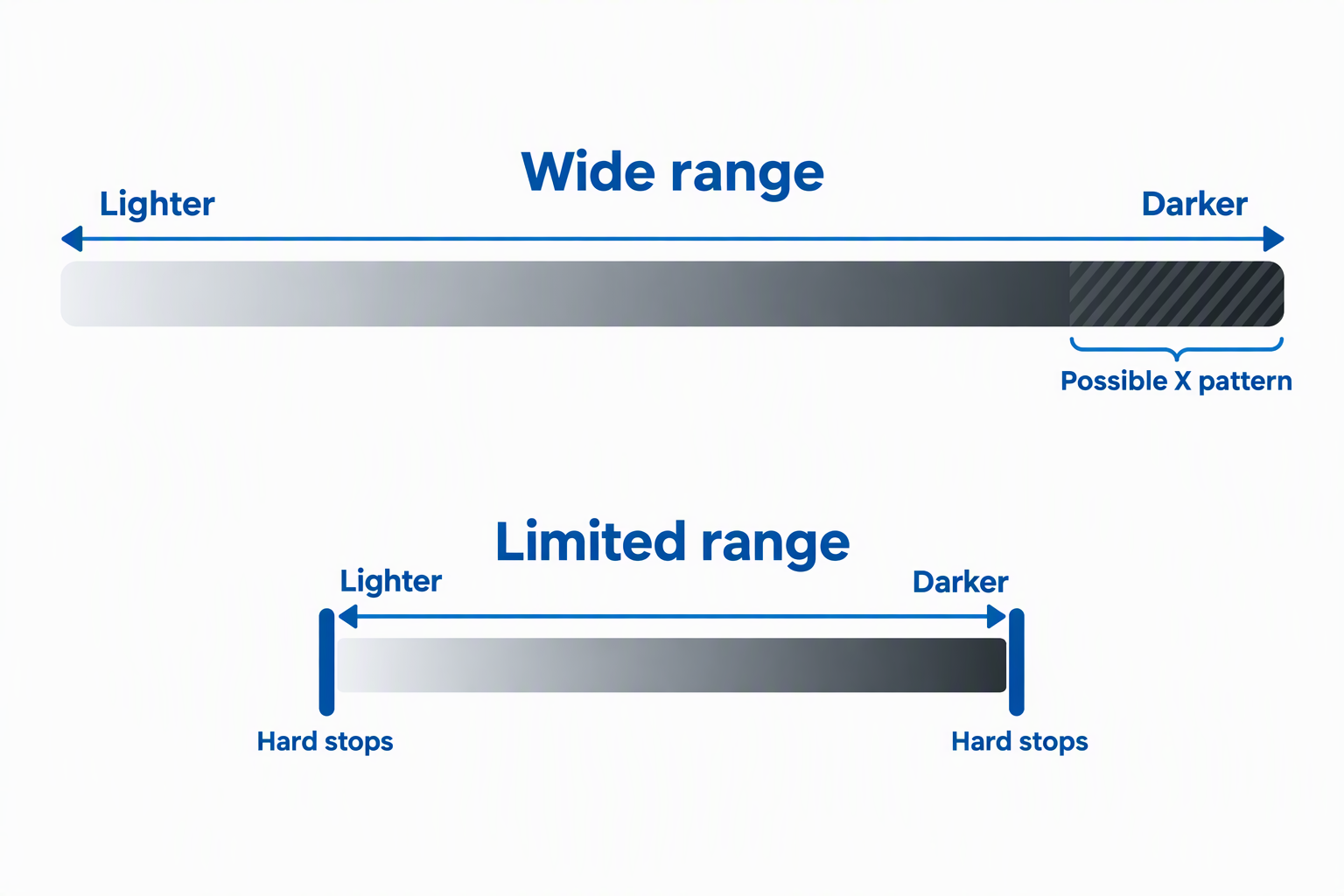
A 1-to-9-stop filter covers more light conditions, but the darkest region can produce uneven polarization and an X-shaped pattern. The K&F SKU0128 and NEEWER Series A both warn about that behavior. A larger nominal range is not always a larger usable range. Operators should check each lens to identify the clean boundary.
Limited 1-to-5 or 2-to-5-stop filters can use hard or self-locking limits to keep rotation inside a designed range. They may require a second stronger filter for extreme daylight, but they simplify ordinary exposure adjustment. Choose the narrowest range that covers the intended scenes.
Understand hard stops, clicks, and continuous rotation
Hard stops prevent the ring from moving beyond the rated minimum and maximum. Clicked positions, like the NEEWER Series S settings, make it easier to repeat a measured density. Continuous rotation supports fine adjustment but can drift into an unusable region on wide-range designs. The best control style depends on whether speed or repeatability counts for more.
Haptic feedback is useful when the operator is watching a subject rather than the filter scale. It does not replace exposure monitoring, since lens, ISO, aperture, and ambient light still affect the result. Use waveform, histogram, or the camera’s chosen exposure tools while turning the filter.
Test for cross patterns and vignetting
An X pattern appears when the polarizing elements reach an unfavorable relationship, often near maximum density. Vignetting can come from the filter frame, stacked accessories, adapters, or a wide lens. It is advisable to check the full density range at every planned focal length before relying on a filter during production.
PolarPro claims no vignetting down to 16 mm and no X pattern for its selected range, while K&F and NEEWER explicitly warn about the darkest settings on their 1-to-9-stop filters. Treat all such statements as product claims and inspect recorded footage. A clean preview at one focal length does not prove the entire zoom range.
Decide whether a combined CPL is desirable
A CPL can reduce reflections from water and glass and change sky contrast, which can improve some exterior scenes. It can also make the image change as the camera angle moves relative to reflective surfaces. Combined ND-and-CPL filters control more than brightness.
For a locked-off product shot near glass, that extra control can be useful. For run-and-gun coverage with frequent reframing, a filter without CPL may be more predictable. Watch skin, painted surfaces, windows, and skies while rotating. Choose the combined design only when polarization is part of the visual plan.
Check hood and cap compatibility
An oversized front ring can reduce mechanical obstruction but changes the cap size. Four products in this set explicitly require a cap larger than the rear thread. The PolarPro includes a custom cap but does not work with standard hoods or caps. Budget for the stated cap and verify hood clearance.
Removing a hood can increase exposure to stray light and physical contact, so the tradeoff belongs in the purchase decision. Store the filter in its case when it is off the lens and keep the glass clean. A compatible protective workflow counts as much as the rear thread.
Related Creator Gear Guides
These guides cover cleaning, protection, support, and capture hardware used alongside daylight video lenses:
- Camera cleaning kits for mirrorless lenses and sensors
- Camera rain covers for outdoor creator shoots
- Camera monopods for run-and-gun creator video
- Camera top handles for handheld creator rigs
- Mirrorless camera cages for desk video rigs
- Camera suction mounts for vehicle creator shots
- Overhead camera mounts for desk tutorials
- HDMI loop-out capture cards for camera monitoring
Frequently Asked Questions
Is a 1-to-9-stop variable ND better than a 1-to-5-stop filter?
Not automatically. A 1-to-9-stop filter covers more brightness with one accessory, but its darkest positions may show an X pattern or uneven results. Usable clean range counts for more than the advertised maximum. The K&F SKU0128 and NEEWER Series A both acknowledge dark-end artifacts.
A 1-to-5-stop filter is often easier to control for routine daylight changes and can use hard limits to prevent over-rotation. Choose based on the scenes, aperture, ISO, and shutter settings the camera will use.
Why does a variable ND create a black X?
Variable ND filters use interacting polarizing layers. At some extreme rotations and with some focal lengths, the relationship can create uneven darkening that appears as an X. The effect is a design and setup limitation, not dirt on the filter.
Back away from the darkest position, change the exposure another way, or use a suitable fixed stronger ND when the variable filter reaches its clean limit. Zoom lenses should be checked across their focal range because the point where the artifact appears can change.
Can a variable ND stay on the lens indoors?
It can remain physically attached if compatible, but even the minimum setting reduces light. Remove it when the loss of light forces unwanted ISO, aperture, or shutter changes. Keeping extra glass on the lens can also complicate flare and cap or hood use.
Store the filter safely rather than forcing it into an unsuitable scene. A case and clean cloth make changes easier in the field. The PolarPro includes both, while the other listings vary in the storage accessories they include.
Does a combined CPL make exposure control harder?
It can. Rotating a combined ND-and-CPL filter changes density while also influencing reflections and contrast. The visual effect may vary as the camera moves, even when ambient brightness stays constant.
Use the combination when reflection control is intentional and there is time to monitor the frame. For event or documentary movement, a filter without CPL can be more predictable because the primary goal remains light reduction.
Can the original lens cap fit over a variable ND filter?
Sometimes, but several filters here require a larger front cap than their rear thread size. Follow the stated front-cap diameter rather than assuming the lens cap fits. A 72 mm K&F needs 77 mm, the 62 mm K&F needs 72 mm, the 82 mm NEEWER needs 86 mm, and the 77 mm K&F needs 82 mm.
The PolarPro does not work with ordinary caps but includes a custom one. The Tiffen and NEEWER Series S listings do not state cap sizing, so verify before building a field kit.
Bottom Line
The PolarPro PMVND Edition II is our best overall variable ND for compatible 82 mm video lenses because its 2-to-5-stop hard-stop range, no-X claim, custom cap, and protective case give it the clearest production workflow. The NEEWER Series S is the strongest 77 mm choice without CPL, while the K&F 77 mm True Color model adds CPL control for scenes where reflections are part of the shot.
Choose the 72 mm K&F or 82 mm NEEWER Series A when a broad 1-to-9-stop range is necessary, but test and avoid their documented dark-end artifact zones. The 62 mm K&F serves smaller combined ND-and-CPL setups, and the Tiffen is the direct 52 mm option. Verify the lens thread and cap size, then test every density at every working focal length before the shoot.
Product stop ranges, lens threads, coating claims, cap requirements, compatibility limits, included accessories, and availability are based on the supplied Amazon product records dated October 14, 2026. Verify current lens fit and package contents before purchase.