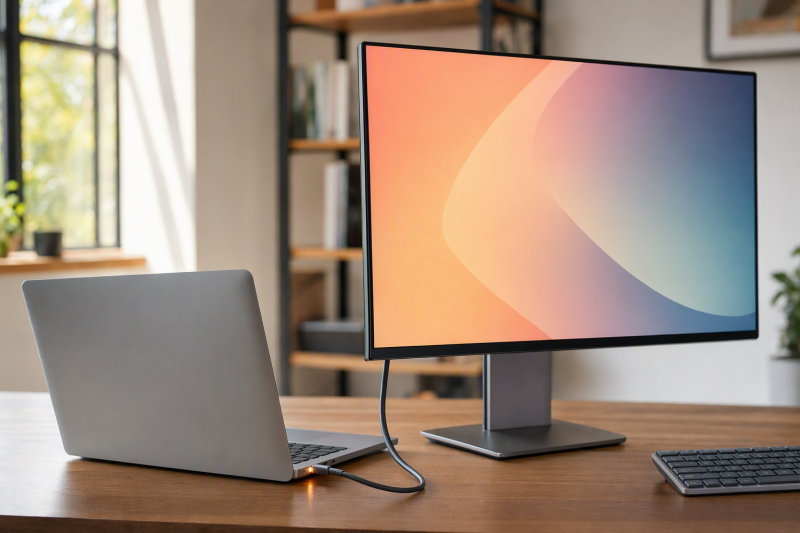
Our best USB-C monitor with 65W laptop charging is the Philips 27E1N5900R/27, which puts a 27-inch 4K panel behind a documented USB-C DisplayPort Alt Mode/data path, two downstream USB ports, and the exact 65W ceiling this page targets. Dell S2725QC adds up to 120Hz, ASUS PA247CV emphasizes a compact ProArt workspace and four-port hub, Dell S2722DC offers QHD, and BenQ GW2786TC adds 100Hz plus DisplayPort MST output. Our broad USB-C monitor guide covers other power classes and display sizes.
The monitor offers up to 65W; the laptop decides what it accepts through USB Power Delivery negotiation. That ceiling covers many thin laptops comfortably and runs short for a performance workstation under load. Panel resolution, refresh, USB-C video input, hub bandwidth, downstream display support, color claims, and charging all stay separate exact-model fields. None of the specifications below is a test result from this site.
Quick picks
- Philips 27E1N5900R/27: Best overall 27-inch 4K 65W USB-C monitor.
- Dell S2725QC: Best 4K option with an up-to-120Hz ceiling.
- ASUS ProArt PA247CV: Best compact creator-oriented hub monitor.
- Dell S2722DC: Best QHD alternative with speakers and a USB hub.
- BenQ GW2786TC: Best FHD 100Hz option with MST output.
Compare USB-C monitors with 65W charging
| Image | Product | Details | Check Price |
|---|---|---|---|
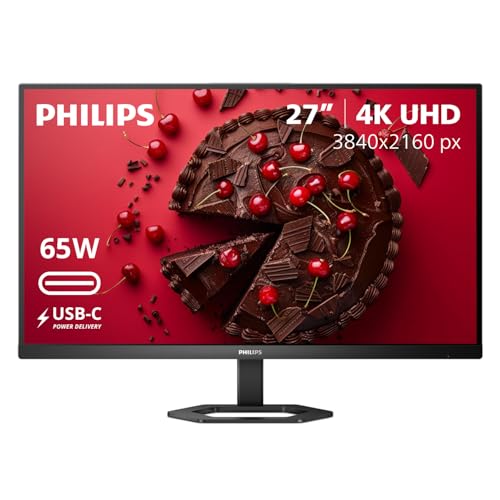 | Philips 27E1N5900R/27 | Panel: 27-inch 3840 x 2160 IPS-class USB-C path: DP Alt Mode and data PD ceiling: Up to 65W Decision feature: HDMI, DisplayPort and 2 downstream USB ports Buyer check: Laptop accepted draw and cable still control | Check Price on Amazon |
 | Dell S2725QC | Panel: 27-inch 3840 x 2160; up to 120Hz USB-C path: Manufacturer-documented display path PD ceiling: Up to 65W Decision feature: Integrated speakers Buyer check: Do not transfer one gaming mode to every host | Check Price on Amazon |
 | ASUS ProArt PA247CV | Panel: 23.8-inch 1920 x 1080 IPS USB-C path: DP Alt Mode and data PD ceiling: Up to 65W Decision feature: 4-port USB-A hub and DP MST out Buyer check: Color/calibration figures are ASUS claims | Check Price on Amazon |
 | Dell S2722DC | Panel: 27-inch 2560 x 1440 USB-C path: Exact Dell model USB-C monitor path PD ceiling: Up to 65W Decision feature: USB hub and speakers Buyer check: Use S2722DC manual, not later S2725 specs | Check Price on Amazon |
 | BenQ GW2786TC | Panel: 27-inch 1920 x 1080 IPS; 100Hz USB-C path: DP Alt Mode and data PD ceiling: Up to 65W Decision feature: DP MST out and 2 downstream USB-A ports Buyer check: 99% sRGB remains a BenQ-stated figure | Check Price on Amazon |
1. Philips 27E1N5900R/27 — best overall 27-inch 4K option

Philips documents a 27-inch 3840 x 2160 IPS-class display, USB-C with DisplayPort Alt Mode and data, and USB Power Delivery up to 65W. HDMI and DisplayPort inputs open the panel to a desktop or second source, while two downstream USB ports turn the USB-C connection into a small peripheral hub for the laptop.
Keep the 4K panel and the 65W path as separate jobs. The host must support DisplayPort Alt Mode to send video, the cable must carry the required data and video lanes, and the laptop must accept the negotiated power profile. Philips’ ceiling proves nothing about constant 65W at the battery, and the gate authorizes no universal refresh, HDR, color, or daisy-chain claim.
Our Take
Choose the Philips when 27-inch 4K workspace and a small USB hub both matter and 65W covers the laptop. In this power class it is the cleanest all-round exact fit.
- 27-inch 4K panel
- USB-C video, data, and up to 65W
- HDMI, DisplayPort, and two downstream USB ports
- 65W may not cover a high-power workstation
- No universal high-refresh or chain claim is retained
2. Dell S2725QC — best 4K option with up to 120Hz

Dell documents a 27-inch 3840 x 2160 panel, an up-to-120Hz ceiling, a USB-C display route with up to 65W, and integrated speakers. For anyone who wants smoother supported desktop motion without giving up 4K resolution or the one-cable laptop route, it is the stronger pick.
“Up to 120Hz” is a monitor ceiling rather than a universal USB-C result. The laptop GPU, exact USB-C output, operating system, cable, selected input, and monitor mode all have to support it. Do not carry a gaming-path claim, adaptive-sync behavior, HDR mode, color format, or response result across to every host. Dell’s 65W output stays a separate negotiated charging ceiling.
Our Take
Pick S2725QC when supported 4K high refresh outweighs the broader hub features of the other models. Buying for 120Hz means confirming the exact host path first.
- 27-inch 4K panel
- Dell-stated ceiling up to 120Hz
- USB-C up to 65W and integrated speakers
- 120Hz depends on the exact input chain
- Gaming behavior is not universal across hosts
3. ASUS ProArt PA247CV — best compact creator-oriented hub

ASUS documents a 23.8-inch 1920 x 1080 IPS panel, USB-C DisplayPort Alt Mode/data with up to 65W, four downstream USB-A ports, and DisplayPort MST output. On a smaller desk that values peripheral ports and a documented downstream display route above 4K pixel density, that mix lands well.
ASUS also publishes factory-calibration and color claims for the exact model. Those remain ASUS statements rather than measurements by this site, and they guarantee no individual workflow’s accuracy. DisplayPort MST output likewise guarantees no second screen at every resolution or on every operating system, since host GPU limits, link bandwidth, cable, and the downstream monitor all stay part of the chain.
Our Take
Choose PA247CV for a compact FHD ProArt desk with four USB-A ports and an exact MST output. Let the connectivity decision drive the purchase, never an unqualified color promise.
- Compact 23.8-inch IPS format
- Four-port USB-A hub
- USB-C 65W path and DP MST output
- FHD has less workspace than 4K
- Calibration claims are manufacturer-stated
4. Dell S2722DC — best QHD alternative with speakers

Dell S2722DC sits in the middle on resolution: a 27-inch 2560 x 1440 USB-C monitor with a manufacturer-stated 65W ceiling, USB hub, and speakers. QHD buys more workspace than FHD while avoiding the scaling and GPU demands that can come with a 27-inch 4K setup.
The frozen gate deliberately keeps this exact model inside Dell’s S2722DC support and manual record. It reproduces no refresh ceiling, detailed port count, cable-in-box statement, HDR mode, color figure, or chain output, so none is added here. Do not inherit any of those fields from the later S2725QC, because a similar model name establishes no shared specifications.
Our Take
Choose S2722DC when QHD, speakers, and a basic USB hub suit the desk better than either FHD or 4K. Anything beyond those frozen facts belongs in Dell’s exact manual before you order.
- 27-inch QHD panel
- USB-C ceiling up to 65W
- USB hub and integrated speakers
- Detailed refresh and port record is not frozen here
- S2725QC specifications do not transfer
5. BenQ GW2786TC — best FHD 100Hz option with MST

BenQ documents a 27-inch 1920 x 1080 IPS panel with a 100Hz ceiling, USB-C DisplayPort Alt Mode/data and up to 65W, DisplayPort MST output, and two downstream USB-A ports. Where readable native-size interface elements, smoother supported desktop motion, and a second-display route outrank high pixel density, it is the practical fit.
BenQ states 99% sRGB for this exact model. Read that as a manufacturer specification, not measured coverage or color accuracy. The 100Hz and MST paths also lean on the host, output capabilities, cable, lane allocation, and downstream display. No universal simultaneous mode or Mac chain is inferred.
Our Take
Pick GW2786TC for an FHD 100Hz office desk with two USB-A ports and a documented MST output. Where text density comes first, take a 4K model instead.
- 100Hz manufacturer ceiling
- USB-C video, data, and up to 65W
- DP MST out and two USB-A ports
- FHD is less sharp than QHD or 4K at 27 inches
- Color figure is manufacturer-stated
How to choose a 65W USB-C monitor
Start with the laptop’s normal power demand
Start by checking what the laptop accepts through USB-C and how much it draws during the intended workload. A thin office laptop may run and charge comfortably within 65W. A performance laptop can charge slowly, hold its level, or drain under load. No monitor forces 65W into a host, and none exceeds its own published ceiling.
Separate offered power from accepted draw
The monitor offers a USB PD profile, the cable carries a supported power class, and the laptop accepts a negotiated amount. Battery state, system load, and vendor charging logic can all shift what you actually see. Keep the original laptop charger within reach where 65W does not cover peak demand.
Confirm USB-C carries video
The connector on its own proves no DisplayPort Alt Mode. The selected laptop port has to support video output, the cable has to be full featured, and the monitor input has to be selected correctly. Our USB-C cable guide explains why a working charging connection can still lack the required display wiring.
Pick panel resolution before hub extras
Philips and S2725QC are 4K; S2722DC is QHD; ASUS and BenQ are FHD. Resolution moves workspace, scaling, GPU load, and text density, and it moves nothing about the 65W charging decision. Choose the panel for viewing distance and software first, then compare downstream USB, speakers, and display output.
Qualify refresh on the exact path
Dell states up to 120Hz for S2725QC and BenQ states 100Hz for GW2786TC. Neither maximum proves the same result through every USB-C host. Check resolution, refresh, input, GPU, cable, OS, and any bandwidth-sharing USB mode as one set. No gaming-performance result is claimed.
Treat MST as topology, not a promise
ASUS and BenQ document DisplayPort MST output. What the chain finally does depends on the host GPU, operating system, cable, bandwidth, first monitor, and second monitor. A downstream socket guarantees no two screens at their panel maxima. Our guide to monitors with built-in docking covers this broader desk design.
Is 65W enough for a laptop?
It is enough when the laptop accepts USB-C PD at or below that ceiling and the workload stays inside the resulting power budget. It replaces no 90W, 100W, 140W, or proprietary charger universally. Check the laptop’s USB-C charging specification, and keep its original adapter for workloads that outrun the monitor path.
Final recommendation
Philips 27E1N5900R/27 is the best overall 65W USB-C monitor for a desk that wants 27-inch 4K resolution and a small hub. After that, one requirement picks each alternative: Dell S2725QC for a supported 120Hz path, ASUS for compact ProArt connectivity, Dell S2722DC for QHD, BenQ for FHD 100Hz plus MST. Whichever you choose, qualify the panel, input, cable, accepted laptop draw, USB hub, refresh, and display topology separately.