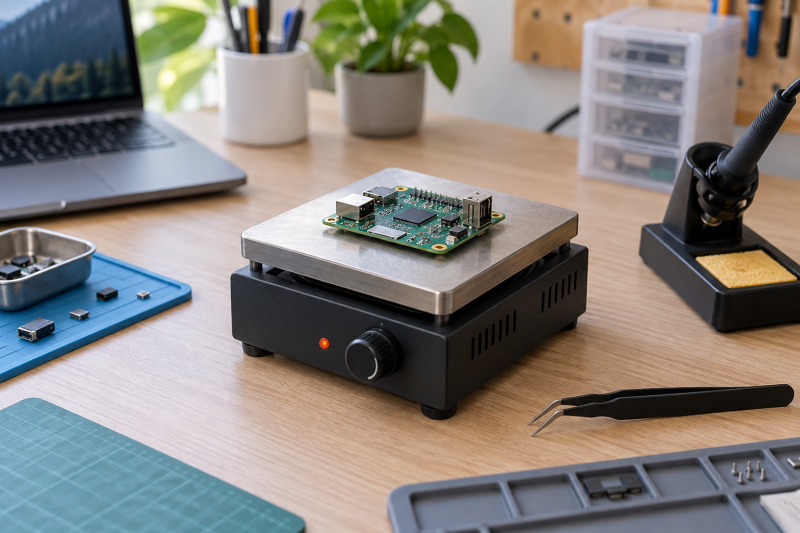
A rework hot plate gives a small board a stated heated surface before or during component work, which is a different job from aiming hot air at one point. The useful differences are the plate’s actual heating area, stated temperature range, power rating, and whether the controls make sense for a compact board or a broader repair bench.
The six choices here range from a 100-by-50-mm WEP plate for narrow SMD work to a 200-by-200-mm Vevitts plate for a larger board. Pick the surface first, then make temperature range and power the tie-breakers. A larger plate takes more bench room, while a small one can be a poor match for a board that overhangs it.
Choose a hot plate by the board area it can support, not by its wattage number alone.Rework Hot Plates Compared

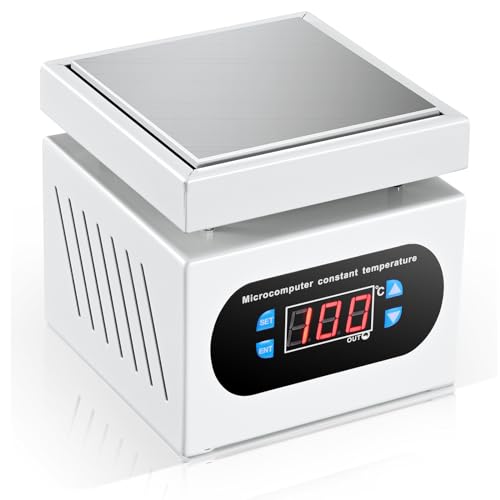
1. Kosmeiner SHP1010A — Best 100 x 100 mm Digital Plate
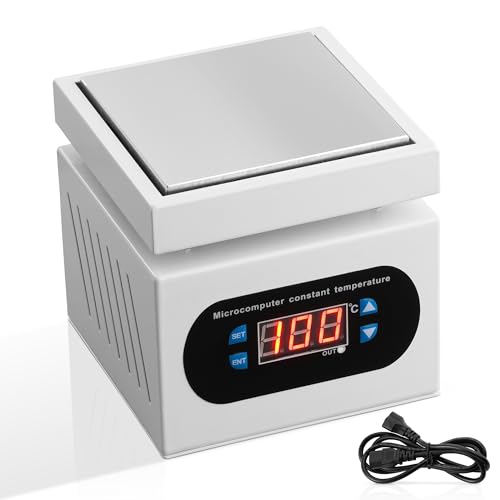
Kosmeiner lists a 100-by-100-mm heating area, 350 W output, a digital display, temperature sensor, and microcomputer control. The listed temperature range is 30 to 400 C, so its square surface is a sensible size for compact boards and smaller accessory work where a full 200-mm plate would occupy more bench than the job needs.
The listing describes an aluminum-alloy heating plate, side ventilation, and heat-resistant edges. It also names multi-point heating for solder joints and electronic components, so the product is aimed at a workbench that needs a stated preheating surface rather than a handheld tool. The dimensions field is not useful here, so the listed 100-by-100-mm heating area is the clearer sizing detail.
Our TakeBuy Kosmeiner when you want a square 100-by-100-mm plate with a stated 30 to 400 C range. It is a straightforward mid-size option when a compact board needs more surface than WEP’s narrow strip, without moving to a 168-mm or 200-mm plate.
- The listed 100-by-100-mm heating area suits compact boards without consuming the space of a large square station.
- A digital display, temperature sensor, and microcomputer control give the 350 W plate a specified control setup.
- The stated 30 to 400 C range covers the same broad range named by several larger rework plates.
- Side ventilation and heat-resistant edges are listed around the aluminum-alloy heating plate.
- The 100-by-100-mm surface leaves less stated support area than the 168-mm and 200-mm square alternatives.
- The listing does not give a separate physical footprint beyond its heating-area figure.
2. Sorandy Mini Hot Plate — Best Compact PD-Powered Bench
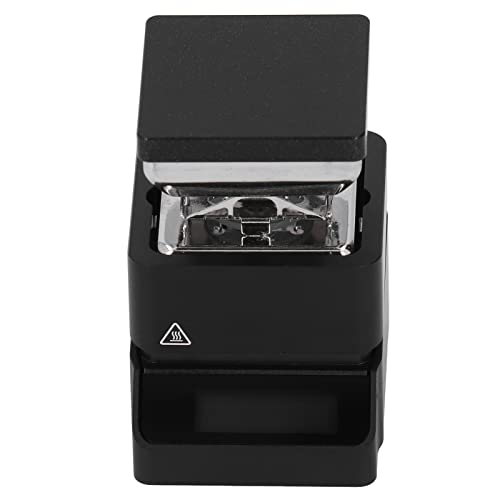
Sorandy lists this as a compact 60 W preheater with deployable support feet, an OLED screen, two rear buttons, and a stated 100 to 350 C constant-temperature range. Its feature text says a 65 W PD power adapter takes the station from 26 C to 300 C in 150 seconds, so the power adapter is part of the buying decision rather than an accessory detail.
Sorandy is the compact choice when a crowded repair desk has room for a focused PCB station but not a large aluminum square. Sorandy describes a square tower body, automatic sleep, color-coded status indicators, and firmware-update capability. Its listing gives no heating-area measurement, so buy it for its compact control format rather than assuming it will fit a particular board size.
Our TakeBuy Sorandy when a compact 60 W station with OLED controls and PD power fits the bench better than a broad plate. The missing heating-area figure is the trade, so confirm the supported board size before treating it as a replacement for a measured 100-mm or 168-mm surface.
- A 60 W compact station with deployable feet uses less listed bench space than a large square rework plate.
- The OLED screen and two physical rear buttons give stated controls for adjusting the 100 to 350 C range.
- With a 65 W PD adapter, the listing states a 26 C to 300 C rise in 150 seconds.
- Automatic sleep and color-coded temperature status indicators provide stated operating information on the small station.
- Firmware-update capability is listed alongside the OLED control and status display.
- The listing does not give a heating-area measurement for matching the station to a particular board.
- Its 60 W rating is lower than the 210 W, 350 W, 500 W, and 850 W alternatives here.
- The stated 150-second rise depends on a 65 W PD power adapter, which is not a generic power detail.
3. Vevitts 946C+ — Best 200 x 200 mm Work Area
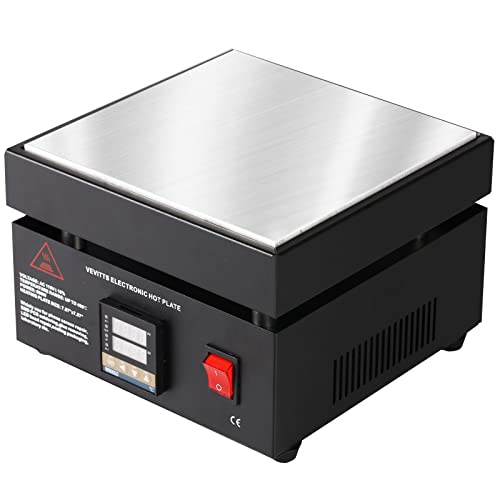
Vevitts lists an 850 W, 110 V hot plate with a 200-by-200-mm / 7.87-by-7.87-inch aluminum-alloy heating plate and a 30 to 400 C range. It is the largest explicitly measured plate in this comparison, so it is the clear starting point for a repair bench where the board area, not compact storage, is the first priority.
The listing describes multi-tube heating, a microcomputer CPU-controlled temperature panel, three-side cooling holes, and operation without a fan. Its standard plate size is the important distinction. A wide board has more listed support area, while a small accessory board may not need an 850 W station or its larger physical presence.
Our TakeBuy Vevitts when you want a 200-by-200-mm surface and 850 W rating and the workbench has the room for it. Its scale is valuable for broader boards, but it is more station than a small, single-component job necessarily requires.
- The listed 200-by-200-mm aluminum plate is the broadest explicitly measured heating area in this comparison.
- An 850 W rating and 30 to 400 C range give this large station substantial stated heating capacity.
- Multi-tube heating and microcomputer temperature control are listed for the aluminum-alloy plate.
- Three-side cooling holes are specified, while the product description says the station operates without a fan.
- The 7.87-by-7.87-inch measurement gives a second stated way to size the work area for a bench.
- The broad 200-mm plate and 850 W rating are less compact than necessary for a small accessory board.
- The listing gives no narrow-strip option for boards that only need a 100-by-50-mm heated area.
4. WEP 946D IV — Best Narrow 100 x 50 mm Boards
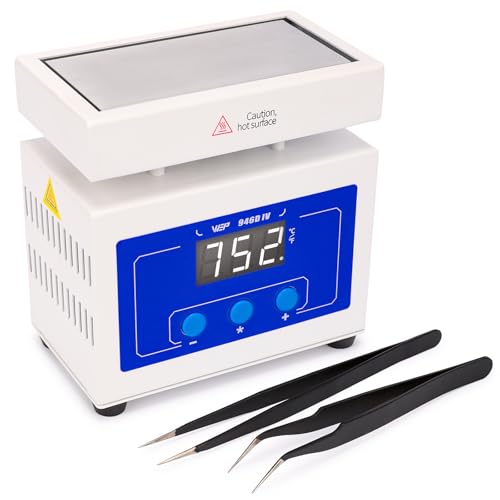
WEP lists a 210 W reflow hot plate with a 100-by-50-mm / 3.94-by-1.97-inch effective heating area, PID temperature control, a digital readout, and a 122 to 752 F range. It is the closest fit for a narrow component or a small board that needs a defined strip rather than a larger square heating surface.
The listing says the aluminum plate has metallic guards and supports Celsius-to-Fahrenheit conversion. It also describes use with a hot-air rework or soldering station for BGA work, which explains its focused format, since it can sit inside a more specialized bench setup. The stated 110 to 127 V specification is the detail to check if the setup is not using a US-compatible outlet.
Our TakeBuy WEP when you want a 100-by-50-mm effective area, PID control, and a digital Fahrenheit or Celsius readout. It is the specialist option for small boards here, not the choice for a board that needs a broad square support surface.
- The stated 100-by-50-mm effective area suits narrow boards and small SMD work rather than a large bench footprint.
- PID control and a digital readout are listed with a 122 to 752 F adjustable temperature range.
- The aluminum heating plate includes listed metallic guards around the focused work surface.
- A Celsius-to-Fahrenheit conversion function makes the displayed range usable in either stated unit system.
- A 100-by-50-mm strip offers less stated board support than every square plate in this comparison.
- The listing rates the station for 110 to 127 V US specifications, so outlet compatibility still matters.
- Its 210 W output is lower than the 350 W, 500 W, and 850 W alternatives listed here.
5. Leftwei 168 mm Hot Plate — Best 168 x 168 mm Square Plate
Leftwei lists a 500 W hot plate with a 168-by-168-mm square surface, a 0 to 400 C range, aviation-aluminum heating area, and multi-angle vents. It is a useful middle size between the 100-mm plates and Vevitts’ 200-mm platform when a board needs a broad square surface but the largest option would dominate the bench.
The listing also gives a 6 A rating and a 168-by-168-by-126-mm form. It describes microcomputer temperature control and a brushed heating area. The rating, form, and controls are stated specifications, but the 168-mm square surface is the feature that should decide this purchase. Leftwei is a mid-size bench station, not a compact PD-powered unit.
Our TakeBuy Leftwei when you want a 168-by-168-mm square surface and 500 W output. It offers more stated board area than the 100-mm plates without moving all the way to Vevitts’ 200-mm work platform.
- The 168-by-168-mm surface gives a mid-size square work area for boards that outgrow a 100-mm plate.
- A 500 W rating and 0 to 400 C range are listed with microcomputer temperature control.
- The aviation-aluminum heating area and brushed surface are explicitly described in the product details.
- Multi-angle vents are listed around the station for its stated heat-dissipation design.
- The 168-by-168-by-126-mm form gives a specified physical size for planning a fixed bench position.
- A 6 A rating is listed for this US-plug version of the square station.
- The 168-mm square plate takes more permanent bench room than Sorandy’s compact tower format.
- It offers less explicitly stated heating area than Vevitts’ 200-by-200-mm plate.
- The listing does not provide a Celsius-to-Fahrenheit conversion feature like the WEP station does.
6. Soiiw 1088 — Best Basic 100 x 100 mm Preheating
Soiiw lists a 350 W, 100-by-100-mm LED microcomputer preheat rework heater with a 30 to 400 C range, an aluminum heating plate, multi-tube heating, and a two-dimensional cooling-hole design. It fills the same basic surface class as Kosmeiner, but its listing is more focused on the essential plate, temperature control, and cooling details than on a sensor or display description.
The listing describes high-performance CPU temperature control and uses ranging from board work to LED-related heating tasks. Its published dimensions are 4.96 by 4.64 by 4.64 inches, so it is the choice for a buyer who wants a stated small physical unit alongside a 100-mm heating surface. It should be compared on those listed dimensions and controls, not as a substitute for an explicitly broader plate.
Our TakeBuy Soiiw when you want a 100-by-100-mm, 350 W plate with 30 to 400 C control and a basic square rework surface is enough. Its listing is less detailed than Kosmeiner’s about the control hardware, but it states the core plate size and physical unit dimensions.
- The listed 100-by-100-mm heating surface gives small boards a defined square preheating area.
- A 350 W rating and 30 to 400 C range cover the core stated controls for a compact plate.
- Multi-tube heating and an aluminum plate are specified for the 1088 rework heater.
- The listing does not name a temperature sensor, PID program, or OLED display for its control hardware.
- Its 100-mm surface gives less stated support area than the 168-mm and 200-mm square stations.
Buying Guide
Start with the board area, not the temperature range
The most useful number is the surface that will sit beneath the board. WEP’s 100-by-50-mm effective area is intentionally narrow, while Kosmeiner and Soiiw both state 100-by-100-mm plates. Those three choices make sense for compact boards or focused work, but they are not sized to provide the same listed support area as a larger square station.
Leftwei expands that square format to 168 by 168 mm, and Vevitts goes to 200 by 200 mm / 7.87 by 7.87 inches. Choose the smallest stated surface that gives the board a sensible place to sit on the bench. A larger plate can be appropriate for a broad board, but it also requires more permanent work space and is not automatically the better option for small electronics accessories.
Treat wattage as a stated specification, not a result promise
These products span 60 W on Sorandy, 210 W on WEP, 350 W on Kosmeiner and Soiiw, 500 W on Leftwei, and 850 W on Vevitts. The spread is a useful way to distinguish their listed electrical ratings, but wattage does not by itself establish how a particular board will behave on the plate. Compare wattage alongside the surface size and controls rather than using it alone as a replacement for the actual job.
Sorandy makes that distinction especially clear because its feature text pairs 60 W with a compact tower body and a 65 W PD adapter. Vevitts pairs 850 W with a 200-mm aluminum plate. The numbers match two different bench roles, a small unit that depends on its power adapter and a broad, dedicated station. Let the board area settle the first question and use power to choose among similar sizes.
Pick the control format you will read while working
Kosmeiner lists a digital display, temperature sensor, and microcomputer control, while WEP lists PID control and a Celsius-to-Fahrenheit conversion. The stated readout details are useful if the bench needs a visible temperature reference in a preferred unit system. Vevitts and Leftwei each describe microcomputer temperature control, so their listings include a controller even though their presentation differs.
Sorandy lists an OLED screen, two physical rear buttons, automatic sleep, and color-coded status indicators. Its compact controls can suit a small workstation, but it does not give a heating-area measurement. Soiiw names high-performance CPU control but fewer interface details. Decide whether physical size, a measured plate, a Fahrenheit readout, or an OLED status display is the detail you need before treating all digital controls as interchangeable.
Check the stated temperature range alongside your intended setup
Kosmeiner, Vevitts, and Soiiw list 30 to 400 C, while Leftwei lists 0 to 400 C. Sorandy lists 100 to 350 C, and WEP lists 122 to 752 F. These ranges are specifications from the product listings, not a claim that every plate suits every material or workflow. They help identify which control limits are stated before a buyer chooses a bench station.
WEP’s Celsius and Fahrenheit readout may help a buyer who works from Fahrenheit documentation, whereas the other product details primarily state Celsius ranges. Sorandy’s 100 C lower setting is different from the 30 C figure on the 350 W and 850 W plates. If a procedure depends on an exact temperature, compare the product’s stated range and documentation directly instead of assuming every rework hot plate has the same adjustment behavior.
Plan the power and bench position as one decision
Sorandy is the unusual option because its listing names a 65 W PD adapter for its stated heat-up figure. WEP specifies 110 to 127 V US operation, and Leftwei is sold as a US-plug 500 W unit. Those details make power compatibility part of selecting the station, not a later accessory purchase. Our digital soldering station guide covers the separate iron decision.
The physical station also needs a stable place. Soiiw lists a 4.96-by-4.64-by-4.64-inch unit, while Leftwei lists a 168-by-168-by-126-mm form and Vevitts lists an 8.66-by-8.66-inch plate dimension. These measurements are listed figures a buyer can use to plan a shelf or repair desk. Our hot-air rework station guide explains the separate top-side heating tool. The right choice is the surface and connection your actual workspace can support, not simply the highest power number.
Frequently Asked Questions
Which hot plate has the largest listed heating area?
Vevitts has the largest explicitly stated work surface here at 200 by 200 mm, also listed as 7.87 by 7.87 inches. Its 850 W rating, 30 to 400 C range, and aluminum-alloy plate make it the natural candidate when a board needs the broadest listed square support area in this comparison.
Leftwei is the next mid-size option at 168 by 168 mm. The size offers more stated area than the 100-mm choices while being smaller than Vevitts. Pick the plate size around the board and bench space, then use the power and control details to decide between similarly sized stations.
Which model is best for a narrow board or small component work?
WEP is the most specifically sized option, with a 100-by-50-mm effective heating area. Its listing also gives PID control, a digital temperature readout, and Celsius-to-Fahrenheit conversion. Those stated features fit a buyer who wants a narrow strip rather than a large square plate.
Kosmeiner and Soiiw both use 100-by-100-mm square surfaces, which offer a different compact layout. WEP’s 210 W rating and focused surface mean it should be selected for a narrow board, not as a replacement for the 168-mm or 200-mm square stations.
Does any option use USB-C or USB PD power?
Sorandy is the only product here whose feature text specifically names a 65 W PD power adapter. It lists a 60 W station, OLED screen, rear buttons, and a stated 100 to 350 C range. Its compact tower format makes the supplied power description particularly relevant to its use on a crowded bench.
The other listings describe 110 V, US-plug, or conventional station specifications rather than a PD-powered setup. Sorandy does not state a heating-area measurement, so confirm that its compact surface suits the board before choosing it solely for the power format.
Which option has a Fahrenheit display?
WEP lists a digital readout with Celsius-to-Fahrenheit conversion and a stated range of 122 to 752 F. The conversion makes WEP the direct option when a buyer wants the product listing to name Fahrenheit adjustment and display support rather than converting another manufacturer’s Celsius figures.
Kosmeiner, Vevitts, Leftwei, and Soiiw state ranges in Celsius, while Sorandy lists 100 to 350 C. The unit display is not a measure of plate size, so keep it separate from the larger purchase decision about whether the board needs WEP’s 100-by-50-mm strip or a larger square surface.
What is the best middle-size square plate?
Leftwei sits between the 100-mm plates and Vevitts’ 200-mm station with its 168-by-168-mm square heating area. It lists 500 W output, 0 to 400 C control, microcomputer temperature control, and a 168-by-168-by-126-mm physical form. Leftwei fills a well-defined mid-size bench role.
Kosmeiner is the smaller square alternative with a 100-by-100-mm surface and 350 W rating. Vevitts is the larger alternative with a 200-by-200-mm surface and 850 W. The choice should follow the amount of stated area the board and your workbench actually need.
Bottom Line
Match the listed plate area to the board first, then choose the control format and power specification that fit the workspace.
For a balanced 100-mm square plate, Kosmeiner is the choice.
For narrow boards, WEP is the clearest pick.
For a fixed bench, Vevitts is the option with the broadest surface.