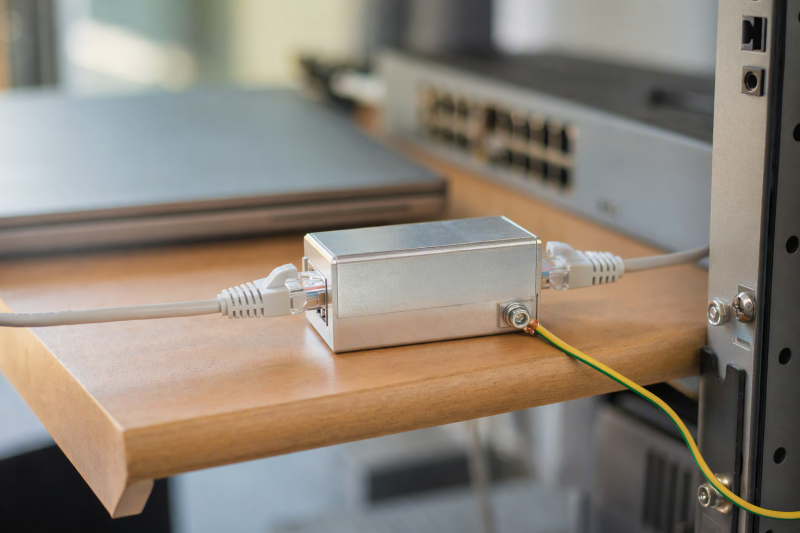
An Ethernet cable from an outdoor camera, roof antenna, detached studio, or another building can carry transient voltage toward the switch serving your workstation. An inline Ethernet surge protector is one part of a protection plan for that specific exposed cable path. It is not a general upgrade for every short indoor patch cable, and it does not replace protection on the AC power line, proper building bonding, or professional advice for outdoor runs and runs between buildings.
These five products cover gigabit or faster Ethernet data lines and differ in port speed, PoE limit, mounting style, and weather exposure. Grounding is not optional. The maker instructions for several units require a properly bonded low-impedance path. Product specifications do not establish that any particular installation is safe or effective.
Before choosing a box, identify where the exposed cable enters, its link speed and PoE draw, and who will bond the protector correctly. An ungrounded inline device is not a complete protection system.Ethernet Surge Protectors Compared
| Image | Product | Details | Check Price |
|---|---|---|---|
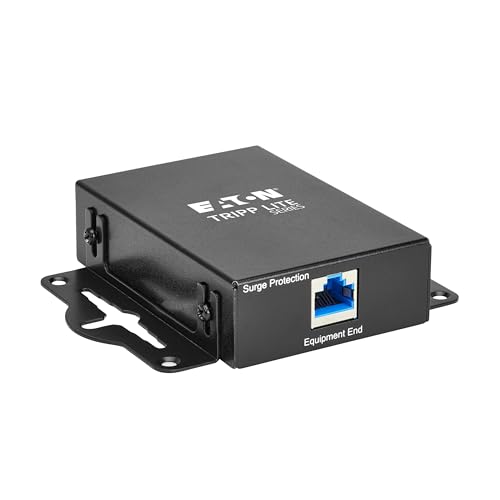 | Eaton B110-SP-POE-1 | Link: 1Gbps PoE: af/at stated Mounting: Wall/surface Best fit: Documented Gigabit line | Check Price on Amazon |
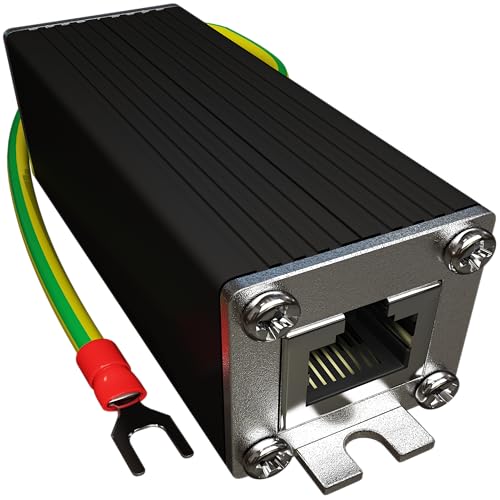 | Tupavco TP325 | Link: 2.5Gbps stated PoE: PoE++ claimed Mounting: Flanges; ground lead Best fit: 2.5GbE exposed leg | Check Price on Amazon |
 | PROCET PT-PR04G | Link: 1Gbps PoE: Up to 120W claimed Mounting: Bonded DIN rail Best fit: Multi-line cabinet | Check Price on Amazon |
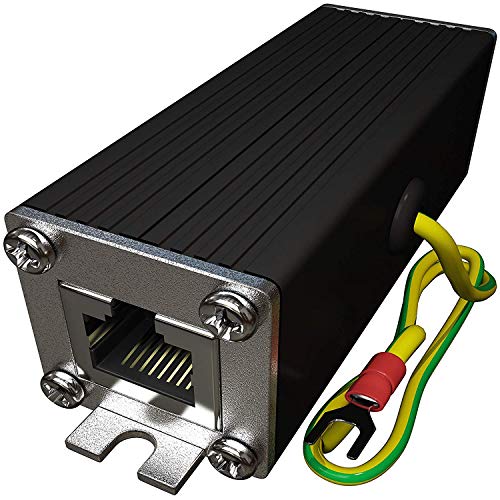 | Tupavco TP302 | Link: 1Gbps PoE: PoE++ claimed Mounting: Inline metal; ground lead Best fit: Compact Gigabit path | Check Price on Amazon |
 | Tupavco TP303 | Link: 1Gbps PoE: PoE stated Mounting: IP44 outdoor enclosure Best fit: Weather-exposed run | Check Price on Amazon |
1. Eaton B110-SP-POE-1 — Best Documented Gigabit Choice
Eaton’s B110-SP-POE-1 is an inline 1Gbps RJ45 protector for PoE lines. The checked listing names IEEE 802.3af and 802.3at support, while Eaton’s owner manual specifies a grounding wire and mounting hardware. The manual describes protection against electrostatic discharge and cable discharge events, with published references to surge tests. That level of documentation is useful when a wired workstation is downstream of a camera or outside network device and the installer must know what the product supports.
This model should not be assumed compatible with 2.5Gbps or 802.3bt PoE++ merely because the connector fits. The listing claims 1Gbps speed with af and at PoE. Check current availability before planning around it. Eaton’s listing says to keep the unit within 300 feet of the protected equipment, but the correct bonding point and placement for an exposed run are installation questions, not a plug-in experiment. Follow Eaton’s manual and the applicable local electrical rules.
Our Take Choose B110-SP-POE-1 if you want the most clearly documented 1Gbps option here with af and at PoE support. It is useful only when its grounding and link limits match the actual cable.
- Eaton publishes a model-specific owner manual.
- Ground wire and mounting hardware listed.
- PoE support for af and at stated.
- 1Gbps ceiling in listed specification.
- Not specified for 2.5GbE or PoE++.
2. Tupavco TP325 — Best 2.5G Data Path
The TP325 listing states 2.5Gbps Ethernet, PoE++ compatibility, protection on all four pairs, and an included 12-AWG ground wire. The checked title is generic, but the product is the Tupavco TP325. The metal housing has mounting flanges for a wall, network panel, or cabinet. It is the right speed class when a 2.5GbE switch and wired workstation need protection on an exposed copper section of cable.
The seller’s high discharge current and wattage figures are product claims, not a guarantee against a direct lightning strike or every fault. Confirm the exact TP325 hardware, current ratings, and grounding instructions before purchase, particularly if PoE++ power runs through the same line. A 2.5G data rating does not prove 5G or 10G compatibility. The protective path depends on installation as well as the printed speed figure.
Our Take Choose TP325 as the multi-gig candidate if the exposed line runs at 2.5GbE. Have the grounding and PoE load checked against the exact model before relying on it.
- 2.5Gbps data rate stated.
- Ground lead and mounting flanges listed.
- No 5G or 10G claim in checked listing.
- High surge and PoE figures require verification against the exact model.
3. PROCET PT-PR04G — Best Multi-Line Cabinet Fit
PROCET describes PT-PR04G as an industrial four-port 10/100/1000-Mbps PoE protector with DIN-rail or wall mounting. Its official page describes a metal enclosure, 60V DC maximum operating voltage, and up to 120W per port under the stated conditions. The metal enclosure and DIN-rail mounting make it an option for a cabinet with several exposed PoE lines, rather than a small adapter to leave loose beside a laptop.
The maker says the DIN rail is the ground path. Cabinet bonding is central to the design, because an unbonded rail or casual desktop placement should not be treated as equivalent protection. The Amazon title says “4 Pairs Port,” while the maker describes four input and four output ports. Verify photos, the exact PT-PR04G variant, and the manual before purchase. For one ordinary office cable, a single-line model is simpler. This product suits the person installing a grounded network cabinet.
Our Take Choose PT-PR04G if you are protecting several lines in a cabinet, provided its exact hardware and DIN-rail bonding are confirmed. It is too much infrastructure for one short indoor patch cord.
- Maker documents four-port industrial design.
- DIN-rail and wall mounting options.
- Gigabit PoE use stated.
- Grounded DIN rail is part of the installation.
- Amazon title is ambiguous about port count.
4. Tupavco TP302 — Best Compact Gigabit Inline Unit
TP302 is a compact Gigabit RJ45 inline protector with a metal body and ground lead. Tupavco’s product page describes gas-discharge tubes on all four pairs, line-to-line and line-to-ground modes, and a bidirectional data path. It can fit near a switch or at a planned network entry point where a grounded termination is available. The listing also advertises PoE++ compatibility, but the exact voltage and current limits still must match the powered device.
Tupavco explicitly says the ground wire must be connected for the protector to work. It also recommends considering protection at both ends of a susceptible cable run. Do not improvise a connection to a random screw or outlet plate. Ask a qualified installer to assess bonding and local rules. The product page’s broad lightning language is a seller claim and should not be read as a guarantee against a direct strike or damage to all connected equipment.
Our Take Choose TP302 if you want a compact 1Gbps unit with useful maker detail. Whether it is appropriate for an exposed run depends on grounding and placement.
- Maker documents grounding and protection modes.
- Compact metal inline housing.
- 1Gbps maximum stated.
- No protection claim is a guarantee against a direct strike.
5. Tupavco TP303 — Best Weather-Exposed Enclosure
The checked Tupavco outdoor listing matches the maker’s TP303 weather-resistant enclosure, with a Gigabit RJ45 path and PoE support. Tupavco describes an IP44 housing that can be mounted outside and closed around the protector. The TP303 has a narrower role than the TP302. Choose the enclosure when the protected cable section is exposed to ordinary weather. An indoor switch that happens to sit near a window is not enough reason.
IP44 is not a universal waterproof or direct-lightning guarantee. Placement, cable glands, local weather, and the required bonded ground still affect the result. The maker’s page discusses both ends of a susceptible run and lists line-to-line and line-to-ground modes. Use the exact installation instructions and have the grounding scheme checked professionally, particularly where the cable enters a building. The TP303’s Gigabit ceiling also rules it out for a workstation link planned at 2.5GbE.
Our Take Choose TP303 if the protected cable section is exposed to weather. It requires the same grounding discipline as a bare inline metal unit and has a 1Gbps data limit.
- IP44 enclosure described by maker.
- Gigabit and PoE use stated.
- Not fully waterproof by IP44 alone.
- Bonding and outdoor installation require planning.
- Not rated for multi-gig data.
Buying Guide: Protect the Exposed Line, Not Just the RJ45 Plug
Identify the risk path and protected side
Start with the cable that leaves the building, crosses to another structure, or runs to outdoor equipment. A short indoor patch lead between a dock and a switch is a different exposure. An inline protector is normally placed to intercept a transient arriving on that specific cable before it reaches valuable equipment, following the maker’s layout instructions. Some designs call for protection at both ends of a long exposed run. The route and entry point should be assessed before buying two arbitrary boxes.
Do not treat a network surge protector as the only layer. AC power, coax, and other conductive paths can carry surges too, and equipment may remain exposed through them. A UPS or mains strip protects a different route. It does not automatically protect the Ethernet data line. For a desk with many devices, the USB-C docking station guide helps organize workstation connections, while the USB-C hub guide covers portable ports. Neither is surge protection.
Match link speed and PoE envelope exactly
A 1Gbps protector may negotiate a 2.5GbE link down or fail to preserve its intended performance. Eaton B110-SP-POE-1, TP302, TP303, and PROCET PT-PR04G are listed at Gigabit. TP325 is the 2.5G option here. Do not infer 10G from a Cat6 cable label or shielded RJ45 socket. Check the entire path, including cable quality, switch ports, and the downstream workstation adapter.
If the line powers a camera or access point, compare PoE standard, voltage, current, and pairs with the exact protected device. Eaton’s checked listing supports af and at, while others advertise bt or PoE++ ranges. Seller wattage maximums are not interchangeable with a device’s actual power draw or an approved installation. A non-PoE workstation still needs a protector rated for its data speed, but you should not let PoE limits distract you from grounding and cable placement.
Make bonding a professional installation decision
A ground lead or metal case is not proof of a safe ground connection. Tupavco says TP302 must be grounded. Eaton supplies a ground wire. PROCET specifies the DIN rail as its ground path. The proper connection depends on the building bonding system, cable route, local code, and other protected services. Do not attach a wire to a convenient screw and assume it is bonded. Have a qualified installer determine the path, especially for outdoor or rooftop copper and for copper runs between buildings.
Inspect and maintain the installation after significant events according to the maker’s instructions. No small inline device makes a direct strike harmless or guarantees that every connected component survives. Where two buildings have different grounding systems, ask whether a nonconductive fiber link is the safer network design. The right outcome may be a different network design instead of a larger advertised surge number.
Frequently Asked Questions
Will an Ethernet surge protector slow my workstation link?
It can if its rated data speed is below the intended link speed. A Gigabit-rated unit should not be assumed suitable for 2.5, 5, or 10GbE. The TP325 listing states 2.5Gbps, while the other four are listed at 1Gbps. That rating is the first filter before comparing surge numbers.
After installation, check the negotiated link speed and test the intended transfer. A successful RJ45 connection alone does not prove the full path operates at the advertised rate. We did not measure insertion loss or throughput for these units.
Can I use one without connecting the ground wire?
Do not rely on an ungrounded protector. Several of these makers explicitly require a ground path, and PROCET uses a bonded DIN rail for its PT-PR04G. Surge energy needs an intended route away from protected equipment. A product that passes data ungrounded may still fail its protective purpose.
Ask a qualified installer where to bond it. Bonding is especially important for outdoor or rooftop cable runs and for runs between separate buildings. The answer depends on the actual electrical system, not on a generic online wiring tip.
Does this protect against a direct lightning strike?
No product in this roundup should be presented as a guarantee against a direct strike. Makers publish laboratory test figures for particular waveforms and conditions. Damage can enter through AC power, other data cables, or the grounding system itself. A single inline RJ45 unit is only one possible layer.
Plan the exposed cable with a qualified professional and consider whether fiber avoids conductive links between buildings. Follow local requirements and the maker’s instructions. We did not validate any direct-strike scenario or equipment-protection promise.
Bottom Line
Eaton B110-SP-POE-1 offers clear documentation of its 1Gbps speed and af and at PoE support, Tupavco TP325 is the multi-gig candidate, and PROCET PT-PR04G fits a bonded cabinet with several lines. The right choice begins with the exposed cable and a safe grounding plan, not the largest surge number in a title.