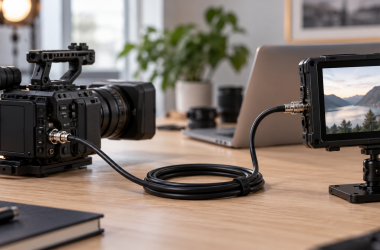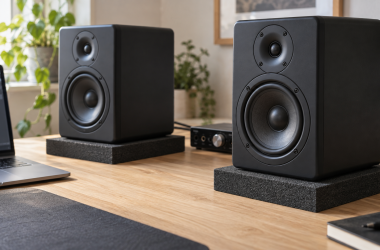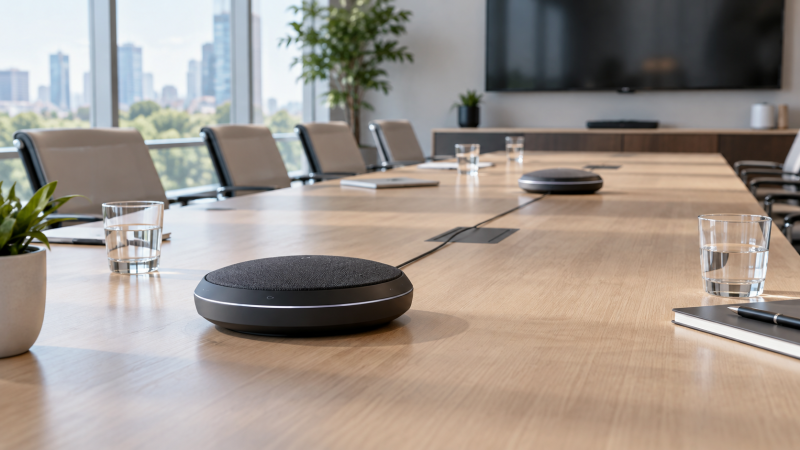
One speakerphone often leaves the far end of a long table outside useful microphone coverage. A daisy-chainable model lets you link a second compatible unit or add microphones to spread pickup and playback across a larger room. The link method, the stated range, and the bundled accessories differ from model to model, so compare them before you buy.
Choose the expansion method and real table layout first, then compare microphone coverage, connection paths, battery, and meeting-platform fit.Best Daisy-Chainable Bluetooth Speakerphones Compared
| Image | Product | Details | Check Price |
|---|---|---|---|
 | RayBit POD4 | Best fit: Extension-mic meeting kit Expansion: Multi-speakerphone daisy chain Audio: 1.8m expansion mic; 3-5m radius | Check Price on Amazon |
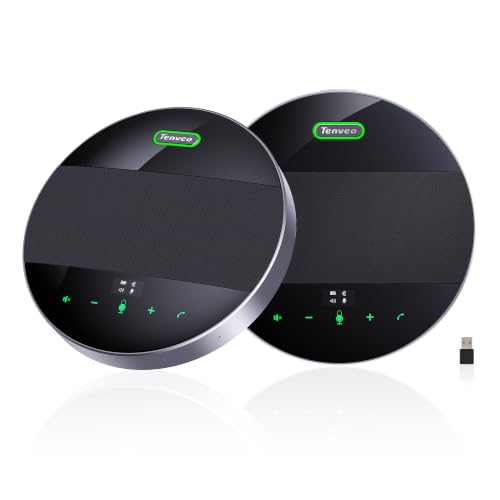 | Tenveo MagiCall-EX | Best fit: 30-attendee dual-unit setup Expansion: Two-unit daisy chain Audio: 4 mics; 12m pickup; 27h talk time | Check Price on Amazon |
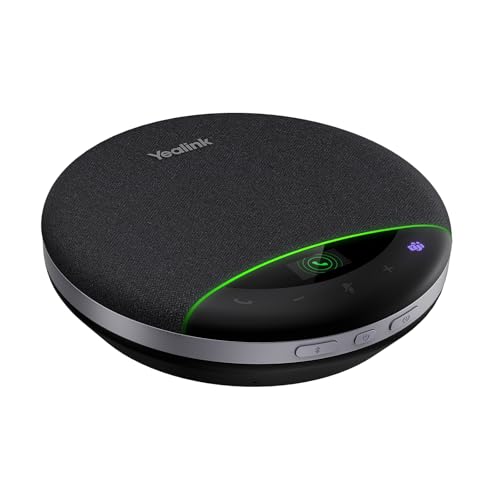 | Yealink SP96 | Best fit: Teams-certified dual-unit room Expansion: Wireless two-unit cascade Audio: 6 mics; 5m radius; 26h talk time | Check Price on Amazon |
 | EMEET M220 | Best fit: Two-room or 16-attendee setup Expansion: Two-speaker daisy chain Audio: 4 mics each; Bluetooth, AUX, USB | Check Price on Amazon |
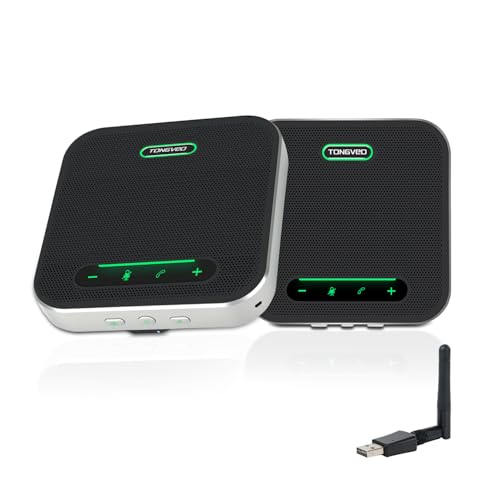 | Wireless 2-in-1 Speakerphone | Best fit: Wireless 20-attendee cascade Expansion: Two-unit wireless cascade Audio: 4 mics; 5m radius; 16h battery | Check Price on Amazon |
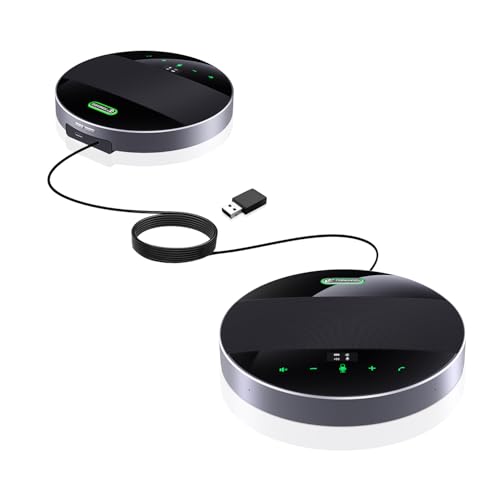 | TONGVEO 2-in-1 | Best fit: 30-attendee wired cascade Expansion: Two-unit 3.5mm cascade Audio: 4 mics; 6m range; 18h talk time | Check Price on Amazon |
 | EMEET Luna Plus Kit | Best fit: Satellite-mic plus daisy chain kit Expansion: Two kits up to 25 attendees Audio: 8 plus 1 mics; 10h call time | Check Price on Amazon |
1. RayBit POD4 — Best Extension-Mic Meeting Kit
When one speakerphone can’t cover the whole length of a table, the RayBit POD4 adds an extension microphone to the main unit. The kit includes the Bluetooth speakerphone, a 1.8m expansion microphone, a wireless dongle, and a three-meter daisy-chain cable. The extension microphone has a stated 3-to-5m pickup radius, which fits a table where pickup has to reach past one central unit, and the listing also describes chaining multiple speakerphones.
Decision point: An included 1.8m expansion mic, three-meter chain cable, and 3-to-5m pickup radius fit a flexible long-table meeting kit. Our TakeBuy RayBit POD4 when the bundled extension microphone and daisy-chain cable fit the physical table layout. Verify where each unit and cable will sit before choosing a multi-speakerphone system for a shared room.
For the connected meeting computer, see our business laptop guide.
- An included 1.8m extension microphone adds a second stated pickup point for a longer meeting table.
- Multiple speakerphones can be daisy chained according to the listing for different room scenarios.
- The extension microphone has a stated 3-to-5m pickup radius with noise reduction and voice enhancement.
- Bluetooth, USB, wireless dongle, and daisy-chain connections support several listed meeting-room endpoints.
- The package includes a three-meter daisy-chain cable, reducing one immediate expansion accessory purchase.
- The actual number of supported chained speakerphones is not specified in the listing’s expansion description.
- Cable placement still needs a safe route across or beneath a long table to avoid clutter.
2. Tenveo MagiCall-EX — Best 30-Attendee Dual-Unit Setup
A large meeting that needs a defined two-speakerphone configuration rather than an open-ended chain is the case the Tenveo MagiCall-EX fits. It supports a two-unit daisy chain for up to 30 attendees, and its stated figures are a 12m voice capture range, a four-microphone array, and 27-hour talk time.
Buy Tenveo MagiCall-EX when its stated two-unit, 30-attendee scale matches the room. Confirm where both speakerphones will sit and whether the 12m claimed capture range reflects the real acoustic environment.
For larger-room video planning, see our 360-degree meeting-camera guide.
- A two-unit daisy chain supports up to 30 attendees according to the listing’s stated scaling claim.
- A 12m or 40-foot voice capture range provides a large stated reference for long-table planning.
- Four microphones with 360-degree pickup provide a named multi-microphone audio configuration.
- USB-C, Bluetooth, wireless, and 3.5mm connections support several listed laptop and mobile endpoints.
- An 8000mAh battery with up to 27-hour talk time supports extended meetings away from power outlets.
- The 30-attendee claim depends on using two units rather than treating one speakerphone as sufficient.
- A 12m capture claim should not replace a real test with room noise and quiet speakers.
3. Yealink SP96 — Best Teams-Certified Dual-Unit Room
A room that standardizes on Teams gets a certified option in the Yealink SP96, a Bluetooth speakerphone with six microphones, a 65mm speaker, a stated five-meter pickup radius, and a manufacturer-rated 26-hour talk time. With the cascade button, two units form a stable wireless link, and the stated coverage doubles from 20 to 40 square meters.
Decision point: Teams certification, six microphones, five-meter pickup, and wireless two-unit cascading fit standardized larger meeting rooms. Our TakeBuy Yealink SP96 when Teams certification and wireless two-unit coverage doubling fit the room standard. Test the cascade link in the actual room before relying on its 20-to-40-square-meter coverage claim.
For display and cable expansion, see our Thunderbolt dock guide.
- Teams certification provides a stated deployment path for organizations standardizing conference-room hardware around Microsoft Teams.
- Six microphones and a five-meter pickup radius give concrete listed audio coverage references for room planning.
- Wireless two-unit cascading doubles stated coverage from 20 square meters to 40 square meters.
- A 65mm speaker and ultra-wideband calling technology support the listing’s stated clear-call emphasis.
- Up to 26 hours of talk time supports extended meetings and portable room use between charges.
- Expansion is described as a two-unit wireless cascade rather than a multi-unit open-ended chain.
- The Teams certification may add little value for organizations using another primary meeting platform.
4. EMEET M220 — Best Two-Room or 16-Attendee Setup
The EMEET M220 fits a shared space that switches between small meetings and one larger meeting. One unit can operate alone in a small room or cascade with a second unit for up to 16 attendees. Each unit has a four-microphone 360-degree array, full-duplex audio, and Bluetooth, AUX, or USB connection options.
Decision point: Two-unit cascading, four microphones per unit, and standalone use in two small rooms fit flexible shared-space deployment. Our TakeBuy EMEET M220 when two speakerphones must work either together for one larger meeting or separately for two small rooms. Check whether the 16-attendee stated capacity fits the normal seating plan.
For portable endpoint connectivity, see our USB-C hub guide.
- Two M220 units can cascade for up to 16 attendees or operate separately for two smaller rooms.
- Each speakerphone has four omnidirectional microphones for the listing’s stated 360-degree pickup arrangement.
- Full-duplex audio supports people speaking at the same time during a conference call.
- Bluetooth, AUX, and USB connections support several stated computer and mobile-device connection paths.
- A protective case supports carrying the speakerphone between offices, home, and travel meetings.
- The stated 16-attendee scale is lower than Tenveo’s 30-attendee two-unit configuration.
- The listing does not provide a specific pickup-radius figure for long-table placement planning.
5. Wireless 2-in-1 Speakerphone — Best Wireless 20-Attendee Cascade
A long table where a cable across the seating area is a problem is the case for this wireless 2-in-1 speakerphone. The manufacturer states it uses four 360-degree microphones, a five-meter pickup radius, and a two-unit wireless cascade for up to 20 attendees. The listing describes the units linking up to 23 feet apart through a wireless dongle, so the expansion needs little cabling.
Buy this wireless 2-in-1 model when the table needs two linked units without a cable crossing the seating area. Test the dongle link and audio stability in the actual room before relying on its stated range.
For network contingency planning, see our travel router guide.
- Two speakerphones cascade wirelessly for up to 20 attendees according to the stated meeting-room scale.
- Four omnidirectional microphones and a five-meter pickup radius support stated 360-degree long-table coverage.
- The units can link up to 23 feet apart through the wireless dongle for cable-light expansion.
- A 6000mAh battery provides up to 16 hours of stated playback time for portable meetings.
- USB, Bluetooth, dongle, and 3.5mm audio offer several listed endpoint connection methods.
- Wireless cascading depends on a stable dongle link, which should be tested in the intended room.
- The stated 20-attendee capacity is lower than 25- and 30-attendee alternatives in this comparison.
6. TONGVEO 2-in-1 — Best 30-Attendee Wired Cascade
A room that sometimes needs two separate speakerphones and sometimes one larger setup is the case for the TONGVEO 2-in-1. It includes two units that can run separately or cascade through a 9.8-foot 3.5mm cable. The listing states up to 30 participants, a 12m combined pickup scope, four microphones per unit, and 18-hour talk time.
Buy TONGVEO 2-in-1 when the two units must also operate independently and a wired 9.8-foot cascade fits the table. Plan a protected cable route before using it in a frequently rearranged room.
For safe desk and floor cable routes, see our cable-management tray guide.
- Two units can operate separately or cascade through a stated 9.8-foot 3.5mm audio cable.
- The listed 30-attendee scale and 12m scope target a longer conference-table or training-room setup.
- Four omnidirectional microphones per speakerphone provide a stated 360-degree pickup arrangement.
- An 8000mAh battery supports up to 18 hours of talk time for portable all-day meetings.
- USB, Bluetooth, and dongle connection options cover several listed computer and mobile endpoints.
- The 9.8-foot physical cable needs safe routing where attendees may move around a long table.
- The 30-attendee figure depends on cascading both included speakerphones rather than one standalone unit.
7. EMEET Luna Plus Kit — Best Satellite-Mic Plus Daisy-Chain Kit
The EMEET Luna Plus Kit suits a room that starts small and grows. It combines an eight-microphone speakerphone with a dedicated satellite microphone for a stated 14-person room, and it supports daisy-chaining two kits for up to 25 attendees. The compatible daisy-chain cable is sold separately, so expansion needs one additional item beyond the kit.
Decision point: Eight plus one microphones, 14-person satellite coverage, and two-kit 25-attendee daisy chaining fit staged room growth. Our TakeBuy EMEET Luna Plus Kit when a satellite microphone helps the first room and two kits can later cover up to 25 attendees. Budget for the separately sold daisy-chain cable before choosing the expansion route.
For a compact meeting display, see our portable monitor guide.
- An eight-microphone speakerphone plus satellite microphone targets a stated 14-person conference room arrangement.
- Two Luna Plus kits can support up to 25 attendees through the listing’s flexible daisy-chain feature.
- VoiceIA noise reduction, echo cancellation, and full duplex provide named meeting-audio processing features.
- USB 2.0, Bluetooth 5.3, and a dongle support several listed connection paths without drivers.
- A 2600mAh battery offers a stated 10-hour call time for a portable conference-room kit.
- The daisy-chain cable is not included, adding a separate purchase to the two-kit expansion plan.
- Ten-hour stated call time is shorter than the 18- to 27-hour claims on several alternatives.
Buying Guide: Choosing a Daisy-Chainable Speakerphone for a Long Table
Map the table before choosing attendee claims
Attendee figures are useful only when your table shape, room noise, and speaker placement resemble the setup the listing assumes. The up to 30 attendees figure for Tenveo MagiCall-EX is for a two-unit configuration, not one speakerphone at the center of the table.
Measure the distance to the farthest seat and decide where both units can sit. Tenveo’s stated capture range of twelve meters is a planning reference, but conversations in your room still need a call test.
Choose wired or wireless cascading deliberately
Wireless links keep cables away from chairs and walkways, while wired links can be easier to plan for in a fixed room. Yealink SP96 uses wireless two-unit cascading to double its stated coverage.
TONGVEO 2-in-1 links its units with a 9.8-foot 3.5mm cable. Choose it when you can protect the cable under or alongside the table instead of running it across a path where people walk.
Match expansion to the hardware you will buy
Some models include two units, while others need you to add a microphone, a speakerphone, or a cable. EMEET Luna Plus Kit starts with eight plus one microphones, and chaining two kits needs a separately sold cable.
Buy everything the expansion needs at the same time. The compatible second unit or microphone has to be on hand before a base unit can cover a long table.
Check microphone pickup and speaker output together
Microphone reach solves only half the room problem. Remote participants must also hear the room’s output clearly. The wireless 2-in-1 listing gives a five-meter pickup radius, so pickup and speaker output are separate figures to plan around.
Use a test call with people at both ends of the table. Room noise and speaker placement can still keep quiet voices from being heard over HVAC noise, distant chatter, or a poorly placed unit.
Verify the endpoint connection and battery plan
Long meetings can fail because nobody planned for the room PC, dongle, cable, or battery. Tenveo offers USB-C, Bluetooth, wireless, and 3.5mm connections for different endpoints, so choose the connection mode before a meeting starts.
Battery claims also vary, from 10 hours on Luna Plus to 27 hours on MagiCall-EX, so match the battery claim to how long your meetings run. For permanent rooms, provide charging access. For mobile sessions, check the charge level and carry the needed cable.
Plan placement around people, not product photos
Place a speakerphone where it can hear the quieter participants, not merely at the visual center of the table. Move a second linked unit toward the far end of the table when that is where the first unit’s pickup is weakest.
Don’t place either unit directly beside a projector fan, laptop exhaust, open doorway, or an area where people shuffle paper. Full-duplex audio helps when people speak at the same time, but placement still decides what the microphones pick up.
Run a repeatable call test before deployment
Use your normal meeting application and ask people at both ends of the table to speak at ordinary volume. With a far-end microphone test, you can see whether the claimed pickup range works with the furniture, ceiling, and background noise in your room.
Repeat the test while two people speak naturally, then listen remotely for echo, delayed words, and speaker volume. One short test meeting is more useful than assuming a published attendee count will exactly predict the result in your room.
Decide who owns charging and cabling
Portable speakerphones raise a simple question about who checks the battery, who supplies the cable, and who returns the units after a meeting. A charging routine keeps a long-table setup from failing because the second speakerphone was stored with an empty battery.
For fixed rooms, label the host USB connection and secure the cable route below the table where practical. A documented setup lets another employee assemble the same cascade without swapping the host and second unit by accident.
Keep the platform endpoint close to the host unit
The host speakerphone normally connects to the room PC, laptop, or conferencing appliance. Make the host connection short, stable, and clearly labeled before you link any second unit.
If Bluetooth, a dongle, and USB are all available, choose one connection path for the room and keep using it. Stable endpoint pairing means less last-minute reconnecting when the meeting begins.
Match expansion to a changing room schedule
Some organizations need two smaller meetings most days and one longer meeting occasionally. Separate-use capability on EMEET M220 fits that schedule, unlike a kit intended to stay linked permanently.
Write down the normal and expanded layouts, including chair count and unit spacing. A simple room layout card helps meeting hosts pick the correct mode without guessing which accessories or cable are required.
For a long rectangular table, place the host near the room computer and the second unit near the participants who would otherwise be farthest from the first microphone array. With balanced unit spacing, both microphones have a useful role instead of being clustered at one end of the room. Keep each unit clear of notebooks, laptops, and water bottles that can block controls or create handling noise. When a table is reconfigured for a workshop, repeat the short call test before attendees arrive. The best arrangement lets remote listeners understand quieter voices without making the cable path or charging routine difficult for the next host. Write down where each unit sits and which charging cable belongs to it.
Frequently Asked Questions
Can I link any two Bluetooth speakerphones together?
No. Daisy chaining normally needs a second unit from the same compatible product family and the link method it specifies. Some models use a cable, while others use a wireless cascade button or dongle.
Confirm the exact compatible second unit before you buy. A generic Bluetooth connection does not link two speakerphones into one expanded system.
Is wireless cascading better than a cable?
It depends on the room. Wireless cascading cuts cable clutter around a long table, and the wireless 2-in-1 model lists two units up to 23 feet apart through a dongle link.
A cable can be the better choice in a fixed conference room where you can protect its route. Test either connection method before an important meeting.
How many speakerphones do I need for a long table?
Start with the table length, seating count, and the product’s stated pickup coverage, then decide whether one unit covers the table. Two units can spread microphone and speaker positions farther apart than one central device.
Test in your own room to decide. A 30-attendee claim doesn’t mean every 30-seat room has the same acoustics or participant spacing.
Do daisy-chained speakerphones improve audio pickup?
They can extend coverage by putting microphones closer to distant attendees. RayBit includes a 1.8m extension microphone, while other products link two full speakerphones.
The result depends on placement, background noise, and the people speaking. Check both ends of the table during a test call.
Do I need Teams certification?
Not necessarily. Teams certification can help an organization standardize meeting-room hardware, and Yealink SP96 lists it alongside its wireless two-unit expansion.
It is less important when the room primarily uses another platform. Start with the meeting application, the endpoints, and the expansion method you need.
Bottom Line
RayBit POD4 is the balanced choice if you want an extension microphone and a chain cable in the box. Choose Yealink SP96 for Teams-certified wireless coverage doubling, or TONGVEO 2-in-1 for its stated wired 30-attendee cascade.