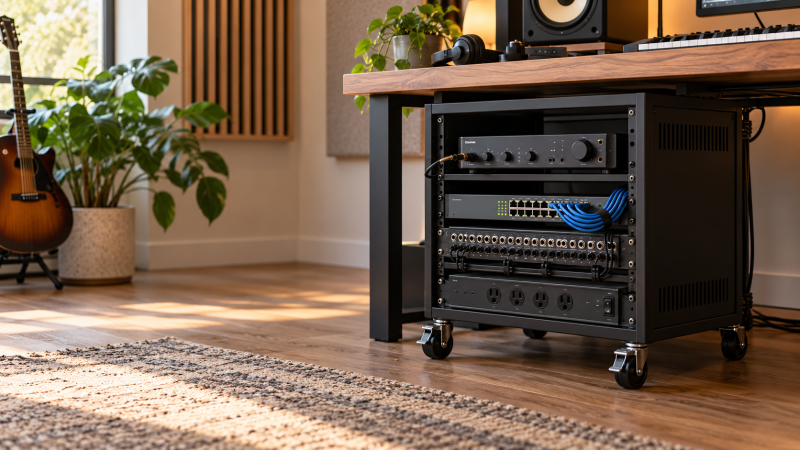
A rolling rack can hold rackmount interfaces, switches, patchbays, power hardware, and processing gear beside your desk, so the desktop doesn’t carry every device. Start with usable rack units, depth, and load rating, then check how the casters, frame, and rack rails fit your room.
These six racks include open frames, a vented cabinet, angled upper racks, and stacked layouts. A stated load capacity is useful only with compatible 19-inch equipment and a stable installation. Before you choose an under-desk spot, measure each device, the cable bend space behind it, and the route you’ll need to roll the loaded rack along.
Pick the rack by usable U space, stated depth, and supported load before selecting an angled top shelf or caster feature.Rolling Studio Equipment Racks Compared
| Image | Product | Details | Check Price |
|---|---|---|---|
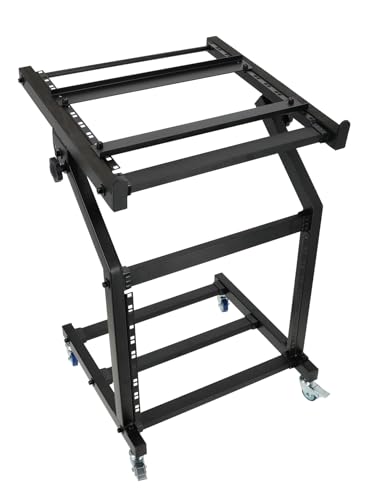
 | 5 CORE 12U Rolling Rack Stand | Best fit: High listed load on angled stand Rack space: 12U Load: Up to 330 lb Format: Rolling adjustable DJ rack Construction: Heavy-duty metal Extras: Two-layer angled top frame | Check Price on Amazon |
 | VEVOR 12U AV Rack Stand | Best fit: Vented cabinet with shelf Rack space: 12U; 19-inch mount Depth: Up to 18 inches Format: Caster-wheel cabinet Construction: Q235 carbon steel Extras: Lockable casters; removable panels | Check Price on Amazon |
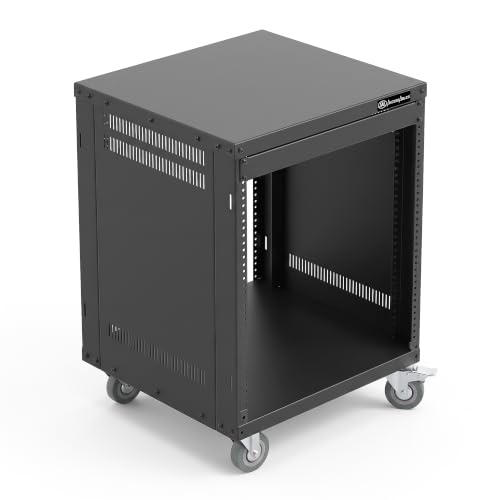 | AxcessAbles RK12U | Best fit: Highest listed capacity Rack space: 12U; 19-inch open frame Load: Up to 550 lb Depth: 18 inches Format: 3-inch caster wheels Construction: 1.5mm steel | Check Price on Amazon |
 | Ultimate Support JamStands SRR100 | Best fit: Stacked adjustable rack spaces Rack space: 12U and 9U Format: Open-frame rolling stand Extras: Angle-adjustable top; casters Use: Studio or stage gear | Check Price on Amazon |
 | Rockville RLM9U | Best fit: 10U plus 9U dual layout Rack space: 10U adjustable plus 9U fixed Format: Rolling studio/stage rack Extras: -40 to 140-degree top tilt Use: 19-inch audio and networking gear Load: 50 lb upper; 110 lb lower | Check Price on Amazon |
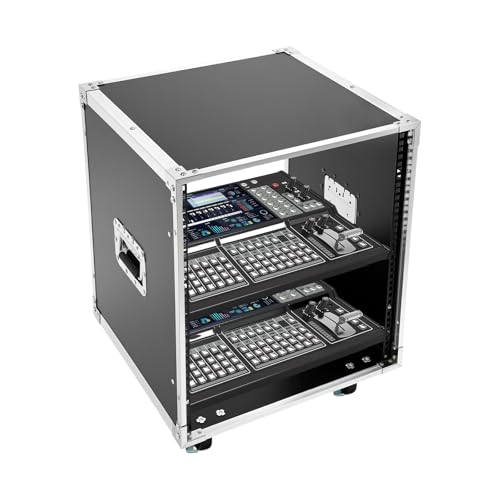 | WINNIESHOP FRP-A-C | Best fit: Locking-caster open frame Rack space: 12U; 19-inch mount Load: Up to 220 lb Format: Rolling AV cart Construction: MDF and aluminum alloy Extras: Handles; open-air ventilation | Check Price on Amazon |
1. 5 CORE 12U Rolling Rack Stand — High Listed Load on Angled Stand
The 5 CORE suits a studio that wants a mixer tilted toward the seat, with amplifiers, equalizers, and microphones racked below. It lists a rolling 12U adjustable rack stand with a two-layer design. The feature information names a top frame for a mixer, a bottom rack for amplifiers, equalizers, and microphones, a spin-knob-adjustable top angle, metal construction, and support up to 330 pounds.
The catch is depth. The 12U label gives the rack-space class, but the listing does not give a cabinet depth, so check the depth of each interface, network appliance, or rack power conditioner before expecting it to fit under a desk.
5 CORE lists a rolling 12U stand, angle-adjustable top frame, metal construction, and up to 330-pound support.Our Take Choose this if you want a mixer or controller angled toward your seat above the listed 12U of rack space.
- The listed 12U space and 330-pound support suit a substantial under-desk rack setup.
- An angle-adjustable top frame can hold a mixer or controller at a reachable angle.
- Its two-layer layout separates a top device from rack-mounted amplifiers, equalizers, and microphones.
- The listing does not state an internal rack depth, so equipment depth needs separate confirmation.
- The angled top helps only if your mixer or controller belongs in that position.
2. VEVOR 12U AV Rack Stand — Vented Cabinet with Shelf
The VEVOR suits a buyer who wants a cabinet-style rack with airflow and still needs cable access. It lists a 12U AV rack cabinet with caster wheels, removable side panels, special vents, and a top shelf. The 19-inch audio/video mounting rack has a stated depth up to 18 inches and an open front and back described as making wiring and maintenance easier. Its four casters lock for position control.
Compared with an open four-post frame, the cabinet is more enclosed while still giving access for cables and airflow. The listing also states Q235 carbon-steel construction. Match your equipment depth to 18 inches and leave room for connector clearance, because the outer cabinet size is not the usable depth.
VEVOR lists a 12U 19-inch rack, up-to-18-inch depth, lockable casters, removable panels, vents, and a top shelf.Our Take Pick this cabinet if your gear fits within the stated 18-inch depth and you want lockable casters and ventilation.
- The stated 18-inch depth gives you a specific size to check your equipment against before buying.
- Lockable casters can hold the cabinet in place after moving it beside a workstation.
- An 18-inch stated depth may exclude deeper servers, UPS units, or cable-heavy equipment layouts.
- Removable side panels and vents still need open space around the cabinet to be useful.
- The top shelf is a stated storage feature, not additional rack-unit space for 19-inch hardware.
3. AxcessAbles RK12U — Highest Listed Capacity
The RK12U is the pick for a buyer who wants an open frame with the highest stated load on this page. AxcessAbles lists it as a 12U, 19-inch open-frame AV rack with wheels, 18-inch depth, and three-inch casters. The title states a 500-pound capacity, and the feature information states up to 550 pounds. The listing also names a 1.5mm steel frame, included screws, spacer, and tool.
Because the title and the feature information give two different capacity figures, check the product documentation before loading expensive equipment. What sets the RK12U apart on this page is the open 19-inch frame together with the highest stated load rating. It suits network devices, power amplifiers, patch panels, and audio interfaces that need access from several sides.
Our Take Choose this if you want a dense but accessible rack with a high stated capacity in an open-frame 19-inch format.
- The up-to-550-pound stated capacity is the highest load figure among these rolling racks.
- Its 12U 19-inch frame and 18-inch depth give defined measurements for rackmount planning.
- Three-inch casters and included screws, spacer, and tool come with the open frame.
- The 1.5mm steel frame is a listed construction detail for a heavy studio or network load.
- The title says 500 pounds and the feature information says 550, so confirm the figure in the documentation before loading.
- An open frame gives cable access but does not provide the removable-panel enclosure of VEVOR.
4. Ultimate Support JamStands SRR100 — Stacked Adjustable Rack Spaces
The Ultimate Support JamStands SRR100 fits a desk where one device needs to face you while the rest sit lower. Ultimate Support lists it as a rolling rack stand with an open-frame design. The feature information describes stacked 12U and 9U rack spaces, an angle-adjustable top rack, and smooth-rolling casters for studio or stage gear. The stacked layout can separate a control-facing upper device area from lower fixed hardware.
Choose it for its layout, not for a published weight capacity. The listing gives no load figure, so don’t pick it for a specific heavy UPS or amplifier weight. It fits when the 12U-plus-9U organization and top-rack angle match the devices you need to reach from a seated desk.
Ultimate Support lists stacked 12U and 9U spaces, an angle-adjustable top rack, open-frame access, and rolling casters.Our Take Buy this if the stacked 12U-and-9U layout and top-rack access come before a published capacity figure for you.
- Stacked 12U and 9U spaces give separate areas for studio or stage equipment.
- An angle-adjustable upper rack can bring front-panel controls closer to a seated workstation position.
- The listing states no weight capacity, so heavy-load planning needs the documentation.
- Deep network or power equipment needs a depth check against the rack before you buy.
- Open-frame access may require more deliberate cable routing when the rack moves between locations.
5. Rockville RLM9U — 10U Plus 9U Dual Layout
The Rockville RLM9U suits a setup where one section has to tilt toward you and the rest can stay fixed. Rockville lists a rolling rack with 10U of adjustable upper space and 9U of fixed lower space for standard 19-inch audio and networking equipment. The upper section tilts from minus 40 to 140 degrees, and two adjustable crossbars can support non-rackable equipment such as mixers and controllers. The listing states a 50-pound upper load and a 110-pound lower load.
The 10U-plus-9U design is not a single 12U compartment. It can suit a mixed equipment list where an interface or switch needs a fixed lower position and a controller needs a tilted top. Before buying for under-desk use, map every device to the listed rack spaces, including a network switch or patch panel.
Our Take Consider this if an adjustable 10U upper area for a controller and a fixed 9U lower area for rack gear fit your layout.
- The listed 10U upper and 9U lower spaces separate adjustable and fixed equipment roles.
- A minus-40-to-140-degree top tilt gives a stated range for control-surface viewing and access.
- Two crossbars are listed for non-rackable mixers and controllers beside standard 19-inch hardware.
- The split 10U-plus-9U layout cannot accept one uninterrupted 12U rackmount device stack.
- The listing states a 50-pound upper load and a 110-pound lower load, but gives no depth figure for equipment planning.
6. WINNIESHOP FRP-A-C — Locking-Caster Open Frame
The FRP-A-C suits a studio that changes its layout and keeps lighter gear on the rack. WINNIESHOP lists a portable rolling 12U open-frame rack for 19-inch networking, audio, and video equipment. Its listing states a 220-pound capacity, reinforced MDF and aluminum-alloy frame, four swivel casters with locking wheels, side handles, and open-air ventilation. It names servers, mixers, and power units among the intended equipment.
Pick this open-frame rack for its locking wheels and side handles. Its 220-pound listed limit is lower than the published figures for the 5 CORE and AxcessAbles racks, but the 12U, 19-inch format still suits a lighter network, audio, or rackmount UPS plan.
WINNIESHOP lists a 12U 19-inch open frame, 220-pound capacity, four locking casters, side handles, and open-air ventilation.Our Take Choose this if you want a 12U open frame with locking casters and handles and 220 pounds is enough.
- The listing names four swivel casters with locking wheels that let the rack roll and then stay parked.
- The 12U 19-inch format supports listed audio, video, networking, server, and power equipment roles.
- Side handles and open-air ventilation suit a rack intended to move between studio positions.
- Its 220-pound stated capacity is lower than the 330-pound and up-to-550-pound alternatives.
- MDF and aluminum framing is a different listed construction choice from AxcessAbles’ 1.5mm steel.
Buying Guide
1. Map rack units before comparing capacity
Rack units decide whether each device has a place. 5 CORE, VEVOR, AxcessAbles, and WINNIESHOP each list 12U. Ultimate Support lists stacked 12U and 9U spaces, and Rockville divides its capacity into 10U adjustable upper and 9U fixed lower space. List every device and the U space it needs before choosing a rolling rack.
A split layout can be useful or limiting. Rockville’s 10U-plus-9U format can separate a controller from a rackmount audio interface, but it cannot become an uninterrupted 12U bay. Ultimate Support also uses stacked spaces, so choose it for organization rather than assuming one tall device stack will fit.
2. Compare stated load ratings in their own terms
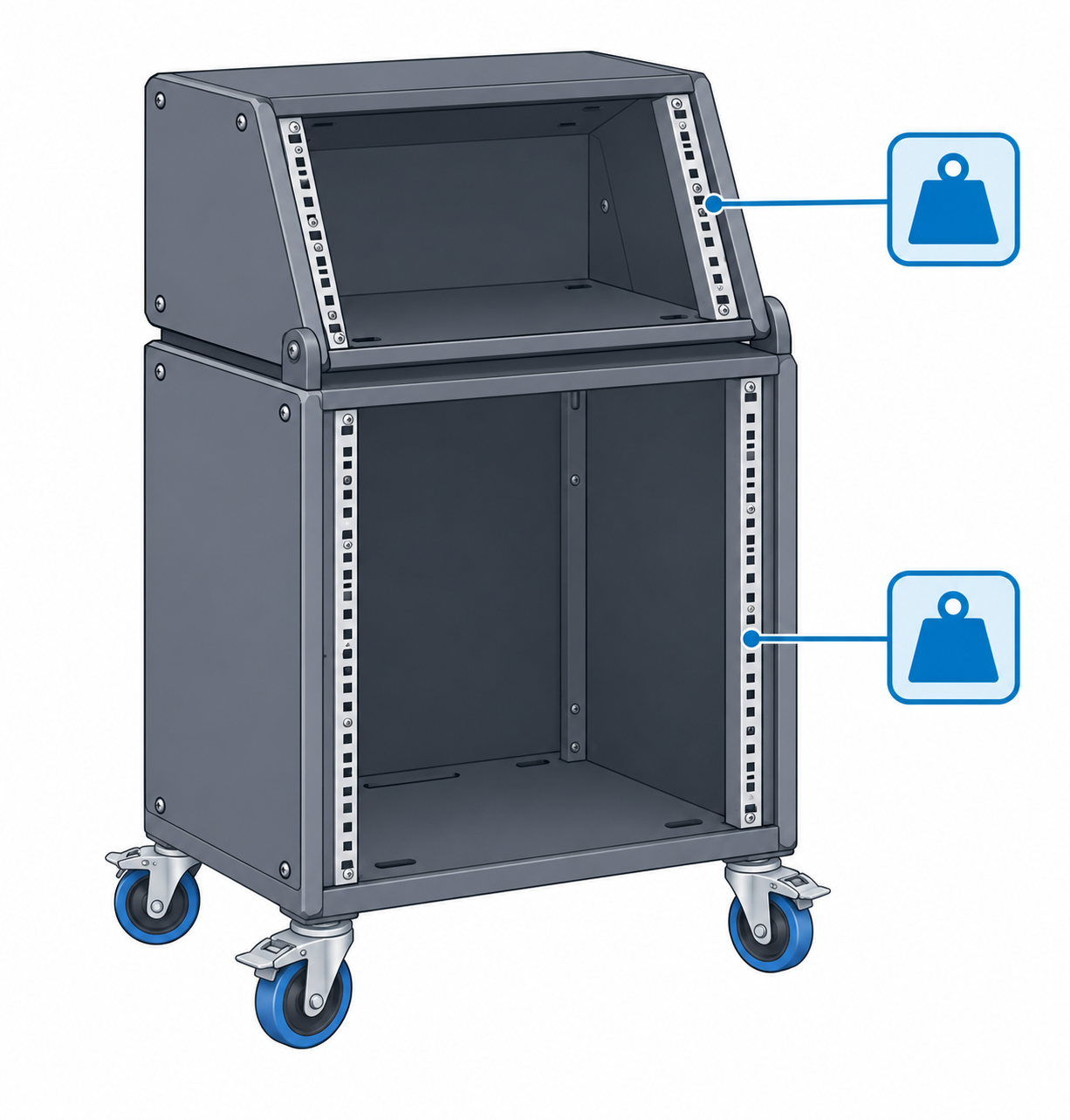
The largest listed capacity belongs to AxcessAbles at up to 550 pounds. Its title says 500 pounds, while the feature information says up to 550 pounds, so verify the product documentation before treating either number as the installation limit. 5 CORE lists 330 pounds and WINNIESHOP lists 220 pounds.
Not every rack publishes a weight figure. Ultimate Support lists no capacity figure, while Rockville states 50 pounds for its upper section and 110 pounds for its lower section. The missing figure is a problem when the plan includes a heavy UPS, amplifier, or dense stack of equipment. Use a published load number only for the model it belongs to, and distribute the load according to its installation guidance.
3. Check depth and cable clearance
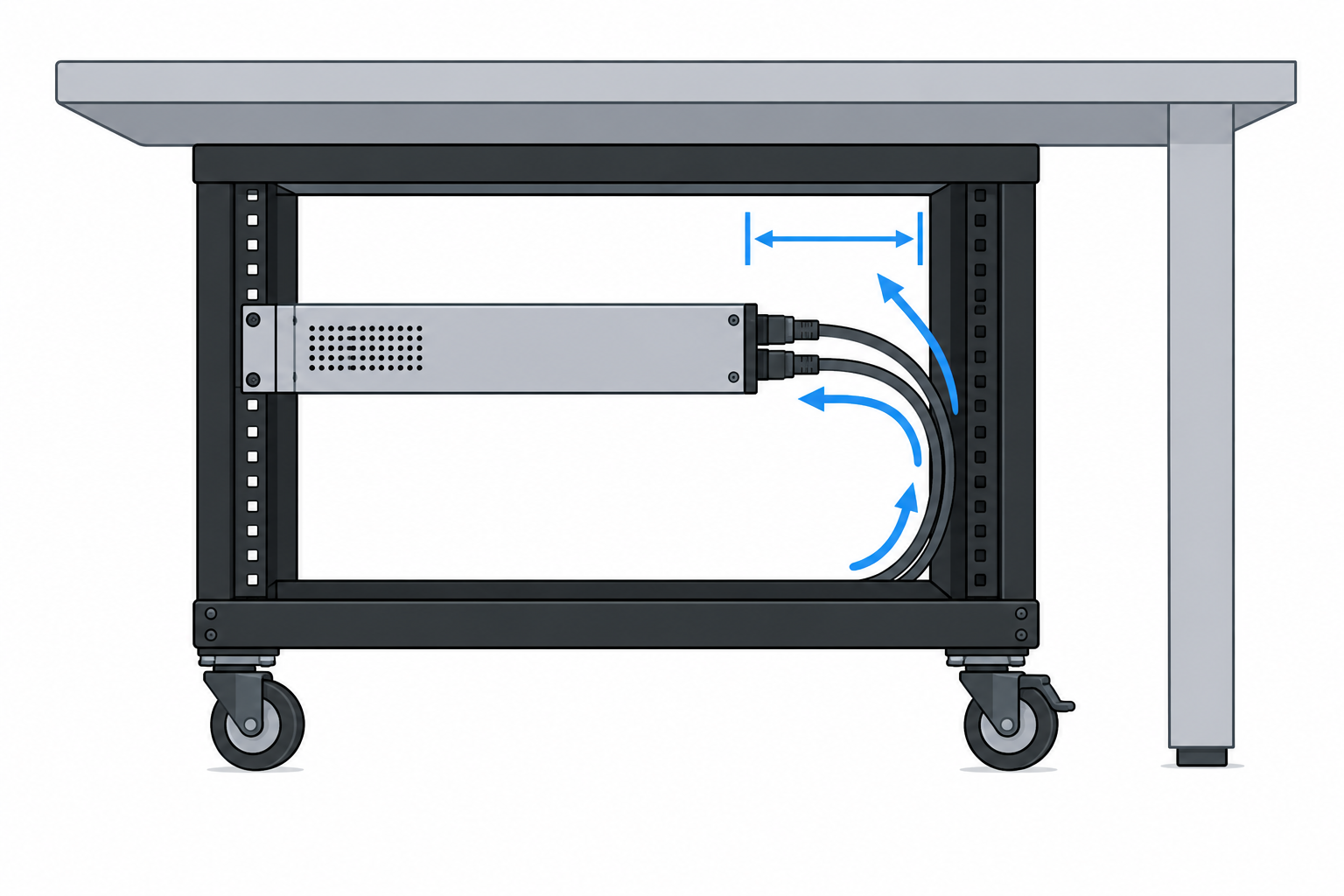
An 18-inch stated depth appears on VEVOR and AxcessAbles. Measure the chassis from the front mounting ears to the rear connector ends, then add reasonable room for power, Ethernet, audio, and SFP networking cables. A rack can accept the box itself yet fail once stiff connections occupy the rear space.
Open frames make access easier but do not create depth. VEVOR’s open front and back are stated as maintenance features, while AxcessAbles is an open 19-inch frame. If a listing does not state its usable depth, as with 5 CORE, Ultimate Support, and Rockville, confirm the depth before choosing a deep server or UPS.
4. Decide whether rolling means frequent movement
Locking casters help when the rack is parked by a desk. VEVOR lists lockable caster wheels, and WINNIESHOP lists four swivel casters with locking wheels. Locking wheels let you move a rack for wiring and then hold it in its planned location. They do not remove the need to disconnect cables or leave slack in sensitive ones.
Handles and wheel size change the moving workflow. WINNIESHOP lists side handles, while AxcessAbles lists three-inch caster wheels. A rolling rack can still be heavy after a switch, UPS, and amplifier are installed. Plan the floor route and cable management before treating casters as a reason to relocate a fully connected rack often.
5. Use upper angles only for controls that need access
An adjustable top rack is most useful for a device with controls you operate. 5 CORE and Ultimate Support list angle-adjustable upper racks, and Rockville lists minus-40-to-140-degree top tilt. A mixer, controller, or patchbay may benefit from that position, but a permanently connected network appliance may not.
A top shelf is not the same as rack space. VEVOR lists a top shelf, while Rockville lists crossbars for non-rackable equipment. Keep a desktop audio rack separate from a rolling rack decision when the goal is simply organizing adapters or compact gear. Reserve the U spaces for devices that actually mount there.
FAQ
Which rack lists the highest capacity?
AxcessAbles RK12U lists up to 550 pounds in its feature information. Its title names 500 pounds, so compare the manufacturer documentation before a heavy installation. It also lists a 12U 19-inch open frame, 18-inch depth, three-inch casters, and 1.5mm steel.
Load capacity is only one condition. The rack must also have enough U space, depth, and cable clearance for every device. A heavy rackmount UPS may have its own installation requirements that also affect the final decision.
Which rolling rack works for a shallow under-desk space?
VEVOR and AxcessAbles both list an 18-inch depth. Those two depths are the only ones stated in this group. Compare the depth against the room behind and in front of the rack, especially where plugs and cables exit the chassis.
A shallow space can still need access for rolling and servicing. VEVOR uses removable side panels and open front/back access, while AxcessAbles is an open frame. Measure the entire parked footprint, not only the rack’s listed depth.
Are all six options 12U racks?
No. Four models list 12U, while Ultimate Support and Rockville use split layouts. Ultimate Support lists stacked 12U and 9U spaces. Rockville lists 10U adjustable upper space plus 9U fixed lower space.
A split arrangement can be valuable for a mixer or control surface, but it changes the largest continuous space. Map the rack units required by a network switch, interface, patchbay, and power unit before selecting a 12U or dual-section frame.
Do I need locking casters?
Locking casters are useful when a rack must stay fixed after it is rolled into position. VEVOR and WINNIESHOP explicitly list locking wheel features. They make sense for an under-desk rack that moves for wiring but should not shift while equipment is operating.
AxcessAbles lists three-inch caster wheels without a locking claim in its listing. Consider the floor and your cable route, then choose the rack whose listed wheels suit how you plan to move it.
Can I put a UPS in a rolling studio rack?
Only if the specific rack’s stated capacity, rack space, and depth cover that UPS. AxcessAbles, 5 CORE, and WINNIESHOP publish 550-pound, 330-pound, and 220-pound figures respectively; Rockville states 50 pounds for its upper section and 110 pounds for its lower section, while Ultimate Support does not list a weight rating.
A UPS also affects center of gravity and cabling. Read the rack and UPS installation instructions before loading one, and use a rack power conditioner for its separate stated role rather than treating it as a substitute for rack support.
Bottom Line
Choose AxcessAbles RK12U for its up-to-550-pound listed capacity and open 12U frame. Choose VEVOR for a vented 18-inch-deep cabinet with lockable casters, and 5 CORE for 12U plus a 330-pound listed load and angled top. Choose Ultimate Support for stacked 12U and 9U spaces, Rockville for the split 10U-plus-9U design, and WINNIESHOP for a 220-pound 12U frame with locking casters and handles.